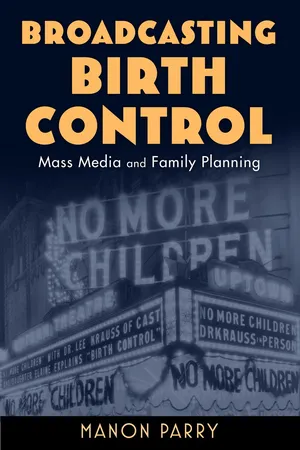
Traditionally, the history of the birth control movement has been told through the accounts of the leaders, organizations, and legislation that shaped the campaign. Recently, historians have begun examining the cultural work of printed media, including newspapers, magazines, and even novels in fostering support for the cause. Broadcasting Birth Control builds on this new scholarship to explore the films and radio and television broadcasts developed by twentieth-century birth control advocates to promote family planning at home in the United States, and in the expanding international arena of population control.Mass media, Manon Parry contends, was critical to the birth control movement’s attempts to build support and later to publicize the idea of fertility control and the availability of contraceptive services in the United States and around the world. Though these public efforts in advertising and education were undertaken initially by leading advocates, including Margaret Sanger, increasingly a growing class of public communications experts took on the role, mimicking the efforts of commercial advertisers to promote health and contraception in short plays, cartoons, films, and soap operas. In this way, they made a private subject—fertility control—appropriate for public discussion.Parry examines these trends to shed light on the contested nature of the motivations of birth control advocates. Acknowledging that supporters of contraception were not always motivated by the best interests of individual women, Parry concludes that family planning advocates were nonetheless convinced of women’s desire for contraception and highly aware of the ethical issues involved in the use of the media to inform and persuade.
- 210 pages
- English
- ePUB (mobile friendly)
- Available on iOS & Android
eBook - ePub
Broadcasting Birth Control
About this book
Information
Chapter 1
Introduction
In 1967, Walt Disney Studios, in collaboration with the Population Council, released an animated movie called Family Planning. This extraordinary film, which was translated into twenty-three languages and was distributed widely in Asia and Latin America, features Donald Duck at an artist’s easel illustrating the burdens of unlimited reproduction and the technologies of birth control while a narrator describes the benefits of limiting family size. America’s beloved cartoon duck was put to work to promote the use of contraception as part of an international movement against overpopulation that flourished in the 1960s and 1970s, but the film is part of a much longer history of the birth control movement’s use of mass media. In fact, media has played a key role in the birth control movement since the very beginning of its twentieth-century campaign.
The history of the birth control movement is traditionally told through accounts of the leaders and organizations that fought for legal access to contraception. The extensive use of mass media to build support for legalization and then publicize the idea of fertility control and the availability of contraceptive services has been largely overlooked. Scholars have only recently begun to examine the cultural work of printed media, including newspapers, magazines, and even novels, in advancing the cause.1 This book builds on this scholarship, moving beyond the printed page to examine the films and radio and television broadcasts birth control advocates developed and the communications experts they increasingly turned to for guidance over the course of the twentieth century. Taking advantage of a rich and relatively unexplored archive of media materials and archival documents describing their production and use, this research reveals the critical role of media in the campaign to transform the private subject of birth control into one fit for public discussion. Of course, other factors contributed to the gradual shift in its favor. I do not focus on measuring the impact of specific media on laws and social prohibitions. Instead, I explore the expectations birth control advocates held for film, radio, and television and how these expectations, and the media themselves, helped shape the messages they disseminated.
The story is not one of uninterrupted progress from repression to openness. In fact, information about ways to prevent or end pregnancy circulated freely in the early nineteenth century in family conversations and in consultations with midwives and healers and began to appear in print in the 1830s. By the 1850s, magazines, newspapers, and popular health manuals featured numerous advertisements for drugs and home treatments. This increasing visibility brought the topic of reproductive control under the scrutiny of purity crusaders and members of the medical profession, who sought to stamp out the proliferation of advertising and the activities of nonphysicians. The distribution of material about contraception and abortion was eventually restricted thanks to their efforts. In 1873, Anthony Comstock, founder of the New York Society for the Suppression of Vice, successfully petitioned Congress to limit the delivery by post of “obscene materials,” including descriptions of contraceptive devices and abortifacients and information on how to obtain them. The ruling was followed by similar state laws, the last of which was not overturned until 1965.2
In the decades following the Comstock Act, advocates for “voluntary motherhood” launched a campaign to legalize contraception, but the movement made few gains against the powerful anti-obscenity lobby. In the early twentieth century, Margaret Sanger, Emma Goldman, and Mary Ware Dennett spearheaded various efforts, and Sanger quickly became the movement’s leading figure. From the very beginning of their activities, campaigners used the mass media as a way around the Comstock law.3
Historians characterize the period from 1914 to 1936 as one of declining radicalism as Sanger established her leadership. The movement shifted away from the rhetoric of female sexual liberation that had first informed its efforts in an attempt to make “birth control” respectable, replacing the term and narrowing the agenda to “family planning.” This is often described as the end of the agitation phase, when birth control advocates gave up their most controversial activities in an effort to build alliances with powerful elite groups, especially the medical profession.4 Incorporating media history into the history of the birth control movement demonstrates, however, that rather than retreating into dignified discussion with only medical experts, birth control advocates continued to use mass culture to build broad support. Decades later, as U.S. advocates began to collaborate with their international colleagues to promote family planning, they again faced the question of how to establish respectability. Although some private negotiations were crucial, family planning promoters remained convinced that by sheer virtue of their public visibility, media activities could convey the idea of widespread acceptance, if they were carefully deployed.
Historians have overemphasized the extent to which the birth control movement traded controversy for propriety in their efforts to win mainstream approval. In fact, as I shall illustrate here, campaigners’ forays into the mass media provoked outrage and censorship in each new medium. As the birth control debate transcended the written word and became images on a screen or phrases broadcast over the radio, critics scrambled to define the parameters of what should be seen or heard and by whom. The introduction of each format, from film to radio and then television, sparked renewed concern over media’s ability to inform, influence, or, if left unregulated, corrupt the audience.
Attempting to professionalize the movement, the Birth Control Federation of America (later the Planned Parenthood Federation of America) hired physicians to fill key roles in the organization and handed over responsibility for the distribution of contraception to the medical profession. This collaborative strategy (which, as historians have noted, compromised the original idea of woman-led fertility control) was replicated in the media production processes of the birth control movement. Although originally media activities were undertaken by the same women who campaigned for the organization, including Sanger, these activities were gradually assigned to a rising class of professional communications experts.
Previously, Sanger and her colleagues had used media with great confidence in its effects, but they had not critically evaluated its impact. Much of their early work had been undertaken without any detailed study of which media were the most persuasive, largely because of the implicit assumption that radio and print were influential and that cinema was especially so. Beginning in the 1930s, however, scholars in the emerging field of communications began to evaluate the role and influence of mass media more carefully. The first major study relating to birth control was launched in Indianapolis in 1937, in response to the shrinking size of white middle-class families. This early survey of 1,444 “relatively fecund” Protestant white couples was intended to show how to promote larger, rather than smaller, families.5 Attempts to measure public attitudes about family limitation were not taken up in earnest until after World War II.
During the war years, psychologists, sociologists, and political scientists interested in persuasive communications applied their research to propaganda efforts to bolster support for the conflict at home and promote the image of the United States around the world. The emerging specialty they forged grew significantly during this period as influential European sociologists, including Theodor Adorno and Paul F. Lazarsfeld, emigrated to the United States and as leading psychologists, such as Carl I. Hovland and Harold D. Lasswell, undertook related research. When postwar concerns turned to maintaining peace, the idea that overpopulation could destabilize nations made the subject a high priority for some of these scholars as they looked for peacetime applications of their work. As a result, many of the founding members of the communications field also became influential figures in family planning promotion, including Wilbur Schramm, who founded the world’s first academic communications department at the University of Illinois in 1947.6 Several other key researchers began their work at a pioneering communications program at the University of Chicago, including Bernard Berelson, one of the first group of scholars on the faculty there, who joined the Ford Foundation in 1951 and ten years later became director of a new communications research program at the Population Council. Donald J. Bogue, also from the University of Chicago, developed the most influential communications theory of the 1960s; it was first used in agricultural development and was quickly transferred to the promotion of family planning.
The field continued to grow in the 1950s. The International Communication Association was founded in 1950, and in 1951 the organization launched the Journal of Communication. In 1963, the journal published a special issue on Communication and Mental Health, the first issue devoted to a health topic. Communications scholars had studied everything from voter motivation in political campaigns to the role of mass culture in the creation of a consumer society. Those who tried to mimic the efforts of commercial advertisers in order to sell health-related behaviors (including the use of birth control) to a wide audience, crafted a new academic specialty that came to be known as health communication.
Practitioners divide the field of health communication into specific areas of research: analysis and intervention in media representations of health issues; scientific communication between researchers; communication between health care providers and between physician and patient; and health education campaigns. Of these, most research falls within the categories of interpersonal communication between patient and physician and mass communication health education campaigns.7 In the formative years of health communication between the 1960s and the 1980s, as the U.S. government funded family planning programs around the world, the subject of health education by mass media dominated the field’s research. This focus generated the wealth of media products I explore here and a canon of key theories or their development and use. The international family planning movement thus played an instrumental role in establishing and expanding health communication as the field’s methods were theorized, applied, and evaluated in the promotion of contraception around the globe.
Because their background was so far removed from the feminist origins of the birth control movement, many in the communications field were more concerned with the goal of successful persuasion than with the idea of female empowerment. The influx of communications professionals thus further diluted the campaigners’ focus on women’s rights, in much the same way that collaboration with the medical profession had done in previous years. However, while Sanger’s earlier compromise radically altered the kinds of contraceptives that were available and the ease with which women could access them, the clash of agendas between feminists and communications professionals was more quickly understood and addressed.8 As I explore, the debate that later emerged in international family planning over the ethics of media persuasion and the promotion of family limitation arose precisely because of the influence of communications theorists on the strategies of the movement.
Private Life and Public Health
Public health advocates, convinced of the power of mass media to influence audiences, have used film, radio, and television to deliver educational messages ever since they were introduced. This extends even to early campaigns on such intimate topics as breast and cervical cancers and venereal disease. In fact, although scholars have sometimes assumed that social taboos surrounding such subjects excluded them from public debate, historians have begun to reevaluate the extent to which such topics were suppressed. In some cases, such as efforts to prevent venereal disease during wartime, the perceived risk justified campaigns about issues that were at the margins of publicly acceptable discourse. Such campaigns also performed social functions beyond their assumed or actual health gains, such as the surveillance and control of target populations. Within the United States, for example, authorities have insisted on physical examinations of prostitutes, foreign travelers, and the poor and people of color in order to regulate sexual activity, limit immigration, and justify eugenic policies of sterilization and institutionalization.9
Posters about cancer risk and magazine advertisements warning against the spread of tuberculosis also reveal the race, gender, and class assumptions of their authors. Early-twentieth-century public health films about tuberculosis or malaria, for example, commonly blamed immigrants and the poor for the spread of disease. Fear of contamination by foreign, pathologized bodies shaped the discourse of international health after World War II in the films of the World Health Organization and the Communicable Disease Center in the United States (now the Centers for Disease Control). These narratives also made their way into popular culture, where contagion served as a metaphor for the spread of immigrants, communism, or sexual permissiveness.10
Although the materials of public health campaigns have been analyzed for the prejudices and assumptions they reveal or perpetuate, few researchers have done more than deconstruct the meanings encoded within them. Only occasionally have researchers investigated the production of such media. Yet a closer look at the intentions of media creators, the models they drew on, and the assumptions they made about their audiences can be richly rewarding and offers the opportunity to reconsider some of the most significant questions in the history of the birth control movement. First, as I will show, the mode of delivery has had a significant impact on the content of birth control media. To what extent were the movement’s shifting political strategies shaped, therefore, by media practices? As influential communications theorist Marshall McLuhan proposed in 1964, “the medium is the message,” framing media materials and the ways they are understood. Weaving an account of the opportunities and limitations of each of the forms of media with an exploration of the visual and aural techniques birth control advocates used, I aim to make a significant contribution to our understanding of the history of the birth control movement by demonstrating how its media campaigns informed rather than simply reflected its strategies and goals.11
Second, going beyond a visual or textual analysis of images and scripts sheds light on the question at the heart of much recent scholarship, namely whether the birth control movement intended to empower birth control users or impose their own values upon them. Historians have explored in detail the tension between personal liberty and state power in the provision of birth control and abortion, concluding that supporters of women’s access to contraception have not always had women’s best interests in mind. Carole McCann, for example, describes the campaign to legalize contraception as only a “partial success” because of paternalistic racial and class assumptions that undermined the movement’s feminist intentions.12 While I acknowledge that these factors constricted some women’s access to a complete range of reproductive health services, my research suggests that family planning promoters were convinced of their clients’ desire for contraceptive services and acutely aware of the ethical issues involved in their work. Moreover, among those who developed media for family planning in the postwar period, I have observed a divide that emerged between those who prioritized the empowerment of their female clients and others who were content to leave gender inequalities in place so long as contraceptive use was adopted.
Because the birth control movement was dominated by white middle-class women and powerful figures in business and politics, the concerns of poor families and people of color were undoubtedly marginalized. Among African Americans, the legacy of white control over black sexuality during slavery as well as coercive and paternalistic practices in clinics fostered great distrust of birth control programs well into the late twentieth century. By the 1960s, instead of privileging access to abortion as a key reproductive right (as did middle-class white women), women of color were more focused on securing access to prenatal and antenatal care and challenging family planning policies intended to prevent poor women from having children. Yet black women also struggled against the pronatalist stance of black nationalist leaders in their efforts to gain access to family planning and control their own fertility. For this reason, family planning promoters could count on well-known African American supporters to endorse birth control in the media.13
Studies of the international population control movement after World War II, when U.S. family planning programs expanded overseas, are similarly critical of the interactions between those who promoted the use of contraception and their target communities, focusing on the purported paternalistic, imperialist, or racist motivations of the “population controllers” who focused primarily on the birth rates of people of color. At best, scholars have concluded, white feminists misunderstood the needs of their clients and collaborated with repressive forces in the movement. As their work has shown, across the international field not all types of contraception were offered to all women, and some were coerced or misled into ending pregnancies, testing new contraceptive technologies with significant side effects, or undergoing sterilization.14
Yet it is important to remember that while some family planning promoters may have been motivated by prejudice, fear of an overpopulated world, or their own self-interest, many others joined the campaign to free women, in the words of Margaret Sanger, from “sexual slavery.” There is little doubt that women the world over—and men—have sought opportunities to control their own fertility. Their attitudes toward family planning programs have differed in various communities and should be understood in their specific contexts. They may also change over time and in particular circumstances. Acknowledging this, historians have begun to consider in more detail the complex relationship between family planning providers and users. As Johanna Schoen concludes in her study of poor women’s access to contraception in the segregated South, “despite the existence of real power differentials between policy makers, public welfare workers, philanthropists, physicians, and the recipients of birth control, no one ever possessed total control, and all participants shaped every outcome in the process of negotiating women’s access to birth control, sterilization, and abortion.”15 Schoen argues that family planning users were not unaware of the race and class prejudices underlying many programs but took advantage of services for their own ends nonetheless. Moreover, while certain reproductive choices may be considered drastic and extreme by some, they have offered affordable, reliable, and discreet protection for others. Laura Briggs’s careful study of Catholic Puerto Rico, for example, where family planning programs had been undertaken since the 1920s, illustrates that a campaign by mainland feminists to end sterilization in the 1970s limited poor women’s access to one of the cheapest contrace...
Table of contents
- Title Page
- Copyright Page
- Epigraph
- Contents
- List of Illustrations
- Acknowledgments
- Chapter 1. Introduction
- Chapter 2. Battling Silence and Censorship
- Chapter 3. The Medium Shapes the Message
- Chapter 4. "Most of the World's People Need Planned Parenthood"
- Chapter 5. Soap Opera as Soap Box: Family Planning and the Telenovela
- Chapter 6. Twenty-First-Century Sex: The Small Screen
- Notes
- About the Author
Trusted by 375,005 students
Access to over 1.5 million titles for a fair monthly price.
Study more efficiently using our study tools.
Frequently asked questions
Yes, you can cancel anytime from the Subscription tab in your account settings on the Perlego website. Your subscription will stay active until the end of your current billing period. Learn how to cancel your subscription
No, books cannot be downloaded as external files, such as PDFs, for use outside of Perlego. However, you can download books within the Perlego app for offline reading on mobile or tablet. Learn how to download books offline
Perlego offers two plans: Essential and Complete
- Essential is ideal for learners and professionals who enjoy exploring a wide range of subjects. Access the Essential Library with 800,000+ trusted titles and best-sellers across business, personal growth, and the humanities. Includes unlimited reading time and Standard Read Aloud voice.
- Complete: Perfect for advanced learners and researchers needing full, unrestricted access. Unlock 1.5M+ books across hundreds of subjects, including academic and specialized titles. The Complete Plan also includes advanced features like Premium Read Aloud and Research Assistant.
We are an online textbook subscription service, where you can get access to an entire online library for less than the price of a single book per month. With over 1.5 million books across 990+ topics, we’ve got you covered! Learn about our mission
Look out for the read-aloud symbol on your next book to see if you can listen to it. The read-aloud tool reads text aloud for you, highlighting the text as it is being read. You can pause it, speed it up and slow it down. Learn more about Read Aloud
Yes! You can use the Perlego app on both iOS and Android devices to read anytime, anywhere — even offline. Perfect for commutes or when you’re on the go.
Please note we cannot support devices running on iOS 13 and Android 7 or earlier. Learn more about using the app
Please note we cannot support devices running on iOS 13 and Android 7 or earlier. Learn more about using the app
Yes, you can access Broadcasting Birth Control by Manon Parry in PDF and/or ePUB format, as well as other popular books in Social Sciences & Medical Theory, Practice & Reference. We have over 1.5 million books available in our catalogue for you to explore.