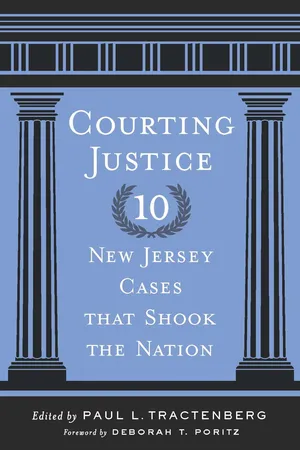
Since 1947 a modernized New Jersey Supreme Court has played an important and controversial role in the state, nation, and world. Its decisions in cutting-edge cases have confronted society’s toughest issues, reflecting changing social attitudes, modern life’s complexities, and new technologies. Paul Tractenberg has selected ten of the court’s landmark decisions between 1960 and 2011 to illustrate its extensive involvement in major public issues, and to assess its impact. Each case chapter is authored by a distinguished academic or professional expert, several of whom were deeply involved in the cases’ litigation, enabling them to provide special insights. An overview chapter provides context for the court’s distinctive activity. Many of the cases are so widely known that they have become part of the national conversation about law and policy. In the Karen Ann Quinlan decision, the court determined the right of privacy extends to refusing life-sustaining treatment. The Baby M case reined in surrogate parenting and focused on the child’s best interests. In the Mount Laurel decision, the court sought to increase affordable housing for low- and moderate-income residents throughout the state. The Megan’s Law case upheld legal regulation of sex offender community notification. A series of decisions known as Abbott/Robinson required the state to fund poor urban school districts at least on par with suburban districts.Other less well known cases still have great public importance. Henningsen v. Bloomfield Motors reshaped product liability and tort law to protect consumers injured by defective cars; State v. Hunt shielded privacy rights from unwarranted searches beyond federal standards; Lehmann v. Toys ‘R’ Us protected employees from sexual harassment and a hostile work environment; Right to Choose v. Byrne expanded state constitutional abortion rights beyond the federal constitution; and Marini v. Ireland protected low-income tenants against removal from their homes. For some observers, the New Jersey Supreme Court represents the worst of judicial activism; others laud it for being, in its words, “the designated last-resort guarantor of the Constitution's command.” For Tractenberg, the court’s activism means it tends to find for the less powerful over the more powerful and for the public good against private interests, an approach he applauds.
- 288 pages
- English
- ePUB (mobile friendly)
- Available on iOS & Android
eBook - ePub
Courting Justice
About this book
Information
1
Henningsen v. Bloomfield Motors, Inc. (1960)
Promoting Product Safety by Protecting Consumers of Defective Goods
Jay M. Feinman and Caitlin Edwards
Ford Motor Company announced the culmination of the largest series of recalls in its history in October 2009: sixteen million cars, trucks, and minivans contained a faulty switch that created a risk of fire even when the vehicle was turned off. The toy in a McDonald’s Happy Meal contains no dangerous lead paint, and the box warns parents that the toy contains small parts and is unsuitable for children under three years of age.
Safety recalls, child-safe toys, and other consumer protections are taken for granted today, but there was a time not so long ago when everyday products were dangerous and consumers who were injured by cars, toys, or other products faced a difficult road to recover compensation from manufacturers. About fifty years ago all of this changed, drastically and in a short period of time. The catalyst for this dramatic change was an unlikely source—a woman from Keansburg, New Jersey, who was injured when her new Plymouth sedan suddenly veered into a brick wall. When she initially sued the dealer who had sold her the car and Chrysler, the manufacturer, the state of the law posed roadblocks to her recovery. The New Jersey Supreme Court recognized that change was needed and issued an opinion that quickly would change the world of products liability and consumer protection.
The Case
On May 7, 1955, Helen Henningsen was “very happy” and “running around like a madwoman.”1 She and her husband, Claus, had gone from their home in Keansburg to nearby Bloomfield Motors, a Chrysler and DeSoto dealership, to buy a car that would be her Mother’s Day present from Claus; it would be the first new car they had owned in seventeen years of marriage. Claus signed a contract for a Plymouth Club Sedan and put down a $1,000 deposit. (In a sign of the times, even though it was to be Helen’s car, the couple always put major purchases in Claus’s name.) The next day the dealer prepared the car for delivery, and they picked up their new car on May 9.
Over the next week Helen only used the car a couple of times to go to the store and around town. On May 19, she drove to Asbury Park. While driving home on Route 36 at about twenty miles per hour, she suddenly heard a “terribly loud noise . . . as if something cracked” under the hood; the steering wheel spun out of her hands, and the car veered sharply to the right and crashed into a highway sign and a brick wall.2 The impact threw Helen’s face into the steering wheel, knocking loose her teeth so they all had to be pulled out. The crash also broke five of her ribs and injured her left knee and ankle, requiring emergency treatment, two subsequent hospitalizations, and surgery to her left kneecap.
Breck Jones, the insurance appraiser who inspected the damaged vehicle, could not pin down the exact cause of the accident but concluded there must have been a mechanical defect, something “wrong from the steering wheel down to the front wheels.”3
The Henningsens sued Bloomfield Motors and Chrysler Corporation, Helen for her injuries and Claus for damage to the car, the medical expenses he paid, and the loss of Helen’s “society and services.” Their legal theories were that Bloomfield and Chrysler were negligent in manufacturing or preparing the car and that they had made express or implied warranties—promises about the quality of the car. However, because of the state of the law in the late 1950s, in New Jersey and across the United States, the Henningsens faced some formidable obstacles.
First, they could not point to how Bloomfield or Chrysler had been negligent, or even what the defect in the car was. The Henningsens’ lawyer argued that the Plymouth was new, the road where the accident occurred was smooth, Helen was not at fault, and Jones had acknowledged that something had gone wrong with the car. From this, the jury could infer that the accident must have been caused by a defect in the car’s steering. But Chrysler and Bloomfield each pointed out that there was no proof that they had been negligent. Chrysler argued that the Henningsens had not demonstrated that Chrysler failed to use reasonable care in making the car. Bloomfield argued in turn that it had done nothing to the car other than the ordinary preparation for delivery. As Samuel Weitzman, Bloomfield’s lawyer, put it, “We do not know what we should have done that they say we didn’t do, and we do not know whether we didn’t do something that we should have done. That is normally the definition of negligence.”4 The lack of proof was fatal to the negligence claim. Chrysler pointed out that in each of the precedents cited by the Henningsens’ lawyer, there had been stronger, often direct, evidence of negligence.
Second, the sale of the car was accompanied by several warranties of quality, expressly made and implied by law, such as the warranty of merchantability—a promise that the car would perform the way cars normally should, including not suddenly veering off the road. But, in enforcing the warranties, the Henningsens faced yet another problem. Helen was injured in the Plymouth that Claus bought from Bloomfield who bought it from Chrysler. Could she enforce a warranty when she was not the purchaser? If so, who made what warranty, Bloomfield or Chrysler?
Under existing law, Helen’s suit would be blocked by what Benjamin Cardozo, legendary chief judge of the New York Court of Appeals and later associate justice of the United States Supreme Court, had described as the “citadel of privity.” Privity was a legal doctrine that barred claims for breach of warranty between persons who had not contracted with each other, just as Helen had not contracted with Bloomfield and neither she nor Claus had contracted with Chrysler. At the time, New Jersey decisions had ruled that warranty “is the creature of contract” and could only be asserted by one contracting party against another. Therefore, under settled law, Bloomfield argued that it had no legal obligation to Helen, and Chrysler argued that it had no obligation either to her or to Claus.
Third, even if Helen could sue to enforce the warranties, the sales documents that Claus had signed effectively forfeited their protections. Paragraph seven of the fine print on the back of the document stated that Chrysler guaranteed the car would be “free from defects in material or workmanship.” Chrysler’s responsibility in honoring that warranty, however, required it only to replace defective parts at the factory within the first ninety days or four thousand miles of ownership. Most importantly, it stated, “It is expressly agreed that there are no warranties, express or implied, made by either the dealer or the manufacturer” except for the ninety-day replacement warranty.
Claus had read the front page of the contract, but not the fine print on the back. Under the law, his ignorance of the fine print did not matter; having signed it, he was presumed to have agreed to all its terms. Therefore, the argument went, neither Chrysler nor Bloomfield owed any further obligation to the Henningsens.
When the case came to trial, many people testified: Claus; Helen; Harold Roman, Bloomfield’s president; police officers and witnesses to the accident; one of Helen’s doctors and other witnesses from the hospital where she was treated; and Breck Jones, the Henningsens’ expert about the purchase of the car, the accident, and Helen’s injuries. The trial judge agreed with Chrysler and Bloomfield that the negligence claim could not stand under existing law, and he dismissed it.
The warranty claims were a different story. When the judge instructed the jury on the law, he presented the steps by which it could surmount the privity barrier and the contract’s disclaimer of warranty. Although he left the final decision to the jurors, he strongly suggested what their conclusion should be. As to the existence of a warranty, he said:
When the defendant Chrysler Corporation manufactured the Plymouth car which the plaintiffs bought, it would be for you to say whether or not there was an implied warranty. . . . In fact, that is what they warranted. When they made the car, they said, “that car is reasonably suited for ordinary use.”
When the Bloomfield Motors . . . displayed the automobile for sale to the plaintiffs and sold it to them, that defendant also warranted that the automobile was reasonably suited for ordinary use.5
The warranty also would extend to Helen even though she was not the purchaser, because the car was purchased for her use. And the disclaimer would not bar the claim because, under the trial judge’s novel theory, a disclaimer would not be effective “unless its inclusion in the contract was fairly procured or obtained.”6
The jury found in favor of Helen and Claus and against both defendants, awarding Helen $26,000 and Claus $4,000 in damages. The defendants appealed to the appellate division, New Jersey’s intermediate appeals court, complaining that the trial judge had erred on the warranty and other issues. Ordinarily, the case would be briefed and argued before a three-judge panel of the appellate division, the panel would decide the case, and, if the loser appealed further, the supreme court would decide whether to hear the case. Not here. The New Jersey Supreme Court, recognizing the importance of the issue, used its authority to reach down and take the case away from the appellate division and hear it right away.
The Arguments
Each of the parties began by submitting briefs—written arguments—to the court. The Henningsens went first, represented by Carmen Rusignola of Newark, aided by lawyers from the Hoboken firm of Baker, Garber & Chazen.7 The negligence claim had been dismissed by the trial court, so the focus was on the warranty claims. Despite prevailing in the trial court, the plaintiffs faced the same obstacles as before. Existing law was against them on the extension of the warranty from Chrysler, through Bloomfield, to Claus and from the actual purchaser, Claus, to the injured party, Helen. They also had to confront the issue of effectiveness of the disclaimer in barring any claim.
To overcome these problems, they tried two approaches. First, they attempted either to distinguish the Henningsens’ case from prior unfavorable decisions or to reinterpret prior decisions so they supported the Henningsens’ position. This approach was untenable, though, and the defendants exposed it in their briefs, pointing out that the prior cases just did not say what the plaintiffs argued they did.
The second approach was more successful, however, and the court ultimately adopted it; the Henningsens’ lawyers shifted ground. The case should be decided, they argued, not by drawing on precedents from dusty law books but by responding to the needs of the times. Accordingly, the lawyers placed as much emphasis on the work of legal scholars as on prior cases.
Most significant were citations to the two major tort law treatises of the times. William L. Prosser’s text had predicted, enthusiastically if prematurely, that strict liability for defective products would be “the law of the future.”8 Fleming James viewed the primary function of tort law to be “social insurance,” providing compensation for the victims of accidents by spreading the losses to manufacturers and society at large.9 The scholars’ theories provided the Henningsens’ lawyers with authority to present to the court in support of their suggestion that the court reshape the law.
As to the making of the warranty, the Henningsens’ brief argued that the dealer and the manufacturer were an economic unit as far as the public was concerned. The warranty extended to Helen because the car was really bought jointly in all but name; even more telling, the plaintiffs’ lawyers encouraged the court to “consider the broader legal problems involved in warranty cases rather than decide the issue on the narrower factual matters in the record,” so any user of a product would benefit from an implied warranty.10
The same approach dictat...
Table of contents
- Title Page
- Copyright Page
- Dedication
- Contents
- Foreword
- Introduction
- 1. Henningsen v. Bloomfield Motors, Inc.
- 2. Marini v. Ireland
- 3. Southern Burlington County NAACP v. Township of Mount Laurel
- 4. In Re Karen Ann Quinlan
- 5. Right to Choose v. Byrne
- 6. State v. Hunt
- 7. In the Matter of Baby M
- 8. Lehmann v. Toys ‘R’ Us
- 9. Doe v. Poritz
- 10. New Jersey’s School Funding Litigation, Robinson v. Cahill and Abbott v. Burke
- Conclusion
- Notes on Contributors
Trusted by 375,005 students
Access to over 1.5 million titles for a fair monthly price.
Study more efficiently using our study tools.
Frequently asked questions
Yes, you can cancel anytime from the Subscription tab in your account settings on the Perlego website. Your subscription will stay active until the end of your current billing period. Learn how to cancel your subscription
No, books cannot be downloaded as external files, such as PDFs, for use outside of Perlego. However, you can download books within the Perlego app for offline reading on mobile or tablet. Learn how to download books offline
We are an online textbook subscription service, where you can get access to an entire online library for less than the price of a single book per month. With over 1.5 million books across 990+ topics, we’ve got you covered! Learn about our mission
Look out for the read-aloud symbol on your next book to see if you can listen to it. The read-aloud tool reads text aloud for you, highlighting the text as it is being read. You can pause it, speed it up and slow it down. Learn more about Read Aloud
Yes! You can use the Perlego app on both iOS and Android devices to read anytime, anywhere — even offline. Perfect for commutes or when you’re on the go.
Please note we cannot support devices running on iOS 13 and Android 7 or earlier. Learn more about using the app
Please note we cannot support devices running on iOS 13 and Android 7 or earlier. Learn more about using the app
Yes, you can access Courting Justice by Paul L. Tractenberg in PDF and/or ePUB format, as well as other popular books in Law & Courts. We have over 1.5 million books available in our catalogue for you to explore.