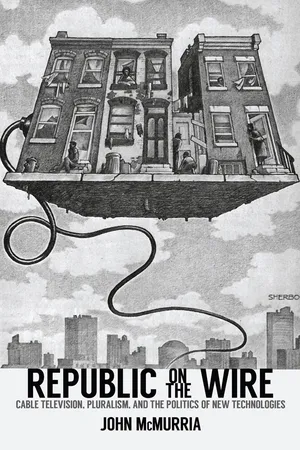
The history of cable television in America is far older than networks like MTV, ESPN, and HBO, which are so familiar to us today. Tracing the origins of cable TV back to the late 1940s, media scholar John McMurria also locates the roots of many current debates about premium television, cultural elitism, minority programming, content restriction, and corporate ownership. Republic on the Wire takes us back to the pivotal years in which media regulators and members of the viewing public presciently weighed the potential benefits and risks of a two-tiered television system, split between free broadcasts and pay cable service. Digging into rare archives, McMurria reconstructs the arguments of policymakers, whose often sincere advocacy for the public benefits of cable television were fueled by cultural elitism and the priority to maintain order during a period of urban Black rebellions. He also tells the story of the people of color, rural residents, women’s groups, veterans, seniors, and low-income viewers who challenged this reasoning and demanded an equal say over the future of television. By excavating this early cable history, and placing equality at the center of our understanding of media democracy, Republic on the Wire is a real eye-opener as it develops a new methodology for studying media policy in the past and present.
- 240 pages
- English
- ePUB (mobile friendly)
- Available on iOS & Android
eBook - ePub
Republic on the Wire
About this book
Information
1
Broadcast Policy, Television Spectrum, and the Pluralist Logics of Inequality
Beginning in 1948, radio station operator L. E. Parsons in Astoria, Oregon, television set retailer Bob Tarlton in Lansford, Pennsylvania, and antenna manufacturer Milton Jerrold Shapp erected antennas on tall buildings or mountaintops in locations on the fringe of television reception to capture television signals from distant cities. From these antennas they strung coaxial cables to television appliances stores, town bars, and individual homes. Historians have narrated these cable television beginnings as a “technical evolution” of wired communications led by the “pioneering efforts” of “entrepreneurs” including Parsons, Tarlton, Shapp, and others.1 What this narrative does not include is a serious consideration of the cultural politics of the Federal Communications Commission’s television spectrum allocations policies, which inhibited the reach of broadcast television signals to areas distant from large cities. Thus, the allocations policy created the conditions for the need for alternative means for receiving television signals, including through community antenna television, as these early cable TV systems were then called.
The FCC did not intend to limit television’s expansion across the United States. Indeed, when the FCC stopped granting television station licenses in 1948 to work out a plan for allocating spectrum frequencies for television, which it completed in 1952, the commission sought a “substantially more efficient use of the available spectrum” than had the FCC in the 1930s, which prioritized high-powered stations that could transmit signals for hundreds of miles. The FCC’s 1952 spectrum allocations plan for television limited the signal reach of television stations to ensure that “as many communities as possible” could “have the opportunity of enjoying the advantages that derive from having local outlets that will be responsive to local needs,” and to optimize the number of communities that could have multiple stations to create what the FCC called a “nationwide, competitive service.”2
To realize these twin goals of local service and competition the FCC added eighty-two new channels in the Ultra High Frequency (UHF) portion of the spectrum to the existing thirteen Very High Frequency (VHF) channels that the FCC had previously allocated for television. The commission did so despite warnings from engineers that UHF signals could not bend around hills and into valleys as well as VHF signals could. Also, UHF transmission towers and television sets equipped with UHF receivers would cost significantly more than for VHF broadcasting. Further, the commission chose to license UHF and VHF in the same local areas, despite the economic advantage that this would give to VHF stations.
Although the commission recognized that the smaller markets, most of which received UHF assignments, would have difficulty economically sustaining a local station, the 1952 plan concluded that “it is not unreasonable to assume that enterprising individuals will come forward in such [smaller] communities who will find the means of financing a television operation.”3 Such confidence led FCC Chair Wayne Coy to predict in 1951 that there would be 1,500 television stations within five years.4
What Coy failed to predict, however, was that television set manufacturers would be slow to include the more costly UHF tuners on their VHF-ready TV sets, that the networks and their national advertising sponsors would prioritize VHF stations in larger markets, and that, as FCC staff engineers warned, UHF stations would experience significant technical difficulties with signal propagation. In the seven years after the FCC began licensing television stations under its new allocations plan, VHF stations grew to 441 while only 79 UHF stations were in operation.5 Additionally, the allocations plan included 200 channels reserved for non-commercial educational stations, most of which were placed in the UHF spectrum. By 1956, only 19 of the 200 educational assignments were put to use.6 With hindsight in 1958, FCC Commissioner Frieda Hennock, a strong supporter initially of the allocations plan, said the plan “was the worst thing that came out of that Commission.”7
Policy histories have been more generous than Hennock, representing the FCC’s television allocation plan as a good faith effort to negotiate the political landscape to realize their goal to maximize local service and nationwide competition.8 Others have focused on the political power of VHF television set manufacturer RCA and its NBC network, which lobbied to ensure that television would develop in the VHF spectrum and not be shifted entirely to the UHF spectrum.9 But these accounts leave unexamined the cultural politics that informed the FCC’s unwavering commitment to the goals of maximizing local service and nationwide competition through VHF and UHF allocations despite warnings about the economic and technological problems of this plan. Indeed, the FCC maintained its commitment to these twin goals of localism and competition for the next two decades in mediating conflicts between UHF station operators, who struggled to finance stations in smaller markets, and cable operators, who imported signals from big city stations from hundreds of miles away, a practice the FCC saw as impeding UHF station growth and thus compromising its twin goals.
Instead of accepting localism and competition as self-evident normative goals for broadcast policy, I consider the sociocultural contexts that gave meaning to these goals among the federal administrators, lawmakers, and other officials who held decision-making authority.10 This requires close attention to the cultural perceptions of policymakers regarding commercial broadcast culture including what forms of broadcast culture they believed competition would promote and what types of programs local stations should air. In evaluating commercial broadcast culture, federal administrators, lawmakers, social scientists, and cultural critics most frequently referenced the civic responsibility of local stations to carry non-commercial “sustaining” programs. Of most value to policy officials were symphonic music performances, which included renowned conductors and music experts guiding viewers in classical music appreciation, and national public affairs discussion programs organized around political and educational professionals leading civic discussion. Conversely, policy officials expressed disdain for popular commercial network broadcasting including daytime soap operas, quiz shows, and nighttime crime dramas, believing that these genres manipulated a “mass” audience through emotional and sensational appeals. Informing these judgments were perceptions that most women, the working classes, and, indeed, the majority of the U.S. population who had no more than a high school education were in need of civic guidance in cultural and political affairs.
Such perceptions among policy officials regarding the relational dynamic between cultural, political, and educational leaders and the so-called masses epitomize American pluralism, which reflected, and informed, thinking about democracy in the United States at mid-century. As I elaborated in the Introduction, pluralism as a theory of American democracy has antecedents in the early twentieth century when influential behavioral scientists including Charles Merriam and his student Harold Lasswell questioned the basis of democracy as the equality of the people. Instead, they developed a science of politics that measured human traits to identify those most conducive to democracy during the modernizing era and looked to the social sciences to guide citizen conduct.11 In the 1940s and 1950s, Pendleton Herring, David Truman, and Robert Dahl argued that American democracy’s stability in a world threatened by totalitarianism resulted from individuals belonging to interest groups and, most significantly, the political guidance of high status group leaders who possessed the higher educations, professional skills, and middle-class demeanors considered necessary to mollify the destabilizing demands of their low-status members and to compete with other group leaders for influence in the political process.12 Pluralism was thus identified as a hierarchical order where the high-status elites in business, government, unions, and other groups guided the conduct of the majority of Americans who were wage earners, people of color, and women. Pluralists believed these groups lacked the occupational status, style of speaking, and way of life of the high-status group leaders. David Truman called these hierarchical relations within the interest group system a “balance wheel” that maintained stability in the American governmental system.13
Federal regulators frequently used the term “balance wheel” to identify their public interest mission, and in particular, the FCC’s requirement that radio stations air “sustaining” programs as public services to balance schedules otherwise filled with advertising-sponsored programs. I consider the ways in which this pluralist balance-wheel way of thinking about democracy in the United States was both reflected in, and informed by, the cultural perceptions of policy officials in the principle policy initiatives of the 1940s and early 1950s, including the FCC’s network monopoly inquiries, its report on The Public Service Responsibilities of Broadcasters in 1946 (widely known as the Blue Book), the Commission on Freedom of the Press and its documents on broadcasting, and the FCC’s television spectrum allocations decisions.
Recent scholarship has identified these policy initiatives as a progressive moment in broadcast history that championed “social democracy” and a “public service mission” for broadcasting to curtail the “crass commercialism” of advertising-sponsored broadcasting. Victor Picard’s book-length study argues that these progressive reformers, including activist groups, progressive policymakers, and citizens, promoted anti-trust actions and public service obligations that included non-commercial public service programming. Throughout the book Picard makes a categorical distinction between “profit-oriented” commercial broadcasting and public service-oriented programming where the latter “benefits all of society” against “corporate libertarian” policies that protect the first amendment rights and property rights of commercial broadcasters. He recognizes that this distinction was not so clear-cut for critics of these public service obligations, who critiqued them for their paternalist and elitist assumptions that commercial broadcast culture catered to the low tastes of a mass audience. Nonetheless, he believes these elitist claims were a “red herring” because, in the example of the Blue Book, its “content analysis made abundantly clear, public affairs shows, cultural programming appealing to ‘minority tastes,’ non-advertising-supported fare, local coverage—all were disappearing from the public airwaves.”14
But such categorical distinctions between commercial and non-commercial programming and reliance on broad content analysis does not engage with the nuances of aesthetic valuation that informed pluralist assumptions that hierarchical relational dynamics between interest group leaders and their members stabilized American democracy at mid-century. Attention to aesthetic valuation includes close attention to the statements made about commercial and public service programming and about the people who preferred one form over another. An aesthetic analysis of the forms of public service “sustaining programs” that policymakers valued most and the commercial genres they despised reveals a more complicated cultural politics that exposes assumptions about class, gender, and race privilege. Relevant also is a consideration of the forms of political engagement in commercial programming that policymakers claimed had little public interest value. The point here is not to legitimate the commercial system of broadcasting or to deny the value of non-commercial alternatives. My argument is that democratic politics resides in contests over who is qualified to make decisions in the public interest, and that these played out in complicated ways that defy categorical distinctions between commercial and non-commercial programming or between national and local programming.
“Sustaining” Pluralist Relations as the “Balance-Wheel Function” of Broadcast Policy
A defining issue for broadcast policy in the late 1930s and early 1940s concerned the increasing power of the broadcast networks over affiliated stations. In 1933 the NBC network inaugurated an “option time” policy, which gave the networks the right to demand the use of station affiliates’ broadcast hours with twenty-eight days’ notice. In 1936 NBC extended its affiliate contracts from one to five years. When the emergent network Mutual Broadcasting System began soliciting stations for network affiliation in 1934, the NBC and CBS networks tightened their territorial exclusivity rules, which restricted their affiliated stations from airing programming from other networks.15 By 1937 both houses of Congress threatened to hold hearings on FCC practices including investigating political favoritism between agency staff and the networks in station licensing. President Franklin D. Roosevelt intervened by appointing a temporary chair to make staff personnel changes and initiate an inquiry into the monopoly practices of “chain broadcasting,” as networking was called. Roosevelt later appointed Lawrence Fly as FCC chair, an ardent New Deal supporter and former general counsel for the Tennessee Valley Authority.16
Following extensive hearings on network monopoly practices, the FCC released its Report on Chain Broadcasting in May 1941 calling for immediate rules curbing the power of networks over their affiliated stations. Networks were no longer to restrict affiliates from airing programs from another network, to dictate scheduling on local stations, to set contracts longer than a year, and to penalize stations for rejecting network programs or setting rates for non-network programs. Corporate organizations were not to own more than one broadcast network, nor were they to own more than one broadcast station in a single market.
Though the FCC wrote these rules to provide local stations with more flexibility and authority over programming decisions, the report emphasized that the most likely and beneficial outcome of this flexibility would be that local stations would air more network “sustaining” programs. As the five commissioners who supported the new rules believed, these non-commercial programs that the FCC recognized as providing balance to otherwise advertising-sponsored programming were important to local broadcasters for building goodwill with their listeners. The new rules, the FCC argued, “undoubtedly will encourage the networks to supply sustaining programs whose good quality will induce stations to carry their commercial programs.”17
Even the two commissioners who opposed the new rules prioritized sustaining programs as central to meeting public interest standards, because they believed the rules would provide less incentive for stations to air them. In their dissenting opinion, these commissioners argued that the restrictions to network business practices would lead to “an unwholesome conglomeration of opportunistic ‘time brokers’ catering to an aggregation of local monopolies in various towns and cities” to an extent that “the incentive would be removed for the origination of such sustaining features as the European war broadcasts, the American Farm and Home Hour, the Town Meeting of the Air, Toscanini, etc.” For the dissenting commissioners, the increased authority of local stations was less important than maintaining the “good programming” with “superior talent” that came from the “efficiency” of national network distribution.18
Neither group of commissioners was correct in their predictions. Despite their warnings, the predictions about unwholesome time brokers did not materialize after the chain broadcasting rules were implemented. And while the majority of commissioners assumed that network sustaining programs promoted station affiliations and goodwill with listeners, their assumptions were not corroborated in a 1946 FCC study that found that many commercial stations chose to carry locally sponsored commercial programs in place of network sustaining programs.19
The significance of considering the rationales of proponents and opponents of the chain broadcasting rules is not just that they both failed to predict the outcome of the new rules. More important here is to consider the cultural perceptions that created a consensus among FCC commissioners, lawmakers, social scientists, and cultural critics regarding the public interest value of sustaining programs, and their shared cultural disdain for popular commercial genres. For FCC Chair Fly, the sustaining programs that aired mostly ...
Table of contents
- Title Page
- Copyright Page
- Dedication
- Contents
- Acknowledgments
- Introduction: American Pluralism, Television Policy, and the Method of Equality
- Chapter 1. Broadcast Policy, Television Spectrum, and the Pluralist Logics of Inequality
- Chapter 2. Contesting (In)Equality at the Margins of Television Reception
- Chapter 3. Pay-TV Orders
- Chapter 4. Local Origination, Public Access, and the Hierarchical Logics of Civic Culture
- Chapter 5. Blue Skies, Black Cultures
- Epilogue: Neutrality, Connectivity, or Equality When Media Converge
- Notes
- Select Bibliography
- Index
- About the Author
Trusted by 375,005 students
Access to over 1.5 million titles for a fair monthly price.
Study more efficiently using our study tools.
Frequently asked questions
Yes, you can cancel anytime from the Subscription tab in your account settings on the Perlego website. Your subscription will stay active until the end of your current billing period. Learn how to cancel your subscription
No, books cannot be downloaded as external files, such as PDFs, for use outside of Perlego. However, you can download books within the Perlego app for offline reading on mobile or tablet. Learn how to download books offline
Perlego offers two plans: Essential and Complete
- Essential is ideal for learners and professionals who enjoy exploring a wide range of subjects. Access the Essential Library with 800,000+ trusted titles and best-sellers across business, personal growth, and the humanities. Includes unlimited reading time and Standard Read Aloud voice.
- Complete: Perfect for advanced learners and researchers needing full, unrestricted access. Unlock 1.5M+ books across hundreds of subjects, including academic and specialized titles. The Complete Plan also includes advanced features like Premium Read Aloud and Research Assistant.
We are an online textbook subscription service, where you can get access to an entire online library for less than the price of a single book per month. With over 1.5 million books across 990+ topics, we’ve got you covered! Learn about our mission
Look out for the read-aloud symbol on your next book to see if you can listen to it. The read-aloud tool reads text aloud for you, highlighting the text as it is being read. You can pause it, speed it up and slow it down. Learn more about Read Aloud
Yes! You can use the Perlego app on both iOS and Android devices to read anytime, anywhere — even offline. Perfect for commutes or when you’re on the go.
Please note we cannot support devices running on iOS 13 and Android 7 or earlier. Learn more about using the app
Please note we cannot support devices running on iOS 13 and Android 7 or earlier. Learn more about using the app
Yes, you can access Republic on the Wire by John McMurria in PDF and/or ePUB format, as well as other popular books in Social Sciences & North American History. We have over 1.5 million books available in our catalogue for you to explore.