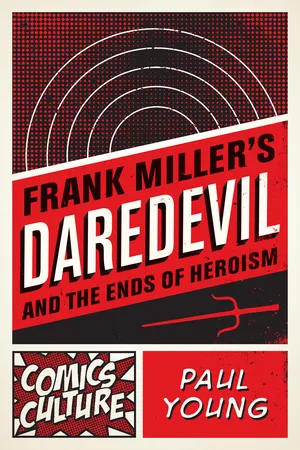
2017 EISNER AWARD NOMINEE for Best Academic/Scholarly Work In the late 1970s and early 1980s, writer-artist Frank Miller turned Daredevil from a tepid-selling comic into an industry-wide success story, doubling its sales within three years. Lawyer by day and costumed vigilante by night, the character of Daredevil was the perfect vehicle for the explorations of heroic ideals and violence that would come to define Miller’s work. Frank Miller’s Daredevil and the Ends of Heroism is both a rigorous study of Miller’s artistic influences and innovations and a reflection on how his visionary work on Daredevil impacted generations of comics publishers, creators, and fans. Paul Young explores the accomplishments of Miller the writer, who fused hardboiled crime stories with superhero comics, while reimagining Kingpin (a classic Spider-Man nemesis), recuperating the half-baked villain Bullseye, and inventing a completely new kind of Daredevil villain in Elektra. Yet, he also offers a vivid appreciation of the indelible panels drawn by Miller the artist, taking a fresh look at his distinctive page layouts and lines. A childhood fan of Miller’s Daredevil, Young takes readers on a personal journey as he seeks to reconcile his love for the comic with his distaste for the fascistic overtones of Miller’s controversial later work. What he finds will resonate not only with Daredevil fans, but with anyone who has contemplated what it means to be a hero in a heartless world. Other titles in the Comics Culture series include Twelve-Cent Archie, Wonder Woman: Bondage and Feminism in the Marston/Peter Comics, 1941-1948, and Considering Watchmen: Poetics, Property, Politics.
- 292 pages
- English
- ePUB (mobile friendly)
- Available on iOS & Android
eBook - ePub
Frank Miller's Daredevil and the Ends of Heroism
About this book
Information
Chapter One
Our Story So Far
Daredevil, like his more famous predecessors the Fantastic Four and Spider-Man (introduced in 1961 and 1962, respectively), became a costumed crime fighter for the most principled of reasons: to defend the innocent and vulnerable from violence. A brilliant, philanthropic attorney by day, by night Matt Murdock wears a bright-red devil costume, complete with horns and a big “DD” emblazoned on his chest, and confronts injustices that the police cannot or will not put right. In other words, this upstanding citizen-hero—a licensed defender of the rule of law on behalf of the those in need of defending, whether alleged perpetrators or victims—harbors an equal and opposite drive to take the law into his own hands, a drive so close to the surface of his identity that to unleash it is as simple as a change of clothes.
Nothing about this formula differs fundamentally from the superhero blueprint as Peter Coogan describes it, beginning with Superman: he has a mission to protect the innocent, powers beyond those of normal people, and a secret identity that he vigorously protects. Yet from the beginning, Daredevil stood apart. He lacks the augmented strength of his peers (though he still possesses abilities premised on science fiction, as I’ll discuss); like Batman, he had to train his body to be stronger, faster, and more agile than those of his enemies. He is older, more mature, and more settled when he commits to wearing the mask than is Spider-Man, who begins his wall-crawling career while still in high school. And his professional association with the justice system turns Spidey’s persecution by the police on its head. Matt Murdock is, if not the first attorney-superhero, then surely the first attorney in a Silver Age Marvel comic to wear tights. Marvel got its reputation for realism in the Silver Age in part by paying more than lip service to how superheroes keep body and soul together in their off hours. This is not to say that the secret identities of DC’s heroes were not integral to their stories. Clark Kent’s job as a newspaper reporter was a convenient way to keep Superman informed about threats to the city of Metropolis.1 However, the civilian professions of Marvel heroes were, at their most suggestive, linked logically and expressively to their identities as costumed adventurers. Peter Parker is a freelance news photographer who sells selfies of his alter ego battling costumed criminals, but he never gets market value for them and is always broke, a situation befitting his not-so-secret identity as Midtown High’s resident nebbish. Tony Stark, a multimillionaire inventor and arms manufacturer, keeps his own heart beating after a land-mine explosion in Vietnam by constructing Iron Man’s armor, a cross between a life-support system and a single-passenger tank that prevents him from stripping to the waist to go swimming or (presumably) go to bed with one of his many glamorous paramours, lest his chest plate give his secret away. Being a millionaire playboy-inventor-superhero doesn’t get much more tragic than that.
Matt Murdock goes Spider-Man and Iron Man one better. He is blind—as blind as justice itself—and yet he risks his life daily as Daredevil to keep his beloved Hell’s Kitchen as safe as he can. The pun on “blind justice” inherent in this situation is hardly subtle, but if the character’s history is any indication, developing the pun into a substantial theme of the series was harder than it looked.
One barrier to its development seems to have been the need to make Daredevil sell, and the path of least resistance to that goal was for Marvel to imitate its past successes. In one of Miller’s earliest extensive interviews, he agrees with the interviewer, Dwight Decker, that “Daredevil always seemed like Spider-Man’s weak sister” but then asserts Daredevil’s potential to be something quite different from the very beginning. “The first few issues [of the series], particularly the run of issues that Wally Wood drew and Stan Lee wrote [issues #5–11], had an approach to the character that Stan later lost. He played up the blindness and the fact that Matt is a lawyer, and made him something special.”2 Miller isn’t wrong to claim that the early issues exploit the blind-justice theme with more focus than the series would for years afterward, but for the most part, lawyering is just Matt Murdock’s day job. The law firm he shares with his friend Franklin “Foggy” Nelson functions as a plot device, with every case providing supervillains for Daredevil to fight. Even in issue #7, renowned for DD’s mismatched battle with the superhuman Sub-Mariner, Lee and Wood get the bad guy on the good guy’s radar by making the suddenly litigious Sub-Mariner pick a law firm at random and end up, of course, at the door of Nelson and Murdock, green swim trunks and all. This sounds like a clever use of coincidence until one notes that Lee had already used a similar conceit three times in the first six issues.
The duality of Murdock’s professional and secret lives offers a gift to any writer willing to lean on the oppositions between the two. But no other single issue from those first years matches the intensity with which Daredevil #1 contrasts Daredevil’s vigilantism with Murdock’s sworn duty to the law. The debut issue, dated April 1964, was written by Stan Lee, Marvel’s Silver Age editor in chief and head manager of its expanding universe of characters, and drawn by Bill Everett, an industry veteran who created the Sub-Mariner in 1939, back when Martin Goodman’s Marvel was known as Timely Comics.3 The issue begins with the titular hero, clad in the yellow-and-reddish-black acrobat’s leotard he wore for his first six issues, beating the heck out of a roomful of thugs. As they sag, defeated, against the walls of their hideout, Daredevil demands they produce their boss, Roscoe Sweeney, a boxing “manager” also known as the Fixer (for reasons easy enough to guess).
Then a lengthy flashback sequence unfolds the origin of our hero. Matt Murdock is the son of a washed-up boxer, Jack “Battlin’” Murdock, a widower who raises his son alone in a working-class New York neighborhood that the series later identified as Hell’s Kitchen. Known as Midtown West or Clinton today, Hell’s Kitchen was a nineteenth-century Irish slum known for its gang violence but also for its bohemian aura; geographically it overlapped with both Times Square and Broadway and was the first home of the Actors Studio. In 1963, its reputation was still mixed enough that New Yorkers would probably have recognized Hell’s Kitchen in Daredevil #1 from Battlin’ Jack’s working-class Irish vibe and the hardscrabble look of Everett’s location drawings. In comics, at least, one can hardly beat Marvel origin stories of the early sixties for their narrative and thematic economy.
The flashback begins with Matt as a boy standing, his shoulder to the picture plane, before his enormous father as they converse in a living room containing some beaten-up furniture. Jack, a self-proclaimed “uneducated pug,” sits in an easy chair with his hands on Matt’s shoulders and makes him promise to earn his living with brains, not brawn. But Lee quickly establishes the inherent conflict of this promise: the elder Murdock lacks the resources to send his son to college when the time comes. To raise the cash for Matt’s education, he signs a contract with the Fixer, portrayed by Everett as a scowling old bookie from Central Casting, though he looks uncannily like Leonid Brezhnev with one of Fidel Castro’s cigars stuffed in his mouth. (Brezhnev did not replace Nikita Khrushchev as leader of the USSR until October 1964, but considering the virulent anticommunism of contemporary Iron Man, Thor, and Ant-Man/Giant-Man stories, the resemblance is difficult to ignore.) Such a bald-faced proclamation of seaminess as the Fixer’s nickname surely would have raised a red flag for most people who aren’t characters in comic books, but in Marvel’s Silver Age, secondary characters like Jack Murdock fulfilled their predestined functions no matter how unlikely they were. What matters for the origin is that Jack has regular gigs in the ring but only because the Fixer plans to clear Jack’s path to a championship match, thus fixing the odds against his opponent, and then force Jack to take a dive so the Fixer can make a fortune on illegal bets placed on his boxer to win.
Once this setup is in place, Lee starts piling on the irony. Matt saves an elderly blind man from being hit by a truck at a crosswalk, only to be blinded himself by radioactive material the truck was carrying; though his eyes no longer see, the radiation permanently heightens Matt’s senses and grants him a sixth “radar” sense that allows him to navigate the world like an especially deft bat; Jack wins the biggest match of his career, but the Fixer’s henchman promptly kills him for refusing to throw the fight; the blind-as-justice Matt Murdock fulfills one promise to his father by studying his way into a top law school but breaks the other promise—to shun physical conflict—by training himself to fight, dressing as a devil, and pursuing the Fixer into a subway station with the intent of placing him before a jury of his peers. Daredevil catches up to the Fixer just as the old shark has a heart attack and dies. He then extracts a confession from the Fixer’s hit man just as police officers arrive at the scene. Case closed.
Daredevil #1 traffics in poetic justice, Marvel origin-story style. For all the ironic reversals dogging the hero, nothing shakes our faith in his goodness. Bad things happen to good people like Matt Murdock’s father and Peter Parker’s doomed Uncle Ben for a higher purpose, to make heroes of young men, and bad things happen to bad people like Ben’s killer and the Fixer because they’re simultaneously the worst and best kinds of bad for adolescent male readers: daddy killers. They allow Matt and Peter to distance themselves from their father figures while paying their vengeful respects to the patriarchy that now promises them a spot at the top.
Yet Daredevil’s path to glory has a darker dimension than Spider-Man’s because in this case, the killer pays with his life. If Spider-Man’s origin emphasizes Peter Parker’s moral motivation for becoming a costumed crime fighter via its twist ending, Peter’s realization that a thief he did not even attempt to stop went on to murder his uncle, Daredevil #1 begs a different question of superheroic ethics: What punishment does the criminal deserve for killing the hero’s father figure, and who decides? Lee and Everett’s answer is obviously the righteous wrath of Matt Murdock, the spunky blind kid in the red-and-yellow suit, but it is a wrath that falls short of murder. It’s not DD’s fault that the Fixer suffers cardiac arrest when he gets caught. But this answer is not as unambiguously positive as one might expect. Though the death of the Fixer is coincidental, his sudden heart attack plays like a preadolescent revenge fantasy turned adult nightmare, particularly when we consider the legal career on which Matt has already embarked when he suits up for the first time. On this pivotal day, only a few days after his graduation from law school, Matt enforces the law extralegally and winds up handing down a death sentence all on his own. As if to emphasize the shaky moral ground on which he stands, he falsely claims to have tape-recorded the Fixer’s confession to trick the Fixer’s hit man into confessing. Of course, we’re rooting for Battlin’ Jack’s boy all the way, but something smells faintly rotten in Hell’s Kitchen.
The story moves so fast that we have no chance to dwell on Matt’s losses any more than Matt himself does. After Jack’s death, Matt mourns him for exactly one panel before he’s back in a law school classroom plotting to catch his father’s killer and looking forward to a bright future as partner in a new firm. But even the relentless forward momentum of the origin story cannot disperse the ethical ambiguity of the Fixer’s death and the questions it raises about Matt’s motives for chasing him down. Matt has, after all, rigged himself a second identity that tables civil determinations about guilt, innocence, or punishment until after he’s interrogated suspects himself.
Lee never recognized, or at least never revisited, the complicated snapshot of vigilante justice that he and Everett put to paper in Daredevil #1. He probably couldn’t have even if he had wanted to. There was plenty of space in the Marvel lineup for a misunderstood hero like Spider-Man or a bickering family like the Fantastic Four but no place for a cold-blooded vigilante, not if the series that Martin Goodman published was to bear the seal of the Comics Code Authority, the comics industry’s collectively supported office of censorship. But I still find it a bit chilling to read the last panels of Daredevil #1, in which the uncostumed Matt casts a tall shadow of Daredevil, horns and all, on the wall of his new office at Nelson and Murdock as his thought balloon reads, “Dad, wherever you are . . . I kinda hope you’re resting easier now!” Here Matt seems proud of his victory over injustice in the subway station, but as its onlookers, we have witnessed how justice can be twisted by ruthlessness. Now we have proof of how oblivious Matt is to the contradiction. He talks like an angel, but the shadow knows he’s a devil even when he isn’t wearing the ugly suit. Now that he has a law degree and his own firm at his disposal, one might reasonably ask, what sort of extralegal havoc will Matt Murdock wreak next?
By 1979, some fifteen years later, the use of Matt’s profession for thematic purposes had all but evaporated long ago. The irony of a blind attorney who assaults alleged perpetrators without trying them first had long dissipated. It was now convention, pure and simple. Apparently it took a creator with nothing whatsoever at stake in the character to turn that neglected theme into Daredevil’s vital engine, a paradox that every subsequent creator would have to acknowledge from that point forward.
A Devil without Advocates
By 1978, the history of Daredevil was littered with failed attempts to generate greater interest in the character. Murdock had joked his way through street fights like Spider-Man, dabbled in the spy business like Nick Fury, played at Errol Flynn–style adventuring, and fought cosmic and supernatural threats like those usually faced by the Fantastic Four and Captain Marvel. More daring was the decision to make the ex-Soviet spy Natasha Romanoff, a.k.a. the Black Widow, Matt’s crime-fighting partner (beginning when she fishes him out of New York Harbor in Daredevil #81) and also his lover. But even the Widow’s complaints about Matt’s insensitivity to gender politics read like a dull echo of how Janet van Dyne, a.k.a. the Wasp, resented the condescension of her partner/boyfriend Ant-Man in the Tales to Astonish anthology series and later in The Avengers. The Widow’s bitterness was only deepened and made more specific than the Wasp’s, in keeping with second-wave feminism circa 1971, though most of her complaints sound like snide attempts by the writers to paint feminism as a victim mentality. Even less conventional decisions involved electing the nebbishy defense attorney Foggy Nelson as New York’s district attorney (Daredevil #48–130) and having Col. Nick Fury invite him to become an agent of S.H.I.E.L.D., Marvel’s answer to Ian Fleming’s SIS (#123; much to the nation’s relief, Foggy turned Fury down). Scriptwriters even turned to science fiction and fantasy for inspiration. At one point, DD battled the Mandrill, a half-ape mutant who could have been lifted from an H. G. Wells novel ghostwritten by H. P. Lovecraft. The Mandrill emits a pheromone that makes women unable to resist his commands—surely the oddest Marvel villain I’ve ever encountered and surely one of the maverick writer Steve Gerber’s less successful experiments in superhero psychedelia.4 As this story grinds on, the Widow and a bunch of other women get brainwashed into following the Mandrill’s every command. Reading it is excruciating, like watching The Stepford Wives reedited to tell the story from the perspective of the Stepford husbands. As far as antifeminist apocalyptic nightmares go, the “Fembot” story arc from the contemporary prime-time TV series The Bionic Woman was at least more honest about its own misogyny, and it was a hell of a lot scarier, if for no other reason than that the Fembots were led by John Houseman. The Mandrill was no John Houseman.
The crowning glory of editorial desperation, however, may have been displacing Daredevil from Hell’s Kitchen. At the time, the mos...
Table of contents
- Title Page
- Copyright Page
- Contents
- Acknowledgments
- A Note on the Texts and Images
- Introduction
- Chapter One
- Chapter Two
- Chapter Three
- Chapter Four
- Interlude
- Conclusion
- Notes
- Index
- About the Author
Trusted by 375,005 students
Access to over 1.5 million titles for a fair monthly price.
Study more efficiently using our study tools.
Frequently asked questions
Yes, you can cancel anytime from the Subscription tab in your account settings on the Perlego website. Your subscription will stay active until the end of your current billing period. Learn how to cancel your subscription
No, books cannot be downloaded as external files, such as PDFs, for use outside of Perlego. However, you can download books within the Perlego app for offline reading on mobile or tablet. Learn how to download books offline
Perlego offers two plans: Essential and Complete
- Essential is ideal for learners and professionals who enjoy exploring a wide range of subjects. Access the Essential Library with 800,000+ trusted titles and best-sellers across business, personal growth, and the humanities. Includes unlimited reading time and Standard Read Aloud voice.
- Complete: Perfect for advanced learners and researchers needing full, unrestricted access. Unlock 1.5M+ books across hundreds of subjects, including academic and specialized titles. The Complete Plan also includes advanced features like Premium Read Aloud and Research Assistant.
We are an online textbook subscription service, where you can get access to an entire online library for less than the price of a single book per month. With over 1.5 million books across 990+ topics, we’ve got you covered! Learn about our mission
Look out for the read-aloud symbol on your next book to see if you can listen to it. The read-aloud tool reads text aloud for you, highlighting the text as it is being read. You can pause it, speed it up and slow it down. Learn more about Read Aloud
Yes! You can use the Perlego app on both iOS and Android devices to read anytime, anywhere — even offline. Perfect for commutes or when you’re on the go.
Please note we cannot support devices running on iOS 13 and Android 7 or earlier. Learn more about using the app
Please note we cannot support devices running on iOS 13 and Android 7 or earlier. Learn more about using the app
Yes, you can access Frank Miller's Daredevil and the Ends of Heroism by Paul Young in PDF and/or ePUB format, as well as other popular books in Literature & Comics & Graphic Novels Literary Criticism. We have over 1.5 million books available in our catalogue for you to explore.