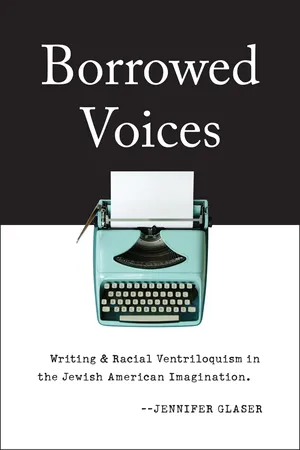
In the decades following World War II, many American Jews sought to downplay their difference, as a means of assimilating into Middle America. Yet a significant minority, including many prominent Jewish writers and intellectuals, clung to their ethnic difference, using it to register dissent with the status quo and act as spokespeople for non-white America. In this provocative book, Jennifer Glaser examines how racial ventriloquism became a hallmark of Jewish-American fiction, as Jewish writers asserted that their own ethnicity enabled them to speak for other minorities. Rather than simply condemning this racial ventriloquism as a form of cultural appropriation or commending it as an act of empathic imagination, Borrowed Voices offers a nuanced analysis of the technique, judiciously assessing both its limitations and its potential benefits. Glaser considers how the practice of racial ventriloquism has changed over time, examining the books of many well-known writers, including Bernard Malamud, Cynthia Ozick, Philip Roth, Michael Chabon, Saul Bellow, and many others. Bringing Jewish studies into conversation with critical race theory, Glaser also opens up a dialogue between Jewish-American literature and other forms of media, including films, magazines, and graphic novels. Moreover, she demonstrates how Jewish-American fiction can help us understand the larger anxieties about ethnic identity, authenticity, and authorial voice that emerged in the wake of the civil rights movement.
- 224 pages
- English
- ePUB (mobile friendly)
- Available on iOS & Android
eBook - ePub
Borrowed Voices
About this book
Information
Chapter 1
The Politics and Poetics of Speaking the Other
Sympathy for the Cause of the Negroes
In 1959, German-Jewish émigré Hannah Arendt weighed in on the fever-pitch battle over school desegregation in the United States. Her essay, “Reflections on Little Rock,” was slated for publication in the journal Commentary, but the editors pulled it from the lineup. The controversial piece, which argued that the federal government should not enforce an end to segregation, was eventually published in the noted leftist magazine Dissent alongside a series of disclaimers and a carefully worded apology from Arendt herself.1
“Reflections” was eloquent but arrogant, drawing the ire and disapproval of Arendt’s colleagues on the left and shocking many American readers by advocating for miscegenation as the key to ending the nation’s race problem. Most troubling to many critics was not her controversial articulation of the disjuncture between the private and public spheres and the way in which she used this split to legitimize southern efforts to stop the federal government from legislating local education. Nor was it the discomfiting fact that an urbane European intellectual was introducing unheard-of levels of abstraction into the messy realities of school desegregation debates in the United States. It was not even the repercussions associated with a noted Cold War liberal’s articulation of segregationist concerns or her unorthodox perspective on miscegenation. Instead, what appalled commentators, from Sidney Hook to Ralph Ellison, was her ease in speaking for the African Americans whose educational and social opportunities were at stake in the desegregation debates.2 Ralph Ellison later described it as being written with “Olympian authority” (108).3
Anticipating criticism, Arendt prefaced the essay with an unusually personal aside, although in general she rarely brandished her Jewishness, even when writing about specifically Jewish subjects: “since what I wrote may shock good people and be misused by bad ones, I should like to make it clear that as a Jew I take my sympathy for the cause of the Negroes as for all oppressed or underprivileged peoples for granted and should appreciate it if the reader did likewise.” This address to her readers, a rhetorical means of sloughing off identification with desegregation’s foes, prefigures many of the complex contests of discursive identification and disavowal in the post–civil rights era. Yet in her attempt to ward off one identification—that of the Dissent writer and magisterial critic with some of desegregation’s most violent and red-faced opponents—Arendt enacted another, far more problematic one. For as “Reflections on Little Rock” soon made clear, she took it “for granted” that “as a Jew” she could ventriloquize the concerns of African Americans; after all, she suggested, her “sympathy for the cause of the Negroes” arose from the beleaguered, existential, everyman status of post-Holocaust Jewry (46). For this German-Jewish critic, speaking as a Jew legitimated not only a politics of sympathetic identification but also a politics of representation: both figuratively and literally, Jew came to stand in for other oppressed others.4 It is precisely the Jew’s unique purchase on suffering, Arendt suggested, that affords Jewish intellectuals such as herself the right to function as mouthpieces for the concerns of “oppressed or underprivileged peoples,” particularly African Americans, without sanction (46).5
Writing of Arendt’s preface, Andrew Lackritz has noted that “while appeal to our own subject position can generate rhetorical authority, it cannot in itself address another important issue: that the very structure of authority that allows us to identify and empathize inserts us back into the structure of inequality the identification would dismantle” (12). Arendt’s status as a Jew, speaking for and of African Americans and their suffering, enabled her to suture her own theoretical speculations about the decline in parental authority in America to the particular pitfalls of the decision of Little Rock parents to involve their children in the desegregation battle—all without acknowledgment of the real distance between her own life and that of the people with whom she identified.6 It also helped her to articulate a view of Jewish exceptionalism deeply at odds with her insistence that the Holocaust be appraised alongside other forms of state-sponsored racial violence, notably colonialism.7
Such sympathetic identification between Jew and African American for rhetorical purposes was not unusual, as Michael Staub points out, and began long before Arendt composed her “Reflections.”8 In the 1930s and 1940s, both Jews and African Americans made analogies between Jewish suffering under fascism and America’s internal racial strife, even though the decimation of European Jewry had cast only the faintest shadow on the United States. Nonetheless, Arendt’s essay emboldened this historical analogy; her invocation of Jewish ethnic particularity and her identification with the “oppressed and underprivileged” Negro prefigured many later debates about the rights of Jewish writers and intellectuals to speak for or of the other. In the words of Werner Sollors, her trajectory “from universalism to increasing ethnic identification” marked a historical and discursive turning point in Jewish self-representation (“Of Mules and Mares” 177–178). Arendt’s embattled presumptuousness in speaking for the other, the way she distinguished between public and private identity, and her embrace of a collective identity structured ironically around individualism shaped the thinking of many mid- and late-twentieth-century Jewish American writers, including Bernard Malamud and Saul Bellow.9 Many of them imagined writing as the public inscription of an impersonal, lyrical self who was simultaneously free to comment on the decline of universalism and the individual and to invoke Jewishness as floating metaphor for everyman suffering.10 This literary mindset, which was associated with the then-dominant New Critical approach to literature, fit well with Arendt’s arrogance. And in that arrogance we can trace the waning of the culturally pluralist ethos that had defined Jewish American responses to racial and ethnic difference in earlier decades of the century and the rise of a more particularist and presumptive racial discourse.
Arendt’s 1959 invocation of her Jewishness as a legitimation of abstract universalist assertions about the lives of African Americans sets the stakes for the far more violent clashes between African American and Jewish writers in the late 1960s and 1970s, when the proto-black separatist movement took issue with how often purportedly liberal Jewish critics and writers “took for granted” their capacity to function as sympathetic spokespeople for the concerns of African Americans (Arendt 46). As Emily Miller Budick, among other critics, has argued, Arendt’s ease in “speaking for the negro” was soon superseded by these future disagreements between African American and Jewish American intellectuals.11 In 1963, Irving Howe published “Black Boys and Native Sons,” in part a reprisal of his earlier review of Ralph Ellison’s Invisible Man. In this celebrated essay, Howe took Ellison to task for rejecting a Richard Wright–style literary realism and, with it, a commitment to representing black experience in America in all the specificity of its horror. In his appraisal, Howe casually slipped into an identification with Ellison (as well as with James Baldwin, whom he also critiqued in this piece) and began to discuss what he would do, were he a black author with the dual imperative to represent and be representative. In his response, the magisterial essay “The World and the Jug,” an incensed Ellison argued that, to the leftist white critic, “a Negro” was “not a human being but an abstract embodiment of living hell,” easily spoken for and used to represent a host of artistic and political bogeymen (112). Further, Ellison claimed that Howe’s audacity in attacking him for failing to be “a good Negro” and “race man” was a result of his uniquely Jewish comfort in “appearing suddenly in blackface” to criticize the black author’s commitment to his race (125–126, 111).
These uncomfortable battles between black and Jewish intellectuals were the beginning point in a trajectory of Jewish racial ventriloquism that stretched into the twenty-first century: the tendency of Jewish American writers to appear or dress their characters “in blackface” (or “redface” or “yellowface”) as they struggled to negotiate their own identities. During this turbulent era, the racial question in America was coming to resemble nothing so much as the Jewish Question that had vexed enlightened Europeans since the emancipation of their paradigmatic others within. Beginning in the late 1960s, the question of how to accommodate racial difference—which Howe claimed that writers such as Ellison and Baldwin had abandoned in their quest for aesthetic and commercial success—came to test the limits of American liberalism and the heart of enlightened universalism.
In the late 1960s, Ellison became far less representative as a black writer and “race man” as more controversial figures such as LeRoi Jones stepped to the forefront. As a spokesman for the newly minted Black Arts movement, he directly and vociferously engaged in debate with Jewish writers and intellectuals. In 1968, critic Larry Neal proclaimed Black Arts, with Jones at its helm, to be the “aesthetic and spiritual sister of the Black Power concept” (446). In “Black Art,” a poetic corollary to Neal’s exegesis, Jones painted a picture of what a politicized black art should look like. Employing the repeated refrain “we want poems,” he wrote of a world in which the abstractions of the conventional white American poem would be replaced by the daily matter of black existence, the materiality of “teeth or trees or lemons piled / on a step” (lines 2–3). He argued that poems, for black art and black artists, must be a form of combat predicated on an opposition to those who would translate the specificities of black life into the universalizing abstractions of white figurative language.
In “Black Art” and elsewhere, Jones used the Jew as just such an abstraction or allegory. The Jew came to stand for all those who would seek to speak for and about blacks without an authentic knowledge of black interiority. The Jewish landlord and small businessman, whether real or discursive, were particularly monstrous inhabitants of his African American neighborhood: “We want poems / like fists beating niggers out of Jocks / or dagger poems in the slimy bellies / of the owner-jews” (lines 12–15).12 Even more violently, he invoked the “Liberal / Spokesman for the jews,” the greatest foe of the African American writer and intellectual, who “clutch[es] his throat / & puke[s] himself into eternity” when the vengeance of “black art” comes calling (lines 28–30).
In Jones’s view, the Jewish liberal had sold the African American man a promise of Americanness that he could never hope to possess.13 Baldwin echoed Jones’s sentiments in his fascinating 1967 essay “Negroes Are Anti-Semitic Because They’re Anti-White” (discussed in chapter 3), in which he writes that “very few Americans, and this include[s] very few Jews, have the courage to recognize that the America of which they dream and boast is not the America in which the Negro lives” (742). According to Baldwin, the assimilation long advocated by Jewish proponents of the melting pot ethos was impossible for those whose skin color and uniquely American history of oppression marked them as immutably different. Perhaps invoking Arendt, Baldwin wrote, “One does not wish, in short, to be told by an American Jew that his suffering is as great as the American Negro’s suffering. It isn’t, and one knows that it isn’t from the very tone in which he assures you that it is” (741).
What right did Jewish liberals have to align themselves with African Americans, especially when their own faraway “white” suffering was accorded far more weight than was the prototypically American suffering of African Americans? This question was echoed by a number of Jewish writers and intellectuals who were attempting to negotiate their own complex relationships to America during the era. Although LeRoi Jones and others were portraying Jews as a monolithic entity, intra-group relations had frayed. American Jews were deeply at odds about what might comprise American Jewish identity after the Holocaust and the foundation of Israel. Did Jews possess a distinct ethnic or racial identity in a country in which they had so successfully acculturated? Were they really marginalized and thus able to speak for other marginalized peoples? What would a secular, diasporic Jewish identity look like?
These questions framed the wars over the politics of sympathy, identification, and address that would undergird the works of many Jewish writers and intellectuals from the late 1960s onward. As the once-casual universalism of intellectuals such as Arendt and Howe came to be aligned with ethnically particularist discourses, the specifically Jewish rhetoric of ventriloquism came to the forefront of Jewish American writing. How would humanist fiction writers such as Bernard Malamud respond to this change in the realms of identification and representation? The Newark and Watts race riots, the Six-Day War in Israel, and the Ocean Hill–Brownsville school crisis of 1968 could not help but intrude onto their discursive sphere. As we shall see, the waning of cultural pluralism, with the Jew as its most successful benefactor and representative, and the rise of a politics of racial and ethnic difference would destabilize the American Jewish literary imagination.
A number of Jewish American critics have productively placed postwar Jewish and African American literature into conversation.14 Although some African American critics, notably Stanley Crouch, have taken an interest in Jewish fiction, they have done so with startlingly less frequency. With this in mind, Daniel Itzkovitz has pointed out that the black-Jewish dialogue is more often than not a black-Jewish monologue that speaks more to Jewish identity and fantasies of interracial congress than to any particular African American interest in Jewishness (“Notes from the Black-Jewish Monologue”). A number of questions about power, agency, and exploitation arise if one probes this “monologue” further. To do so, I use a figure associated with monologism (or, perhaps, a compromised dialogism) to assess the relationship between Jews and African Americans in the discursive or imaginary sphere during this period of racial and ethnic strife: that of “speaking for” or “ventriloquizing” through the other. I am most interested in how Jewish writers, in ways that are both ethical and unethical, have instrumentalized the other to get at the compromised, multifarious nature of late twentieth-century Jewish identity. Jews speak for the other in order to talk about themselves.
Talking Ain’t Telling: Voicing The Tenants
Bernard Malamud’s controversial novel, The Tenants (1971), centers on the seductive pull of speaking for the other and its inevitable failure. At first, however, the novel seems little more than another literary meditation on the perils of writer’s block. As the novel begins, protagonist Harry Lesser (characterized primarily as “the Writer” or “the Jewish writer”) is living as a “tenant” in multiple senses of the word. Levenspiel, Lesser’s landlord and every inch the stereotypical Jewish slumlord, has evicted or paid off the rest of the Manhattan building’s residents and intends to knock down the existing structure, which has been pockmarked by the history of immigrant residence, to make way for a luxury apartment complex and a series of high-end stores.15 The city’s labyrinthine rent control laws intervene, however, and Levenspiel is unable to legally remove Lesser, his last tenant, from the property he has long inhabited. Along with enduring daily interruptions from Levenspiel, Lesser is perpetually anxious about finding a legal eviction notice in his mailbox.
The precarious nature of Lesser’s reclusive physical existence and the single-minded manner in which he defends his right to remain a tenant are exceeded only by the transience of his emotional life and his career. He makes veiled allusions to a failed first marriage, sacrificed because of his devotion to art. He is repeatedly mocked for composing his third novel around the subject of love, a theme about which he admits to having little practical knowledge. His career, too, is in a tailspin. In The Tenant’s early pages, Lesser’s refusal to leave Levenspiel’s building is primarily framed as a middle-aged author’s attempt to revive his flailing reputation by finishing his long-delayed third novel. As becomes increasingly clear, he is an anachronism who adheres to the precepts of western literature that he learned in school. (He quotes Dryden in casual conversation.) His literary standards are becoming as obsolete as the building that he stubbornly inhabits.
The contingency of Lesser’s condition as a renter, a temporary resident in “the house of fiction,” in the words of the critic Steven G. Kellman invoking Henry James, reflects his compulsion to write himself into a permanence of sorts. As Lesser remarks early in the novel, “nine and a half years on one book is long enough to be forgotten. Once in a while a quasi-humorous inquiry, beginning: ‘Are you there?,’ the last three years ago. I don’t know where’s there but here I am writing” (9). His unfinished work has a playfully tentative title, The Promised End. Taken from a line near the end of Shakespeare’s King Lear, the title becomes an early and ironic marker of Lesser’s tragic fate as a repr...
Table of contents
- Title Page
- Copyright Page
- Dedication
- Contents
- Acknowledgments
- Introduction
- Chapter 1. The Politics and Poetics of Speaking the Other
- Chapter 2. The Perils of Loving in America
- Chapter 3. What We Talk about When We Talk about the Holocaust
- Chapter 4. The Jew in the Canon and the Culture Wars
- Chapter 5. Race, Indigeneity, and the Topography of Diaspora
- Coda
- Notes
- Works Cited
- Index
- About the Author
Trusted by 375,005 students
Access to over 1.5 million titles for a fair monthly price.
Study more efficiently using our study tools.
Frequently asked questions
Yes, you can cancel anytime from the Subscription tab in your account settings on the Perlego website. Your subscription will stay active until the end of your current billing period. Learn how to cancel your subscription
No, books cannot be downloaded as external files, such as PDFs, for use outside of Perlego. However, you can download books within the Perlego app for offline reading on mobile or tablet. Learn how to download books offline
Perlego offers two plans: Essential and Complete
- Essential is ideal for learners and professionals who enjoy exploring a wide range of subjects. Access the Essential Library with 800,000+ trusted titles and best-sellers across business, personal growth, and the humanities. Includes unlimited reading time and Standard Read Aloud voice.
- Complete: Perfect for advanced learners and researchers needing full, unrestricted access. Unlock 1.5M+ books across hundreds of subjects, including academic and specialized titles. The Complete Plan also includes advanced features like Premium Read Aloud and Research Assistant.
We are an online textbook subscription service, where you can get access to an entire online library for less than the price of a single book per month. With over 1.5 million books across 990+ topics, we’ve got you covered! Learn about our mission
Look out for the read-aloud symbol on your next book to see if you can listen to it. The read-aloud tool reads text aloud for you, highlighting the text as it is being read. You can pause it, speed it up and slow it down. Learn more about Read Aloud
Yes! You can use the Perlego app on both iOS and Android devices to read anytime, anywhere — even offline. Perfect for commutes or when you’re on the go.
Please note we cannot support devices running on iOS 13 and Android 7 or earlier. Learn more about using the app
Please note we cannot support devices running on iOS 13 and Android 7 or earlier. Learn more about using the app
Yes, you can access Borrowed Voices by Jennifer Glaser in PDF and/or ePUB format, as well as other popular books in Literature & Jewish Literary Criticism. We have over 1.5 million books available in our catalogue for you to explore.