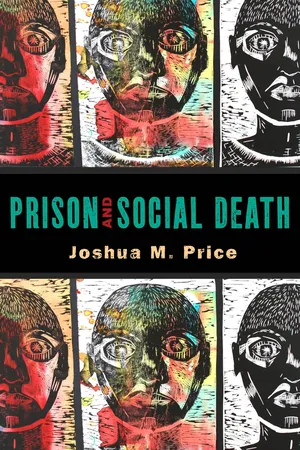
The United States imprisons more of its citizens than any other nation in the world. To be sentenced to prison is to face systematic violence, humiliation, and, perhaps worst of all, separation from family and community. It is, to borrow Orlando Patterson’s term for the utter isolation of slavery, to suffer “social death.” In Prison and Social Death, Joshua Price exposes the unexamined cost that prisoners pay while incarcerated and after release, drawing upon hundreds of often harrowing interviews conducted with people in prison, parolees, and their families.
Price argues that the prison separates prisoners from desperately needed communities of support from parents, spouses, and children. Moreover, this isolation of people in prison renders them highly vulnerable to other forms of violence, including sexual violence. Price stresses that the violence they face goes beyond physical abuse by prison guards and it involves institutionalized forms of mistreatment, ranging from abysmally poor health care to routine practices that are arguably abusive, such as pat-downs, cavity searches, and the shackling of pregnant women. And social death does not end with prison. The condition is permanent, following people after they are released from prison. Finding housing, employment, receiving social welfare benefits, and regaining voting rights are all hindered by various legal and other hurdles. The mechanisms of social death, Price shows, are also informal and cultural. Ex-prisoners face numerous forms of distrust and are permanently stigmatized by other citizens around them.
A compelling blend of solidarity, civil rights activism, and social research, Prison and Social Death offers a unique look at the American prison and the excessive and unnecessary damage it inflicts on prisoners and parolees.
- 212 pages
- English
- ePUB (mobile friendly)
- Available on iOS & Android
eBook - ePub
Prison and Social Death
About this book
Information
Part One
Elements of Social Death
Chapter 1
Crossing the Abyss
The Study of Social Death
May 2007. The woman comes through the security door into the visiting room. She glances around the room and looks a bit startled when the corrections officer motions her to a stool opposite me. She is surprised to see me at first. I am accustomed to this reaction. Even though she had written me personally and asked me to come to interview her (she must have gotten my name through a jail grapevine), we had never met before and she did not know we were coming today. Rosie, one of my students from New York City, sits at my side.
The jail has started restricting our access, so now, instead of a prearranged private room, we must conduct our interviews in the public visiting room. The staff at the NAACP interprets this as the jail administration trying to obstruct our research and our attempts to monitor jail conditions. The practical consequence is that we are now allowed no pens, no papers, no recording devices, no privacy, and our interviews are conducted in the presence of correctional officers. Especially significant, however, is that our visits are now docked from each person’s allotment of two hours of visiting time per week. Docking their time forces the people incarcerated at the jail to balance their desire to report abuse to a civil rights organization (us) against their need to see family and friends.
We go through a few preliminaries, buffeted by the chaotic sounds all around us—lovers chatting, holding hands over the dividers, babies bouncing, guards roaming around, half bored, alternating between staring indifferently beyond all of us and glaring from time to time. I introduce myself to her formally and I explain that we are from the NAACP. I tell her she does not have to answer any of our questions. Would she still like to talk with us? I ask. She nods. Then she gives us her narrative. She is self-possessed and emotionally self-contained though her rage at the jail is clear and her grief hovers at the margins. (In order to protect people’s privacy, I have changed names and identifying details throughout.)
“I entered the jail on October 27th and I thought I might be pregnant. I have three children, and so I know what it is to be pregnant. I was a little happy.” This time when she entered, “I felt some pain on my side. On my right side.” She was allowed to see a nurse, but the nurse dismissed her fears. She awoke one night with tremendous pain in her side and started banging on her cell door. It took fifteen minutes for the guard to come and another fifteen minutes for the nurse to come, who had her transferred to the medical unit. Her experience there was not much better. She started bleeding from the vagina, but the nurses incorrectly told the doctor it was from her anus and generally treated her complaint lightly. She awoke the following night and her panties were caked in blood. When she showed the doctor, he told her this was serious and sent her to an outside hospital. It was a tubal pregnancy and she had to have her right fallopian tube removed.
As I listen, I try to stay composed. I try not to react strongly to anything she says or reveal shock or disbelief. And I am not in disbelief. She is the third woman I have met in as many months who has miscarried at the jail. She is not the first who has suspected a tubal pregnancy but could not receive medical attention. Through speaking with incarcerated women and with my students in the project who are themselves mothers, I have learned that an undiagnosed tubal or ectopic pregnancy is potentially fatal for the mother. If it is not diagnosed, the tubal pregnancy can rupture the fallopian tube, leading to internal hemorrhage and possible sterility.
As always, I ask if we can come back for a follow-up visit, just to check on her and to make sure the jail has not engaged in recriminatory treatment against her for speaking with us. I also ask permission because we do not want to compete with other people’s visits. “You don’t have to worry about that,” she replies, a bit dryly. “Ain’t nobody coming to visit me.”
I change key. “How are you? How have you been emotionally?” I ask. She has been through a lot of trauma recently. Her bearing cracks a bit. “I’m all right. I’m facing a lot of time, you know? And I already have two kids in foster care and so this one would have faced the same thing. So maybe it is for the best.”
“Is there discrimination involved? Or do they treat all prisoners this way, do you think?”
“I wouldn’t say there’s discrimination,” she responds. “They’re just assholes.”
Later, Rosie remarks this confirms a lot for her: women are often left to self-diagnose any health problem; the system is chaotic.
For me, her story of acute suffering that edged its way out under the fluorescent lights is a bit hard to take. She will not, in all probability, receive any of what has come to be known lately as “grief counseling.” I do not know how she adjusts emotionally—or physically—to her condition and her experience given that she is facing a long period of incarceration (I never learn her crime).
She does not think racism is involved. Others provide examples of racist treatment. Most of the people we interview are African American, and I hear so many, many stories of reproductive horrors. So much death, so many separations, undiagnosed conditions, so many worries and festering wounds. It is hard for me not to see a link between prison, reproductive health, and race. (Fieldnotes, 2007)
To be sentenced to prison is to be sentenced to social death. Social death is a permanent condition. While many people integrate themselves back into the society after imprisonment, they often testify that they permanently bear a social mark, a stigma.
The term “social death” comes from Orlando Patterson’s analysis of slavery. In analyzing the social status of the slave, Patterson argued that slaves were rendered noncitizens, social nonentities (Patterson 1982).1 They were condemned to social death. Social death comprised three aspects: the slave was subject to systematic violence, to generalized humiliating treatment, and to “natal alienation.” Natal alienation meant severance from ancestors and children. Even when a family was together, as on a plantation, each had to be made powerless vis-à-vis the others. An enslaved person could be whipped or sold off at any time, and other slaves were in little position to do anything. The institution of slavery made it difficult, moreover, to transmit one’s heritage to one’s progeny. In effect, one’s family and community ties had little or no legal or social standing. Natal alienation under slavery meant a radical kind of separation from others. This was an essential part of the structure of slavery. It is why Patterson deemed the slave a “genealogical isolate.”
Similarly, the prison separates people from communities of support, and from their parents and children. The isolation of people in prison renders them vulnerable, moreover, to other forms of violence, including sexual violence (see Levi and Waldman 2011; B. Smith 2003, 2005). Natal alienation forces people in prison into a structure of vulnerability, subject to direct and indirect violence and humiliation. Calling the condition of prison “natally alienating” allows us to bring together many forms of state intervention that otherwise may seem disparate and unrelated. For example, it allows us to explain the implications of incarceration for reproductive health and reproductive justice.
While people’s experiences vary significantly, the interviews I have conducted consistently revealed three basic qualities of incarceration: generalized humiliation, institutional violence, and natal alienation. The conjunction of the three yields the peculiar contours of social death.
People who have been sentenced to prison are not the only social dead. Immigrants facing deportation are subject to social death (De Genova and Peutz 2010). Social death is also a central part of genocide (Card 2003). People undergoing genocide are often first dehumanized through social death. The connections among different forms of modern social death are complex. This book, however, focuses on the social death of incarceration. In the case of the United States, social death is also a racial mark.2
In arguing that they face social death, I am not claiming that incarcerated people are enslaved. Nor am I arguing that in facing social death, resistance is thereby forgone. Acknowledging any kind of potent social category or oppression does not imply that people give in to that oppression or that they do not create important bonds of solidarity and survival. I do not see the woman above as passive. If I thought that resistance was futile, I would not engage in participatory research.
Participatory Research on Jail Health Care
The research for this book is drawn in large part from grassroots participatory research and activism around health care of incarcerated people in upstate New York. Between 2004 and 2007, working with community members, my students and I interviewed over 150 people at the Broome County Correctional Facility. We also conducted over twenty interviews with formerly incarcerated people in the offices of the local NAACP. After the jail administration restricted our access in 2007, I focused on the challenges facing the formerly incarcerated when they try to reintegrate into society.
This is how it happened. I live in Binghamton, a deindustrialized working-class town in upstate New York. In July 2004, I came on a small item in the Reporter, a local progressive newspaper. The local branch of the NAACP, the article read, had received numerous letters from people held at the county jail who complained of poor health care. The NAACP was calling a meeting to discuss the complaints and what could be done. I decided to attend the meeting, mostly because I thought this was an important issue and because I wanted to get more involved in the community. At that time, the NAACP met in an industrial section of the city, amid the factory ruins, a block from a Coca-Cola plant, in an old building abutting the tracks of the freight train. The meetings were held around an office table.
Only about seven other people attended that first meeting, most quite a bit older than I, septuagenarians from the civil rights movement who were still active in the community. We started the meeting by introducing ourselves. I said I was from the university, but this felt almost unnecessary. Since I was sporting a rumpled, blue oxford shirt and short hair, they took me for a student. Once they learned I was a social scientist, they invited my participation in documenting the prisoner abuse. We decided that I would follow up on complaints and interview people. It turned out that later they asked around about me. Several colleagues vouched for my political commitment.
I returned a few days later. Stan, the NAACP branch secretary, presented me with a folder full of letters and documents on the health care provider at the county jail. The Sheriff’s Department runs the Broome County Correctional Facility. Like most jails, it is county run. County jail inmates are generally people being held before trial, people arrested but who have not made bail, or people sentenced to less than a year. (Conventionally, prisons or penitentiaries hold people sentenced for more than a year and they are under state or federal jurisdiction.) The jail houses more than five hundred people. At the time I began this research, the county contracted Correctional Medical Services (CMS), a private health care corporation, to provide medical care at the jail. In 2006, possibly due in part to scandals and lawsuits facing CMS nationally and in part to local pressure, the jail contracted with a new, smaller organization, Correctional Medical Care (CMC). Yet CMC soon came under state scrutiny as well, after a series of suspicious inmate deaths around the state.3 The size of the county jail’s medical contract is more than two million dollars per year (Reilly 2012). The financial transactions of even a small jail in a provincial town are sizeable.
Over the next few years, as I researched medical care at the jail, I served as a member of several NAACP delegations that met with the sheriff to express our concerns about conditions at the jail and the treatment of the incarcerated, especially their health care. In each of these meetings, the sheriff assured us that everything was fine: “You’ll always find complainers, but . . .” his office had not received many complaints. (I learned only later of a series of lawsuits pending against the jail that alleged poor medical treatment.) On the other hand, he touted the revenue the jail generated for the county. Keeping someone incarcerated in a New York State penitentiary costs around $60,000 a year per person, the most expensive per capita cost in the nation (Henrichson and Delaney 2012). Jails cost significantly less, perhaps in the range of $26,000 per person (Schmitt, Warner, and Gupta 2010, 11). The sheriff told us he “rents” cell beds to other agencies—federal agencies, including immigration authorities and the Federal Bureau of Prisons, and county jails as far away as Long Island. He charges them per diem rates. This, he argued, generates enormous revenue to the county. This practice is widespread in prisons and jails (see Barry 2009). To put this in context, the scale of the corrections economy nationally exceeds $74 billion a year, up from $22 billion in 1982.4
Soon after I began, I realized how useful it would be to involve my students in conducting the research. With NAACP staff, we developed a research protocol, including a set of interview questions and steps to ensure everyone’s welfare and safety, including students, community members, and people held at the jail. I am trained as an anthropologist and ethnographer, so I taught student volunteers from my classes how to do interviews and supervised them as we took statements from people who wished to register concerns about their treatment. Other students did research on Correctional Medical Services and other aspects of privatizing correctional medical care.
The project evolved to the point where it became a collective effort, centered on weekly meetings at the NAACP to discuss what we were learning from the interviews and plan next steps. At its height, about twenty-five people attended the weekly meetings at the NAACP. White people, African Americans, Latinos, Muslims, Roman Catholics, immigrants from the Caribbean and the Middle East, currently and formerly incarcerated people, working-class and middle-class students, and civil rights activists participated. These groups overlap. Some of the people who had been incarcerated had served short stints in jail, while others had spent most of the last thirty or forty years in state or federal penitentiaries.
Those involved worked together to explore the depth and size and character of the abuse. People who were currently in the jail, formerly incarcerated men and women now at home or in shelters, as well as the relatives of people who had died or who had children or spouses still incarcerated, came forward and identified themselves to us, sometimes in great fear and sometimes without fear. We were not funded and did not seek funding. No one was paid. The research was participatory and activist in the sense that the motivation for the work was to stop abuse of incarcerated people.
Many we interviewed at the jail were confident and calm. Others were terrified, or despondent. Some were in physical pain during the interview itself. Though almost everyone we interviewed was lucid, sober, and direct, I interviewed a few who were obviously mentally ill—who heard screams and voices in their heads, or who did not have a clear sense of how long they had been incarcerated, or who genuinely did not seem to understand what they had been charged with or why they were in jail, or who were desperate for their medication.
The stories the people in jail told me were often harrowing. We interviewed someone who had gone into a diabetic coma when denied his insulin shots; a woman who showed me her scarlet, swollen limb, whose skin was peeling, and who told me she was worried she had gangrene but could not get medical attention. I interviewed people forced to languish in their cells for days with a burst appendix or a fractured vertebra before they received anything other than Pepto-Bismol or Advil.
We found many examples of neglect or abusive treatment that interfered with incarcerated women’s reproductive freedom, including denial of prenatal care and lack of access to abortion (resulting in, for example, unwanted births, tubal pregnancies, and other added health risks to women with problem pregnancies), and no routine preventive care.
We saw patterns emerge from interviewing women about their gynecological and other health care needs, women who needed pap smears, breast exams, prenatal care and counseling, who suffered from untreated yeast infections, who had not been given their HIV cocktail or their hepatitis medication, who were worried they had a problem pregnancy but could not receive a medical exam, who had swollen limbs, open wounds, or who simply lacked a diagnosis. Their health seemed to be treated with indifference and sometimes with antipathy. To be in prison is to be ignored, shunted aside, and “treated as garbage,” as one long-termer remarked.
People in jail generally recognize suffering in solitude and without recourse as violent and humiliating. Poor health care, or withholding adequate health care, can be in effect a form of punishment (see Farmer 2003). This is especially true when poor health care is rampant, routine, and even institutionalized.
Prison violence thus cannot be limited simply to intentional physical abuse by other incarcerated people or by a specific guard or guards. It involves insti...
Table of contents
- Title Page
- Copyright Page
- Dedication
- Contents
- Acknowledgments
- Part I. Elements of Social Death
- Part II. Method and a History of Social Death
- Part III. Abolition Democracy
- Notes
- References
- Index
- About the Author
- Read More in the Series
Trusted by 375,005 students
Access to over 1.5 million titles for a fair monthly price.
Study more efficiently using our study tools.
Frequently asked questions
Yes, you can cancel anytime from the Subscription tab in your account settings on the Perlego website. Your subscription will stay active until the end of your current billing period. Learn how to cancel your subscription
No, books cannot be downloaded as external files, such as PDFs, for use outside of Perlego. However, you can download books within the Perlego app for offline reading on mobile or tablet. Learn how to download books offline
Perlego offers two plans: Essential and Complete
- Essential is ideal for learners and professionals who enjoy exploring a wide range of subjects. Access the Essential Library with 800,000+ trusted titles and best-sellers across business, personal growth, and the humanities. Includes unlimited reading time and Standard Read Aloud voice.
- Complete: Perfect for advanced learners and researchers needing full, unrestricted access. Unlock 1.5M+ books across hundreds of subjects, including academic and specialized titles. The Complete Plan also includes advanced features like Premium Read Aloud and Research Assistant.
We are an online textbook subscription service, where you can get access to an entire online library for less than the price of a single book per month. With over 1.5 million books across 990+ topics, we’ve got you covered! Learn about our mission
Look out for the read-aloud symbol on your next book to see if you can listen to it. The read-aloud tool reads text aloud for you, highlighting the text as it is being read. You can pause it, speed it up and slow it down. Learn more about Read Aloud
Yes! You can use the Perlego app on both iOS and Android devices to read anytime, anywhere — even offline. Perfect for commutes or when you’re on the go.
Please note we cannot support devices running on iOS 13 and Android 7 or earlier. Learn more about using the app
Please note we cannot support devices running on iOS 13 and Android 7 or earlier. Learn more about using the app
Yes, you can access Prison and Social Death by Joshua M. Price in PDF and/or ePUB format, as well as other popular books in Social Sciences & Criminology. We have over 1.5 million books available in our catalogue for you to explore.