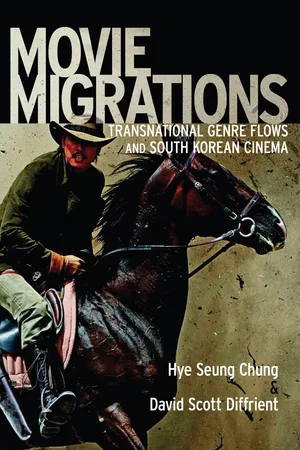
As the two billion YouTube views for “Gangnam Style” would indicate, South Korean popular culture has begun to enjoy new prominence on the global stage. Yet, as this timely new study reveals, the nation’s film industry has long been a hub for transnational exchange, producing movies that put a unique spin on familiar genres, while influencing world cinema from Hollywood to Bollywood. Movie Migrations is not only an introduction to one of the world’s most vibrant national cinemas, but also a provocative call to reimagine the very concepts of “national cinemas” and “film genre.” Challenging traditional critical assumptions that place Hollywood at the center of genre production, Hye Seung Chung and David Scott Diffrient bring South Korean cinema to the forefront of recent and ongoing debates about globalization and transnationalism. In each chapter they track a different way that South Korean filmmakers have adapted material from foreign sources, resulting in everything from the Manchurian Western to The Host ’s reinvention of the Godzilla mythos. Spanning a wide range of genres, the book introduces readers to classics from the 1950s and 1960s Golden Age of South Korean cinema, while offering fresh perspectives on recent favorites like Oldboy and Thirst. Perfect not only for fans of Korean film, but for anyone curious about media in an era of globalization, Movie Migrations will give readers a new appreciation for the creative act of cross-cultural adaptation.
- 306 pages
- English
- ePUB (mobile friendly)
- Available on iOS & Android
eBook - ePub
Movie Migrations
About this book
Information
Subtopic
Korean HistoryPart I
From Classical Hollywood to the Korean Golden Age
Cinephilia, Modernization, and Postcolonial Genre Flows
Chapter 1
Toward a Strategic Korean Cinephilia
A Transnational Détournement of Hollywood Melodrama
A slight yet significant gesture: a man lights a cigarette with the graceful elegance and the casual demeanor of someone whose cool exterior belies a passionate, romantic streak. He hands another, unlit cigarette to a young woman standing opposite him. She brings it to her lips and leans seductively toward him. Face to face, the couple poses as if on the verge of a kiss. As they slowly draw nearer to each other, the ends of the two cigarettes touch, one lighting the other. By visualizing the convergence of two cultures—one ostensibly bound to tradition, the other representative of modernity—this blissful contact not only seals the pact of their newfound affection but also inscribes, at a deeper level, the complex cultural hybridization bound up in the symbolic image of the romantic couple.
Any American movie fan worth his or her salt will recognize this famous “nicotine kiss” between William Holden and Jennifer Jones as the most memorable scene in Henry King’s sweeping East-meets-West melodrama Love Is a Many-Splendored Thing (1955), a film that taught would-be-lovers around the world a particularly Hollywood way of igniting both cigarettes and passions. Aficionados of South Korea’s cinematic Golden Age, however, might recall a different scene upon hearing the previous description. In place of a picturesque Hong Kong beach, dramatically framed in CinemaScope and populated by a swimsuited twosome, a drab black-and-white apartment in poverty-stricken Seoul might flicker in their minds. This is one of the settings of director Yu Hyŏn-mok (Yu Hyun-mok)’s critically acclaimed The Stray Bullet (Obalt’an, 1961), a postwar classic that ingeniously rearticulates and recontextualizes the scene in Love Is a Many-Splendored Thing by situating its cigarette-lighting couple within a claustrophobic interior. The male hero is not the American correspondent played by Holden, a personification of the escalating US imperial presence in the British crown colony, but rather an unemployed, battle-scarred Korean War vet played by matinee idol Ch’oe Mu-ryong, emasculated by his lack of financial means to court and marry another woman, his movie star fiancée (Kim Hye-jŏng). His partner in this scene (Mun Hye-ran), unlike her Hollywood counterpart (the financially stable Eurasian medical doctor played by Jones), is a struggling part-time college student who earns her tuition by spending four hours a day in a smoky cellar as a factory worker. Counterpoised against Hollywood’s star-crossed lovers who whisper sweet-nothings against a swelling musical score, the Korean couple confesses familial loss and destitution while mimetically enacting the romantic Holden-Jones pose accompanied by a soundtrack featuring little more than caged birds chirping offscreen.
Yu’s film subtly critiques Hollywood’s Orientalist geopolitical imaginary by decisively refusing its fantasy settings and romantic excess. Like French Situationist guru Guy Debord,1 director Yu mobilizes the technique of détournement, whereby the tropes of dominant popular culture are appropriated, rerouted, and reconfigured so as to provoke a counterhegemonic disarticulation of meaning. The Korean détournement of the melodramatic scene cleverly registers the squalor and despair of postwar Seoul in which a young, handsome couple is literally caged inside slum walls while their Hollywood counterparts leisurely engage in touristic consumption in exotic Hong Kong and neighboring Macao. The Stray Bullet is a remarkably modernist text that not only hybridizes Korean and Euro-American signifiers (costumes, languages, and soundtracks) but also commingles and intermixes Hollywood melodramatic tropes and realist South Korean aesthetics. Golden Age South Korean melodrama diverges from its American equivalent of the Eisenhower era due to the former’s focus on ordinary lower-middle and working-class citizens (sŏmin or sosimin) as opposed to the latter’s gravitation toward upper-middle-class bourgeois housewives and widows.2 In this respect, one could argue that South Korean film melodrama offers a more discursive range of spectatorial positions than that engendered by Hollywood’s 1950s family melodrama, which, as Christine Gledhill points out, opens up a cross-class fantasy of identification for petite bourgeois or working-class audiences vis-à-vis screen surrogates basking in “lavish furnishings and consumer goods”3 whose fetishistic potency represents America’s postwar prosperity and abundance. In marked contrast, the South Korean society of the 1950s and the 1960s was torn apart by postwar poverty and chaos. Melodrama sided with underprivileged masses suffering social and familial alienation in the shadowy margins of modernization and economic development. Thus, in terms of its aesthetic characteristics and semantic ingredients, South Korean melodrama was seldom divested of its realistic, socially conscious core.


Figures 1.1 and 1.2. Cross-cultural détournement: The “nicotine kiss” scenes from Love Is a Many-Splendored Thing (above) and The Stray Bullet (below).
Although many commentators observe the influence of Italian Neorealism and German Expressionism in The Stray Bullet,4 few scholars have pointed out the film’s intertextual relationship with Hollywood melodrama. By linking South Korean Golden Age cinema (1955–1972) and Classical Hollywood melodrama within a comparative paradigm, this chapter addresses not only the cross-cultural translation and adaptation of particular scenes and star-images but also South Korean audiences’ unique cinephilic fixation on overlooked Hollywood films. Korean audiences’ infatuation and identification with Hollywood cinema should be historicized in the postwar cultural context rather than being simply frowned upon as a symptom of US cultural imperialism. The post-Korean War generation’s intense nostalgia for sentimental Hollywood melodrama is a significant indicator of the cultural displacement that occurs when spectatorial desire for the “other” operates within a postcolonial setting. Before embarking upon specific comparative case studies, a brief examination of the otherwise discursive cultural forces intermingled within and responsible for the formation of South Korean melodrama will provide a historical backdrop against which to frame intertextual relations.
Origins of South Korean Melodrama: Sinp’a, Han, and Hollywood
In her book-length study of Korean melodrama, feminist film scholar Yu Chi-na identifies three origins of the genre that figured decisively in the context of an emergent national cinema.5 The first source is the Japanese sinp’a (new school) drama introduced and localized during the colonial era (1910–1945). In the late-nineteenth-century Meiji period, the sinp’a drama arose in Japan as a popular alternative to the kup’a (old school) drama, kabuki.6 Set in a modern milieu, it usually features a sentimental plot revolving around family tragedy and heterosexual romance. After Japan’s annexation of Korea in 1910, the sinp’a drama strongly influenced Korean theater, film, and literature, injecting Japanese theatrical modes of storytelling into the syntactic core of Korean cultural productions. Famous silent sinp’a films include Twin Jade Pavilion (Ssangongnu, 1925), Arirang (1926), Long Cherished Dream (Changhanmong, 1926), and Fallen Blossoms on a Stream (Nakhwayusu, 1927). During the Golden Age of South Korean cinema in the 1950s and 1960s, the sinp’a drama became associated with female audiences, identified by such derogatory nicknames as “handkerchief army” (sonsugŏn pudae), “tear gas” (ch’oerut’an), and “rubber shoes” (komusin: trademarks of married, middle-aged women who migrated to the metropolis from rural areas).7 The term sinp’a is still used by South Korean critics and audiences to derogatorily designate old-fashioned melodramas filled with unlikely coincidences and fortuitous reversals as well as excessive sentimentality.8
In addition, Yu and other scholars claim that Korean melodrama hinges upon the national sentiment of han, a slippery and subtle term that, depending on context, denotes everything from “resentment” and “lamentation” to “unfulfilled desire” and “resignation.”9 Han can be vaguely defined as the deep-rooted sadness, bitterness, and longing sparked by prolonged injustices and oppression. Various scholars have identified the sociopolitical sources of Korean han to include: a long history of foreign invasions by the Chinese, the Japanese, and the West; patriarchal Confucian traditions that have silenced and enslaved women for hundreds of years; the inhumane treatment and exploitation of the subaltern class under the feudal caste system as well as during the full-throttle modernization process; and the gross violations of civil rights by successive authoritarian military regimes in the postcolonial period.10 Indeed, the recuperation of the abiding sense of han in South Korean melodrama seems to facilitate our appreciation of the indigenous and dormant forces behind a genre deeply influenced by colonial cultural import. However, overdependence on this elusive, psycho-phantasmic concept for the explication of generic categories intrinsic to a particular national cinema risks generating what can be labeled “critical nationalism.” By “critical nationalism,” we refer to the attitude of filmmakers, critics, and scholars alike who contend that han is uniquely Korean, a concept that almost, if not completely, escapes translatability in other cultural lexicons. Im Kwon-taek (Im Kwŏn-t’aek)—a household name in South Korea and a director whose oeuvre brims with han-centric films that aestheticize Korean history, tradition, and culture in melodramatic modes—concisely sums up this position: “Han is not a concept that Koreans can agree on. I can’t even count the number of books that have been written about han. . . . However, han is a specific emotion that has profound links to the history of the Korean people, and as such, might be a difficult concept for non-Koreans to grasp fully.”11 The critical overemphasis on such an ambiguous concept as definite marker of Korean-ness contributes to the erection of “imagined [emotional] communities” of the nation and its culture.
From the point of view of genre studies, han can be better understood as a historically and culturally specific mobilization of what Peter Brooks defines as the “melodramatic imagination” or “melodramatic mode.”12 Han indeed connotes melodramatic affect and sensibility in the Korean context. However, what is unique about Korean han is its context rather than affect in and of itself. The overlooked transnational valency of the concept becomes salient once we examine the etymological roots of this monosyllabic Sino-Korean character. According to a Chinese-English dictionary, “han is hen (‘hate’) in Chinese, kon (‘to bear a grudge’) in Japanese, horosul (‘sorrowfulness’) in Mongolian, korsocuka (‘hatred,’ ‘grief’) in Manchurian, and hân (‘frustration’) in Vietnamese.”13 Although similar concepts exist throughout East and Southeast Asia, only han has emerged as a privileged marker of national culture and identity.
Instead of essentializing the uniqueness of Korean melodrama on the grounds of the ontologically uncertain han, it is useful to examine how similar concepts function in other national cinemas and how they converge with and diverge from it. For example, in exploring the transnational circulation of filmic han as it cross-pollinates into neighboring cultural arenas, attention could be directed to the historical epics and melodramas of Zhang Yimou, Chen Kaige, and other Chinese Fifth Generation filmmakers who anchor their stories in the imagery of suffering female bodies. Is the han expressed by the Korean surrogate child bearers in Im Kwon-taek’s Surrogate Mother (Ssibaji, 1986) fundamentally different from the pain and suffering of the Chinese concubines in Zhang Yimou’s equally exoto-ethnographic melodrama Raise the Red Lantern (Dà hóng dēnglóng gāogāo guà, 1991)? Or does the difference lie in the cultural and historical crevice separating these two nations?
One can similarly cast doubt on the concept of mono no aware as being distinctively Japanese. Defined by Donald Richie as “sympathetic sadness . . . a serene acceptance of a transient world” and by David Bordwell as “the pathos of things,”14 mono no aware is an underlying emotional chord struck in the meditative family melodramas of Ozu Yasujirō and other Japanese auteurs sensitive to quotidian poetics. It is tempting to argue that mono no aware is what distinguishes tranquil Japanese melodramas from their more emotionally intense South Korean counterparts. However, many Japanese audiences appear to have experienced mono no aware when they saw Hur Jin-ho (Hŏ Chin-ho)’s Christmas in August (8wŏl ŭi K’ŭrisŭmasŭ, 1998), a critically lauded pan-Asian success already canonized as a representative South Korean melodrama. According to film critic Deruoka Sojo, many Japanese who compared this film to Ozu’s work were surprised to discover that Korean sentiments were, after all, very similar to their own.15 This dispels prejudiced perceptions about South Korean cinema as alienating and defamiliarizing due to its imagined exoticism and emotive primitivism. The cult status of Christmas in August in Japan is such that the film was remade into a Japanese version directed by Nagasaki Shun’ichi in 2005. As evidenced by the Japanese reception of Christmas in August, mono no aware as well as han can be unraveled as a discursively radiating transnational experience rather than as a uniquely indigenous manifestation of a given culture’s resignation to or transcendence of sorrow. Granting that han and mono no aware have different origins, histories, and connotations, both concepts have been similarly mobilized by critics as the aesthetic purveyors of national identity. If i...
Table of contents
- Cover
- Title Page
- Copyright Page
- Contents
- Acknowledgments
- Introduction: South Korean Cinema’s Transnational Trajectories
- Part I. From Classical Hollywood to the Korean Golden Age: Cinephilia, Modernization, and Postcolonial Genre Flows
- Part II. From Cinematic Seoul to Global Hollywood: Cosmopolitanism, Empire, and Transnational Genre Flows
- Notes
- Index
- About the Authors
- Read More in the Series
Trusted by 375,005 students
Access to over 1.5 million titles for a fair monthly price.
Study more efficiently using our study tools.
Frequently asked questions
Yes, you can cancel anytime from the Subscription tab in your account settings on the Perlego website. Your subscription will stay active until the end of your current billing period. Learn how to cancel your subscription
No, books cannot be downloaded as external files, such as PDFs, for use outside of Perlego. However, you can download books within the Perlego app for offline reading on mobile or tablet. Learn how to download books offline
Perlego offers two plans: Essential and Complete
- Essential is ideal for learners and professionals who enjoy exploring a wide range of subjects. Access the Essential Library with 800,000+ trusted titles and best-sellers across business, personal growth, and the humanities. Includes unlimited reading time and Standard Read Aloud voice.
- Complete: Perfect for advanced learners and researchers needing full, unrestricted access. Unlock 1.5M+ books across hundreds of subjects, including academic and specialized titles. The Complete Plan also includes advanced features like Premium Read Aloud and Research Assistant.
We are an online textbook subscription service, where you can get access to an entire online library for less than the price of a single book per month. With over 1.5 million books across 990+ topics, we’ve got you covered! Learn about our mission
Look out for the read-aloud symbol on your next book to see if you can listen to it. The read-aloud tool reads text aloud for you, highlighting the text as it is being read. You can pause it, speed it up and slow it down. Learn more about Read Aloud
Yes! You can use the Perlego app on both iOS and Android devices to read anytime, anywhere — even offline. Perfect for commutes or when you’re on the go.
Please note we cannot support devices running on iOS 13 and Android 7 or earlier. Learn more about using the app
Please note we cannot support devices running on iOS 13 and Android 7 or earlier. Learn more about using the app
Yes, you can access Movie Migrations by Hye Seung Chung, David Scott Diffrient in PDF and/or ePUB format, as well as other popular books in Media & Performing Arts & Korean History. We have over 1.5 million books available in our catalogue for you to explore.