Sociologists have long been curious about the ways in which city dwellers negotiate urban public space. How do they manage myriad interactions in the shared spaces of the city? In Urban Nightlife, sociologist Reuben May undertakes a nuanced examination of urban nightlife, drawing on ethnographic data gathered in a Deep South college town to explore the question of how nighttime revelers negotiate urban public spaces as they go about meeting, socializing, and entertaining themselves. May’s work reveals how diverse partiers define these spaces, in particular the ongoing social conflict on the streets, in bars and nightclubs, and in the various public spaces of downtown. To explore this conflict, May develops the concept of “integrated segregation”—the idea that diverse groups are physically close to one another yet rarely have meaningful interactions—rather, they are socially bound to those of similar race, class, and cultural backgrounds. May’s in-depth research leads him to conclude that social tension is stubbornly persistent in part because many participants fail to make the connection between contemporary relations among different groups and the historical and institutional forces that perpetuate those very tensions; structural racism remains obscured by a superficial appearance of racial harmony.
Through May’s observations, Urban Nightlife clarifies the complexities of race, class, and culture in contemporary America, illustrating the direct influence of local government and nightclub management decision-making on interpersonal interaction among groups.
Watch a video with Reuben A. Buford May: Watch video now. (http://www.youtube.com/watch?v=VCs1xExStPw).
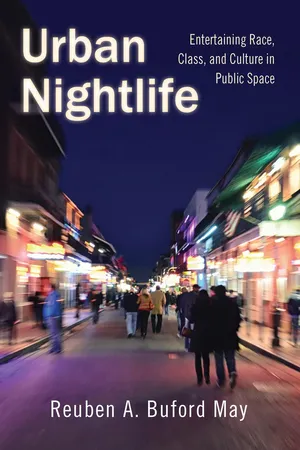
- 242 pages
- English
- ePUB (mobile friendly)
- Available on iOS & Android
eBook - ePub
Urban Nightlife
About this book
Information
1
Integrated Segregation in Urban Nightlife
“Tom, come back,” I heard a woman’s voice shout.1
I looked in the direction of the voice and watched as a tall White man left Kilpatrick’s bar and stumbled his way through the crowd toward me. I had been standing in my usual spot with my back to the street surveying the comings and goings of patrons for a couple of hours. The yellow parking ticket box had become my leaning post for watching the street corner activity. This particular corner, the northeast corner of Reginald and Stuckey Streets, is usually alive with activity as patrons move between three popular bars—Kilpatrick’s, Figaro’s, and the Corral—and tonight was no different.
After a few steps through the crowd Tom stumbled to a stop just near the corner. He swayed a little as other patrons passed on either side of him. Several feet away I could see a young woman intently moving toward him. She pressed her way through the crowd using her forearm and called out again, “Tom, come back.”
Tom looked disoriented as he turned to the sound of her voice. A few feet away now, the woman lunged through the last group of patrons and grabbed Tom by the sleeve of his white, button-down, Ralph Lauren Polo shirt. She gave it a slight tug as if to both restrain Tom from further movement and gather herself.
Tom turned to the woman with a look of exasperation on his face as he labored to regain his balance. After a few swaying moves he looked into her eyes and said in his best impersonation of someone sober, “Look, Allison, maybe we should take a break from each other. I just wanna have fun.”
Allison frowned.
Other patrons continued to pass Tom and Allison but paid little attention to the two as they talked loudly.
“I wanna have fun too,” Allison protested as she fought back tears, “but that doesn’t mean you have to kiss other girls.”
“We were only dancing and she kissed me,” Tom replied.
Allison held tightly to Tom’s arm and tried to pull him closer.
Tom resisted, nudging Allison back by extending his arm.
A young man, who was walking toward Kilpatrick’s with a group of his buddies, bumped into Allison and caused her to sway. She could hardly keep her balance in her red high-heeled shoes. Allison pulled on Tom to regain her balance, and this caused Tom to teeter. As both swayed, I could see tears welling in Allison’s eyes.
“Tom, we can have fun together,” she said.
“Look, Allison, I’m leaving. I’m going to catch my friends. I’ll call you tomorrow and we can talk.”
Tom snatched his arm from Allison and began crossing the street with a throng of patrons who were heading to other bars along Stuckey Street.
Allison stood on the corner shaken and upset. Tom continued to walk away, as tears began running down Allison’s face. She waited a few seconds before she cried out again, “Tom, Tom,” but Tom did not stop.
Although many patrons passed her, Allison seemed to stand alone on the crowded corner. She began wiping the tears from her eyes with the fingertips of both hands and, after a few strokes, wiped her hands on her white miniskirt. I looked to see if Tom had decided to come back, but he seemed to be moving faster the farther he got away from Allison. It was as if he were now liberated to “have fun” the way he wanted.
I looked back at Allison, who had begun to quiver as her tears intensified. She stooped to the ground, as groups of patrons continued to pass on either side. They took little note of her, even as she crouched slowly toward the ground.
She would have been in a full crouch position if it had not been for another young woman who grabbed Allison by the shoulders and lifted her up.
“Allison, come on. It’s okay. Don’t worry about Tom,” said the woman.
Allison stood to her feet slowly with the help of the woman. Tears were still streaming down her face. The woman, apparently a friend, placed her arm across Allison’s shoulder. They almost looked like twins wearing their white miniskirts and polo shirts.
As Allison whimpered into her friend’s shoulder, I turned my attention to the revelry of a group of young men leaving Figaro’s bar next door to Kilpatrick’s.
“You prick,” a tall White man said as he shoved his shorter friend and laughed. The other three young men, all White, began laughing as they joined this impromptu drunken game of shoving one another back and forth. Each of them was wearing a variation of the khaki shorts/polo shirt combination. They bumped into other patrons who seemed to take their game as a minor irritant and continued moving on to the next place to “get a drink and have some fun.”
Just a few feet away from the group participating in the pushing game stood two White men talking with a group of four White women. One of the young men, dressed in khaki shorts, leather flip-flops, and a green polo shirt, seemed to be doing all the talking while his friend stood making quick glances to the group of young women, and then out to the activity of patrons passing on the sidewalk. The man in the green polo shirt wore his brown hair closely shaved. He focused his attention on the woman standing closest to him. She was a slim blonde, wearing a yellow halter summer dress and high-heeled wedge shoes with cork bottoms and white uppers. The hem of her dress stopped several inches above her knees and accented her long tanned legs. As the two talked and exchanged flirtatious smiles their friends stood impatiently. Moments later the group of women, led by the woman in the yellow dress, began walking toward the corner where I stood. As they left the young men, the one in the green polo turned to his friend, who then mouthed the words, “She is so hot.” The men shared a high five and laughed, then turned and walked into the Corral.
As I watched that group of young women walk to the corner, led by the woman in the yellow dress, I noticed two Black men sitting on the bench that faces Kilpatrick’s. The bench is about ten feet in front of my vantage point, and it sits by the edge of the sidewalk where patrons pass between bars. Both of the Black men were wearing blue jean shorts and sat with their buttocks on the backrest of the bench. The one to my left was thin and dark skinned. His hair was cut low, almost bald, and he wore a red-and-black, loose-fitting polo shirt. His feet were adorned in red-and-black Nike basketball shoes. As the group of women passed, he tapped his friend on the shoulder. His friend had brown skin and wore a Michael Jordan North Carolina throwback basketball jersey and powder blue-and-white Nike basketball shoes. He shook his head in agreement as he said, “Damn she is fine.”
This narrative represents the typical kinds of activities I observed while studying nightlife in downtown Northeast, Georgia. I first began this study as an examination of the idea of “having fun” in and around nighttime hangouts. Downtown Northeast is an area just north of Big South University—a large, predominantly White university with a national reputation as a “place for fun” based upon its annual placement on various top party school rankings. My primary focus was on how people get along in the public spaces of Northeast, Georgia, as they go about “having fun” in the nightclubs and bars and along the streets. Based upon my general knowledge of this kind of atmosphere, I had expected there to be stories of excessive consumption of alcohol, flirtation, brazen sexuality, and hedonism on the part of college students seeking to enjoy themselves in a public place with a reputation for meeting those expectations. Indeed there were such stories; yet as I conducted this study it became evident that there was another story—a story about the dynamics of race, class, and culture—embedded within the idea of “having fun” in this urban public space. I observed the ways in which race-related issues became intimately tied to class and culture in downtown Northeast, and how these issues manifested unexpectedly or were coded in various ways. This book reveals those observations.
I became interested in the street corners and the immediate social context of the bars, nightclubs, drinking spots, and restaurants that pervade downtown Northeast’s nightlife, due in part to my sociological training in the traditional Chicago School approach. Scholars associated with the Chicago School focus on the nature of human behavior within the context of urban life.2 Writing in the early 1900s, these scholars, primarily from the University of Chicago’s Department of Sociology, examined how institutions like schools and churches as well as physical layouts of neighborhoods and communities shaped the ways in which individuals and groups interact.3 These scholars used a variety of approaches to gather information about urban life, including ethnography, wherein a researcher participates and observes the activities of everyday life.
My desire to learn about downtown Northeast was motivated further by my general intellectual curiosity about public life and everyday interactions of people in urban settings. Some readers might refer to this curiosity and observational activity as nothing more than “people watching” or what the sociologist Elijah Anderson calls “folk ethnography,” wherein individuals “with an eye to sorting out and making sense of one another either for practical reasons or to satisfy a natural human curiosity” spend hours taking in the sights, sounds, and interactions in public contexts.4 Although “people watching” is an accurate description of one essential activity of ethnography, this designation fails to capture the other laborious and complex tasks required of sociologists involved in formal ethnography—those tasks include systematic observations, extensive note taking, on-site interviewing, comparative analysis, and theory building. Hence, ethnographers are charged with greater responsibility for a more comprehensive approach to exploring the social world than “people watching” suggests. Furthermore, ethnographers, after documenting what they have observed, then attempt to draw connections to what other ethnographers have said about social interaction in similar public spaces.
In sharing what they have learned, ethnographers are also clear about how their own biographies might have influenced how they interpret what they have observed.5 As an African American male who grew up in Chicago, I am certain that my interpretations of nightlife in downtown Northeast enjoy both the advantages and disadvantages of my personal biography. It is worth noting that others will have observed similar occurrences in the nightlife, but as with all knowledge that requires interpretation, our perspectives may differ. This to me is the beauty of ethnography—it offers an opportunity for alternative perspectives about shared social occurrences. From my perspective, I find a compelling story in how nightlife participants negotiate race, class, and culture as they share the public space. I draw on literature from urban sociology to frame this story around the idea that groups are consistently contesting one another for use of that space.
Contested Public Space
Urban public spaces are generally viewed as regions open and accessible to a variety of individuals.6 Consistent with this idea of being “open,” these physical locations, like the street corners I described previously, may be occupied by almost anyone who chooses to be present. According to this idea of public space, individuals and groups may go into, pass through, or depart from the location as they wish. The underlying assumption is that there is freedom of movement in and around urban public space, especially when compared to private spaces that are governed by strict rules about who may or may not use that space. And yet, according to sociologist Lyn Lofland, while urban public spaces “are generally understood to be more accessible (physically and visually) than private spaces,” there also exists social constraints that specify who may occupy particular public spaces.7
These constraints—for instance, normative expectations about who is to be found in particular physical locations—transform what is theoretically a free and open site into a space that is fixed with ideologies about use. The French philosopher Henri Lefebvre argues that these ideologies most frequently reflect the desires of the dominant class, which is favorably positioned to exert control over that space.8 Hence the social meaning given to urban public space rests on how those in power conceptualized that space. As social psychologists John Dixon and his coauthors suggest, this way of defining space is easily observed in most urban settings: “Even society’s most accessible and civic-minded spaces, the public areas of our towns and cities, are suffused by the ideologies of class, age, gender, sexuality, and ‘race.’ In acknowledging this fact, however, one must be careful not to imply that public spaces have become uniform arenas of repression and exclusion.”9 Although those in power may invoke ideologies to define the social meaning of a physical location, individuals and groups who may be excluded from using certain spaces by class, age, gender, sexuality, and race may contest both the purpose and the use of that space. In such a context there will be conflict, especially when those marginalized others are strangers—that is, those who are neither culturally nor biographically known to one another.10
Conflict over the use of urban public space may arise from simple matters of passing or greeting strangers, or over more complex matters involving institutional control of urban public space. In this book, I am primarily concerned with conflict arising from small group or interpersonal interactions in nightlife. The outcome of these interpersonal interactions frequently depends on a person’s ability to draw upon what Anderson calls “street wisdom.”11 In his ethnographic study of encounters between African Americans and Whites on Philadelphia’s public streets, Anderson suggests “street wisdom is largely a state of mind” and “is gained through a long and sometimes arduous process that begins with a certain “uptightness” about the urban environment.”12 It is this uptightness that compels strangers to question what each potential encounter with others might entail. According to Anderson, as individuals gain experience navigating public spaces, they learn how to draw on “a developing repertoire of ruses and schemes for traveling the streets safely.”13 Chiefly, “street wisdom” manifests in an individual’s confidence and comfort in knowing how to address everyday situations on the city streets.
Although Anderson focuses on the potential conflict that city dwellers have as they encounter one another on the streets during routine everyday activities, I have observed that urban nightlife participants also draw upon “street wisdom” as they go about having fun in the nightclubs and bars of urban areas. The assessments that participants make of one another in the nightlife seem to be heightened by the fact that the cover of night facilitates a number of illicit activities that pose significant threats to nightlife participants’ safety.
Like Anderson, other urban sociologists suggest that given the heterogeneity and density of urban populations, users of urban public space must work consistently to decipher verbal and nonverbal cues in order to avoid conflict.14 In some instances, deciphering these cues can be problematic and leave individuals confused. For example, the sociologist Mitchell Duneier, in his examination of interaction between African American men street vendors—some of whom are homeless—and White middle-class women in Greenwich Village, demonstrates that despite possessing “street wisdom” some women passersby are drawn into “entanglements” with African American men.15 These entanglements occur when the men waylay the women into conversations that frequently end with women being rude since the “the men offer evidence that they do not respond to cues that orderly interaction requires.”16 Beyond the kind of conflict one might expect to occur among strangers in general, Duneier speculates that “race-class-gender differences on top of micro-level conversational tro...
Table of contents
- Title Page
- Copyright Page
- Dedication
- Epigraph
- Contents
- Preface
- Acknowledgments
- Chapter 1. Integrated Segregation in Urban Nightlife
- Chapter 2. What Is Having Fun and Who Has It
- Chapter 3. Gendered Interaction, Caravanning Groups, and Social Boundaries
- Chapter 4. Is It a Blackout? Dress Codes in Urban Nightlife
- Chapter 5. Knockout: Verbal and Physical Confrontations
- Chapter 6. When Race Is Explicit
- Chapter 7. Having Fun in Black and White
- Appendix A: A Brief History of Northeast
- Appendix B: Methodology
- Notes
- Bibliography
- Index
- About the Author
Trusted by 375,005 students
Access to over 1.5 million titles for a fair monthly price.
Study more efficiently using our study tools.
Frequently asked questions
Yes, you can cancel anytime from the Subscription tab in your account settings on the Perlego website. Your subscription will stay active until the end of your current billing period. Learn how to cancel your subscription
No, books cannot be downloaded as external files, such as PDFs, for use outside of Perlego. However, you can download books within the Perlego app for offline reading on mobile or tablet. Learn how to download books offline
Perlego offers two plans: Essential and Complete
- Essential is ideal for learners and professionals who enjoy exploring a wide range of subjects. Access the Essential Library with 800,000+ trusted titles and best-sellers across business, personal growth, and the humanities. Includes unlimited reading time and Standard Read Aloud voice.
- Complete: Perfect for advanced learners and researchers needing full, unrestricted access. Unlock 1.5M+ books across hundreds of subjects, including academic and specialized titles. The Complete Plan also includes advanced features like Premium Read Aloud and Research Assistant.
We are an online textbook subscription service, where you can get access to an entire online library for less than the price of a single book per month. With over 1.5 million books across 990+ topics, we’ve got you covered! Learn about our mission
Look out for the read-aloud symbol on your next book to see if you can listen to it. The read-aloud tool reads text aloud for you, highlighting the text as it is being read. You can pause it, speed it up and slow it down. Learn more about Read Aloud
Yes! You can use the Perlego app on both iOS and Android devices to read anytime, anywhere — even offline. Perfect for commutes or when you’re on the go.
Please note we cannot support devices running on iOS 13 and Android 7 or earlier. Learn more about using the app
Please note we cannot support devices running on iOS 13 and Android 7 or earlier. Learn more about using the app
Yes, you can access Urban Nightlife by Reuben A. Buford May in PDF and/or ePUB format, as well as other popular books in Social Sciences & Urban Sociology. We have over 1.5 million books available in our catalogue for you to explore.