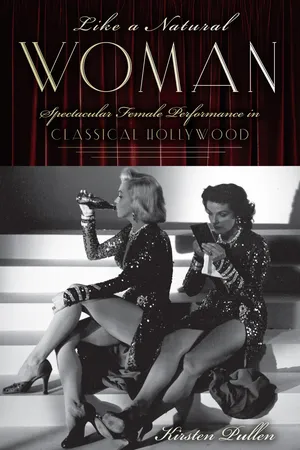
Bathing beauty Esther Williams, bombshell Jane Russell, exotic Carmen Miranda, chanteuse Lena Horne, and talk-show fixture Zsa Zsa Gabor are rarely hailed as great actors or as naturalistic performers. Those terms of praise are given to male stars like Marlon Brando and James Dean, whose gritty dramas are seen as a departure from the glossy spectacles in which these stars appeared. Like a Natural Woman challenges those assumptions, revealing the skill and training that went into the work of these five actresses, who employed naturalistic performance techniques, both onscreen and off.Bringing a fresh perspective to film history through the lens of performance studies, Kirsten Pullen explores the ways in which these actresses, who always appeared to be “playing themselves, ” responded to the naturalist notion that actors should create authentic characters by drawing from their own lives. At the same time, she examines how Hollywood presented these female stars as sex objects, focusing on their spectacular bodies at the expense of believable characterization or narratives.Pullen not only helps us appreciate what talented actresses these five women actually were, but also reveals how they sought to express themselves and maintain agency, even while meeting the demands of their directors, studios, families, and fans to perform certain feminine roles. Drawing from a rich collection of classic films, publicity materials, and studio archives, Like a Natural Woman lets us take a new look at both Hollywood acting techniques and the performance of femininity itself.
- 288 pages
- English
- ePUB (mobile friendly)
- Available on iOS & Android
eBook - ePub
Like a Natural Woman
About this book
Information
Chapter 1
Engineered for Stardom
Publicity, Performance, and Jane Russell
Jane Russell, Ashton Reid announced in Collier’s in 1945, is “queen of the motionless pictures.”1 Russell had worked on two films, The Outlaw and Young Widow, but neither had yet been widely released.2 Even so, she was better known than many starlets with films in wide release because of the countless pinups, magazine pictorials, billboards, and fan magazine articles generated by the publicist Russell Birdwell for her debut in Howard Hughes’s The Outlaw. By 1945, photographs of Russell had appeared in almost three dozen different magazines, often more than once;3 billboards supporting The Outlaw were posted in several cities; and gossip about her on-set behavior, her relationship with Howard Hughes, and her marriage to the star quarterback Bob Waterfield were fan magazine staples. According to Reid, Russell had “the best known feminine face in America,” she had appeared in more magazines than any other US woman, and “her biography had been published twice as often as that of the next Hollywood star.”4 Russell’s celebrity was arguably greater than her acting talents. Her career illuminates the important role of publicity in establishing naturalism as a commonplace understanding of how actors create roles and how celebrity is constructed and maintained, as well as how both may depend on a spectacular female body. Russell is a key case study not only because of the specifics of her career but also because of the ways in which that career followed the general outlines of all actresses’ during the Classical Hollywood era.
In 1941, when Russell was filming her debut as Rio McDonald in The Outlaw, Life magazine ran a three-page feature heralding her as “1941’s best new star prospect.” In fewer than five hundred words, the magazine communicates several essential points about Russell: she’s filming a Western and coincidentally grew up on a ranch; she was an ordinary office worker until Howard Hughes plucked her from obscurity and gave her a $1,000 wardrobe; and she has an astonishingly beautiful face and remarkable figure. Admitting that “whether Jane can act still remains to be seen . . . but . . . with her face and figure she doesn’t need to,”5 the text and photographs suture Russell’s biography to the familiar narrative of Hollywood starlets who suddenly discover that their physical attributes and natural personality are all they need to become successful performers. Russell’s Life photo essay correlates actor and role, lays the foundation for Russell’s sex symbol image, and offers readers behind-the-scenes footage of a working film set. As George Kouvaros points out in his important reading of the photographs taken by Magnum Agency photographers on the Misfits set, these kinds of publicity campaigns present “a series of meanings both connected to the drama occurring within the film and the historical context of its production.”6 Through their participation in a gendered narrative of stardom that elides women’s abilities to influence their film characters as well as their career trajectories, these photographs and text do more than just introduce a rising star. In important ways, they materialize links between actor and role, between persona and self, and between sexuality and performance through the body of Jane Russell/Rio.
Crucially, the photos demonstrate how and why Russell is a “natural” for the big screen. The essay includes eight photographs, the first a half-page shot of Russell in her “Mexican halfbreed” costume as Rio,7 lolling in the hay with her arms overhead and her beautiful bosom thrust forward. In another, Russell perches on a balcony. She’s in her street clothes (a light-colored blouse and skirt, dark flat shoes, and a leather belt with a silver Western buckle) and facing the camera, but the panoramic shot also includes the RKO-constructed Western town—complete with horses, stagecoach, and false-front buildings constructed among real scrub-covered hills and the vast horizon—where The Outlaw was shot. Read together, these two photographs place Russell in the film’s mise-en-scène: the more candid shot of Russell in the hay includes her costume, while the more formally posed photo features her in street clothes but within The Outlaw’s frame of reference.
The photo shoot also includes four close-ups of Russell’s face, used to bolster the magazine’s claim that she has a promising career. The first asserts that she has an “expressive face”; the second highlights her “excellent smile”; the next two document her “amused distaste” and “annoyance” eating “dried Hopi Indian corn.”8 These photos do not markedly differ from each other; whether she’s flashing her excellent smile or picking that annoying corn out of her teeth, she seems pleasant and cheerful. The captions, then, suggest that Russell’s face telegraphs a particular emotion and urge readers to interpret her nearly interchangeable expressions in particular ways.
There are two candid shots of Russell with her costars, which link Russell with her character. Walter Huston (Doc Holliday) and Jack Beutel (Billy the Kid) are anchored to the film through their costumes, while Russell is with their characters but dressed as “herself” (albeit in her new $1,000 wardrobe). This arrangement suggests that Russell is Rio, or at least connected to Doc and Billy, even when she’s not filming or rehearsing. These images, juxtaposing Russell in and out of costume and character, further collapse distinctions between herself (a self-described rough-riding Californian happiest on her family’s ranch) and Rio (the tough, brave, and earthy cowgirl).
As is the case with her character, Russell is either defined by her relationship with the two men or available as spectacle for the audience. Of course, this observation echoes Laura Mulvey’s influential assertion that women in Classical Hollywood exist for the viewing pleasure of the audience through identification with male protagonists and “can be said to connote to-be-looked-at-ness.”9 In her photo with Walter Huston (Holliday is Rio’s first lover), both have their backs to the camera as they stand next to an on-set horse corral. Though Huston is in costume, including his cowboy hat, Russell is in the street clothes she wore in the balcony shot. Her smiling face is turned toward the camera, and she appears to be listening intently to Huston, perhaps as the two discuss their characters or the film (or dinner). The final photo captures Russell with Jack Beutel, the other unknown actor plucked to star in Hughes’s film, in front of an adobe house. Beutel is in his Billy the Kid costume, featuring his silver-studded and fringed leather chaps, but Russell is in low-heeled cowboy boots, gabardine pants belted by that same Western belt, and a tight cotton sweater; she appears to be pinning up her hair.
This final shot is especially rich. Though out of costume in this shot, Russell is still marked as a “cowgirl.” As Michael Kirby points out in his seminal essay on the acting/not-acting continuum, “costume creates a ‘character.’” Coincidentally, he uses the example of a man dressed in Western clothes on a city street, suggesting that at some point “we see either a cowboy or a person dressed as (impersonating) a cowboy. The exact point on the continuum at which this specific identification occurs” differs according to context and audience response.10 Thus, following from Kirby, Russell is both in and out of costume in all of her photos and may be placed at different points on an acting continuum by Life’s readers. Second, Russell’s posture (prominent bosom, lowered chin, and hands behind her head with elbows pointing up and out) mirrors the opening photograph of Rio in the hay. Of course, photos of Rio in a haystack/Russell with her arms folded above her head quickly became ubiquitous as well as synonymous with The Outlaw, as Birdwell used similar images to suggest the “racy” content of the film. Kouvaros suggests that capturing stars in repeated poses, both in “candid” shots, official portraits, and gestures captured on film, “indicates . . . the disclosure of a biographical detail” and offers a particular intimacy and authenticity. Following from Kirby, while the iconography of the photo suggests a kind of (nonmatrixed) character for Russell, its content suggests a kind of (matrixed) performance. Finally, Kouvaros suggests that postwar actor photography as well as acting itself increasingly prized “absorption,” that is, an antitheatrical stance that suggests the performer is unaware of the audience.11 Defining theatricality as artificiality, Kouvaros demonstrates how representations of film acting increasingly linked actorly absorption on the film set with authentic performances on the cinema screen.
Naturalism functions by suggesting that an invisible “fourth wall” separates actors from the audience: what happens onstage is thus an authentic representation of what really occurs in living rooms, kitchens, diners, offices, hotels, and other spaces of modern life. In naturalist theater, the actors are of course aware of the audience, but they behave as though they are not. Publicity photos like the shots of Russell on the balcony and with Huston or Beutel telegraph this understanding of acting by presenting subjects who, as Kouvaros explains, “are aware of the photographer’s presence, yet everything about their bearing suggest an ability to direct their attention elsewhere.”12 Pinning up her hair, Russell indicates both a consciousness of the photographer (she echoes an earlier pose, and most young women—especially those who have worked as models—know that raising their arms over their heads makes their breasts look fuller) and an internal absorption (her hairpin-filled mouth and turned-away head suggest that she’s fully engaged in the private act of fixing her hair, something no lady did in public in 1941).
The photo essay, the first in a major national magazine, uses multiple strategies to imply that Jane Russell is a “natural” actress. Presenting her in and out of costume, it reinforces Russell’s nascent persona as a brash temptress. The Life article further suggests that Russell can act, through the shots of her smiling and eating Indian corn but especially through her absorption and internality. Jeanine Basinger’s popular history of the studio system, The Star Machine, argues that Classical Hollywood film acting is based on whether or not performers are “believable on screen.” Audiences look for authenticity in films as well as publicity images. Stars are created, Basinger argues, by merging character and performer so that roles seem to be “a secret peek into what that actor was really like.”13 Russell, like all the other actresses in this study, was subject to the machinations of the studio system and interpellated by its performance tropes. In this chapter, I use Russell’s public image in order to demonstrate publicity campaigns’ centrality to public perceptions of acting, performance, and identity. Then I focus on how two of Russell’s films, Gentlemen Marry Brunettes and The Fuzzy Pink Nightgown, directly engage studio-generated links between actor and role, illuminating both how gendered and how commonplace such assumptions were.
Becoming Jane Russell
Both Russell and many of her biographers agree that there were two Jane Russells (or four, if her breasts were counted separately, which they sometimes were): the glamorous, supremely sexual screen siren and the Pentecostal Christian. Born Ernestine Jane Geraldine Russell (named for her mother and maternal aunt) in 1921 to the daughter of Canadian immigrants living in Bemidji, Minnesota, Russell moved to California before she was a year old. Elder sister to four brothers, several of whom followed her into film work, she grew up on her family’s ranch in Van Nuys.14 When Russell was seventeen, her father died. According to her autobiography, Russell was a wild teenager, drinking and experimenting with sex. Pregnant at eighteen, she had an abortion, and though her high school football-star boyfriend, Bob Waterfield, believed the child was his, Russell claims she wasn’t sure.15 Waterfield went on to lead the UCLA Bruins to the 1943 Rose Bowl, and he and Russell married in April of that year. After a stint in the US Army Waterfield had a successful career as a pro football player, leading the Los Angeles Rams to three straight NFL championship games (1949–1951). He and Russell adopted three children: Thomas, an Irish toddler, and Tracy and Robert, both born in the United States. They divorced in 1967, after Waterfield began coaching for the Rams. In 1968 Russell married Roger Barrett, an actor she met while appearing in regional theater, but he died of a heart attack just three months after their marriage. In 1974 she married John Peoples, and they were together until his death in 1999. After the 1960s, when her film career declined, she eschewed publicity and public appearances, especially after Peoples’s death. She died from complications of a respiratory illness in 2011; she was eighty-nine.
It’s important to note that her autobiography, Jane Russell: My Path and My Detours (1985), focuses on her struggle to be a good Christian, her challenges as a wife and mother, and her relationship with her extended family and friends much more than on her career as an actress and certainly her reputation as a bombshell. Despite her tremendous religious faith (she claimed to have tried to “save” Marilyn Monroe), Russell struggled with depression and alcoholism, as well as a terrific temper. In her autobiography, she details several instances of physical altercations between her and Waterfield and admits they were unfaithful to each other. She became depressed and alcoholic after the death of her second and third husbands and entered an alcohol recovery center in 2002 at the urging of her children. A political conservative, she claimed in a 2003 interview that she was “a mean-spirited, right-wing, narrow-minded, conservative Christian bigot.”16 Russell’s self-presentation, then, represents her as a hardworking, often tested, conservative Christian housewife who happened to sing and make an occasional film rather than as a glamorous, luxury-loving movie star.
Of course, no one would be interested in Russell’s path or detours unless she was a movie star, and her autobiography also suggests that she was most happy (and sober) when she was working regularly, especially onstage or singing in nightclubs. After graduating from high school, she took acting classes at Max Reinhardt’s studio and with Maria Ouspenskaya at the Actors Lab, where she was trained in Stanislavsky technique. She also modeled for a photographer and worked as a receptionist in a chiropodist’s office. In her autobiography, Russell claims not to have pursued an acting career. Instead, Howard Hughes pursued her, casting her as the lead in The Outlaw and building its publicity campaign around her scantily clad and provocatively posed body. In 1954, after the success of Gentlemen Prefer Blondes (1953), for which she remains best known, Hughes signed her to a twenty-year, $1,000-a-week contract in exchange for six films with his studio, RKO Pictures.17 She made about a dozen films for RKO and other studios: films noir with Robert Mitchum (His Kind of Woman, 1951; Macao, 1952); Westerns (Young Widow, 1946; Montana Belle, 1952; Waco, 1966; Johnny Reno, 1966); the Bob Hope vehicles Paleface (1948) and Son of Paleface (1952); and two important dramatic films, The Tall Men (1955) and The Revolt of Mamie Stover (1956), with director Raoul Walsh. In 1955 she and Waterfield founded a production company, Russ-Field. Later that year Hedda Hopper reported that “professionally,” Russell was “divided three ways: Hughes sold three of her six-picture commitments to 20th Century–Fox,” and she would “make one annually for Hughe...
Table of contents
- Title Page
- Copyright Page
- Dedication
- Contents
- Preface
- Introduction: Playing Herself: The Naturalist Paradigm and the Spectacle of Female Sexuality
- Chapter 1. Engineered for Stardom: Publicity, Performance, and Jane Russell
- Chapter 2. More than a Mermaid: Esther Williams, Performance, and the Body
- Chapter 3. Light Egyptian: Lena Horne and the Representation of Black Femininity
- Chapter 4. Carnival!: Carmen Miranda and the Spectacle of Authenticity
- Chapter 5. Famous for Being Famous: Persona, Performance, and the Case for Zsa Zsa Gabor
- Notes
- Index
- About the Author
Trusted by 375,005 students
Access to over 1.5 million titles for a fair monthly price.
Study more efficiently using our study tools.
Frequently asked questions
Yes, you can cancel anytime from the Subscription tab in your account settings on the Perlego website. Your subscription will stay active until the end of your current billing period. Learn how to cancel your subscription
No, books cannot be downloaded as external files, such as PDFs, for use outside of Perlego. However, you can download books within the Perlego app for offline reading on mobile or tablet. Learn how to download books offline
Perlego offers two plans: Essential and Complete
- Essential is ideal for learners and professionals who enjoy exploring a wide range of subjects. Access the Essential Library with 800,000+ trusted titles and best-sellers across business, personal growth, and the humanities. Includes unlimited reading time and Standard Read Aloud voice.
- Complete: Perfect for advanced learners and researchers needing full, unrestricted access. Unlock 1.5M+ books across hundreds of subjects, including academic and specialized titles. The Complete Plan also includes advanced features like Premium Read Aloud and Research Assistant.
We are an online textbook subscription service, where you can get access to an entire online library for less than the price of a single book per month. With over 1.5 million books across 990+ topics, we’ve got you covered! Learn about our mission
Look out for the read-aloud symbol on your next book to see if you can listen to it. The read-aloud tool reads text aloud for you, highlighting the text as it is being read. You can pause it, speed it up and slow it down. Learn more about Read Aloud
Yes! You can use the Perlego app on both iOS and Android devices to read anytime, anywhere — even offline. Perfect for commutes or when you’re on the go.
Please note we cannot support devices running on iOS 13 and Android 7 or earlier. Learn more about using the app
Please note we cannot support devices running on iOS 13 and Android 7 or earlier. Learn more about using the app
Yes, you can access Like a Natural Woman by Kirsten Pullen in PDF and/or ePUB format, as well as other popular books in Mezzi di comunicazione e arti performative & Storia e critica del cinema. We have over 1.5 million books available in our catalogue for you to explore.