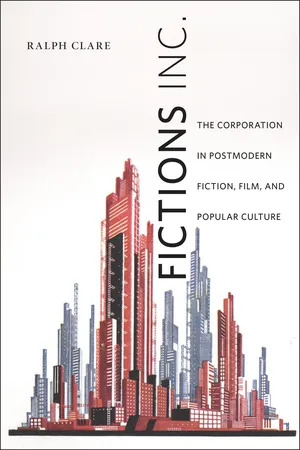
Fictions Inc. explores how depictions of the corporation in American literature, film, and popular culture have changed over time. Beginning with perhaps the most famous depiction of a corporation—Frank Norris’s The Octopus —Ralph Clare traces this figure as it shifts from monster to man, from force to “individual, ” and from American industry to multinational “Other.” Clare examines a variety of texts that span the second half of the twentieth century and beyond, including novels by Thomas Pynchon, William Gaddis, Don DeLillo, Richard Powers, and Joshua Ferris; films such as Network, Ghostbusters, Gung Ho, Office Space, and Michael Clayton; and assorted artifacts of contemporary media such as television’s The Office and the comic strips Life Is Hell and Dilbert. Paying particular attention to the rise of neoliberalism, the emergence of biopolitics, and the legal status of “corporate bodies, ” Fictions Inc. shows that representations of corporations have come to serve, whether directly or indirectly, as symbols for larger economic concerns often too vast or complex to comprehend. Whether demonized or lionized, the corporation embodies American anxieties about these current conditions and ongoing fears about the viability of a capitalist system.
- 262 pages
- English
- ePUB (mobile friendly)
- Available on iOS & Android
eBook - ePub
Fictions Inc.
About this book
Information
Topic
LetteraturaSubtopic
Critica letteraria1. California Dreaming: Twentieth-Century Corporate Fictions at the End of the Frontier
I thought IBM was born with the world,
The U.S. flag would float forever,
The cold opponent did pack away,
The capital will have to follow,
It’s not eternal, imperishable,
Oh yes it will go,
It’s not eternal, imperishable,
The dinosaur law
—Stereolab, “Wow and Flutter”
As the British pop group Stereolab reminds us, despite the “wow and flutter” of corporate capitalism’s neon signs and glittering commodities, it is not nearly as timeless and transcendent as it projects itself to be. It is a time-and-space-bound economic system that structures the world in particular ways and compels it to particular ends. In other words, before beginning an analysis of the ways in which American fiction and popular culture have figured corporations in the era of late capital, there needs to be not only a historicizing of this peculiar institution, the corporation, but also a historicizing of its fictional representations. So we need to ask, in what ways have representations of corporations changed in American fiction throughout the twentieth century, and how do the specific realities of corporate capitalism under which such texts are produced come to bear on those representations? To answer these questions we need to select two texts that can serve as representative of their historical periods but that also display some sort of preoccupation with American capitalism. Such a choice contains a certain element of arbitrariness and pretentiousness to it, granted, but the search itself is fairly limited by its own qualifications. Nonetheless, two texts stand out as exemplary for this project.
Frank Norris’s The Octopus comes to the fore for several reasons. First, the novel’s publication date (1901) makes it one of the earliest fictional takes on a burgeoning twentieth-century corporate capitalism. Second, the novel directly focuses on capital’s influence over social, cultural, and political life, and, even more compellingly, this focus is narrowed to a specific industry and corporation—the Railroad Trust and the Pacific and Southwestern Railroad (or P. and S.W., based on the Southern Pacific Railroad Corporation). Third, the novel is a chronicling of the 1880s amid the rough and heady days of industrialism, a key transitional time in the story of capital, and enables Norris to look forward as he looks back and to offer a fair prediction of capital’s expansion during the first half of the twentieth century.
Thomas Pynchon’s The Crying of Lot 49 is a novel similarly obsessed with exploring the malaise of its present (1966) with constant reference to the past, thus making the novel the perfect companion to Norris’s already “historicized” novel. Lot 49 also depicts a corporate monster set loose in sunny California, albeit a more chameleon-like creature than the one we encounter in The Octopus. And, like Norris’s novel, Pynchon’s is perched at an important moment in the story of capital, the dawning of the era of late capitalism, which saw the corporation emerge as perhaps the most dominant institution in the world. Pynchon calls attention to corporate capitalism’s increasingly deleterious effects on postmodern life: Lot 49 not only begins to question the emerging Corporate State, it also forecasts the possibilities of resisting it in the future.
Aesthetically speaking, these two works could not be any more different, and the same could be said about much of their content. But there is a major thematic strain that runs from the one to the other, and that is the (historical) preoccupation with American capitalism and, more specifically, the corporation. The fact that the aesthetic and representational strategies of each text are wildly divergent only lends support to the claim that economic forces, here corporate capitalism, have far-ranging and far-reaching effects. In turn, aesthetic possibilities and limitations prove to have a strong influence regarding how each text represents and figures the corporation.
This, in part, explains why it is possible to read The Octopus and Lot 49 as producing inverse responses to the sense of the (im)possibilities of resistance. At first reading, this much seems clear: capitalism in The Octopus, for all its devastation, contradictorily brings the world closer together (a nascent global capitalism) and therefore ups the chances of forming a resistant collective (The League). Even after the novel extinguishes each possible attempt to resist the system and reaches the ultimate space of despair by its end, it quickly exchanges this conclusion with a fantastic vision of triumph. Such negativity is flushed out and into the space of global capitalism, which in its immense promise can contain such anguish and doubts until they erupt at a future date.
In Lot 49, by contrast, an exhausted capitalist expansion has resulted in an unmappable, chaotic world, in which the subject is wholly alienated and the means and ends of political action obfuscated. The novel thus begins with the seemingly total inconceivability of resistance (Oedipa cannot imagine it or even care), builds to the ambiguous possibility of a resistance through the Tristero, and ends with an impending apocalyptic note of (Oedipa’s) despair as the lights go out in the auction house.
Yet while The Octopus appears the more optimistic novel and Lot 49 the more pessimistic one, the underlying logic suggests that the earlier novel’s (re)production of despair makes it a less hopeful novel than the guardedly optimistic Lot 49, which (re)produces the swirling political and cultural aspirations and anxieties of the 1960s. At the very least, Lot 49 can be argued to be ambivalent regarding the possibility of resistance by leaving open a space in which a “new” kind of resistance might emerge (the dispersed, more properly anarchic Tristero), whereas The Octopus, having foreclosed on all possibilities of resistance, retreats into questionable, if utopian, fantasies of global capital’s future. An extensive and rigorous comparison of these texts, then, uncovers such complex continuities and discontinuities in both the realities and representations of corporations from the early to late twentieth century in American fiction.
In an Octopus’s Garden
Frank Norris’s The Octopus stands as one of the earliest fictional representations of a corporation in American literature. The novel dramatizes the struggle between California wheat farmers and the railroads in the San Joaquin Valley during the late nineteenth century, specifically those farmers involved in the Mussel Slough Tragedy of 1880, in which five farmers and two marshals (themselves farmers working for the railroad) were killed in a shootout over land disputes. Norris employs the infamous metaphor of the octopus to suggest the scope and influence of the Southern Pacific Railroad Corporation at the time. As the novel’s poet-protagonist, Presley, imagines it, the railroad is a “vast symbol of power, huge, terrible, flinging the echo of its thunder over all the reaches of the valley, leaving blood and destruction in its path,” and it is a “leviathan, with tentacles of steel clutching into the soil, soulless Force, the iron-hearted Power, the monster, the Colossus, the Octopus” (51). Norris’s primary representative tentacle for the railroad arrives in the grossly adipose figure of S. Behrman, whose unctuousness enrages many of the farmers who must deal with the railroad’s shady maneuverings through Behrman on a day-to-day basis. Later in the novel, after the railroad has successfully ousted the farmers from their land, Presley finds himself in a chance meeting with the president and owner of the P. and S.W., Shelgrim, a man whose power and girth easily overshadow even Behrman’s impressive frame.
We have been warned about Shelgrim before, since he epitomizes “the New Finance, the reorganization of capital, the amalgamation of powers, the consolidation of enormous enterprises—no one individual was more constantly in the eye of the world; no one more hated, more dreaded” (104). When Presley, during a visit to San Francisco, stumbles onto the P. and S.W.’s headquarters, he sees the office as “the centre of all that vast ramifying system of arteries that drained the life-blood of the State; the nucleus of the web in which so many lives, so many fortunes, so many destinies had enmeshed” (569). Having witnessed firsthand the actual violent machinations of this sprawling corporation, he decides, “Why not see, face to face, the man whose power was so vast, whose will was so resistless, whose potency for evil so limitless, the man who for so long and so hopelessly they had all been fighting” (570). Following this urge, an excited Presley enters the building and, although the hour is late, finds that Shelgrim is still working and will see him shortly.
Before Presley enters Shelgrim’s office, however, we might pause to consider the symbolism of this particular scene. If the railroad corporation is a kind of steel octopus, with a limitless reach, a “vast” influence, and whose tentacles suck the life-blood from the people and the land, then there arises the difficulty of ever confronting such a malevolent force, let alone challenging it. The only solution would be to find the head and chop it off, as it were. Hacking away at the mere tentacles, the novel suggests, is a futile endeavor, as hopeless as if Hercules were to slice off the Hydra’s heads without searing each of its necks with a torch afterward. What Presley realizes while waiting nervously outside Shelgrim’s office is that he has the chance to meet with this monster in the hideous flesh and demand accountability for the traumatic events that so recently have transpired in the San Joaquin Valley. Presley is depressed by this point in the novel, disillusioned by the real-life defeat of the vaunted farmer / common man he celebrated in his successful populist poem “The Toilers.” A visit with Shelgrim, then, and a discussion with the man responsible for all the senseless violence, should be nothing short of a catharsis. It is with such a belief that Presley is ushered into Shelgrim’s office and seated in front of the man’s desk.
Norris makes the overarching metaphor of the novel significantly tangible at this point and transfigures Shelgrim into the octopus itself: “Curiously enough, Shelgrim did not move his body. His arms moved, and his head, but the great bulk of the man remained immobile in its place, and as the interview proceeded, this peculiarity emphasised itself, Presley began to conceive the odd idea that Shelgrim had, as it were, placed his body in the chair to rest, while his head and brain and hands worked independently” (574). But Presley’s preconceptions of Shelgrim are shattered. The man shows tolerance and charity toward a wayward alcoholic employee, and he criticizes Presley’s poetry as second-rate. Presley finds that “the man was not only great, but large; many sided, of vast sympathies” (575). When Presley tries to articulate his scorn for Shelgrim, he is silenced and instead receives an admonishing lecture on the forces unleashed by capitalism. Shelgrim tells him, “Try to believe this—to begin with—that Railroads build themselves. Where there is demand sooner or later there will be supply. Mr. Derrick, does he grow his wheat? The Wheat grows itself. What does he count for? Does he supply the force? What do I count for? Do I build the Railroad? You are dealing with forces, young man, when you speak of Wheat and Railroads, not with men. . . . The Wheat is one force, the Railroad, another, and there is the law that governs them—supply and demand. Men have only little to do in the whole business” (576). Presley’s reply that Shelgrim is the “head” of this business and therefore can control it elicits a similar response from the president: “I can not control it. It is a force born out of certain conditions, and I—no man—can stop it or control it” (576).
Shelgrim’s rhetoric demonstrates a complex mix of conscious deception and unconscious revelation. Marx, for instance, would have little to disagree with in Shelgrim’s assertion of the “forces” that capitalism unleashes in its transformation of nature (itself a producer) into a commodity, and money into capital. If we were to replace “the Railroad” here with “capital,” then we would be left with a fair description of what capitalism does and is impelled to do, making it clear why no individual can halt such a force. As Marx puts it in Capital, “In so far as he [the capitalist] is capital personified, his motivating force is not the acquisition and enjoyment of use-values, but the acquisition and augmentation of exchange-values.” Consequently, “Only as a personification of capital is the capitalist respectable. As such, he shares with the miser an absolute drive towards self-enrichment. But what appears in the miser as the mania of an individual is in the capitalist an effect of a social mechanism in which he is merely a cog. . . . Competition subordinates the individual capitalist to the immanent laws of capitalist production, as external and coercive laws. It compels him to keep extending his capital, so as to preserve it, and he can only extend it by means of progressive accumulation” (739). Shelgrim is right, at least in one sense, about his own impotence in the face of such overwhelming forces. To embrace the logic of capital means one must subscribe to it wholly, not in part.
However, Shelgrim’s total denial of any responsibility for the process is also a dissemblance for two reasons. First, to swear off accountability for the initial choice that subsequently binds one to the rollercoaster of capitalism is to mystify that original decision. Certainly, Shelgrim is a cog in the capitalist machine, but he is a cog larger (literally) than most, one that assures the greasing of other wheels and cogs and institutes the most cutthroat of tactics when dealing with the farmers. Second, Shelgrim’s appeal to forces such as “supply and demand” obfuscates how a supposedly “free” market actually works.1 The forces “born out of certain conditions” and the organic metaphors of growth presume that capitalism is a “natural” force and not a force emerging from historically particular circumstances—the industrial revolution, the ideology of Manifest Destiny, free-market and monopoly capitalism, for instance. Shelgrim’s naturalized view that “railroads build themselves” is meant to cut off a proper systemic analysis of capital by equating it with the uncontrollable force of nature.
Presley’s reaction to this speech is significant in that it shows how persuasive Shelgrim’s words are. Even though Presley came into the office with every intention of achieving some kind of justice, he is easily swayed by Shelgrim’s speech. He leaves with the feeling that
somehow he could not deny it. It rang with the clear reverberation of truth. Was no one, then, to blame for the horror at the irrigating ditch. Forces, conditions, laws of supply and demand—were these then the enemies, after all? Not enemies; they were malevolence in Nature. Colossal indifference only, a vast trend toward appointed goals. Nature was, then, a gigantic engine, a vast cyclopean power, huge, terrible, a leviathan with a heart of steel, knowing no compunction, no forgiveness, no tolerance; crushing out the human atom standing in its way, with nirvanic calm, the agony of destruction sending never a jar, never the faintest tremor through all that prodigious mechanism of wheels and cogs. (577)
Presley’s tentative flirtation with the radical political movements of the day has not prepared him to combat Shelgrim’s dogma and its curious translation of Marx’s ideas. This is perhaps Norris’s doing, whose Naturalist credo with its attendant “Social Darwinism” is itself an ideology ripe for use by the Left or the Right. If in Naturalism nature always trumps nurture, then a (mis)reading of Marx’s ideas about productive forces and capital’s potential to unleash ever-greater forces can easily fall in line with the doom-and-gloom notion that man is wholly determined by his biological drives, which are ultimately hard-wired by Nature itself.2 The “law of supply and demand” becomes a holy commandment that cannot be historicized or critiqued in this view, as it is by necessity launched to the status of a transcendental signifier through which all other (natural) signs will be interpreted for their truth value.
But Norris is doing something else here as well, something as progressive as the seemingly “regressive” reading of a too-deterministic Marx refracted through Émile Zola’s Naturalism. The suggestion of the physical scope and influence of corporate power, while it pessimistically “naturalizes” it, also prefigures the state of the corporation in the era of late capital, particularly when Presley confronts the “head” of this cephalopod. What Shelgrim tells him is that there is essentially no head or center to the railroad corporation, that such an idea is absurd. Presley’s urge to sum up the power of the corporation, or of capital, in the figure of one man is understandable but impossible. A solution such as this would be too easy and would make it seem as if the logic of capital were subject merely to the personality quirks of its leading practitioners. The fact that capital is becoming more decentralized as it spreads is precisely what Norris is intimating here, and it is what makes capital in the era of multinational corporations so much more slippery than it was in Norris’s time. In short, the despair Presley feels at the end of the nineteenth century toward an ever-disseminating capitalism is a kind of despair avant le lettre, not to come into its fullest expression until the new century saw capitalism develop into a more mature and properly global system.
Given the novel’s suggestion of an endlessly expanding capitalism, The Octopus recognizes that resisting the system is no easy task. Yet as capital incessantly restructures the world, it inadvertently creates new opportunities to combat it. Nowhere is this clearer than in the wheat farmers’ purchase of a “ticker” that connects the San Joaquin ranchers “by wire with San Francisco, and through that city with Minneapolis, Duluth, Chicago, New York, and at last, and most important of all, with Liverpool” (54) and that figures as the key technological innovation that will bring the global reaches of capital to light. The result is that the farmers tend to the up-to-the-minute market information as much as they do their crops and that “at such moments they no longer felt their individuality. The ranch became merely the part of an enormous whole, a unit in the vast agglomeration of wheat land the whole world round, feeling the effects of causes thousands of miles distant—a drought on the prairies of Dakota, a rain on the plains in India, a frost on the Russian steppes, a hot wind on the llanos of the Argentine” (54). What is curious about Norris’s keen description of an emerging global capitalism here is that the very vastness of the world economic system with its far-reaching repercussions constitutes some kind of new totality where we would expect the individual’s sense of this totality to be shattered by such a realization. Perhaps this is a result, again, of Norris’s Naturalism, which sharply diverges from the soon-to-be modernist texts that embraced, in both form and content, fragmentation, rupture, and dislocation as the century’s new aesthetic and zeitgeist. The new telecommunications connecting the farmers to the world economy robs them of their individuality yet replaces that loss with some wider, and not necessarily worse, sense of collective spirit. Though they are “merely a part” and a “unit,” the farmers still form a “they” and “part of an enormous whole” that is linked by the imagery of nature. Norris falls short of the modernist character’s existential crisis in his depiction of the farmers, for the seemingly fragmented world merely morphs from prairie to plain to steppe to llano. The earth retains a sense of wholeness throughout, which is guaranteed by an enduring Nature.
This new potential collectivity blooms when the farmers’ legal fight to retain their land and purchase it at the original price “promised” by the railroad is stymied at every turn by a corrupt legal system “owned” by the Trust. In response to the railroad’s increasing squeeze on their finances, the enraged farmers hold an emergency meeting and ...
Table of contents
- Title Page
- Copyright Page
- Contents
- Acknowledgments
- Introduction: From Manchuria to Manchuria Inc.
- 1. California Dreaming: Twentieth-Century Corporate Fictions at the End of the Frontier
- 2. “Domo Arigato, Mr. Sakamoto, for the New Non-Union Contract!”: (Multi)national Threats and the Decline of the American Auto Industry in Ron Howard’s Gung Ho
- 3. Good Times, Bad Times . . . You Know I Had My Share(s): The Corporation in Five Popular Films
- 4. A Capital Death: Medicine, Technology, and the Care of the Self in Don DeLillo’s White Noise
- 5. Family Incorporated: William Gaddis’s J R and the Embodiment of Capitalism
- 6. Your Loss Is Their Gain: The Corporate Body and the Corporeal Body in Richard Powers’s Gain
- Conclusion: Corporate Hegemony, Cubed
- Notes
- Works Cited
- About the Author
Trusted by 375,005 students
Access to over 1.5 million titles for a fair monthly price.
Study more efficiently using our study tools.
Frequently asked questions
Yes, you can cancel anytime from the Subscription tab in your account settings on the Perlego website. Your subscription will stay active until the end of your current billing period. Learn how to cancel your subscription
No, books cannot be downloaded as external files, such as PDFs, for use outside of Perlego. However, you can download books within the Perlego app for offline reading on mobile or tablet. Learn how to download books offline
Perlego offers two plans: Essential and Complete
- Essential is ideal for learners and professionals who enjoy exploring a wide range of subjects. Access the Essential Library with 800,000+ trusted titles and best-sellers across business, personal growth, and the humanities. Includes unlimited reading time and Standard Read Aloud voice.
- Complete: Perfect for advanced learners and researchers needing full, unrestricted access. Unlock 1.5M+ books across hundreds of subjects, including academic and specialized titles. The Complete Plan also includes advanced features like Premium Read Aloud and Research Assistant.
We are an online textbook subscription service, where you can get access to an entire online library for less than the price of a single book per month. With over 1.5 million books across 990+ topics, we’ve got you covered! Learn about our mission
Look out for the read-aloud symbol on your next book to see if you can listen to it. The read-aloud tool reads text aloud for you, highlighting the text as it is being read. You can pause it, speed it up and slow it down. Learn more about Read Aloud
Yes! You can use the Perlego app on both iOS and Android devices to read anytime, anywhere — even offline. Perfect for commutes or when you’re on the go.
Please note we cannot support devices running on iOS 13 and Android 7 or earlier. Learn more about using the app
Please note we cannot support devices running on iOS 13 and Android 7 or earlier. Learn more about using the app
Yes, you can access Fictions Inc. by Ralph Clare in PDF and/or ePUB format, as well as other popular books in Letteratura & Critica letteraria. We have over 1.5 million books available in our catalogue for you to explore.