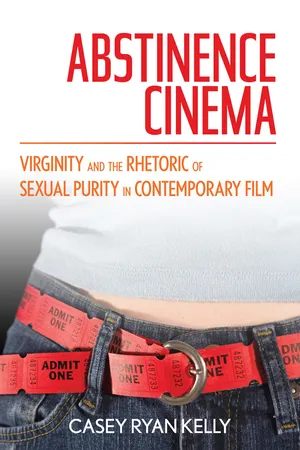
From the perspective of cultural conservatives, Hollywood movies are cesspools of vice, exposing impressionable viewers to pernicious sexually-permissive messages. Offering a groundbreaking study of Hollywood films produced since 2000, Abstinence Cinema comes to a very different conclusion, finding echoes of the evangelical movement’s abstinence-only rhetoric in everything from Easy A to Taken. Casey Ryan Kelly tracks the surprising sex-negative turn that Hollywood films have taken, associating premarital sex with shame and degradation, while romanticizing traditional nuclear families, courtship rituals, and gender roles. As he demonstrates, these movies are particularly disempowering for young women, concocting plots in which the decision to refrain from sex until marriage is the young woman’s primary source of agency and arbiter of moral worth. Locating these regressive sexual politics not only in expected sites, like the Twilight films, but surprising ones, like the raunchy comedies of Judd Apatow, Kelly makes a compelling case that Hollywood films have taken a significant step backward in recent years. Abstinence Cinema offers close readings of movies from a wide spectrum of genres, and it puts these films into conversation with rhetoric that has emerged in other arenas of American culture. Challenging assumptions that we are living in a more liberated era, the book sounds a warning bell about the powerful cultural forces that seek to demonize sexuality and curtail female sexual agency.
- 210 pages
- English
- ePUB (mobile friendly)
- Available on iOS & Android
eBook - ePub
Abstinence Cinema
About this book
Information
1
Melodrama and Postfeminist Abstinence
The Twilight Saga (2008–2012)
In Our Vampires, Ourselves, Nina Auerbach writes that “every age embraces the vampire it needs.”1 In other words, vampires are protean figures who—from Gothic literature to contemporary film and television—are continually remolded to reflect the fears and desires of a particular age. Banished from the daytime, forced to sleep in coffins and subsist on human blood in relative exile, the Gothic vampire symbolized a range of dark desires associated with social exclusion and sexual deviance. Most notably, the vampire’s penetrating fangs and hypnotic charisma were masked articulations of sexual transgressions and taboo desires that could not be named in the context of nineteenth-century public morality.2 Eugenia DeLamotte argues that the implicit sexual terror of vampirism was “the threat of physical violation—a transgression against the body, the last barrier protecting the self from the other.”3 If vampirism in the Victorian era reflected the historical period’s latent curiosity about illicit sexual desires, then what do the newly beautified, Americanized, and wholesome vampires of the Twilight films say of sexuality in contemporary American culture?
Forced to embody both traditional morality and contemporary sex appeal, the makeover of the cinematic vampire in the Twilight films exemplifies and attempts to resolve the ongoing tension between the prurient interests of popular culture and conservative nostalgia for traditional Victorian morality. In this chapter, I contend that the wholesome update of the vampire reflects the growing influence of conservative voices that have adjusted their strategy for recruiting youth to present chastity as sexy, ritual courtship as hip, and chivalry and purity as romantic. Moreover, abstinence proponents assert that young women’s pursuit of “Prince Charming” and a fairy-tale marriage are more fulfilling than dating and a career.4 As a bellwether of sexual attitudes, the popular mainstreaming of socially conservative vampires marks the abstinence movement’s efforts to domesticate illicit sexuality by making what was old new again. This new conservative vampire registers the abstinence movement’s appropriation of postfeminist ideals to rebrand attachments to Victorian morality as the new sexual revolution.
Through an examination of the neotraditional vampires of the Twilight films, this chapter uncovers the tropes that have helped abstinence advocates rebrand chastity and ritual courtship as chic, edgy, and even “cool.” The films enact a postfeminist melodrama in which the pursuit of feminine purity is the only safe and morally virtuous pathway to personal empowerment.
Grossing over $3.3 billion to date, the Twilight saga is the most successful series of vampire films and one of the most successful movie franchises in the history of Hollywood.5 The films were adapted from Stephenie Meyer’s successful young-adult books of the same name, which have sold one hundred and sixteen million copies worldwide as of 2015 and have been translated into more than thirty different languages.6 Meyer’s novels and their film adaptations—Twilight (2008), New Moon (2009), Eclipse (2010), Breaking Dawn 1 (2011), and Breaking Dawn 2 (2012)—are part of a broader cultural revitalization of the vampire that unburdens the supernatural creature of its once hideous and malevolent past. In company with Charlaine Harris’s Southern Vampire Mysteries and its adaptation in the HBO series True Blood (2008–2014), the twenty-first-century vampire has gone mainstream. In part, the popularity of Twilight rests with a refurbished vampire who ditched the cape and the crypt for luxury cars, fit physiques, and contemporary couture. The new vampire is sexy and fashionable and even desires genuine romantic relationships with humans. Although they retain their dangerous edge, the vampires of Twilight are wholesome and beautiful companions of humankind that are no longer constrained by their affliction.
The Twilight saga chronicles the torrid romance of seventeen-year-old Isabella (Bella) Swan (Kristen Stewart) and 109-year-old Edward Cullen (Robert Pattinson), a vampire masquerading as a high school student in the small town of Forks, Washington. The films depict the travails of their courtship, with special emphasis on Edward’s attempts to control his thirst and protect Bella’s life and virtue from both human and supernatural forces. Their interspecies romance is made possible only by the mutual repression of their desires: Edward’s thirst for human blood and Bella’s desire for sexual intimacy. Like most literary vampires, Edward is physically powerful and controlling. While these attributes typically render vampires terrifying, in Twilight they are employed to make what is otherwise a very traditional courtship ritual seem dangerous but exhilarating.
Twilight presents a dramatic shift in the vampire narrative, one that is perhaps well suited for a sexually regressive political landscape. It shares more in common with Victorian novels such as Wuthering Heights, Jane Eyre, and Pride and Prejudice than it does with Bram Stoker’s Dracula (1897) or Anne Rice’s Interview with the Vampire (1976). In the Twilight saga, the members of the Cullen vampire family drive expensive cars and live in a luxurious home.7 The Cullens are beautiful, popular, and perpetually young. And while these new vampires retain much of their physical prowess and supernatural power, they control their thirst by feeding only on animals. Instead of fearing the daytime, the Cullens seem to revel in it, and their skin shines like diamonds in the sunlight. Indeed, the only thing “old” about the new vampire is their morality. Sexy as he may be, Edward is a Victorian gentleman who believes in monogamy, true love, and sexual abstinence until marriage. As audiences learn through his courtship of Bella, the new vampire is the hip, youthful custodian of a much older and traditional sexual morality. Twilight, then, transforms vampirism from an exploration of dark and illicit desires to a celebration of sexual repression and heterosexual romance. If the vampire is indeed a malleable figure who symbolizes the state of a culture’s sexual politics, Twilight’s new vampire marks a transition from sexual liberation to liberation from sexuality. Given the series’ immense popularity and zealous fandom, the Twilight saga is an ideal set of cinematic texts through which to explore the revival of the old traditionalism (sexual abstinence, traditional motherhood, male chivalry) at work in new forms that embody both sex appeal and a youth sensibility of “cool.”
A critical analysis of the Twilight films illustrates that the mystery and sex appeal of the new vampire thinly veil a nostalgic fantasy of a world sanitized of illicit sexual desire and stabilized by heterosexual marriage, chivalry, and the traditional nuclear family. As a postfeminist melodrama, the series illustrates the odd confluence of abstinence culture (symbolized by the Cullen family) and postfeminist conceptions of female empowerment (represented by the illusory set of choices available to Bella). Although Twilight depicts a moderately empowered female protagonist who is vested with decision-making power, Bella is presented with dilemmas in which the only reasonable or desirable alternative is to embrace the inevitability of patriarchy or participate in her own subjugation. Whereas sexual abstinence and traditional marriage offer romance, true love, family, economic mobility, protection against illicit desires, and perpetual youth, feminism is portrayed as moribund. Put differently, sex outside marriage, careerism, independence, and personal autonomy are all associated with atrophy, death, and dystopianism. At the same time, the film’s conflation of choice with empowerment elevates Bella’s embrace of purity and traditionalism to a more successful and fulfilling model of feminist politics.
Thus far, many feminist scholars and popular critics have focused on the Twilight saga’s religiously conservative undertones and implicit valorization of abstinence until marriage. I agree with many of these assessments. However, the films’ abstinence rhetoric is at its core a rejection of the structure and norms of contemporary society itself, particularly for women. Bella’s romantic union with the Cullen family symbolizes a utopian fantasy that lurks within abstinence culture, wherein a retreat to the traditional family offers a remedy for a human society that is dangerous, sinful, and ultimately disappointing. In this world, abstinence until marriage is preparation for a domestic life in which women’s sexual desires and personal autonomy are confined within the structure of the neotraditional family. In the Twilight saga, vampires no longer represent illicit sexual desire but instead offer a reprieve from a society polluted by desire and destabilized by feminism. Bella’s retreat from public life is well compensated: a romantic world filled with enchantment, beautiful ageless bodies, conspicuous consumption, unbound economic mobility, and of course familial immortality. Sexual abstinence in the Twilight films becomes sutured to a much larger political vision: returning to a nostalgic world before feminism, sexual liberation, and secularism disturbed the once-rigid boundaries between the public and domestic spheres. The Twilight saga is so significant because the films’ utopian vision constitutes the symbolic markers of sex appeal and female empowerment that it ultimately undermines. Pro-abstinence messages in the Twilight saga leave audiences with an illusory choice between a public and autonomous life that ends in death and a barricaded world of romance and perpetual adolescence.
The Structure of the Twilight Universe
The Twilight saga consists of five adapted screenplays written by television producer Melissa Rosenberg in consultation with the series’ original novelist, Stephenie Meyer. Much like other serial adaptations such as the Harry Potter and Hunger Games series, financial incentives to continue the lucrative franchise resulted in a turnover of directors, who included Catherine Hardwick (Twilight), Chris Weitz (New Moon), David Slade (Eclipse), and Bill Condon (Breaking Dawn 1 and 2).8 While there are many minor differences between the novels and films, the fundamental narrative remains intact.9
Ultimately, the narrative follows a traditional heterosexual romance that proceeds from friendship and courtship through engagement, marriage, and reproduction. But Bella and Edward’s relationship produces two significant tensions that drive the narrative forward. First, Bella’s essential human traits are a constant liability to both herself and the Cullen family. For vampires, Bella is an inexplicably unique specimen. Unlike other humans, Bella’s blood is intoxicating. Thus, bringing her into contact with other, less refined vampires is a unique risk to her safety and to the Cullen family. While the easy solution would be to “turn” Bella, Edward finds the corruption of her soul and virtue to be a selfish and unacceptable outcome. As a Victorian gentleman, Edward engages in constant self-loathing and expresses ambivalence concerning his feelings for Bella. He suggests that the only way he can protect Bella is to be with her, yet he finds himself to be a constant danger to her moral and physical well-being. At some moments he is compassionate and loving, while at others he is manipulative, distant, and even abusive. Convinced that he is a danger to Bella, Edward and his family temporarily relocate to Volterra, Italy, where Edward can watch Bella from a distance. Their relationship is overwrought with references to Shakespeare’s Romeo and Juliet and motifs of “star-crossed lovers,” including (failed) suicide attempts by both Edward and Bella upon hearing false reports of each other’s death.
Once Edward resolves to return to Forks and continue his courtship of Bella, the two reach a grand bargain in which Edward will “turn” Bella and consummate their relationship if she agrees to marry him. Bella consents, but only if she can experience sexual intimacy after their marriage but before her transformation. Despite the supposed physiological impossibilities, Bella’s human traits betrays her yet again when she becomes pregnant with Edward’s child during their honeymoon. Edward is forced to transform Bella during childbirth to save her from the parasitic vampire-child inside her womb. Although Bella survives childbirth, the half-human, half-vampire child amplifies the tensions between humans and the vampire orthodoxy. For the vampire monarchy in Volterra, vampire children are an abomination because they cannot control their thirst and are incapable of camouflaging their vampiric existence from humans. Although Bella invites dangerous if not mortal conflict between the Cullens and the vampire authority, her daughter is born with the supernatural power to foster insight, perspective, and peaceful unity among the individuals she touches. The child’s residual human traits and supernatural power help avert a final apocalyptic battle between the Cullens and their allies and the Volterra monarchy.
Second, Bella and Edward’s romance exacerbates (but ultimately resolves) long-standing tensions between supernatural forces. Forks is the site of a tenuous truce between the Cullens and the Quileute Indian tribe, a pack of shape-shifting werewolves who have a historic hatred of vampires. Jacob Black (Taylor Lautner), a Quileute member, jeopardizes this tacit peace by pursuing a romantic relationship with Bella. Although Bella eventually chooses Edward, throughout the first four films she is torn between a mortal life with a warm-blooded wolf and an undead but immortal existence with a cold-blooded vampire. Edward and Jacob struggle not only for Bella’s love but also for the right to protect her from malevolent vampires. The birth of Bella’s daughter, however, resolves the tensions between the Cullens and the Quileutes by creating a shared interest in the child’s salvation. Jacob “imprints” on Bella’s daughter, which he describes as an involuntary form of coupling whereby wolves commit themselves to another in either a romantic or familial sense. Reflecting the “true love waits” trope, imprinting requires that Jacob delay consummating their romantic courtship until Nessie is ready for marriage. Thus, Bella’s child not only gives Bella strength and purpose but also guarantees a consolatory romantic relationship for Jacob while bringing peace to the supernatural world.
The Twilight Phenomenon
Since the early success of German expressionist films such as Nosferatu (1922) and Vampyr (1932), Hollywood productions such as Dracula (1931) and Mark of the Vampire (1935), and the formulaic horrors created by Hammer Film Productions such as The Horror of Dracula (1958), vampires have evolved into iconic cinematic monsters.10 Many scholars of horror films note that because vampires tend to embody threatening and taboo desires, they are always in transition.11 In other words, vampires evolve to reflect transformations in political and cultural attitudes toward gender and sexuality. By and large, celluloid vampires have maintained their Gothic transgressiveness throughout popular films such as Martin (1978), Nosferatu the Vampyr (1979), Fright Night (1985), Once Bitten (1985), Vamp (1986), Near Dark (1987), The Lost Boys (1987), Bram Stoker’s Dracula (1992), Interview with the Vampire (1994), Blade (1998), Shadow of the Vampire (2000), Queen of the Damned (2002), Let the Right One In (2008), and Abraham Lincoln: Vampire Hunter (2012) and in television series such as Dark Shadows (1966–1971) and Buffy the Vampire Slayer (1997–2003).
The Twilight saga is remarkable for its transformation of vampires from what Auerbach calls the “hideous invaders of the normal” to icons of the conservative institutions and ideologies they once menaced.12 William Day explains that this reversion is made possible by subtle changes in the vampire narrative over the past thirty years from revulsion to exhilarating fascination. He writes, “The central event in vampire stories over the last thirty years is the vampire’s transformation from monster or object of covert fascination into a protagonist embodying our utopian aspirations to freedom, self-acceptance, self-expression, and community outside the restrictions and limitations of conventional middle-class American society.”13 Although they remained terrifying outsiders, post-sexual-revolution vampires began to offer audiences liberation from their repressed desires. This growing sense of audience identification with vampire protagonists also made it possible for the pendulum to swing in the other direction. As vampires lost their status as transgressive and irredeemable outsiders, they became easier to enlist in the project of propping up mainstream hegemonic institutions. As a result, the Twilight films have been able ...
Table of contents
- Title Page
- Copyright Page
- Dedication
- Contents
- Acknowledgments
- Introduction: The Cinema of Abstinence
- Chapter 1. Melodrama and Postfeminist Abstinence: The Twilight Saga (2008–2012)
- Chapter 2. Man-Boys and Born-Again Virgins: The 40-Year-Old Virgin (2005)
- Chapter 3. Monstrous Girls and Absentee Fathers: The Possession (2012)
- Chapter 4. Abstinence, the Global Sex Industry, and Racial Violence: Taken (2008)
- Chapter 5. Sexploitation in Abstinence Satires
- Conclusion: Counternarratives
- Notes
- Filmography
- Bibliography
- Index
- About the Author
Trusted by 375,005 students
Access to over 1.5 million titles for a fair monthly price.
Study more efficiently using our study tools.
Frequently asked questions
Yes, you can cancel anytime from the Subscription tab in your account settings on the Perlego website. Your subscription will stay active until the end of your current billing period. Learn how to cancel your subscription
No, books cannot be downloaded as external files, such as PDFs, for use outside of Perlego. However, you can download books within the Perlego app for offline reading on mobile or tablet. Learn how to download books offline
Perlego offers two plans: Essential and Complete
- Essential is ideal for learners and professionals who enjoy exploring a wide range of subjects. Access the Essential Library with 800,000+ trusted titles and best-sellers across business, personal growth, and the humanities. Includes unlimited reading time and Standard Read Aloud voice.
- Complete: Perfect for advanced learners and researchers needing full, unrestricted access. Unlock 1.5M+ books across hundreds of subjects, including academic and specialized titles. The Complete Plan also includes advanced features like Premium Read Aloud and Research Assistant.
We are an online textbook subscription service, where you can get access to an entire online library for less than the price of a single book per month. With over 1.5 million books across 990+ topics, we’ve got you covered! Learn about our mission
Look out for the read-aloud symbol on your next book to see if you can listen to it. The read-aloud tool reads text aloud for you, highlighting the text as it is being read. You can pause it, speed it up and slow it down. Learn more about Read Aloud
Yes! You can use the Perlego app on both iOS and Android devices to read anytime, anywhere — even offline. Perfect for commutes or when you’re on the go.
Please note we cannot support devices running on iOS 13 and Android 7 or earlier. Learn more about using the app
Please note we cannot support devices running on iOS 13 and Android 7 or earlier. Learn more about using the app
Yes, you can access Abstinence Cinema by Casey Ryan Kelly in PDF and/or ePUB format, as well as other popular books in Mezzi di comunicazione e arti performative & Storia e critica del cinema. We have over 1.5 million books available in our catalogue for you to explore.