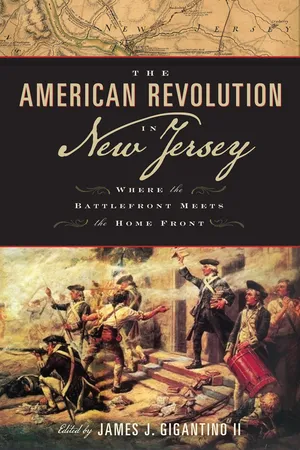
Battles were fought in many colonies during the American Revolution, but New Jersey was home to more sustained and intense fighting over a longer period of time. The nine essays in The American Revolution in New Jersey, depict the many challenges New Jersey residents faced at the intersection of the front lines and the home front.
Unlike other colonies, New Jersey had significant economic power in part because of its location between the major ports of New York and Philadelphia. New people and new ideas arriving in the colony fostered tensions between Loyalists and Patriots that were at the core of the Revolution. Enlightenment thinking shaped the minds of New Jersey’s settlers as they began to question the meaning of freedom in the colony. Yeoman farmers demanded ownership of the land they worked on and members of the growing Quaker denomination decried the evils of slavery and spearheaded the abolitionist movement in the state. When larger portions of New Jersey were occupied by British forces early in the war, the unity of the state was crippled, pitting neighbor against neighbor for seven years.
The essays in this collection identify and explore the interconnections between the events on the battlefield and the daily lives of ordinary colonists during the Revolution. Using a wide historical lens, the contributors to The American Revolution in New Jersey capture the decades before and after the conflict as they interpret the causes of the war and the consequences of New Jersey’s reaction to the Revolution.
- 222 pages
- English
- ePUB (mobile friendly)
- Available on iOS & Android
eBook - ePub
The American Revolution in New Jersey
About this book
Information
Part One
A Revolutionary Experience
1
A Disproportionate Burden on the Willing
William L. Kidder
The militia system in effect during the American Revolution ensured that the battlefront met the home front of virtually every New Jersey family that did not actively oppose the Patriot cause. The dramatic impact on daily life was most notably seen in the experiences of families of the militiamen of the First Hunterdon County Regiment, who lived in what is today part of Mercer County in the city of Trenton, north of the Assunpink Creek, and the adjoining townships of Ewing, Lawrence, and Hopewell. These militiamen were expected to keep the economy going strong by farming, producing goods as craftsmen, and engaging in other economic activity while at the same time turning out for militia duty so frequently that they began to feel like full-time soldiers. Not surprisingly, they could perform neither task very well and were roundly criticized for their failures.
Each of the English colonies, from their earliest days of settlement, set up militia systems for local defense based on the ancient concept that all free residents of a community had a moral obligation to defend it from invaders. However, the variety of cultures and geographical situations throughout the thirteen colonies produced variations in militia preparedness. In the absence of significant outside threats to local communities during New Jersey’s colonial period, the militia laws were not taken seriously by the residents and not strictly enforced by the legislature. On the eve of the Revolution, New Jersey would have been hard pressed to assemble a militia army such as the one that confronted the British in Massachusetts in the spring and summer of 1775.1
Like Massachusetts, though, New Jersey had experience forming extralegal militias to seek redress of grievances, especially the property rights of local farmers. When conflicting claims over land ownership in the 1730s and 1740s led to violent confrontations between proprietors and farmers, the colonial government found itself unable to call out the established militia because it was composed of the same farmers who were protesting and “rioting.” Later, during the early protest phase of the Revolutionary era, ad hoc militia companies similar to those of the 1740s formed again to stand up for colonists’ rights. Between the hostilities at Lexington and Concord in April 1775 and the adoption of the Declaration of Independence in July 1776, Patriot committees in New Jersey gradually took over the functions of government, including control of the militia, from royal authority. Patriot leaders expected that standing together as militiamen in protest against British government actions would bring about reconciliation and that militia duty would be a minimal obligation and not interfere with economic pursuits. The realities of the Revolution proved to be vastly different.2
Revolutionary New Jersey’s first militia law was enacted by the Provincial Congress a year before independence was declared. Like early regulations passed in all the new states, this June 1775 law was a watered-down version of the colonial law and was the first in a series of statutes enacted throughout the war in an attempt to create a “well-regulated” militia. However, just as in the other states, the New Jersey militia law was never considered satisfactory by those responsible for the state’s defense. After full-scale war broke out, the more professional and full-time Continental army was created to engage the British army. The thirteen state militias still existed, however, and military leaders continually debated how to use these men to assist and supplement the professionals most effectively. The evolving militia laws kept families in constant uncertainty as to how they could satisfy the requirements of the current law and also keep life and household together. Militia service was not voluntary, and men between the ages of sixteen and fifty who did not enlist in the Continental army or obtain an exemption due to physical or mental health, religious conviction, or some form of designated public service were automatically assigned to their local militia company. However, being on the militia rolls and actually turning out for active service when called were two different things. The laws established legal ways for men to avoid active service by paying fines or providing substitutes, and some men simply tried to ignore the laws because they were not strictly and uniformly enforced. Consequently, one of the major complaints about the militia was that not enough men turned out when needed. The reasons a man might choose to stay home varied from half-hearted support for the cause to the need to keep his farm or business from failing. All of the states saw their laws evolve in reaction to similar problems and outcomes.3
The adoption of the Declaration of Independence forced each family in the thirteen new states to reevaluate its support for the cause. Some men, including officers, who were actively serving in the militia to redress grievances could not abide fighting for independence. For example, Captain Robert Harrison of the First Hunterdon resigned his commission on July 8, 1776, and joined a Loyalist regiment. Families opposing independence had to decide whether to keep a low profile and support, as passively as they dared, the state government that now ruled them or to abandon their homes and seek refuge with the British army.4
The militia laws in all the new states, with local variations, required individual ownership of military equipment that was expensive and represented a sizeable chunk of most family budgets. In New Jersey, each man had to own a flintlock smooth-bore musket equivalent to those used by the professional armies of the time, along with a bayonet, powder, lead balls, flints, a cartridge box to hold ammunition, and a wire brush and pick to clean the firing mechanism. A few men owned a more expensive hunting rifle instead of a musket. Although slower to load, it was more accurate than a musket and was soon allowed as a substitute, along with its different set of accoutrements. Each man was also supposed to provide his own haversack and canteen, often homemade items. No uniform was mandated, and most men simply wore their civilian clothing, though some chose to use a fringed linen hunting shirt as an informal uniform when out on militia duty. Militiaman Elijah Moore recalled getting five bullet holes in his hunting shirt at the Battle of Monmouth. Keeping a militiaman outfitted with the required equipment was a monetary, time, and labor drain on families.5
Each man of a family required his own set of weapons and accoutrements, but in times of short supply it was not always possible for a militiaman to purchase everything, even if he had enough money. Failure to own a particular item could result in a fine each time a man turned out for drill or active duty, although captains could waive a fine when convinced that the individual had done his best to comply. As the war dragged on, wear and damage to firearms and accoutrements often required additional costs for repair or replacement, expenses again borne by the militiaman and his family. On many occasions men turned out with borrowed equipment or even without a firearm or other required item.
Passage of a law did not mean that it could be fully implemented. For example, when the British were preparing to leave Philadelphia in June 1778, General Philemon Dickinson commanded several militia regiments at Trenton, including the First Hunterdon. Because Trenton was considered a potential British target, Dickinson on June 9 ordered defensive earthwork redoubts constructed at the lower Trenton ferry under the direction of Colonel Joseph Phillips of the First Hunterdon. Regimental adjutants were told to “bring on, all their unarmed Men daily, to compleat the Work already begun at the lower Ferry.” At first these workers supplemented soldiers who did have weapons, but on June 12 Dickinson directed that “the Fatigue party at the lower Ferry will only consist of the unarmed men, belonging to each Regiment, who are to be brought on daily, until the work is finished.” These orders reveal that a considerable number of men were without arms and were available for construction work while the armed men performed guard duty and patrols. Fortunately, Trenton was not attacked, and the militiamen stationed there became part of the force that harassed the British army on its march east across New Jersey and participated in the Battle of Monmouth, actions for which they received high-level commendation.6
Militia companies were extensions of local family and community social structures. This close proximity made it difficult for officers in command of brothers, sons, nephews, cousins, in-laws, and neighbors to be disciplinarians and order family and friends into combat. Conflicts could arise at any time, because a captain could choose when to levy a fine on a militiaman for not attending drill, not turning out when called, not having a musket or other required equipment, or any other failure to abide by the militia law. He could excuse a man when he knew of extenuating circumstances, but these decisions could create tensions and hard feelings. Because all the officers and privates lived with each other in their civilian lives, it was difficult not to carry personal conflicts from one aspect of life into the other. Although the First Hunterdon seems to have been cohesive, the neighboring Third Hunterdon in Amwell Township experienced almost continual dissension among its officers, resulting in court-martial proceedings in the spring of 1781 in which the lieutenant colonel, a major, and several captains exchanged charges and countercharges alleging various acts of fraud, neglect of duty, and undermining authority. Colonel Phillips and other officers of the First Hunterdon were assigned to the court that sorted things out and severely punished some of the parties.7
Militia duty hit the home front particularly hard as the war dragged on and the men were called out virtually every other month during the British occupation of New York City and vicinity from 1776 through 1783. The First Hunterdon companies spent the majority of their active duty time opposite Staten Island—clear across the state from their home communities on the Delaware River. This posting added a week or so of travel time to their absences from home and was an extra burden on their families. In addition to providing large contingents for outposts near enemy-held territory and joining the Continental army in major battles, militiamen were called on quite frequently to arrest Loyalists, guard prisoners, protect the legislature or the governor, gather intelligence, provide and drive supply wagons, and other sundry duties. Historian Don Higginbotham has pointed out that, if we consider the “all-encompassing role” the militias of all the states “were asked to play, then we can better understand their limitations and their failures.”8
The requirements of militia duty increased the already heavy labor demands on families. Most militiamen were farmers accustomed to allocating workers among various jobs during the course of the agricultural year. How much a farmer could produce on whatever amount of land he owned was determined to a great extent by how much labor he could employ at critical times. Labor sources began with family members, including wives and children, and exchanges of labor with neighbors. This “free” labor could be supplemented, to the degree a man could afford, with hired labor, apprentices, and purchased indentured or enslaved servants. From his workforce, a farmer was faced with supplying men periodically for militia duty as just one of the many jobs needing to be done. New Jersey’s entire militia was rarely called out at the same time, and companies were divided into groups of men, called classes, which could be summoned in alternate months to form composite companies with classes from several companies. As in other states, men from the same family usually were assigned to different classes so that the call-up of one class would not remove too many men from one family.9
What many military leaders considered to be a major flaw in the militia legislation of New Jersey and other states was a provision that allowed men to pay a fine or provide a substitute to avoid personal service when called out. Wealthier men could often afford to pay a fine during the critical months they needed to work at home, or even every month they were called. Some men could hire a substitute for some or all of the months they were called out, or they could routinely send a family member as a “free” substitute. For example, a son might serve one month for himself, the next for his father, the next for himself, and so on for some period of time. Militiaman Oliver Hunt was apprenticed to shoemaker Richard Hunt and served alternate months for himself and...
Table of contents
- Cover
- Series Page
- Title Page
- Copyright
- Dedication
- Contents
- Acknowledgments
- Introduction
- Part One. A Revolutionary Experience
- Part Two. The Impact of the Revolutionary Experience
- Notes on Contributors
- Index
Trusted by 375,005 students
Access to over 1.5 million titles for a fair monthly price.
Study more efficiently using our study tools.
Frequently asked questions
Yes, you can cancel anytime from the Subscription tab in your account settings on the Perlego website. Your subscription will stay active until the end of your current billing period. Learn how to cancel your subscription
No, books cannot be downloaded as external files, such as PDFs, for use outside of Perlego. However, you can download books within the Perlego app for offline reading on mobile or tablet. Learn how to download books offline
Perlego offers two plans: Essential and Complete
- Essential is ideal for learners and professionals who enjoy exploring a wide range of subjects. Access the Essential Library with 800,000+ trusted titles and best-sellers across business, personal growth, and the humanities. Includes unlimited reading time and Standard Read Aloud voice.
- Complete: Perfect for advanced learners and researchers needing full, unrestricted access. Unlock 1.5M+ books across hundreds of subjects, including academic and specialized titles. The Complete Plan also includes advanced features like Premium Read Aloud and Research Assistant.
We are an online textbook subscription service, where you can get access to an entire online library for less than the price of a single book per month. With over 1.5 million books across 990+ topics, we’ve got you covered! Learn about our mission
Look out for the read-aloud symbol on your next book to see if you can listen to it. The read-aloud tool reads text aloud for you, highlighting the text as it is being read. You can pause it, speed it up and slow it down. Learn more about Read Aloud
Yes! You can use the Perlego app on both iOS and Android devices to read anytime, anywhere — even offline. Perfect for commutes or when you’re on the go.
Please note we cannot support devices running on iOS 13 and Android 7 or earlier. Learn more about using the app
Please note we cannot support devices running on iOS 13 and Android 7 or earlier. Learn more about using the app
Yes, you can access The American Revolution in New Jersey by James J. Gigantino in PDF and/or ePUB format, as well as other popular books in History & Early American History. We have over 1.5 million books available in our catalogue for you to explore.