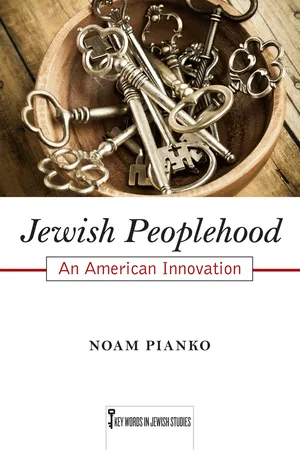
Winner of the 2017 American Jewish Historical Society’s Saul Viener Book Prize Although fewer American Jews today describe themselves as religious, they overwhelmingly report a strong sense of belonging to the Jewish people. Indeed, Jewish peoplehood has eclipsed religion—as well as ethnicity and nationality—as the essence of what binds Jews around the globe to one another. In Jewish Peoplehood, Noam Pianko highlights the current significance and future relevance of “peoplehood” by tracing the rise, transformation, and return of this novel term. The book tells the surprising story of peoplehood. Though it evokes a sense of timelessness, the term actually emerged in the United States in the 1930s, where it was introduced by American Jewish leaders, most notably Rabbi Stephen Wise and Rabbi Mordecai Kaplan, with close ties to the Zionist movement. It engendered a sense of unity that transcended religious differences, cultural practices, geographic distance, economic disparity, and political divides, fostering solidarity with other Jews facing common existential threats, including the Holocaust, and establishing a closer connection to the Jewish homeland. But today, Pianko points out, as globalization erodes the dominance of nationalism in shaping collective identity, Jewish peoplehood risks becoming an outdated paradigm. He explains why popular models of peoplehood fail to address emerging conceptions of ethnicity, nationalism, and race, and he concludes with a much-needed roadmap for a radical reconfiguration of Jewish collectivity in an increasingly global era. Innovative and provocative, Jewish Peoplehood provides fascinating insight into a term that assumes an increasingly important position at the heart of American Jewish and Israeli life. For additional information go to: http://www.noampianko.net
- 186 pages
- English
- ePUB (mobile friendly)
- Available on iOS & Android
eBook - ePub
Jewish Peoplehood
About this book
Information
Topic
Teologia e religioneSubtopic
Storia ebraica1
Terms of Debate
Jewish Nationhood and American Peoplehood
I remember standing as a boy on the sidewalks of midtown Manhattan, on a Solidarity Sunday in the mid-1980s, along with thousands of New Yorkers rallying for Soviet Jews. These large gatherings of American Jews working together to free our fellow Jews emphasized and embodied a powerful message that certain bonds connected Jewish people around the world to one another. We chanted and sang the rallying cry “Am yisrael chai” (The Jewish people lives!) for hours. This iconic song, written by Rabbi Shlomo Carlebach specifically for the Soviet Jewry movement, encapsulated a sense of membership in a group with a long past, a deeply felt collective present, and a shared future.
The solidarity that American Jews expressed and experienced with Soviet Jewish dissidents and their cause transcended different languages, cultures, religious practices, and even the Cold War that pitted our countries of citizenship against each other, uniting American Jews in common cause against the Soviet regime. The basis for that solidarity felt so obvious that it hardly had to be articulated: a shared collective history with its experiences of both persecution and endurance, bonds of blood and descent, and an attachment to the State of Israel whose establishment in 1948 created a focal point for Jews around the globe. “Am yisrael chai” was such a powerful concept, capable of inspiring activism and political action for a shared cause—the enduring existence of a distinct transhistorical people.
Looking back over the twentieth century, the Soviet Jewry movement marked a high point in the affirmation of a particular vision of Jewish collectivity and group cohesion.1 The sense of obligation to protect Jews around the globe was undoubtedly shaped in part by the trauma of the Holocaust and the growing realization and absorption of what American Jewry had been unable to do by way of rescuing their European sisters and brothers from their fate. What defined the Jewish people in this post-Holocaust context of the late twentieth century was the belief that across the diversity of Jewish life, Jews shared an unmistakable set of characteristics and collective goals. The principle of Jewish unity undergirded the need to stand up for one another in the face of unceasing persecution and to work together to fulfill a common mission. Jewish peoplehood came to function as the key term in American Jewish life for articulating these assumptions—and for presenting them as axiomatic.
Two decades after the collapse of the Soviet Union, this sense of unity that links so many members of the world Jewish community appears quiescent. The basic sense of a common denominator of Jewish cohesion so powerfully on display during the Soviet Jewry rallies and felt so deeply during other twentieth-century events, such as the creation of the State of Israel and especially the Six Day and Yom Kippur Wars, has largely dissipated. Contemporary Jews appear far less committed to peoplehood than previous generations, and the dominant communal discourse on Jewish peoplehood is characterized by the conviction that this shift is an alarming sign of a dramatic decline in contemporary Jewish collective identity, with negative implications for Jewish continuity.
Several years ago, two American Jewish scholars, the sociologist Steven M. Cohen and the historian Jack Wertheimer, lamented the dissolution of Jewish peoplehood in an article in the journal Commentary, “Whatever Happened to the Jewish People?”2 After opening the article with a description of the Soviet Jewry solidarity movement in the early 1980s, they compare the then-present situation circa 2006 to what they consider the heyday of Jewish peoplehood:
Today, less than twenty years later, it is almost inconceivable that the American Jewish community could muster the will to mount so massive a show of unity. It is not just that, at the moment, no large-scale crisis seems to engage the American Jewish psyche. Rather, something vital in the psyche has changed. Mounting evidence now attests to a weakened identification among American Jews with their fellow Jews abroad, as well as a waning sense of communal responsibility at home.3
Cohen, Wertheimer, and many other Jewish communal thought leaders posit this decline based on an implicit set of assumptions about the nature of Jewish collectivity. They underscore a corrosive change to the “vital psyche” of the Jewish people. The affirmation of that collective psyche implies that the shift stems not from an inevitable change in the external historical situation (e.g., the freeing of Soviet Jews in the 1990s), but instead results from a problematic diminution in the substance of Jewish connectivity itself. Their claim thus implicitly rejects viewing events of the 1970s and 1980s as one particular historical manifestation of Jewish peoplehood, and peoplehood itself as inevitably subject to change over time.4
It would be difficult to challenge Cohen and Wertheimer’s claim that a show of unity like a Soviet Jewry rally would not take place today. What it means to be a member of the Jewish people and what the ties are that bind this collective group together have become far more complicated to conceptualize and enact. In the years since those rallies, the overriding sense of unity represented by centralized Jewish institutions, the State of Israel as focus for diaspora communities, and the plight of persecuted Jews has been eroded by several factors, including high rates of intermarriage, a shift toward individualized Jewish identity, the mass emigration of Soviet Jews, changing attitudes toward the State of Israel, and the decentralization of Jewish communal life in the United States. Wider trends like increasingly permeable identity boundaries and globalization have accompanied these intra-Jewish developments.
But the question “Whatever happened to the Jewish people?” beyond its factual observations implicitly contends that twentieth-century criteria for defining and measuring peoplehood legitimately represent a standard applicable across time and space, a normative set of unchanging beliefs and practices that typify the “Jewish psyche” and transcends changing historical circumstances. One particular set of behaviors—specifically, “weakened identification among American Jews with their fellow Jews abroad, as well as a waning sense of communal responsibility at home”—serves as an indicator of the declining relative strength of the essential quality of Jewish peoplehood.5 This specific definition of what it means to be part of the Jewish people may also suggest one reason why the recent Pew report’s findings of a rise in identification with the Jewish people did not garner more optimistic celebration among concerned Jewish communal leaders.6 The survey respondents’ conception of peoplehood lacked the level of political conviction and call to activism on behalf of world Jewry that would match a particular criterion for peoplehood—that is, a high level of identification with Jews abroad and responsibilities to the local Jewish community.
But is there an unambiguous, unchanging, and timeless basis for defining the essence of Jewish peoplehood, as Cohen and Wertheimer imply? Do changing models of Jewish individual and collective expression represent a decline in a transhistorical criterion for peoplehood? Or is there another way to interpret changing attitudes as a reflection of the ongoing evolution of the meanings and practices of Jewish collectivity, and of Jewish peoplehood—one of many expressions of that collectivity, and one that is itself relatively new and innovative rather than timeless and immutable?
This chapter charts the evolution of Jewish peoplehood as shaped by both Zionist conceptions of Jewish nationhood and English-language notions of people as a group category aligned with the democratic values at the core of what it means to be American. I focus primarily here on these modern terms of debate, rather than precedents from Jewish texts or history, as the most important sources of modern Jewish peoplehood to demonstrate the recent genesis of the term. The first section of this chapter argues that Jewish peoplehood’s defining features have clear etymological and theoretical precedents in terminology linked to European and European Jewish nationalism developed in the nineteenth and early twentieth centuries. In particular, Jewish peoplehood brings forward three aspects of the nationalist paradigm of collective identity: rigid boundaries between national groups, the assertion of a shared essential national quality, and the shift to grounding collective narratives in secular history rather than religious narratives. The second section traces the transition from nationhood to peoplehood in the American context. It focuses on why a new terminology was needed, what made peoplehood particularly useful, and how it came to represent a critique of and corrective to certain articulations of Jewish nationalism even as it drew heavily on aspects of nationalist logic. The third section traces the rise of Jewish peoplehood post-1948, shaped not only by the emergence of the State of Israel but also by a deepening attention to peoplehood in American public debates about identity politics, such that Jewish peoplehood came to be presented as transhistorical and essential—in a sense asserting, through this relatively new term, its own timeless authenticity.
This approach challenges the implicit claim that one can meaningfully ask the question “Whatever happened to the Jewish people?” without first probing the historical origins of the specific constellation of meanings associated with peoplehood—an analysis that goes against the very grain of peoplehood’s representation. Reconceptualizing the role of this word—from an enduring concept to a recent innovation—and tracing its evolution from an American alternative to the limited terms for collective identity in diaspora culture, to one that supports key Zionist concepts, raises a fundamental question about Jewish peoplehood that contrasts with the view that this veteran concept is now in decline: How did peoplehood, a neologism from the 1930s, shift in a few decades from being a marginal idea developed unsystematically to respond to a new set of early twentieth-century opportunities and challenges, into a (and perhaps even the) core defining component of Jewish identity and the dominant taxonomic category for Jewish collectivity in the second half of the twentieth century and beyond?
What Is a Nation? Peoplehood’s European Precursors
The seemingly close linguistic link between am yisrael (the people/nation of Israel) and Jewish peoplehood might lead the reader to ask legitimatelyhere: Isn’t Jewish peoplehood basically just an English translation of the Hebrew phrase am yisrael? Though the lineage of Jewish peoplehood as a central concept throughout Jewish history is in fact often traced precisely through this connection, that association is tenuous. Certainly the conception of Jews as a collective group has this and many other precursors in Jewish sources, practices, and institutions. Historical antecedents for referring to Jews as the Jewish people include a rich Hebrew conceptual vocabulary, with terms that emphasize a shared divine election (am segula [a treasured nation], knesset yisrael [congregation of Israel]), territorial sovereignty (am yisrael, beit yisrael [house of Israel]), and tribal bonds (b’nei yisrael [children of Israel], shivtei yisrael [tribes of Israel]). Biblical sources as early as the Book of Esther called the collective Yehudim (Jews). Words in other Jewish languages include the Yiddish der yidn (the Jews) or the Ladino la uma (the [Jewish] nation/ethnoreligious group).
However, the dominant contemporary English translation of these terms, Jewish people, has no direct antecedent in Hebrew or any other Jewish language. Furthermore, the addition of -hood—a suffix connoting the condition of groupness itself—is itself an innovation, with no historical precedents at all (nor does there seem to have been any other abstract noun describing that condition of the Jewish collective). The fact that the English key word Jewish people lacks a clear antecedent (as does its abstract noun form, Jewish peoplehood) signifies that its use does not chiefly reflect translation.
Based on the list of possible terms to select as the source for English-speaking Jews to refer to their own group identity, neither the most historically common term for referring to Jews individually and collectively (yisrael, or Israel) nor any other single historical key term has taken center stage in Jewish communal discourse. The Jewish people might better reflect a combination of the translation of am (as in am yisrael) with that of yehudi (Jew/ish), but the term am yehudi appears nowhere in traditional Hebrew sources. And a Hebrew analogue for peoplehood, amiyut, has only entered the Hebrew language recently, as a new word translated from and created to serve as a parallel to peoplehood, attempting to represent in Hebrew the hood-ness that is asserted in the English (and largely American) term.7
Moreover, translations of the Hebrew terms am and yisrael into “people” and “Jews/Jewish,” respectively, represent subjective interpretations. The modern Even-Shoshan Hebrew-Hebrew Dictionary renders am as “a large collection of people with a shared ancestry, history and generally a spoken language and most of whose members are concentrated in a specific state [medina, as in medinat yisrael, or the State of Israel].”8 Based on linguistic comparison of the use of am in the biblical context, the Brown-Driver-Briggs lexicon of the Hebrew Bible suggests “kinsman” as the most appropriate translation of the ancient term.9 These two sources—one written by an Israeli Hebraist shortly after the founding of the state and the other created by nineteenth-century Christian biblical critics—illustrate two divergent historical meanings of the Hebrew word am, the former largely territorial and cultural, the other ethnic and perhaps even biological. The multiple possible connotations of am in these dictionaries make references to the term as an antecedent for modern Jewish peoplehood an argument based more on reading contemporary interpretations of collectivity back into Jewish sources rather than on translating a singular and constant historical concept into an English word.
A far more obvious choice for an English term to refer to the Jewish collective would have been Israel (the English rendering of yisrael). Israel—the new name, meaning “godwrestler,” given to the patriarch Jacob in the biblical book of Genesis—stands out in biblical and rabbinic literature as the most common single term (or the most prevalent second noun in construct noun phrases) used to refer to the collective, as well as to one of its members. Indeed, before 1948, Israel referred to Jews regardless of geography and political status; for example, nineteenth-century American Jews most often used Israelite (as well as Hebrew) to refer to themselves.10 But today Israel refers almost exclusively to the Jewish state, whose early leaders made a conscious decision to name itself the State of Israel rather than several other proposed options.11 From a Zionist perspective, the phrase am yisrael seems implicitly to make a historical case for the modern nation of Israel as the heir to the legacy of the Bible—but that association of Israel with citizenship in a modern state would have made little sense before the state’s establishment, when Israel applied equally to Jews in the homeland and the diaspora.12
Reflecting a juxtaposition of Jewish and people (the latter grounded in a selective translation of am) with the addition of -hood, Jewish peoplehood is as much a new creation as a translation of longstanding terminology. Furthermore, the grammatical construction of the term peoplehood, as opposed to people alone, implies a focus on the fact of collectivity, rather than the basis of cohesion or practices of membership. Indeed, the suffix -hood, according to the Merriam-Webster dictionary, means “individuals share a specific state or character (as in brotherhood).”13 Peoplehood, referring to the Jewish people with an abstract noun, renders the existence of some particular condition or quality as a given, and focuses on the very idea of sharing an abstract commitment of being part of a people, rather than on that condition or quality per se. The recent language of peoplehood, then, has fostered a circular definition of the term, with the condition of being a people—and articulating that condition—as its defining ...
Table of contents
- Cover
- Series Page
- Title Page
- Copyright
- Contents
- Foreword
- Acknowledgments
- Introduction: A Deceptively Simple Key Word
- 1. Terms of Debate: Jewish Nationhood and American Peoplehood
- 2. State of the Question: Enduring Entity or Constructed Community
- 3. In a New Key: Can Peoplehood Speak to a Global Era?
- Notes
- Index
- About the Author
Trusted by 375,005 students
Access to over 1.5 million titles for a fair monthly price.
Study more efficiently using our study tools.
Frequently asked questions
Yes, you can cancel anytime from the Subscription tab in your account settings on the Perlego website. Your subscription will stay active until the end of your current billing period. Learn how to cancel your subscription
No, books cannot be downloaded as external files, such as PDFs, for use outside of Perlego. However, you can download books within the Perlego app for offline reading on mobile or tablet. Learn how to download books offline
Perlego offers two plans: Essential and Complete
- Essential is ideal for learners and professionals who enjoy exploring a wide range of subjects. Access the Essential Library with 800,000+ trusted titles and best-sellers across business, personal growth, and the humanities. Includes unlimited reading time and Standard Read Aloud voice.
- Complete: Perfect for advanced learners and researchers needing full, unrestricted access. Unlock 1.5M+ books across hundreds of subjects, including academic and specialized titles. The Complete Plan also includes advanced features like Premium Read Aloud and Research Assistant.
We are an online textbook subscription service, where you can get access to an entire online library for less than the price of a single book per month. With over 1.5 million books across 990+ topics, we’ve got you covered! Learn about our mission
Look out for the read-aloud symbol on your next book to see if you can listen to it. The read-aloud tool reads text aloud for you, highlighting the text as it is being read. You can pause it, speed it up and slow it down. Learn more about Read Aloud
Yes! You can use the Perlego app on both iOS and Android devices to read anytime, anywhere — even offline. Perfect for commutes or when you’re on the go.
Please note we cannot support devices running on iOS 13 and Android 7 or earlier. Learn more about using the app
Please note we cannot support devices running on iOS 13 and Android 7 or earlier. Learn more about using the app
Yes, you can access Jewish Peoplehood by Noam Pianko in PDF and/or ePUB format, as well as other popular books in Teologia e religione & Storia ebraica. We have over 1.5 million books available in our catalogue for you to explore.