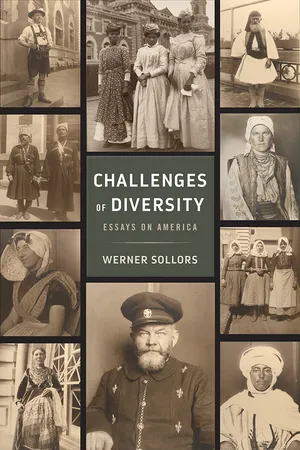
What unites and what divides Americans as a nation? Who are we, and can we strike a balance between an emphasis on our divergent ethnic origins and what we have in common? Opening with a survey of American literature through the vantage point of ethnicity, Werner Sollors examines our evolving understanding of ourselves as an Anglo-American nation to a multicultural one and the key role writing has played in that process. Challenges of Diversity contains stories of American myths of arrival (pilgrims at Plymouth Rock, slave ships at Jamestown, steerage passengers at Ellis Island), the powerful rhetoric of egalitarian promise in the Declaration of Independence and the heterogeneous ends to which it has been put, and the recurring tropes of multiculturalism over time ( e pluribus unum, melting pot, cultural pluralism). Sollors suggests that although the transformation of this settler country into a polyethnic and self-consciously multicultural nation may appear as a story of great progress toward the fulfillment of egalitarian ideals, deepening economic inequality actually exacerbates the divisions among Americans today.
- 214 pages
- English
- ePUB (mobile friendly)
- Available on iOS & Android
eBook - ePub
Challenges of Diversity
About this book
Information
Topic
Literatur1
Literature and Ethnicity
The Roots of Ethnicity: Etymology and Definitions
On October 9, 1854, Nathaniel Hawthorne, then serving as the American consul to Liverpool, made a curious entry in his journal: “My ancestor left England in 1635. I return in 1853. I sometimes feel as if I myself had been absent these two hundred and eighteen years.” During his years in England, Hawthorne became fascinated by the idea of tracing his roots, made genealogical enquiries, and was hopeful of finding “a gravestone in one of these old churchyards, with my own name upon it; although for myself, I should wish to be buried in America. The graves are too devilish damp here.”
Hawthorne’s search for genealogical facts remained fruitless, but his literary curiosity was intensified by his inability to trace his real ancestors. Ready to embrace an imaginary ancestry, he was intrigued by the legend of a bloody footmark, which a sixteenth-century clergyman, George Marsh, had miraculously left on the stone pavement of Smit-hills Hall in Lancashire. When martyr Marsh was arrested, he “stamped his foot in earnest protest against the injustice with which he was treated. Blood issued from his foot, which slid along the stone pavement of the hall, leaving a long footmark printed in blood; and there it remained ever since, in spite of the scrubbings of all after generations.” The Ancestral Footstep, one of Hawthorne’s fragmentary attempts at creating an English-American romance, is an excellent image for Hawthorne’s sense of what is now known as “ethnicity.” It refers to a specific tradition, born out of protest against another tradition; it is as thick as blood; and it defies “scrubbing” descendants. It is embedded in myth and invites faith rather than critical scrutiny. Hawthorne reasons: “Of course, it is all humbug—a darker vein cropping up through the gray flagstone,” but concludes that “the legend is a good one.”
The dark-brown stain of the footprint also defied Hawthorne’s endeavors to use it as an emblematic center of a novel. Despite numerous efforts, he could not make the legend functional in the story of an American’s return to his Old World roots. Hawthorne tried to make the American the missing heir of the English manor house, but realized that an English title would compromise the hero’s Americanness. Hawthorne then changed the plot and made the English inheritance invalid and unreal, thus making ethnicity imaginary, but again he ran into new problems. On the one hand, the English manor house represented for Hawthorne the structured social life Americans had left behind in the Old World. On the other hand, it was the doomed shell of a class structure that had left its bloody footprint on the pavement of time.
In another unfinished romance, Septimius Felton, Hawthorne returned to the bloody footmark, but sketched a different American protagonist with a “wild genealogy,” a descendant of an old witch on one side and “an Indian prophet and powwow” on the other. This strange and exceptional man had “brooded upon the legends that clung around his line, following his ancestry, not only to the English universities, but into the wild forest, and into hell itself. [. . .] His mind and character had a savage and fiendish strain, intermixed with its Puritan characteristics.” But this multiethnic prototypical American carried Hawthorne no further than did his imaginary New England descendant of martyr Marsh. The author could not finish the tale of The Ancestral Footstep. Hawthorne’s love-hate for his ancestors, his understanding of the “humbug” of good genealogical legends, and finally, his difficulties in finding a precise literary use of ethnicity are indicative of a persistent problem in American literature and culture. The memory of diverse pre-American pasts has instilled a pervasive sense of ethnicity into the minds and imaginations of American writers.
If American culture symbolizes man’s entry into fragmented modernity, then “ethnicity” functions as a formidable expression of a countervailing yearning for history and community. The tension between these forces is a persistent theme in American literature. Tocqueville described American society as one “which comprises all the nations of the world—English, French, German: people differing from one another in language, in beliefs, in opinions; in a word a society possessing no roots, no memories, no prejudices, no routine, no common ideas, no national character,” and inquired, “What is the connecting link?” More than a century later Margaret Mead concluded that “however many generations we may actually boast of in this country, however real our lack of ties in the old world may be, we are all third generation, our European ancestry tucked away and half forgotten, the recent steps in our wanderings over America immortalized and overemphasized.” Ethnicity as a tenuous ancestry and as the interplay of different ancestries may be the most crucial aspect of the American national character.
The word “ethnicity” itself has an interesting past with etymological contexts of its own. In the modern sense of “differentiation based on nationality, race, religion, or language,” “ethnicity” is an Americanism, first used in 1941 in W. Lloyd Warner’s Yankee City Series as one category—along with age, sex, and religion—that separates “the individual from some classes of individuals and identifies him with others.” In 1953 David Riesman extended the dimensions of the word “ethnicity” in a famous American Scholar debate about McCarthyism. Riesman suggested that the struggle between ethnicity and modernity was at the root of the problem: “There is a tendency for the older ‘class struggles,’ rooted in clear hierarchical antagonisms, to be replaced by a new sort of warfare: the groups who, by reason of rural or small-town location, ethnicity, or other parochialism, feel threatened by the better educated upper-middle-class people (though often less wealthy and politically powerful) who follow or create the modern movements in science, art, literature, and opinion generally.” Riesman furthermore argued that the shift from class to ethnicity in America created outlets for fears and hatreds of Indians, Mexicans, and other ethnic groups but that ethnic diversity and regional and religious pluralism tended to confine the dangerous potential of a fanatical fascist leader to “his” ethnic group or section. Whereas Warner did not always include the descendants of English migrants under the term “ethnicity,” Riesman applied it to all Americans, denying the validity of “ethnicity minus one.”
“Ethnicity” is, of course, derived from the older adjective and noun “ethnic,” which in turn goes back to a Greek root comprising the word field “nation” and “heathen.” The word ethnikos was thus used in the Greek Bible to render the Hebrew goyim (non-Israelites, Gentiles). In the Christianized context of the English language, the word “ethnic” (sometimes spelled “hethnic”) recurred, from the fourteenth through the nineteenth centuries, in the sense of “pagan, heathen, non-Christian.” Only in the mid-nineteenth century did the more familiar meaning of “ethnic” as “peculiar to a race or nation” reemerge. However, the English language has retained the memory of “ethnic” as “heathen,” often secularized in the sense of ethnic as “other,” as “nonstandard,” or in the United States, as somehow “un-American.” This connotation gives the opposition of “ethnic” and “American” the additional religious dimension of the contrast between “heathens” and “chosen people.” Therefore, the relationship between “ethnicity” and “American identity” parallels that of “heathenish superstition” and “true religion,” and it is in the sense of “heathendom” that the word ethnicity was once recorded in 1772. But this instance is described as obsolete and rare in the Oxford English Dictionary.
“Ethnics”—originally just “people”—are etymologically the “others,” “they” as opposed to “us.” “Ethnicity” as “otherness” refers to self-definitions of one group of people through an opposition against other groups: we are not like them, they are not like us. Puritans liked to distinguish their own religious practice from heathenish customs. In 1702, Cotton Mather wrote that the “custom of preaching at funerals may seem ethnical in origin.”
The negative separation from heathens has had its counterpart in a more or less hidden envy and admiration for the “other,” which reached a high point with romantic racialism in the mid-nineteenth century. Thus, Harriet Beecher Stowe’s Uncle Tom’s Cabin (1852) expostulated that Negroes make better Christians than whites. The Anglo-Saxons, on the other hand, a “cool, logical, and practical” race, should remember that God gave the Bible “to them in the fervent language and with the glowing imagery of the more susceptible and passionate Oriental races.” And in one of James Fenimore Cooper’s last novels, The Oak Openings (1848), the Indians are “the chosen people of the Great Spirit.” Frank Forrester (William H. Herbert) wrote of the slave woman Tituba, in The Fair Puritan, an Historical Romance of the Days of Witchcraft (1844–1845), that there was “more of the true, the lowly, and the grateful spirit of the Christian, in that poor, overtasked, despised, scourged heathen, than in her haughty master.”
Ethnicity as otherness evoked disparagement and emulation in American writing. In order to attain full selfhood one has to experience otherness; and in that sense, ethnicity is not only in others but also in ourselves. Perhaps a latent fascination with the other in ourselves may account for the great popularity of autobiographical narratives of conversions from heretic to true believer, from criminal to social hero, or from ethnic to American. The affinities of ethnicity and heathendom are focused most clearly in conversion stories. Mary Antin’s immigrant autobiography, The Promised Land (1912), begins: “I was born, I have lived, and I have been made over. Is it not time to write my life’s story? I am just as much out of the way as if I were dead, for I am absolutely other than the person whose story I have to tell.” It is obvious that the imagery of progressive change, of a transformation from a pre-American past to an American identity—Edward Steiner’s From Alien to Citizen (1914) or Michael Pupin’s From Immigrant to Inventor (1923)—is patterned on the symbolism of religious conversions. There is a heathenish dimension to the past, to any past, in American literature and a sacred quality to the future in America. American writers of the most diverse ancestries perceived America in religious terms, whether they sided with the saving grace of an American future (“Reborn in the Promised Land!”) or with the adversary ethnicity of a “heathenish” past (“A Curse Upon Columbus!”).
Horace Bushnell instructed his parishioners in 1859 that regeneration is “the naturalization of a soul in the kingdom of heaven” and thus related the process of becoming a true Christian with that of becoming an American. In 1873, Chamberlain Cummings preached that not only the “others” must be regenerated, or “naturalized,” but that Jew and Gentile, Christian and heathen must be born again. If the completion of Cummings’s metaphor means that all Americans, whether immigrant or native born, have to be naturalized in order to become true Americans, then this expanded use of the idea of a rebirth anticipated the rhetoric of the ethnic “revival”; however, in the 1960s, the relationship of ethnicity and American identity was inverted. Traditionally, the struggle was toward a true Christian, or later, a truly American identity; now many Americans yearn for an ethnic identity. Ethnicity has been transformed from a heathenish liability into a sacred asset, from a trait to be overcome in a conversion and rebirth experience to an identity to be achieved through yet another regeneration.
The rhetoric of ethnicity thus comes out of the tradition of American revivalism and awakenings: American literature is a rich repository of the footprints of ethnicity. American writers from Cotton Mather to Richard Wright, from Charles Brockden Brown to Pietro di Donato, from William Faulkner to Hisaye Yamamoto have developed such a systematic religious symbolism of ethnicity and American identity that American literature as a whole can be read as the ancestral footstep or coded hieroglyph of ethnic group life of the past and ethnic tensions in the present.
In this sense, “literature and ethnicity” in America refers to nothing less than the whole range of American culture, from classics to commercials, from seventeenth-century migrants’ letters (as collected and edited by Everett Emerson) to nineteenth and twentieth-century black folk rhetoric (definitively analyzed in Lawrence Levine’s Black Culture and Black Consciousness); from the first stage Yankee and ancestor of “Uncle Sam” in Royall Tyler’s The Contrast (1787) to the first Ibsen productions on Scandinavian and Yiddish stages in America; from Uncle Tom’s Cabin to Dr. Fu Man Chu serial movies; from Japanese-American detention-camp newspaper editorials to Mutt and Jeff and the Katzenjammer Kids; from T. S. Eliot to T. A. Daly; from The Birth of a Nation to Roots; from the Bay Psalm Book to Rhymin’ Paul Simon. In his introduction to The Uprooted (1951), Oscar Handlin made the famous statement: “Once I thought to write a history of the immigrants in America. Then I discovered that the immigrants were American history.” Analogously, one may say that ethnic literature is American literature.
Ethnicity is a pervasive theme in all American literature, whether in the shape of ethnicity as ancestry or ethnicity as diversity. The relationship of an American identity with pre-American pasts, the interaction of people with different pre-American pasts, and the emergence of an American character are among the central themes of American writing. And the very forms of American literature are also partly shaped by the forces of “ethnicity,” from the first emergence of Americanized genres to the highest achievements of the American Renaissance, from the opposition of “romance” and “novel” to the rise of modernism and proletarian writing, from the growth of a mass culture to the literature of alienation and to the writings of the ethnic revival of the 1970s.
Promised Land and Melting Pot: Typology and Ethnicity
The most important source of literary ethnicity in North America is in the application of biblical images to the colonists’ new experiences. Biblical analogies to the drama of seafaring and settling in new worlds are common in colonial literatures; in Puritan New England, however, a systematic religious symbology was applied to the transatlantic crossing—a theme of primary importance in American literature—and to a New World consciousness. The religious thought of seventeenth-century New England was thus an important source of the most widespread literary treatments of American ethnicity. Especially that aspect of Protestant theology known as typology has influenced diverse ethnic literary traditions in America.
Whereas traditional Christian typological exegesis was restricted to an interpretation of Old Testament characters and events as “types” that foreshadowed the redemptive history of the New Testament, Puritan typology related the secular history of the American colonists to biblical types. American writing from the seventeenth to the twentieth centuries abounds with characters who, in Sacvan Bercovitch’s phrase, reveal the “Puritan origins of the American self” and who appear to be, as Ursula Brumm suggested, “based on fixed models, of which the most important are Adam and Christ.” The events of early American history were, with the help of typology, rhetorically transformed into the biblical drama, as New Englanders interpreted their transatlantic voyage as a new exodus, their mission as an errand into the wilderness, and their role as that of a new Israel. American literature is exceptionally religious in its imagery, and this is true for mainstream as well as for minority writers. These anomalous religious tendencies advanced by the literature of a modern, postrevolutionary, bourgeois culture that so often invokes the ideals of the Enlightenment were ironically reinforced by the fact of immigration.
The continuous history of immigration strengthened the typological imagination in America. Marcus Lee Hansen wrote about the “process of Puritanization” among immigrant groups when he observed how familiar the records of seventeenth-century Massachusetts sounded to a historian of nineteenth-century immigration. The potential divisiveness of a multiethnic culture could be softened by a widespread acceptance of a modified typological framework for the American literary imagination. Roman Catholic, Jewish, and continental Protestant forms of worship had little in common with Puritan theology; yet the participants of the new immigration, along with African Americans, share a surprising concern with typology in their writings. Among the most prevalent typological elements are the imagery of a continued exodus from Egyptian–Old World bondage to the shores of an American promised land, the creation of American protagonists as Adamic and Christic figures, and the related notion of the welding of an American “new man.” The image of the new exodus provides a sacral meaning to a secular migration. In the view of Puritan ministers in New England, God had carried the first settlers “by a mighty hand, and an out-stretched arm, over a sea greater than the Red Sea.” Cotton Mather described both William Bradford and John Winthrop as a “new Moses”; and according to Winthrop’s famous dictum, New England was the biblical “Citty vpon a Hill.” Following the book of Revelation, colonists viewed America as a typological “new Jerusalem” and a “new Canaan,” an association that remained powerful and alive in New England place names as well as in American literature.
Philip Freneau and Hugh Henry Brackenridge’s “Poem, On the Rising Glory of America” (1771) views America typologically: “A Canaan here, / Another Canaan shall excel the old.” In Timothy Dwight’s patriotic poem The Conquest of Canaan (1785), the motif of the New World as a “last retreat for poor, oppress’d mankind” is part of a providential view of the history of America as the history of fulfillment: “And a new Moses lifts the daring wing / Through trackless seas, an unknown flight explores, / And hails a new Canaan’s promis’d shores.” It is no exaggeration to say that the exodus is one of America’s central symbols. When the choice of an official seal for the United States was discussed in 1776, Franklin suggested as the device “Moses lifting up his wand and dividing the Red Sea while Pharaoh was overwhelmed by its waters, with the motto, ‘Rebellion to tyrants is obedience to God’“; and “Jefferson proposed the children of Israel in the wilderness ‘led by a cloud by day and a pillar of fire at night.’” The eagle that was used for the seal is not just the classical emblem, but also the eagle of Revelation (12:13–17), an image of exodus and emigration.
Isaac Mitchell’s novel The Asylum (1811), again viewed America as a promised land and as a haven for the oppressed: “The new land is the poor man’s Canaan; to him it is a land flowing with milk and honey.” The belief in America as a promised land for what Emma Lazarus called the “huddled masses” and the “wretched refuse” (in her Statue of Liberty poem, “The New Colossus”) may reflect the popularity of the exodus theme in the literature of non-English immigrants to America, and the association of the exodus with a deliverance from slavery may explain the widespread use of this theme in African American writing. The typological adaptation of the second book of Moses to varieties of secular migrations remains a characteristic trait of American literature.
Phillis Wheatley, for example, who had been captured and enslaved in Senegal and sold to a Boston tailor in 1761, paradoxically described her own enslavement as a typological deliverance from Egypt in the poem “To the University of Cambridge, in New England.” Absorbing the American rhetoric, she also claimed a full American identity as a Christian in “On Being Brought from Africa to America” and enjoined her compatriots: “Remember, Christians, Negroes black as Cain / May be refined, and join the angelic train.” Similarly, Mary Antin, in The Promised Land, took a position of apparent self-effacement only to pro...
Table of contents
- Cover
- Title Page
- Copyright
- Dedication
- Contents
- Introduction
- 1. Literature and Ethnicity
- 2. National Identity and Ethnic Diversity
- 3. Dedicated to a Proposition
- 4. A Critique of Pure Pluralism
- 5. The Multiculturalism Debate as Cultural Text
- Notes
- Acknowledgments
- Index
- About the Author
Trusted by 375,005 students
Access to over 1.5 million titles for a fair monthly price.
Study more efficiently using our study tools.
Frequently asked questions
Yes, you can cancel anytime from the Subscription tab in your account settings on the Perlego website. Your subscription will stay active until the end of your current billing period. Learn how to cancel your subscription
No, books cannot be downloaded as external files, such as PDFs, for use outside of Perlego. However, you can download books within the Perlego app for offline reading on mobile or tablet. Learn how to download books offline
Perlego offers two plans: Essential and Complete
- Essential is ideal for learners and professionals who enjoy exploring a wide range of subjects. Access the Essential Library with 800,000+ trusted titles and best-sellers across business, personal growth, and the humanities. Includes unlimited reading time and Standard Read Aloud voice.
- Complete: Perfect for advanced learners and researchers needing full, unrestricted access. Unlock 1.5M+ books across hundreds of subjects, including academic and specialized titles. The Complete Plan also includes advanced features like Premium Read Aloud and Research Assistant.
We are an online textbook subscription service, where you can get access to an entire online library for less than the price of a single book per month. With over 1.5 million books across 990+ topics, we’ve got you covered! Learn about our mission
Look out for the read-aloud symbol on your next book to see if you can listen to it. The read-aloud tool reads text aloud for you, highlighting the text as it is being read. You can pause it, speed it up and slow it down. Learn more about Read Aloud
Yes! You can use the Perlego app on both iOS and Android devices to read anytime, anywhere — even offline. Perfect for commutes or when you’re on the go.
Please note we cannot support devices running on iOS 13 and Android 7 or earlier. Learn more about using the app
Please note we cannot support devices running on iOS 13 and Android 7 or earlier. Learn more about using the app
Yes, you can access Challenges of Diversity by Werner Sollors in PDF and/or ePUB format, as well as other popular books in Literatur & Nordamerikanische Literaturkritik. We have over 1.5 million books available in our catalogue for you to explore.