eBook - ePub
Human Resources As Business Partner
How to Maximize The Value and Financial Contribution of HR
- 146 pages
- English
- ePUB (mobile friendly)
- Available on iOS & Android
eBook - ePub
Human Resources As Business Partner
How to Maximize The Value and Financial Contribution of HR
About this book
This practical book sets out how HR can become a true business partner. It will require a rethinking of HR's contribution to the organization in the future. All the key topics are covered in this work from a specific HR strategic model, reshaping of HR to align itself better with the business, and a number of new tools and techniques to aid in creating real financial value to the organization. Many HR personnel have already jumped onto the title of calling themselves a business partner, but what this involves is a very different and complex skill set as well as a new process approach to creating added value. Being a business partner is a very different and exciting approach to creating measurable value, specifically from HR activities and interventions.
Trusted by 375,005 students
Access to over 1.5 million titles for a fair monthly price.
Study more efficiently using our study tools.
Information
CHAPTER 1
The Challenge
1.1 Getting HR into Shape
The concept of redesigning the shape of New HR was an idea first expounded by Dave Ulrich. Before explaining this, it is necessary to cut through some of the myths in HR about who your customer is. Once that is understood a move to the new shape of HR becomes more comfortable and easier to explain.
I am fortunate in that I meet literally thousands of HR people every year. Ask them the question “who is your customer” and the reply is always the same (99 percent of the time)—the employees. But is this statement true?
It can’t be—the HR function is a function that is funded at corporate level, the employees don’t pay for the function, don’t have any say about your salary, and they often use HR to undermine their managers. The employees have supervisors, team leaders, and managers to recruit, develop, and help them produce higher levels of competence and performance. It’s also the line manager’s responsibility to enforce discipline and deal with day-to-day grievance issues.
So what is HR’s new role? It’s a function to provide the tools, systems, and processes to enable managers to enhance and get the best from their staff. Using innovation and skill, HR can; if its focus is right, help an organization to significantly improve its performance. This is the essence of HR. The Business Partner.
To enable this to happen, HR will need to get into a streamlined shape so that it is in a position to take on more strategic and value-producing roles.

The concept is very uncluttered, put all of the terms and conditions, holidays, training requests on the intranet. Managers, staff, and employees’ first point of information on any of these topics will be on your local intranet, cloud site, or system. The second line of contact will be by phone—these calls will be fielded by the HR call manager. This is not setting up a call center in the true sense but having a phone that is answered to deal with enquiries or for clarification about where to get information from. Invariably 90 percent of these calls will merely be directing people to the appropriate place on the intranet.
The third point or level of contact will be the HR professional—You.
This is where expert advice will be available and where you will be dealing with the senior personnel of the organization.
This design offers you many advantages. It will stop that endless stream of people wandering into the HR department and allow you the time to focus on what’s important—creating value. It also sends a strong message to everyone—that you are a professional department and are running the function in a professional way.
I would also suggest, and this won’t be popular, keeping the HR department door locked. This is necessary for a number of reasons. It’s showing others that you deal with very confidential information and that you take personal security of employees’ information very seriously. On this point alone you will get approval for doing this. Likewise as you will be working more on strategic plans you don’t want anyone just walking in during a meeting or when you are producing organizational efficiency charts. It’s a sobering thought that every one of your employees carries with them the perfect espionage tool—the mobile phone. A device that can record meetings, photograph sensitive employee pay details, and, with the right software, download corporate data in a trice.
So there it is; a performance-based layout for HR for starting to get into the right shape for the Business Partners’ role. I’m not suggesting for one moment that HR specialists sit like gods in locked offices all day. They are best employed working more with the management team and senior managers on things like efficiency projects.
Work toward Being a Specialist
The second issue of what should HR be doing in the future is that of mastery. Although many of these areas of mastery will be discussed later in the book this will give you and the rest of the business a quick overview of the key areas of HR—the Business Partner.
1.2 The Strategic Focus and Process
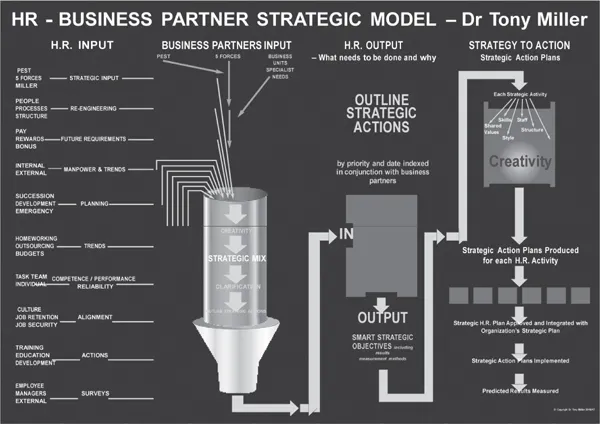
CROs and top management have repeatedly complained about the inability of HR to contribute to the formation of organizational strategy. This process map is an attempt to help HR to be more strategically focused using a proven template of what needs to be done. This process map also provides the vital link to lock strategic decisions into operation by using Strategic Actions Plans, also known as SAPs.
Strategic involvement for HR seems the inevitable development of this important function if it is to be a true business partner.
To date many HR professionals have found increased difficulty in trying to get to grips with current HR strategic models.
Most of their design, although well meaning, is oversimplistic and in the main does not provide the amount of critical information needed to collect and produce high-level strategic information.
This chapter is specifically focused on providing you with a complete map for not only putting together the HR strategy but also ensuring full integration with the business requirements.
Before getting to grips with the map, let’s just spend a moment looking at timelines for the formulation of HR strategy.
There are three timelines we need to be aware of.
First, what we can learn from previous experience looking retrospectively at what we have done.
The second strategic timeline relates to current issues and information, which needs to be resolved in the future. The third and most important timeline is that of the future. It is only the future that we really have control of; from a strategic viewpoint it is the most important.
Often this timeline comprises both retrospective and current issues.
Most of the current strategic models that are being put forward for HR use are oversimplistic, particularly for those of us who are only involved in strategic planning occasionally.
Most businesses today use a model of some sort to ensure continuity and for putting strategic plans together.
The majority of these models consist of a combination of best practice in strategic planning and therefore use established strategic models such as PEST and FIVE FORCES.
In addition to those two models, there is the MILLER model, which looks specifically at productivity over time.
This model is essentially an HR model but tends to be reviewed by the majority of the other strategic partners.
The MILLER model, although being a strategic HR model, is specifically aimed at detecting when organizations need to change or reinvent themselves. Therefore, it has added importance for use in HR departments as it is HR’s responsibility to point out strategically when change in the organization needs to be triggered.
The additional information not covered in the aforementioned three models is that of the strategic partners’ specific area of expertise.
As well as using these strategic models, each partner will have a checklist of what to look at and report on for the future in their next strategic plan.
From what I’ve been told by hundreds of HR professionals internationally, this is the area that current HR professionals are having most difficulty with.
The map included here gives you a checklist of some of the most important HR areas to examine and use to see if there needs to be a specific inclusion in your strategic plan for those items. We tend to split our future focused plans into three timelines—each one has a very different type of approach.
Ferrari strategies: normally 1 to 2 years ahead, these are fun and most people can do them, often they are coupled to one specific financial year. This issue is with such strategies they do not have sufficient future focus; therefore, be cautious if all your strategies start to look like Ferrari strategies.
Oil tanker strategies: less exciting but when you start strategic planning for the first time—try to put forward more oil tanker strategies than Ferrari. The timeline for these is 2 to 5 years. You do need more effort and skill to use this.
Finally, Space Shuttle strategies 6 to 15 years. You really have to be a master of what’s going on with the ability to grasp the big picture and to have the commitment to identify and see through such strategies. Longer-term strategies require a lot of very careful project management if they are to be delivered on time and within budget.
Having worked through the checklist and drawn up your strategic plan you can see from the map that there is then the strategic mix; HR strategy does not stand on its own.
It is part of a far more complicated strategy, as it has to integrate with the corporate strategy of all of the other business partners.
It is therefore extremely likely and from my experience inevitable that HR strategy will need to be reworked a number of times before it is ready for full integration into the overall busi...
Table of contents
- Cover
- Title Page
- Copyright
- Dedication
- Contents
- Acknowledgments
- Human Resources, as Business Partner–Introduction
- Chapter 1 The Challenge
- Chapter 2 Mastering Productivity
- Chapter 3 Our Employees Are Our Greatest Asset?
- Chapter 4 Organizational Design, DownSizing, and Right Sizing
- Chapter 5 Four Key HR Processes and How to Improve Them
- Chapter 6 Trends and Correlations
- Chapter 7 The HR Business Partner in Action Case Study
- Bibliography
- HR Department Maturity Questionnaire
- Appendix
- Index
Frequently asked questions
Yes, you can cancel anytime from the Subscription tab in your account settings on the Perlego website. Your subscription will stay active until the end of your current billing period. Learn how to cancel your subscription
No, books cannot be downloaded as external files, such as PDFs, for use outside of Perlego. However, you can download books within the Perlego app for offline reading on mobile or tablet. Learn how to download books offline
Perlego offers two plans: Essential and Complete
- Essential is ideal for learners and professionals who enjoy exploring a wide range of subjects. Access the Essential Library with 800,000+ trusted titles and best-sellers across business, personal growth, and the humanities. Includes unlimited reading time and Standard Read Aloud voice.
- Complete: Perfect for advanced learners and researchers needing full, unrestricted access. Unlock 1.5M+ books across hundreds of subjects, including academic and specialized titles. The Complete Plan also includes advanced features like Premium Read Aloud and Research Assistant.
We are an online textbook subscription service, where you can get access to an entire online library for less than the price of a single book per month. With over 1.5 million books across 990+ topics, we’ve got you covered! Learn about our mission
Look out for the read-aloud symbol on your next book to see if you can listen to it. The read-aloud tool reads text aloud for you, highlighting the text as it is being read. You can pause it, speed it up and slow it down. Learn more about Read Aloud
Yes! You can use the Perlego app on both iOS and Android devices to read anytime, anywhere — even offline. Perfect for commutes or when you’re on the go.
Please note we cannot support devices running on iOS 13 and Android 7 or earlier. Learn more about using the app
Please note we cannot support devices running on iOS 13 and Android 7 or earlier. Learn more about using the app
Yes, you can access Human Resources As Business Partner by Tony Miller in PDF and/or ePUB format, as well as other popular books in Business & Human Resource Management. We have over 1.5 million books available in our catalogue for you to explore.