eBook - ePub
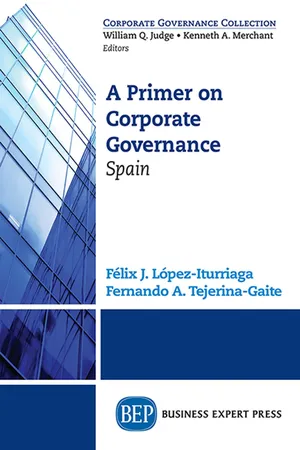
A Primer on Corporate Governance
Spain
- 148 pages
- English
- ePUB (mobile friendly)
- Available on iOS & Android
eBook - ePub
About this book
Spain has a civil law-based legal system, and court decisions
are not a source of law but are of interpretative value. The
privatization of large state-owned firms, liberalization, integration
with the European Union, and the launch of the euro have
all contributed to the transformation of Spain's financial system
into a modern market. This book covers the main features
of the Spanish model of corporate governance and will help
you understand the characteristics of a civil law and a bank-oriented
financial system in which banks play an active role
relative to markets.
For example, the bank orientation within Spain is built so
that the corporate governance system relies heavily on the
internal mechanisms of governance. Spain also bypasses the
standard procedures of controlling shareholders mitigating
conflicts between management and minority shareholders;
instead, Spain allows controlling shareholders to mitigate the
conflict between controlling shareholders and minority shareholders.
Each chapter provides an inside look at the functioning
of both internal and external mechanisms of corporate control.
Trusted by 375,005 students
Access to over 1.5 million titles for a fair monthly price.
Study more efficiently using our study tools.
Information
CHAPTER 1
Introduction
1.1 Foundations of Corporate Governance
As Bloomfield (2013) states, corporate governance has been the single most significant issue on the business agenda internationally and globally for the past 30 or more years. Both in the academia, the politics and the practitioner’s arena, new initiatives constantly arise in order to improve and strengthen how corporations are governed. One could invoke two types of reasons to explain the worldwide diffusion of this concern: The increasing importance of capital markets and the growing concern of political authorities, partially as a response to managerial excesses that led to the financial crisis.
According to the World Federation of Exchanges, in 1990 there were 21,033 quoted companies in capital markets all over the world, and 46,674 companies in 2012. The same source shows that the world market capitalization increased from US$11.8 billion in 1990 to US$58 billion in 2012. This evolution can be seen in Figure 1.1.

Figure 1.1 Number of quoted firms and market capitalization worldwide
Source: World Federation of Exchanges (n.d.).
Note: Annual statistics.
Given the widespread flourishing of corporate governance, there are a number of definitions. One of the most cited is the one contained in the Cadbury Report (1992), according to which corporate governance is the system by which companies are directed and controlled. It is a pioneering and very general definition, so that different regulatory bodies and authors have provided complementary definitions. In this vein, the Organization for the Economic Cooperation and Development released, in 2004, the Principles of Corporate Governance, which conceives the corporate governance as a set of relationships between a company’s management, its board, its shareholders, and other stakeholders that also provides the structure through which the objectives of the company are set, and the means of attaining those objectives and monitoring performance are determined.
From an academic point of view, Shleifer and Vishny (1997) understand corporate governance as the ways in which suppliers of finance to corporations assure themselves of getting a return on their investment. It implies a clear financial approach to the topic and allows dividing the mechanisms of corporate governance into two broad groups: the internal mechanisms and the external ones. The internal mechanisms have to do with the relationships and incentives within the company (primarily the board of directors and the equity ownership of the firm), whereas the external mechanisms are related to the means that outside parties have to influence the control of the firm (namely, the market for corporate control and the legal and regulatory system).
This way of understanding the corporate governance concerns a number of constituencies such as the managers, the directors, the shareholders, and other stakeholders. Nevertheless, to effectively understand this set of relationships it cannot be removed from the contextual issues that shape the corporate governance. Research has suggested some of these underlying factors which explain how corporate governance regimes vary across countries. Among these factors, the institutional issues such as the legal tradition, the capital markets, and the accounting rules play an outstanding role. Some of these factors are reviewed in the next section.
1.2 Institutional Elements of Corporate Governance
Obviously, the optimal combination of external and internal mechanisms of corporate governance is deeply affected by the institutional architecture of each country. Financial systems have been traditionally divided into two main groups on the basis of their orientation or the weight of financial intermediation (Allen and Gale 2001). There is a continental or bank-oriented system in which money flows from ultimate creditors to ultimate debtors through financial institutions. In this system, financial intermediaries play a critical role; it is the system predominant in Japan and a number of continental European countries, such as Germany, France, Italy, or Spain. On the contrary, there is also an Anglo-Saxon or market-oriented system in which money is directly channeled by capital markets instead of financial intermediaries (the United Kingdom, the United States, and others).
Levine (2002) remarks the positive role of banks in acquiring information about firms and managers and thereby improving corporate governance. The bank-based view also stresses the shortcomings of markets because they create a myopic investor climate that reduces the incentives for long-run relationships between firms and financial intermediaries. In contrast, the market-based view highlights the role of markets in enhancing corporate governance by easing takeovers and making it easier to tie managerial compensation to firm performance. This view also underlines how financial markets can facilitate risk management.
A special case of the financial services view is the so-called Law and Finance approach (La Porta et al. 1998). According to these authors, bank versus market centeredness is not an especially useful way to distinguish financial systems. Furthermore, a well-functioning legal system facilitates the operation of both markets and intermediaries. It is the legal system that det...
Table of contents
- Cover
- Half Title
- Title Page
- Copyright
- Abstract
- Contents
- List of Figures
- List of Tables
- Preface
- Chapter 1: Introduction
- Chapter 2: The Spanish Institutional Context
- Chapter 3: Internal Mechanisms of Corporate Governance in Spain
- Chapter 4: External Mechanisms of Corporate Governance in Spain
- Conclusion
- References
- Index
- Ad page
- Backcover
Frequently asked questions
Yes, you can cancel anytime from the Subscription tab in your account settings on the Perlego website. Your subscription will stay active until the end of your current billing period. Learn how to cancel your subscription
No, books cannot be downloaded as external files, such as PDFs, for use outside of Perlego. However, you can download books within the Perlego app for offline reading on mobile or tablet. Learn how to download books offline
Perlego offers two plans: Essential and Complete
- Essential is ideal for learners and professionals who enjoy exploring a wide range of subjects. Access the Essential Library with 800,000+ trusted titles and best-sellers across business, personal growth, and the humanities. Includes unlimited reading time and Standard Read Aloud voice.
- Complete: Perfect for advanced learners and researchers needing full, unrestricted access. Unlock 1.5M+ books across hundreds of subjects, including academic and specialized titles. The Complete Plan also includes advanced features like Premium Read Aloud and Research Assistant.
We are an online textbook subscription service, where you can get access to an entire online library for less than the price of a single book per month. With over 1.5 million books across 990+ topics, we’ve got you covered! Learn about our mission
Look out for the read-aloud symbol on your next book to see if you can listen to it. The read-aloud tool reads text aloud for you, highlighting the text as it is being read. You can pause it, speed it up and slow it down. Learn more about Read Aloud
Yes! You can use the Perlego app on both iOS and Android devices to read anytime, anywhere — even offline. Perfect for commutes or when you’re on the go.
Please note we cannot support devices running on iOS 13 and Android 7 or earlier. Learn more about using the app
Please note we cannot support devices running on iOS 13 and Android 7 or earlier. Learn more about using the app
Yes, you can access A Primer on Corporate Governance by Felix J. Lopez-Iturriaga,Fernando A. Tejerina-Gaite in PDF and/or ePUB format, as well as other popular books in Business & Finance. We have over 1.5 million books available in our catalogue for you to explore.