- 198 pages
- English
- ePUB (mobile friendly)
- Available on iOS & Android
eBook - ePub
About this book
The very best firms today are poietic organizations; that
is, they are exceptional at streamlining the processes of
ideation, creation, and production. These poietic organizations
do two things well: They design and develop high
power teams, and they create an organizational culture
and context
that supports improvisation, design, experimentation,
aesthetic awareness, and strengths development.
Great teams exhibit the same characteristics—trust,
commitment, and energy.
Inside you'll learn how to design and develop creative
high power teams and organizations by first assessing team
member strengths using personality factors and multiple
intelligences theory. Following these assessments, how to
best represent and share this information to promote team
development is illustrated, while examining three types
of high performance teams—improvisational, design, and
research teams. The second half of this book focuses on
the major models upon which organizations are built, the
pros and cons of these choices, and strategy. Using current
research, examples and cases, the author articulates ways
to transform your organization into a high power and
poietic organization.
Information
CHAPTER 1
Introduction
Coming together is a beginning. Keeping together is progress. Working together is success.
—Henry Ford, American industrialist, 1863–1947
Individual commitment to a group effort—that is what makes a team work, a company work, a society work, a civilization work.
—Vince Lombardi, American football coach, 1913–1970
The Rise of the Poietic Organization
Apple, Google, Facebook, PayPal, and Amazon have all dramatically changed the basis for competition by unveiling game-changing products and services, new methods of bringing goods to market, and great design. We are interested in how these great organizations, through organizational design and by leveraging the power of IDEAS (improvisational capacity, design proficiency, experimentation, aesthetic awareness, and strengths1), have developed creative high-performance teams and workplaces; that is, how they maximize poiesis.2
Poiesis is the Greek word for production and creation, or simply “to make.” What is distinctive about poietic organizations is that they fully master three types of knowledge, which are illustrated in Figure 1.1.
• Theoria pertains to knowledge accruing from a study of the natural world.
• Praxis pertains to knowledge of the world of action and practice (e.g., medicine).
• Techne pertains to knowledge about the creation of art or craft.
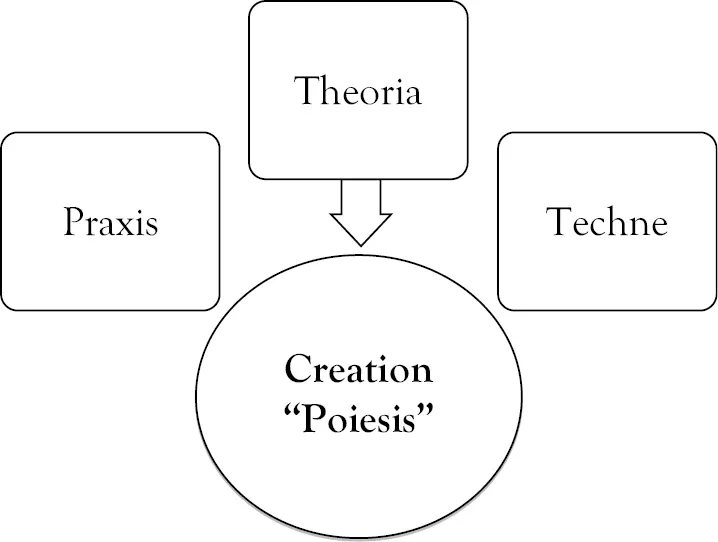
Figure 1.1 Knowledge essential to creativity and production
Poietic organizations learn to apply all three types of knowledge (theory, practice, and craft) in the production of innovative products and services. They invest in the domains of knowledge listed in Table 1.1 in order to excel at what they do.
Table 1.1 Knowledge essential to organizational creativity and production3
| Creation and production (poiesis) | ||
| Practice | Theory | Craft |
| • Managing • Leading • Decision making | • Scientific methods/theory • Systems and organization theory • Theories of human potential | • Improvisation • Design • Experimentation • Aesthetics |
| Strengths and core competencies | ||
For example, it has been shown that improvisational models from jazz are relevant to new product development. Much more so than “making due,” improvising organizations leverage existing processes and procedures by learning to adapt and modify them to changing conditions. Companies such as Nest, Virgin Air, OXO, and Apple take advantage of the power of design to craft award-winning, highly differentiated products and services that are hard to imitate. They are very aware of the role of aesthetics in product and even workplace design. They embrace new emerging models of organization that tolerate uncertainty, duality, creativity, and even chaos. Experimentation is the cornerstone of science, but poietic organizations also use experimentation and tinkering to learn.
Poietic organizations also leverage core competencies (Prahalad and Hamel 1990) in science, technologies, and systems to their benefit. They are adept at managing change, embracing processes of transformation, building superior teams, and reinventing themselves. By making these investments in their knowledge base, they consequently excel at production and creation. At the individual level, they help their employees to realize their creative potential; that is, to become creators. They then pair creators with great managers, leaders, and knowledge workers (i.e., those who infuse teams with new data, information, and knowledge) to create great teams. The purpose of this book then is to focus on how to transform your team and organization to compete with these top creative companies.
Competitive Advantages of the Poietic Organization
Poietic organizations have several competitive advantages over others. Consider the primary ways that businesses compete: cut costs or increase revenues. This insight derives from the equation fundamental to all businesses:
Profits = Revenues − Costs
These generic competitive strategies were first articulated by Michael Porter in the 1980s. In his model, a firm assumes either overall cost leadership or differentiation (Porter 1980, 34−46). Cost leadership requires paying attention to business processes and resource management. Differentiation requires attention to marketing and enhancing the overall value of the product or service. This is accomplished by increasing the quality, aesthetics, functionality, or flexibility of the product or service. Kim and Mauborgne (2005) take these concepts further by suggesting that companies can differentiate and cut costs at the same time. They offer some very useful tools such as the Strategy Canvas for mapping out how to simultaneously eliminate or reduce high-cost components of the product or service, while at the same time increasing or adding new dimensions of value. Poietic organizations are highly...
Table of contents
- Cover
- Half Title
- Title Page
- Copyright Page
- Dedication
- Abstract
- Contents
- Preface
- Acknowledgments
- Chapter 1: Introduction
- Chapter 2: Team Assessment and Development Using Personality Factors
- Chapter 3: Team Assessment and Development Using Multiple Intelligences Theory
- Chapter 4: Team Design with Roles
- Chapter 5: High Performance Improvisational Teams
- Chapter 6: High Performance Design Teams
- Chapter 7: High Performance Research and Scientific Teams
- Chapter 8: Models of Organizations
- Chapter 9: Rise of the Poietic Organization
- Chapter 10: Organizational Transformation
- Chapter 11: Transforming Your Organization into a High Power Creative Design System
- Chapter 12: Summary and Conclusions
- Appendix
- Notes
- References
- Index
- Ad Page
- Back cover
Trusted by 375,005 students
Access to over 1.5 million titles for a fair monthly price.
Study more efficiently using our study tools.
Frequently asked questions
Yes, you can cancel anytime from the Subscription tab in your account settings on the Perlego website. Your subscription will stay active until the end of your current billing period. Learn how to cancel your subscription
No, books cannot be downloaded as external files, such as PDFs, for use outside of Perlego. However, you can download books within the Perlego app for offline reading on mobile or tablet. Learn how to download books offline
Perlego offers two plans: Essential and Complete
- Essential is ideal for learners and professionals who enjoy exploring a wide range of subjects. Access the Essential Library with 800,000+ trusted titles and best-sellers across business, personal growth, and the humanities. Includes unlimited reading time and Standard Read Aloud voice.
- Complete: Perfect for advanced learners and researchers needing full, unrestricted access. Unlock 1.5M+ books across hundreds of subjects, including academic and specialized titles. The Complete Plan also includes advanced features like Premium Read Aloud and Research Assistant.
We are an online textbook subscription service, where you can get access to an entire online library for less than the price of a single book per month. With over 1.5 million books across 990+ topics, we’ve got you covered! Learn about our mission
Look out for the read-aloud symbol on your next book to see if you can listen to it. The read-aloud tool reads text aloud for you, highlighting the text as it is being read. You can pause it, speed it up and slow it down. Learn more about Read Aloud
Yes! You can use the Perlego app on both iOS and Android devices to read anytime, anywhere — even offline. Perfect for commutes or when you’re on the go.
Please note we cannot support devices running on iOS 13 and Android 7 or earlier. Learn more about using the app
Please note we cannot support devices running on iOS 13 and Android 7 or earlier. Learn more about using the app
Yes, you can access Designing Creative High Power Teams and Organizations by Eric W. Stein in PDF and/or ePUB format, as well as other popular books in Business & Leadership. We have over 1.5 million books available in our catalogue for you to explore.