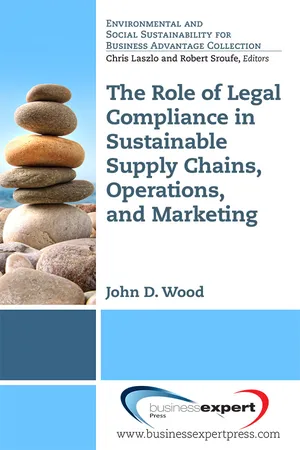
eBook - ePub
The Role of Legal Compliance in Sustainable Supply Chains, Operations, and Marketing
- 160 pages
- English
- ePUB (mobile friendly)
- Available on iOS & Android
eBook - ePub
The Role of Legal Compliance in Sustainable Supply Chains, Operations, and Marketing
About this book
Sustainability is a global megatrend with ramifications
across all functional areas of business. This book addresses
an underdeveloped topic in the field of sustainable
business—the use of corporate resources
dedicated to legal compliance.
In order to comply with the law, supply chain, operations,
and marketing professionals must know what the applicable
legal frameworks are. In order to promote sustainable
business, these same professionals must go beyond mere
compliance with these laws. This book will assist you in
both respects by (1) offering concise discussions of the primary
legal frameworks governing the social, economic, and
environmental dimensions of supply chain management,
operations management, and marketing; and
(2) making the business case for going beyond mere compliance with legal
requirements.
Written by an expert in environmental law and public
policy, this book argues that companies that go beyond
mere compliance with social, economic, and environmental
safeguards inherent in legal regimes will capture greater
benefits and incur fewer risks from their supply chain, operations,
and marketing activities.
Information
Part I
The Role of Legal Compliance in Sustainable Business
Chapter 1
Introduction
What Are We Doing Here?
Sustainability is a global megatrend with ramifications across all functional areas of business. On the demand side, sustainable business is driven in part by investor and consumer demand for socially responsible, environmentally conscientious, and economically valuable products and services. On the supply side, drivers of sustainable business include cost savings from efficient resource use, natural resource scarcity from overconsumption, and increased risk of extreme weather events from a changing climate. Effectively, sustainable business practices reduce costs and risks while increasing long-term value creation and strategic positioning.
Although discussions of sustainability between heads of state began in earnest with the 1987 publication of the United Nations Development Programme report Our Common Future, it has taken over two decades for the policies of sustainability to take hold in the private sector. It would be a mistake to think that sustainability is just a fad that will go out of vogue as soon as economic conditions get tough and businesses are forced to focus on the financial bottom line. That is because sustainable business is the new bottom line.
According to research from MIT Sloan Review based on surveys of over 3,000 business executives and managers representing a wide range of company sizes from all over the world, corporate spending on sustainability actually grew after the global economic recession of 2007, with nearly 60 percent of companies increasing their investment in sustainability initiatives as of February 2011.1 Further, leaders from across industry sectors, from electronics to mining, increasingly agree with the statement that “acting on sustainability is essential to remaining competitive.”2 It now becomes necessary to define “sustainability.”
Let’s start with two key definitions. Sustainable economic development “meets the needs of the present without compromising the ability of future generations to meet their own needs.”3 Sustainable business means “balancing social, economic, and environmental considerations in business decision making; stewarding the natural resource base upon which the business depends; giving back to the communities in which business is done; and promoting long-term value creation for the company’s investors.”4
Even if readers do not share the policy ambitions of sustainable development, it pays to be informed of the legal landscape of business. Legally astute business managers are in a position to understand and proactively address emerging legal issues, which can mean avoided risks and liabilities for the company, resulting in increased firm value.5 For instance, a legally astute executive would be familiar with the potential for legal liability from taking over ownership of a legacy facility that might contain hazardous waste on the premises. Ultimately, it pays to know how law comes to bear on business affairs, and as it turns out, the legal landscape is shifting toward sustainability as a baseline for minimum standards of care in corporate conduct.
Before going further, let’s define the purpose and scope of this endeavor. This book addresses an underdeveloped topic in the field of sustainable business, specifically, the use of corporate legal resources. This is not a book about the legal documents used by business, such as performance contracts, financial instruments, or intellectual property. Rather, this book is about how companies can sustainably manage the resources dedicated to legal compliance.
Now let’s define our central key concept: sustainable legal compliance means avoiding social and environmental harms that the law would otherwise permit by going beyond mere compliance. We will look at the role of legal compliance in promoting sustainability within core functional areas of business: supply chain management, operations management, and marketing.
Let’s Get the Controversy Out in the Open
Obviously, the subject of this book is replete with hot-button issues, such as the proper role of government in regulating economic activity, and the extent of corporate social and environmental responsibility. The temptation is to give in to comfortable assumptions and political views, which tend to cut strongly to the political left or right: on the left, big corporate is bad, and on the right, big government is bad. These superficial generalizations stymie the author’s efforts to carry on a sustained, lucid, and practical discussion of these issues. Personally, I take the militant moderate path, because there is no use in an out-of-balance discussion. Both extreme ends of the spectrum—no regulation versus overregulation of economic activity—are wrong for a lot of reasons.
As a matter of fact, corporate entities are big in terms of influence over public policy decisions, and so too are government entities big in terms of influence over economic activity. Instead of seeking to reduce the influence of existing corporate or government power structures (however valuable that may be), this book seeks to speak to those in government and industry with power over policies. Far from promoting some political ideology, the humble goal of this book is to stimulate the discussion on corporate sustainability by shining light on the neglected topics of the role of law in achieving sustainable supply chains, operations, and marketing.
Putting aside the controversy, from a market perspective, sustainable business can be approached from a tactical and strategic position. Tactically, sustainable business practices facilitate compliance; help avoid regulatory penalties, fines, legal fees, and project delays; minimize supply chain disruption through optimized operations; and enhance emergency preparedness and natural disaster recovery. Strategically, sustainable business practices enhance reputation capital and protect the company brand; shore up social license to operate; and enhance shareholder value.
Sustainable Business in Context
The laws of nature, civil government, and economics are driving corporations toward the new normal of sustainable performance.
Part of the driving force behind sustainable business is the looming problem of resource scarcity. We simply must become better stewards of the natural resources upon which supply chains for raw materials depend. According to a 2011 survey from Ernst & Young and GreenBiz, over three quarters of corporate respondents believe that core business objectives will be impacted by natural resource shortage in the next 3 to 5 years.6 The painful pinch of running up against nature’s barriers to growth is nearly upon us. The risk of overexploited natural resources on business performance is so material that dependency on forest products, rare earth metals, minerals, and water resources is becoming a de facto financial reporting obligation.
In addition to nature’s barriers to unsustainable growth, government entities at all levels of political organization—municipal, state, regional, national, and international—have started taking initiatives to solve the interconnected social, economic, and environmental challenges of sustainable development. However, in a certain respect, the one-way ratchet proliferation of laws, rules, regulations, guidelines, and standards can be an impediment to efficient economic activity.
Laws are general statements of public policy made by the legislative branch that describe the goals and powers of government to address the health, safety, and welfare of the country. Rules and regulations are specific statements of policy made by the executive branch to implement laws enacted by Congress. Guidelines and standards are detailed explanations of substantive and procedural regulatory requirements provided by the executive branch to facilitate private sector compliance with regulations.
For example, the Clean Air Act is a law enacted by Congress to address environmental and public health issues from air pollution, whereas the National Ambient Air Quality Standards are regulations designed to implement the goals of the Clean Air Act, and New Source Review Policy and Guidance documents are meant to improve compliance with the regulations authorized by the law. (We discuss the Clean Air Act at greater length in Chapter 6.)
As the legal environment of business becomes increasingly complex with new laws, regulations, and guidelines, the more painful compliance becomes for borderline compliant firms. If the private sector can take the lead on sustainability issues, the pressure for governmental responses to social and environmental problems may be reduced. An operating environment with success defined by market competition rather than government mandates may be good for business. But free market dynamics that create major externalities, such as air pollution, call for a governmental response.
Sustainable legal compliance in the private sector would incrementally reduce the need for top-down laws, regulations, and guidelines through a process of industry driven self-governance. What would leadership in the area of legal compliance look like? We answer this question at the end of each chapter in this book with practical applications to go beyond mere compliance.
The Good, the Bad, and the Ugly News
Many companies have seized the opportunity to become a leader in terms of sustainable performance metrics. Unilever, Timberland, Seventh Generation, and many others have demonstrated that businesses can make a lot of money doing right by society and doing right by the environment. These companies are the “good news.” Hopefully, there will be more good news in years to come. The “bad news” is drawn from companies that, through innocent mistake or criminal negligence, have failed to manage risks to the environment and public welfare, or even positively created risks that materialized in disastrous fashion. Catastrophic oil spills and financial scandals come to mind as exemplars of unsustainable corporate performance. Unfortunately, it seems there will always be bad news.
The ugly news is that the transition from the unsustainable status quo to a sustainable economy will involve many small steps forward and backward as markets respond to an unprecedented, tectonic shift in what it means to responsibly run a business. For instance, trying to do the right thing can lead to adverse unintended consequences; putting the planet before profits might punish some companies for failing to strike the appropriate balance. Alternatively, some companies will continue to be rewarded despite poor environmental performance. Puberty is ugly too, but still a necessary transitional phase toward maturity. Ugly news should be treated as mere growing pains to a maturing economy, and should not be viewed as a refutation of the general sustainability imperative.
Where Do We Go From Here?
The U.S. government, like many civil governments around the world, regulates economic activity that adversely impacts the environment, public health, and worker safety. Often these regulations take the form of rules laid out in complex statutory schemes,...
Table of contents
- Cover
- Half Title
- Title Page
- Copyright Page
- Abstract
- Contents
- Disclaimer
- Part I The Role of Legal Compliance in Sustainable Business
- Part II Legal Compliance in Sustainable Supply Chain Management
- Part III Legal Compliance in Sustainable Operations Management
- Part IV Legal Compliance and Sustainability Marketing
- Part V Legal Compliance and Climate Change Mitigation
- Conclusion
- Notes
- References
- Index
- Ad Page
- Backcover
Trusted by 375,005 students
Access to over 1.5 million titles for a fair monthly price.
Study more efficiently using our study tools.
Frequently asked questions
Yes, you can cancel anytime from the Subscription tab in your account settings on the Perlego website. Your subscription will stay active until the end of your current billing period. Learn how to cancel your subscription
No, books cannot be downloaded as external files, such as PDFs, for use outside of Perlego. However, you can download books within the Perlego app for offline reading on mobile or tablet. Learn how to download books offline
Perlego offers two plans: Essential and Complete
- Essential is ideal for learners and professionals who enjoy exploring a wide range of subjects. Access the Essential Library with 800,000+ trusted titles and best-sellers across business, personal growth, and the humanities. Includes unlimited reading time and Standard Read Aloud voice.
- Complete: Perfect for advanced learners and researchers needing full, unrestricted access. Unlock 1.5M+ books across hundreds of subjects, including academic and specialized titles. The Complete Plan also includes advanced features like Premium Read Aloud and Research Assistant.
We are an online textbook subscription service, where you can get access to an entire online library for less than the price of a single book per month. With over 1.5 million books across 990+ topics, we’ve got you covered! Learn about our mission
Look out for the read-aloud symbol on your next book to see if you can listen to it. The read-aloud tool reads text aloud for you, highlighting the text as it is being read. You can pause it, speed it up and slow it down. Learn more about Read Aloud
Yes! You can use the Perlego app on both iOS and Android devices to read anytime, anywhere — even offline. Perfect for commutes or when you’re on the go.
Please note we cannot support devices running on iOS 13 and Android 7 or earlier. Learn more about using the app
Please note we cannot support devices running on iOS 13 and Android 7 or earlier. Learn more about using the app
Yes, you can access The Role of Legal Compliance in Sustainable Supply Chains, Operations, and Marketing by John D. Wood in PDF and/or ePUB format, as well as other popular books in Business & Business generale. We have over 1.5 million books available in our catalogue for you to explore.