- 192 pages
- English
- ePUB (mobile friendly)
- Available on iOS & Android
eBook - ePub
Attributes of Project-Friendly Enterprises
About this book
Project management sophistication is the state of enterprise practices in which success of projects is predictable and that the definitive measure of project management success continually improves with time. Sophistication in project management will lead to efficiency in operations and better profits. Enlightened enterprises are sensitive to project management sophistication and the definitive way of measuring it and improving it. As full assessment of the organizational project management sophistication is relatively time consuming and costly, enterprises have a need and desire for instruments that would provide an estimate of the project management maturity of the organization with less effort. This book includes such instruments and attributes of a successful enterprise. Attributes of Project-Friendly Enterprises creates a structured approach and presents attributes of a healthy project environment that include key indicators of success for projects, proposals, portfolios, project teams, Project Management Office (PMO), and the enterprise.
Information
CHAPTER 1
Introduction
In practical terms, the primary objective of an organization is to create value for its stockholders. The interests of the stockholders will be served when the organization creates a healthy profit through the achievement of its strategic objectives. And projects are the instruments by which an enterprise accomplishes its strategic objectives.
Organizations, due to the nature of their business, design and execute projects that can be classified as internally and externally funded projects. In organizations that conduct externally funded projects for a fee (of sorts) on behalf of external clients, efficiency in the conduct of projects is the means by which the amount of real profit is enhanced. If the primary line of business of the organization is service, manufacturing, or research; the projects in the organization are probably internally funded, and the missions of project teams are to create increased operational efficiency, new products, or new markets.
McKinsey found that nearly 60 percent of senior executives felt that building a strong project management discipline is a top-three priority for their companies as they look to the future.
PMI, in its report of “Value of Project Management” opined that implementation of project management helps create a strategic value chain that gives companies competitive advantage, specifically in high-risk sectors and markets. Ability to deliver projects on time and within budget often determines whether a company will get the next job or whether its new product hits the market.
The Economist Intelligence Unit survey reported that 90 percent of global senior executives ranked project management methods as either critical or somewhat important to their ability to deliver successful projects and remain competitive.
Source: PMI (2010).
Even internally funded projects still play an important role in the profit margin, albeit indirectly. In the case of a nonprofit organization, the projects are executed either internally or externally and are conceived to serve its main purpose, which is a social cause and not profit. However, the underlying project management principles of effective and efficient use of resources are still valid and important to expand their services for social cause without increase in their resources.
Sophistication in managing projects in and of itself should, and does, appeal to enterprises because it provides a point of pride among peers. However, project management sophistication has an enormous amount of operational practicality for creating improved organizational capabilities. In turn, operational efficiency has the practical advantage of providing the foundation of profitability, competitive edge, and first in class position (Figure 1.1).
Project management sophistication refers to the state of enterprise practices in which success of projects is predictable, and in which the specific measures of both the project management success and project success continually improve with time. However, it must be noted that organizational processes are considered mediating variables for project success. In other words, there is no direct correlation between project management processes and project success, which is influenced by people-related factors and team effectiveness in managing task-related project factors such as cost, scope, and schedule. Organizational processes are different from project management methods and properly designed project management methods are proven to reduce risks, cut costs, and save time, thereby impacting the project success.
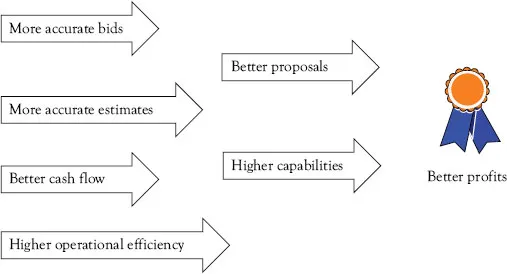
Figure 1.1 Benefits of project sophistication: Internally and externally funded
Sophistication of Project Management
Enlightened enterprises are sensitive to project management sophistication, the specific way of measuring it, and the methodical manner of improving it. In some contracting environments, efficiency in managing the projects is a prerequisite for being selected as the performing organization for an externally funded project.
It is a pragmatic and healthy policy to subscribe to a continuous improvement plan that is guided by regular formal assessment of the manner by which the organizational projects contribute to organizational success and growth. Continuous monitoring of the vital statistics of the project management activities is significantly valuable (directly or indirectly) in providing a tool for overall enhancement of all aspects of the operations of the enterprise. As project management encompasses project proposals projects, programs, and portfolios, a sophisticated enterprise collects performance data not only on projects, but also on proposals and portfolios. Performance data of projects, proposals, and portfolios include various important aspects such as effectiveness of project management processes, tools, implementation, performance, and end results. In turn, with data on the status of all ongoing project management initiatives in hand, a sophisticated enterprise can put measures in place in order to continually improve all of the project implementation processes (Figure 1.2).
Enterprise-specific historical data are paramount in planning proposals, projects, programs, and portfolios. There might be organizations for which there is no meaningful historical data for quantifying each of the four major project management functions, that is, project management, proposal management, project portfolio management, and proposal portfolio management. In these cases, one would have to presume that the enterprise is highly unsophisticated; and by extension one would have to presume that the formalized system for managing those features of the enterprise might have just been initiated. Naturally, the proposal portfolio management will not be among the organizational functions if the organization does not engage in formal proposals for externally funded projects.
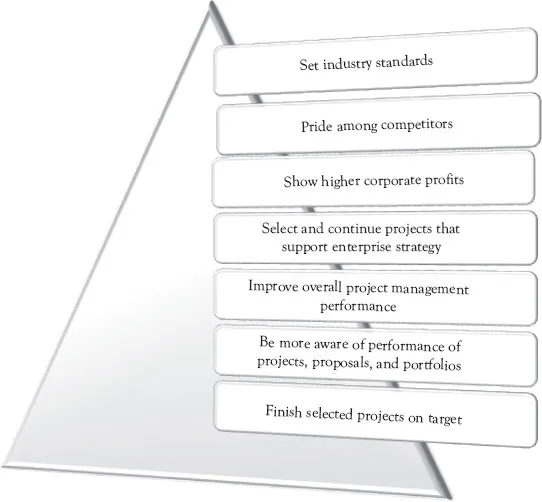
Figure 1.2 Stages of project management sophistication
In an enterprise that is not highly sophisticated, projects are initiated in isolation of one another, and are based on ad hoc urgencies. Since the projects are initialed in isolation of one another, there usually is not a centralized listing of all projects and there is always a very good chance that some of the projects duplicate one another, partially or totally. By contrast, a sophisticated enterprise has a formalized, logical, and consistent structure for initiating, and for organizing its projects. With a collective view of the current and proposed projects, a sophisticated enterprise will be able to authorize new projects with consistency, with efficiency and effectiveness, and without duplication of projects.
In an organization that is sophisticated in project management, there are four different project management teams, all of which contribute to the overall project management mission of the enterprise. These teams deal with execution of projects (internally funded or externally funded), proposals for externally funded projects, portfolios of proposals, and portfolios of internally funded projects. Although the missions of these teams are distinctly different, there might be some overlap in the personnel who serve on these teams.
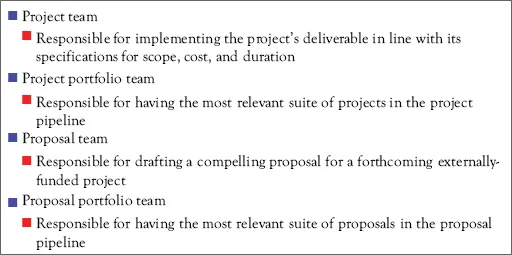
Figure 1.3 Organizational project management teams
In sophisticated organizations, one would be able to identify the teams that are charged with handling different project management missions. Specifically, one would be able to find teams that manage individual projects, teams that manage portfolios of internally funded projects, and teams that manage proposals for externally funded projects (Figure 1.3).
By comparison, in unsophisticated organizations, the distinctly different project functions have not been formalized, nor have they been clearly identified. Therefore, the missions of the teams become highly diffused, and usually the senior management tends to be part of all of these teams. The participation of senior management is usually characterized as review, approval, or governance. There is a debate as to whether the senior management, of unsophisticated organizations, is obligated to attend these meetings because the objectives are vague, or that the presence of senior management in these teams is the source of the vagueness in objectives in the first place.
Programs, Projects, and Portfolios
There is an overlap between the definitions, components, and domains, of portfolios, projects, and programs. Projects and programs have an overlap in the execution phase; in that, a program can often be considered to be a very large project that is composed of many related small projects and it has long duration. Often a program is perceived as more permanent. Another overlap between projects and programs is that considerations for the management of knowledge areas are roughly the same for projects and programs. Portfolios and programs have overlaps in the prioritization for authorization of the projects within them, and in prioritization of those projects for execution. Prioritization for authorization is normally conducted in the light of limited funds, whereas prioritization during execution is normally conducted in the light of limited resources. In this book, although programs are not explicitly covered, their execution features are addressed through projects, and their prioritization features are addressed through portfolios.
Enterprise Project Management
Project proposals constitute the detailed and formal means for the initiation process for externally funded projects. A far less formalized proposal will be necessary for initiating internally funded projects, primarily because the performing organization and funding organization are one and the same in this case. Detailed proposals are somewhat uncommon for internally funded projects although, if present, they suggest sophisticated and unbiased approach to approving internal projects for implementation.
Projects are at the core of the project management activities. An informed view of a project will include detailed data on attributes such as cost, schedule, and quality across many phases (initiation, planning, monitoring, etc.). Additionally, the informed view will provide data for characterizing the predictions for project completion. It also provides documented and definitive indicators for the progress toward those completion predictions. On the other hand, an informed view of a proposal will include details of proposal cost, the value of the resulting project, expected profit, and so on.
A portfolio is a collection of projects or proposals that are connected to ea...
Table of contents
- Cover
- Title
- Copyright
- Preface
- Acknowledgments
- Chapter 1. Introduction
- Chapter 2. Project Attributes
- Chapter 3. Proposal Attributes
- Chapter 4. Portfolio Attributes
- Chapter 5. Team Attributes
- Chapter 6. Enterprise Attributes
- Appendix
- Bibliography
- Index
- Adpage
Trusted by 375,005 students
Access to over 1.5 million titles for a fair monthly price.
Study more efficiently using our study tools.
Frequently asked questions
Yes, you can cancel anytime from the Subscription tab in your account settings on the Perlego website. Your subscription will stay active until the end of your current billing period. Learn how to cancel your subscription
No, books cannot be downloaded as external files, such as PDFs, for use outside of Perlego. However, you can download books within the Perlego app for offline reading on mobile or tablet. Learn how to download books offline
Perlego offers two plans: Essential and Complete
- Essential is ideal for learners and professionals who enjoy exploring a wide range of subjects. Access the Essential Library with 800,000+ trusted titles and best-sellers across business, personal growth, and the humanities. Includes unlimited reading time and Standard Read Aloud voice.
- Complete: Perfect for advanced learners and researchers needing full, unrestricted access. Unlock 1.5M+ books across hundreds of subjects, including academic and specialized titles. The Complete Plan also includes advanced features like Premium Read Aloud and Research Assistant.
We are an online textbook subscription service, where you can get access to an entire online library for less than the price of a single book per month. With over 1.5 million books across 990+ topics, we’ve got you covered! Learn about our mission
Look out for the read-aloud symbol on your next book to see if you can listen to it. The read-aloud tool reads text aloud for you, highlighting the text as it is being read. You can pause it, speed it up and slow it down. Learn more about Read Aloud
Yes! You can use the Perlego app on both iOS and Android devices to read anytime, anywhere — even offline. Perfect for commutes or when you’re on the go.
Please note we cannot support devices running on iOS 13 and Android 7 or earlier. Learn more about using the app
Please note we cannot support devices running on iOS 13 and Android 7 or earlier. Learn more about using the app
Yes, you can access Attributes of Project-Friendly Enterprises by Vittal S. Anantatmula,Parviz F. Rad in PDF and/or ePUB format, as well as other popular books in Business & Project Management. We have over 1.5 million books available in our catalogue for you to explore.