eBook - ePub
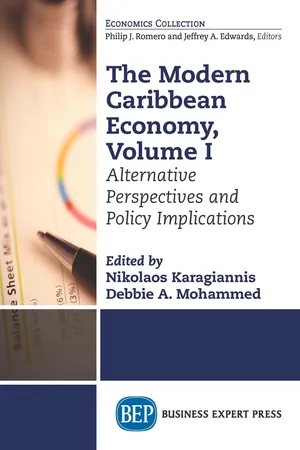
The Modern Caribbean Economy, Volume I
Alternative Perspectives and Policy Implications
- 98 pages
- English
- ePUB (mobile friendly)
- Available on iOS & Android
eBook - ePub
The Modern Caribbean Economy, Volume I
Alternative Perspectives and Policy Implications
About this book
Caribbean economies have been faced with mounting challenges arising from the increasing pace of economic globalization. The financial crisis of 2007 further exacerbated economic instability due to high foreign debt, lack of competitiveness, declining productivity, and high unemployment and underemployment. This in turn has precipitated increasing social and environmental problems, including poverty, inequality, crime and violence, and environmental degradation, all of which require new perspectives and policy approaches for transformative change and sustainable development. In this two volume multidisciplinary edited book The Modern Caribbean Economy, Volume I provides scholars and practitioners with alternative theoretical perspectives and concrete policy recommendations, while Volume II discusses economic, industrial, and social problems facing the Caribbean along with pragmatic proposals to successfully deal with these, while building local resilience and enhancing institutional strength in the region.
Trusted by 375,005 students
Access to over 1.5 million titles for a fair monthly price.
Study more efficiently using our study tools.
Information
CHAPTER 1
The Contribution of Canadian Economic Thought to Caribbean Political Economy
A Preliminary Investigation
Zagros Madjd-Sadjadi
Summary
Chapter 1 seeks to investigate whether there are common theoretical threads between Canadian economic thought and Caribbean political economy. In doing so, the author briefly discusses the “staples theory,” the work of Arthur Lewis, the Plantation school literature, and contributions by Eric Williams and William Demas. The author then identifies key points of commonality and disagreement between the different approaches, and concludes with a discussion as to why the Canadian connection was dropped and the Lewis connection was downplayed.
Introduction
When I first stepped foot on the campus of The University of the West Indies, Mona as a newly appointed Lecturer of Economics back in 2003, I entered a storied place steeped in tradition. Here was a university that had produced not one, but two, Nobel laureates, including one in economics, Sir William Arthur Lewis, and I was about to join an illustrious company of scholars who had once roamed these fabled halls from the aforementioned Nobel laureate to such giants in Caribbean economic thought as William Demas, Norman Girvan, George Beckford, Kari Levitt, and Lloyd Best, these latter three thinkers forming the genesis of what had become known as the “plantation economy school” of political economy.
Yet, upon first reading the writings of the “plantation economy school” of political economy formulated at The University of the West Indies, Mona, I was struck that it did not appear to be an indigenous literature at all but bore striking resemblance to the work of Canadian staples theory scholars, such as Harold Innis, Mel Watkins, and, interesting enough, Kari Levitt, in her incarnation as a Canadian scholar who produced the classic work, Silent Surrender (1970). The more I looked, the more Canadian connections I saw. Not only was the economic theory similar to that of the staples theorists of Canada but they used similar terminology and each member of the plantation economy school had a notable connection to Canada, with four of them having studied or otherwise worked in the country prior to or contemporaneously with producing their seminal works and the fifth having worked extensively with Kari Levitt. Yet, importantly, no reference to the work of Canadian scholars was found in the plantation economy school literature. I discovered that this was not the only failure to acknowledge those who had come before because much of the time they either failed to acknowledge or openly denigrated Sir William Arthur Lewis contributions to their theory, despite many connections to that theory. For this latter insight, I am indebted to the work of Mark Figueroa (1998), a fellow economist at The University of the West Indies, who has outlined much of these issues in far more detail than I have attempted in the third section of this essay.
In this essay, I will demonstrate that the plantation economy literature is an outgrowth of Canadian “staples theory” with new packaging, which was married to the existing work of Sir Arthur Lewis, Nobel laureate in economics and the quintessential Caribbean economist of the pre-plantation economy school era. The decision, whether it was overt or unconscious, to fail to acknowledge the Canadian legacy has more to do with the politics of the region than anything else. This is not to articulate a position that the plantation economy research does not have unique, important, and fundamentally original contributions. Nothing could be further from the truth. Instead, it simply is an attempt to state that the intellectual founders owe a debt of gratitude to more than those whom they initially acknowledged. In the next section, I provide a brief discussion of staples theory as envisioned by Harold Innis and new staples theory, which has as its major proponents Mel Watkins and Kari Levitt, and which merges staples theory with other forms of dependency theory to support a non-Marxian foreign-ownership model of the economy. I then examine the work of Sir Arthur Lewis and his contributions to the political economy of the region, especially his groundbreaking works Theory of Economic Growth and Economic Development with Unlimited Supplies of Labour. This is followed by a discussion of the Plantation economy school literature of George Beckford, Lloyd Best, and Kari Levitt, as well as its supposed development from the work of Raul Prebisch, Eric Williams, and William Demas. During this discussion, I will identify key points of commonality and disagreement between the three approaches under examination. I conclude the paper with a discussion as to why the Canadian connection was dropped and the Lewis connection was downplayed.
Staples Theory
Staples theory is both a theory of regional equilibrium and regional disequilibrium. In the former context, as discussed by the Economic Council of Canada (1977), the theory reduces down to a form of neoclassical trade theory, wherein spatial distribution of resources leads to comparative advantages such that certain regions end up providing raw materials (the hinterland) while the metropoles (the heartland) end up acting as processors of these raw materials not because they lacked the processing power but rather because they possessed the ability to package and get production to market through access to seaways and other transportation networks. According to this theory, the various boom-bust periods of the Canadian hinterlands correspond roughly to changes in economic demand for those goods and the ability of these regions to extract these resources in a competitive fashion. The collapse of the Atlantic fisheries market due to overfishing and inadequate property rights led directly to the dependency of that region on the rest of Canada. The solution is to allow markets to play themselves out properly, having individuals shift their place of employment and residence to areas of more suitable financial suitability. In other words, it is a theory that stresses people prosperity over place prosperity. Its greatest defender is Courchene (1986) who argues that regional disparities persist because of an inability to separate out these two concepts. Essentially, regional adjustment assistance acts as a form of interprovincial “welfare” that anchors individuals into a particular location, making them less likely to move. While textbooks discuss wage and price flexibility, the real world is one of wage rigidity due to minimum wage legislation, unemployment insurance, and federal policies that provide aid to specifically targeted groups (such as fishermen) to encourage them not to migrate. This is precisely the wrong strategy according to the viewpoint. Courchene (1986: 49) goes out of his way to state, “It would be absurd to argue that the provinces deliberates chose this option. Likewise it would be inappropriate to asset that it was a conscious policy decision on Ottawa’s part to generate the current status quo with respect to the economic viability of various provinces.” However, if this is the case, one wonders why it is that supposedly rational governments could not foresee the consequences of their actions. To argue that a province that is in a position of dependency will not attempt to maximize its own gains from that condition rather than make a (futile) attempt to break free of the chains appears to be an attempt to derive a politically correct stamp on the logical (but undesirable) natural conclusion.
This form of staples theory coincides with the perspective of the Rowell-Sirois Commission (1940) that sees the extraction of natural resources as one of several stages in economic growth that would eventually result in an economy that no longer is tied to the land. Essentially, the argument is that resource extraction provides the necessary income for capital accumulation that will allow the nation to move up the chain of industrialization to the next stage. This is a lovely sentiment but wholly unsupported by facts, which indicate that Canada is still in many ways more like the resource extraction economy of its past than an advanced industrialized economy of Europe’s present. Although Canada has moved up the resource base from fur trade, fisheries, and timber to oil sands, uranium, and potash, it still has a long way to go to become the processing giant that the United States, Europe, or Asia is. In some ways, having resources provides one with the “resource curse”, even if it is a relatively benign affliction of it.
In contrast to the equilibrium model depicted above, Harold Innis, in The Fur Trade in Canada, provides a decidedly disequilibrium model of the economy and is, in fact, the precursor to modern dependency theory, of which the Plantation School play a part. Innis was an economic historian trained in the American Institutionalist school tradition to look at how economic structures determine our destiny. In his book, A History of the Canadian Pacific Railway (Innis 1923, 294), he alleged that the exporting for the Canadian prairie provinces of wheat, a staple crop, grown under conditions of pure competition but that were transported by a veritable monopoly in the Canadian Pacific Railroad created the basis for exploitation of the region: “The question as to whether the prairie provinces shall control their own natural resources has become increasingly difficult . . . the dominance of eastern Canada over western Canada seems likely to persist.” Similarly, in his books, The Cod Fisheries (1940) and The Fur Trade in Canada (1930) the locus of control that exists was always in the hands of the dominant powers that could wield monopoly power over the staple producers. This dichotomy would play a central role for Innis in the development of the new Canadian economy:
The economic history of Canada has been dominated by the discrepancy between the center and margin of western civilization. Energy has been directed towards the exploitation of staple products and the tendency has been cumulative. The raw material supplied to the mother country stimulated manufacturers [in the mother country] of the finished product and also of the products that were in demand in the economy. (Innis 1956c: 385)
In other words, Canada, being a staples producer for the main country, found itself in a peculiar position. As its comparative advantage lay in its ability to produce natural resources in a competitive environment, there would not be a surplus gained to allow it to develop the same level of industry as was found in Europe. This could lead to one of three different possible scenarios. The first was an outgrowing of the original staples economy. It was this view that was undertaken by W. A. Macintosh (1964) who would argue, similar to Rostow’s (1960) Stages Theory of Industrialization, that staples production was but a necessary first step in a transition to a full-fledged manufacturing power. However, this could only occur if diversification around the economic staple could be sufficient to catapult the economy to the next level. For example, Ontario began as a producer of wheat and barley. To get these commodities to the market, it developed transportation linkages and the servicing of these linkages allowed the economy to develop an infrastructure necessary to move industrial goods. At the same time, due to its control over transportation linkages and the reduced costs associated with generating small industrial production in the area due to the proximity of this infrastructure allowed the creation of a nascent industrial economy, which later grew into the powerhouse that it is today. However, much of this can also be attributed to import substitution that was carried out under the nationalization policies of various Canadian governments. Thus Canada, through import substitution was able to grow industrially. However, this did not alleviate the natural geographic issues initially found with staples production. Instead, it merely transferred to the industrial heartland of the country the same role that had previously been occupied by the mother country of England, while the staples-producing hinterlands continued to act as economic dependencies. Innis argued that we could not simply take for granted what had transpired in Europe because one could not “fit the phenomena of new countries into the economic theories of old countries” (Innis 1956a: 10).
Innis begins his tale by noting that many of the staples that were produced, all of which were unprocessed at least at first in the country of extraction, were not subject to free competition. The Hudson Bay Company was created for the explicit purpose of supplying fur to England. It was granted a monopoly trading permit to engage in this activity and demand for the product was a derived demand based upon the manufacturing of fur clothes in England. Since the furriers had already set up extensive manufacturing facilities and the new found colony had neither a transportation network nor a large population of Europeans at the time, the tendency would be to ship these products back to England for eventual manufacturing. Canada grew in population predominantly by immigration and, therefore, it would not have the industrial capabilities of the mother country. The reason for this was two-fold. Industrialization required a large population to be moved from off the land into factories and this was simply not available in Canada. Second, industrialization was quite advanced relative to another that could be undertaken in Canada during this time so there was little incentive to develop industrial capabilities given that the major market for these goods was the mother country. It made little difference whether one was to produce in the colony or in the home country, since very little of the output of the colony would go to service the colonial population. Therefore, there would be little incentive to create manufacturing plants. It was only when the population became large enough to support its own manufacturing that such endeavors became reasonable and the tendency was then to locate such plants in what would be the industrial heartland due to transportation linkages.
Thus, staple production created the impetus for more immigration and whether industry would be set up tended to depend on the nature of the staple itself. The gathering of cod, for example, caused the development of secondary industries supporting the development of fisheries, such as shipbuilding. Production of wheat led to railroads, barges, and production of grains and cereals. Staples also defined the characteristics of the society with fishery-based economies having less centralization than agricultural-based economies since the latter’s products had to be moved to rail lines that were permanently positioned:
Concentration on the production of staples for export to more highly industrial areas in Europe and later in the U.S. had broad implications for the Canadian economic, political, and social structure. Each stable, in turn left its stamp, and the shift to a new staple invariably produced periods of crises. (Innis 1956b: 8)
This transformation from one staple to another was a second possible avenue of adjustment. As technology and tastes changed, so too would the staple production. Lobster production, for example, which is now a major source of fisheries income in the North Atlantic had no major basis until the start of this century as the delicacy was regarded more as suitable for the likes of orphans and prisoners. Lobster meat was used as fertilizer in the Maritimes up until the turn of the last century. This ended with the development of modern transportation that allowed the lobster to be sold live in faraway ports. The denigration of taste that occurred in the canning process was alleviated and the commodity became much more valuable. This is one way that staples producing economies can survive, by adapting and changing with the times.
The third possibility is what is known as the staples trap (Watkins 1963). This is the most pessimistic outlook for the staples economy and occurs when “staples exploitation limited the options and opportunities for a more equitable and controlled distribution of economic development, leading the country invariably deeper and deeper into a ‘staples trap’ of dependency and stagnation” (Brodie 1990: 42). As prices fall for the staple over time due to competition from other entities or because quantities fall due to over extraction of the staple or because of increases in population that production of the staple can no longer support or because the staple is no longer in such great demand for whatever reason, the country becomes mired in poverty and its dependency on the staple becomes an albatross around its proverbial neck. This tends to occur when backward, forward, and final demand linkages are insufficiently broad to support a higher standard of living or the progression to a new type of economy is no longer dependent on the now outdated staple.
Sir William Arthur Lewis
The only Nobel laureate in economics to have worked in the Caribbean, his work is significantly denigrated by the Caribbean Plantation School theorists. He was born in St. Lucia and was a prominent figure in the development of the West Indies, taking a position at the University College of the West Indies campus in Mona, Kingston, Jamaica as its first Principal from 1958 to 1960 and as the first Vice-Chancellor of the newly formed University of the West Indies, Mona in Kingston, Jamaica from 1960 to...
Table of contents
- Cover
- Half Title Page
- Title Page
- Copyright Page
- Contents
- Acknowledgements
- Introduction
- Chapter 1 The Contribution of Canadian Economic Thought to Caribbean Political Economy: A Preliminary Investigation
- Chapter 2 Towards a Holistic Development Framework for the Caribbean: Key Theoretical Notions and Policy Implications
- Chapter 3 Public Sector Capacity for Governance in the Caribbean
- Chapter 4 Reforming Education in the Caribbean: From Policy to Transformative Leadership
- About the Contributors
- Index
Frequently asked questions
Yes, you can cancel anytime from the Subscription tab in your account settings on the Perlego website. Your subscription will stay active until the end of your current billing period. Learn how to cancel your subscription
No, books cannot be downloaded as external files, such as PDFs, for use outside of Perlego. However, you can download books within the Perlego app for offline reading on mobile or tablet. Learn how to download books offline
Perlego offers two plans: Essential and Complete
- Essential is ideal for learners and professionals who enjoy exploring a wide range of subjects. Access the Essential Library with 800,000+ trusted titles and best-sellers across business, personal growth, and the humanities. Includes unlimited reading time and Standard Read Aloud voice.
- Complete: Perfect for advanced learners and researchers needing full, unrestricted access. Unlock 1.5M+ books across hundreds of subjects, including academic and specialized titles. The Complete Plan also includes advanced features like Premium Read Aloud and Research Assistant.
We are an online textbook subscription service, where you can get access to an entire online library for less than the price of a single book per month. With over 1.5 million books across 990+ topics, we’ve got you covered! Learn about our mission
Look out for the read-aloud symbol on your next book to see if you can listen to it. The read-aloud tool reads text aloud for you, highlighting the text as it is being read. You can pause it, speed it up and slow it down. Learn more about Read Aloud
Yes! You can use the Perlego app on both iOS and Android devices to read anytime, anywhere — even offline. Perfect for commutes or when you’re on the go.
Please note we cannot support devices running on iOS 13 and Android 7 or earlier. Learn more about using the app
Please note we cannot support devices running on iOS 13 and Android 7 or earlier. Learn more about using the app
Yes, you can access The Modern Caribbean Economy, Volume I by Nikolaos Karagiannis,Debbie A. Mohammed, Nikolaos Karagiannis, Debbie A. Mohammed in PDF and/or ePUB format, as well as other popular books in Economics & Development Economics. We have over 1.5 million books available in our catalogue for you to explore.