eBook - ePub
The Unified Theory of Profitability
25 Ways to Accelerate Growth Through Operational Excellence
- 156 pages
- English
- ePUB (mobile friendly)
- Available on iOS & Android
eBook - ePub
The Unified Theory of Profitability
25 Ways to Accelerate Growth Through Operational Excellence
About this book
When we discuss accelerating top line growth and maximizing profitability, we often consider hiring more people, cutting expenses, or raising prices. What we should be doing is looking at different ways to effectively utilize what we already have. Rather than hiring new people, we need to improve the performance of our current employees. As an alternative to cutting costs, we need better invest the money we already spend. Instead of raising prices, identify ideal customers to market and sell to. This book will discuss strategies on how to do all of these things and more. The author provides 25 ways to accelerate revenue growth and increase profitability immediately, without making any new financial investments. That is the Unified Theory of Profitability. It means looking at the organization and finding ways to better leverage what already exists and focusing on the activities or changes that will provide optimal results. Readers will become experts on executing on these strategies. It can be done! Find the solutions that work, commit to implementing them and results will flourish.
Trusted by 375,005 students
Access to over 1.5 million titles for a fair monthly price.
Study more efficiently using our study tools.
Information
PROFITABILITY CATEGORY #1
E Equals MC Squared
Customer loyalty is one of the key factors in growing your profitability. You need to have a stable of customers who come back and buy your products and services. This creates a foundation or a springboard for you to take off from.
One of the biggest misconceptions in business is that a happy customer is a loyal customer. Many organizations (including some of my clients) score very high on customer satisfaction surveys, yet struggle to retain their customers. Who cares if customers are happy if they do not stay?
Instead of having blind acceptance that the customer is always right because they are happy, organizations need to focus on stratifying their customers. Who are your best customers (your “A” customers)? Why are they your best customers? How will you treat them differently? Who are your “B” customers and how will you treat them? Not all customers are created equal.
Once you acknowledge that customer stratification is important, and understand that there are only three aspects to customer relationships, you can then implement the right strategies and spend time with the right customers. The only three aspects to customer relationships that matter are:
1. Repeat business—gathering more business from existing customers
2. Referral business—acquiring new customers through your existing customer base
3. Lack of complaint—retaining customers by avoiding doing anything to cause them to complain
E = MC2 is the resulting equation from the implementation of strategies that create customer loyalty.
E = Emotion (making an emotional connection with customers)
M = Mastering profit margin levers
C2 = Customer continuance
Therefore, if you are able to create an emotional connection with your customers, then you will be able to maximize profit margins and ensure your customers come back.
In the next four chapters, we will explore different strategies on how to increase your customer loyalty and how to leverage that loyalty to accelerate and grow profitability.
CHAPTER 4
Creating Growth Through Your Best Customers
The fastest and easiest way to grow your business is through your existing customers. Full stop. Do not go any further. End of chapter.
Seriously, of course, it is important to acquire new customers to help with the sustainability of your organization, but if you are looking to accelerate growth and profitability, which is the theme of this book, then the first place you need to look is your existing customers.
Figure 4.1 shows the different ways that you can grow with customers.
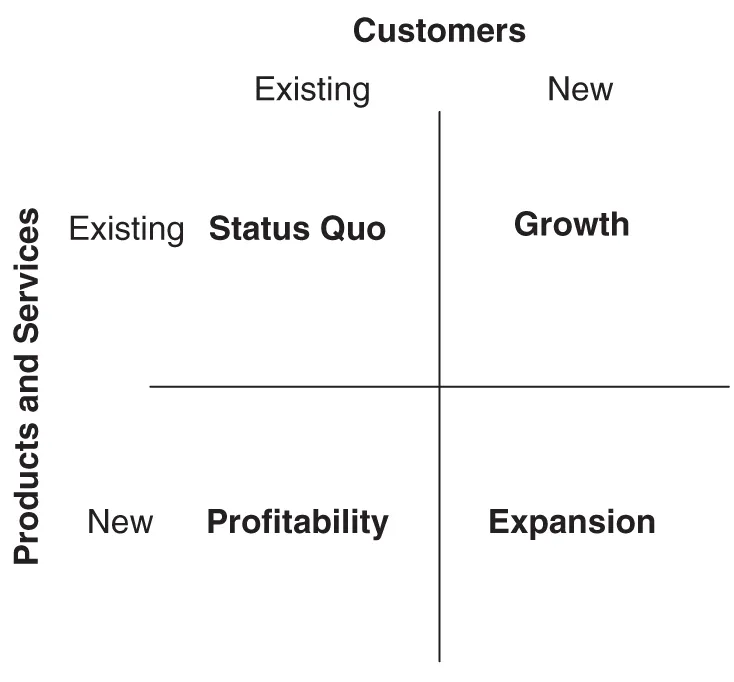
Figure 4.1 Growing your business
You can sell existing products and services to existing customers (Status Quo).
You can sell new products and services to existing customers (Profitability).
You can sell existing products and services to new customers (Growth).
You can sell new products and services to new customers (Expansion).
Experience will show that if your business is in Status Quo, then you are actually declining, and the hardest way to increase profitability is through Expansion. Therefore, we are left with selling new products and services to existing customers, and selling existing products and services to new customers. Which one do you think can have an immediate impact on your organization’s profitability?
If you said selling new products to existing customers, then you win the prize. Here is why:
Your existing customers have already purchased something, and so they are familiar with what you do well.
They have already opened their bank accounts and purchased something from you. You are no longer an unknown to them. So, assuming you at least met their expectations the first time they bought something from you, there is no reason why they would not want to buy more stuff from you.
Therefore, the main reason that customers do not buy more stuff from you is because they do not know what else you offer. Do not assume they know. Assume they do not know and that you have to take every opportunity to tell them.
Costco does a very good job of selling more to its existing customers. In order to shop at Costco, you need to be a member, so that they know exactly who their customers are. They have created a loyal group of customers who shop with them regularly. Costco previously offered only bulk purchases—house supplies, food, beauty products, and so on, but soon realized that they had a captive audience and tonnes of real estate in their stores. Now they offer TVs, sporting goods, clothes, and a lot more items. They took their captive audience and offered them more.
The following are some ways you create the emotional connection with your existing customers that will lead to them buying more products and services from you:
• Offer them access to exclusive products or services (something they can only get from you).
• Treat them like VIPs and make them feel like they are your only customer.
• Offer them input into the development of your new products and services.
• Offer them information and insight not provided elsewhere.
• Onboard them quickly and easily (see Chapter 28 for more details on this).
If you want to increase profitability quickly, start with your existing customers. What else can you offer them that would be of value? What else are they buying elsewhere that they are not buying from you? How can you educate them on what else you offer? If you communicate what you have available and create that emotional connection that keeps them coming back for more, you will see your profits rise.
CHAPTER 5
Eliminating Zero-Margin and Low-Margin Products and Services
Do you know which of your products and services are profitable and which ones are not?
If you do not know, you better find out. How can you make strategic decisions if you do not know where your money is made?
As an MBA student, I worked on a group project for a distribution company. This company distributed more than 100 different newspapers across the country. We analyzed each of those newspapers independently to assess their financial contribution to the company. We found that only 36 of the more than 100 newspapers were profitable for the distribution company. Only one-third of the products they delivered were profitable. That meant everything else was losing the company money. Our advice to them: Get rid of two-thirds of your offerings and focus on growing the ones that make money.
This had not happened previously, because it was a poorly run organization or because it had a weak management team. They had just never looked at the information the way we did. They believed that because they were already delivering newspapers to certain areas of the country, it only made sense to deliver additional newspapers to those same parts of the country. A very logical business decision, right?
The problem is that business is not always about logic. It is about business. More often than not, it is about money. So, although it may make reasonable sense to add more newspapers to a truck already going to a geographic area, it may not make financial sense.
Therefore, what can you do to identify what is profitable and what is not? First, start with a list of everything that customers pay for. What are the sources of revenue for your organization? Now allocate costs to those sources of revenue. Do not make this too complicated at first. Get a ballpark figure because spending too much time and detail on this will take your focus away from what you are trying to accomplish – which is getting an initial sense of where you are making money and where you are losing money.
Where are you making money and where are you losing money? Where are profit margins either nonexistent or very small?
Now you can split your revenue sources into three groups:
• Those products and/or services with strong margins that we will keep offering and want to grow
• Those products and services with weaker margins but with an opportunity to improve those margins
• Those products and services with weak or no margins that we need to stop offering
Let us talk about the third group first—products and services you need to stop offering. At this point, you are asking, “how do I stop offering those products and services?”
Simple. You just stop. Next time someone asks you for that product, you tell them you are no longer offering it. Next time someone wants that service you have offered for 15 years, you tell them you no longer provide that service.
If you want to make the transition easier, then find a more profitable alternative to provide to the customer. “We no longer offer product X, but you might want to try product Y, which does the same thing and lasts longer.” Sometimes you will not have an alternative to offer and that customer will go away. That is all right.
Not every customer is a good customer
Here are some ways to let go of your zero- and low-margin business:
• Offer an alternative produce or service that has higher margins.
• Stop offering it altogether and focus on growing your higher-margin business.
• Set up a business partnership and refer customers looking for those products and services to someone else.
• Sell that portion of the business to another company.
It does not really matter how you do it, it is just important that you do it. Companies make tough decisions all the time.
Twenty years ago, it would have been unheard of that IBM did not make computers or that Sony does not make portable music players, but it happened. Just like now, it might be unheard of that in 20 years GM will not make software for cars, only the physical cars themselves.
If we want to stay relevant, our companies need to constantly evolve. If we want to stay profitable, we have to get rid of our sacred cows. That means letting go of...
Table of contents
- Cover
- Half Title Page
- Title Page
- Copyright Page
- Contents
- Acknowledgments
- Introduction
- The Foundations of Profitability
- Profitability Category #1–E Equals MC squared
- Profitability Category #2–Maximizing Power at the Point of Attack
- Profitability Category #3–Doing the High Jump, Not the Limbo
- Profitability Category #4–Taking Procurement out of the Basement
- Profitability Category #5–The TAO of Cost Minimization
- Profitability Category #6–Supply Chain Optimization
- Profitability Category #7–Operational Excellence
- Profitability Category #8–Your Crystal Ball
- Final Thoughts: Pursuing Excellence, not Perfection
- Index
Frequently asked questions
Yes, you can cancel anytime from the Subscription tab in your account settings on the Perlego website. Your subscription will stay active until the end of your current billing period. Learn how to cancel your subscription
No, books cannot be downloaded as external files, such as PDFs, for use outside of Perlego. However, you can download books within the Perlego app for offline reading on mobile or tablet. Learn how to download books offline
Perlego offers two plans: Essential and Complete
- Essential is ideal for learners and professionals who enjoy exploring a wide range of subjects. Access the Essential Library with 800,000+ trusted titles and best-sellers across business, personal growth, and the humanities. Includes unlimited reading time and Standard Read Aloud voice.
- Complete: Perfect for advanced learners and researchers needing full, unrestricted access. Unlock 1.5M+ books across hundreds of subjects, including academic and specialized titles. The Complete Plan also includes advanced features like Premium Read Aloud and Research Assistant.
We are an online textbook subscription service, where you can get access to an entire online library for less than the price of a single book per month. With over 1.5 million books across 990+ topics, we’ve got you covered! Learn about our mission
Look out for the read-aloud symbol on your next book to see if you can listen to it. The read-aloud tool reads text aloud for you, highlighting the text as it is being read. You can pause it, speed it up and slow it down. Learn more about Read Aloud
Yes! You can use the Perlego app on both iOS and Android devices to read anytime, anywhere — even offline. Perfect for commutes or when you’re on the go.
Please note we cannot support devices running on iOS 13 and Android 7 or earlier. Learn more about using the app
Please note we cannot support devices running on iOS 13 and Android 7 or earlier. Learn more about using the app
Yes, you can access The Unified Theory of Profitability by Andrew Miller in PDF and/or ePUB format, as well as other popular books in Business & Operations. We have over 1.5 million books available in our catalogue for you to explore.