- 172 pages
- English
- ePUB (mobile friendly)
- Available on iOS & Android
eBook - ePub
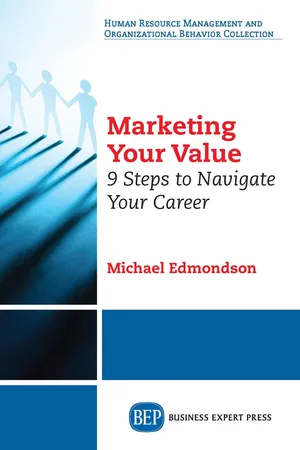
About this book
"This book is an excellent read for college students, recent graduates and mid-career professionals as they navigate their careers and prepare for the next step towards their professional goals." Pareena Lawrence, PhD, Provost and Dean of the College, Professor of Economics, Augustana College, Rock Island, Illinois "In the tradition of 'What Color is Your Parachute' and 'What Should I Do With My Life?', 'Marketing Your Value: 9 Steps to Navigate Your Career' is likely to be invaluable to anyone who is entering the job market, considering a change of direction, or advising those who are." William Pannapacker, PhD, Professor of English, Director of the Andrew W. Mellon Foundation Scholars
Program in the Arts and Humanities, Faculty Director of the Great Lakes Colleges Association's Digital Liberal Arts Initiative, Hope College. Navigating the chaos in today's global marketing place, including global unemployment and underemployment, the digital revolution, and technological advancements, requires a sophisticated strategy that is built upon the paradigm that professional development is directly linked to personal growth. To grow as a professional, therefore, one must increase their self-awareness, build a compelling brand, and then communicate their message in a clear and consistent fashion. This book explains how professionals can market their value to navigate their career and live a life of purpose. Divided into three sections, this publication offers you an opportunity to assess your personal and professional skills, challenges you to create a compelling personal brand, and helps you develop the communication materials necessary to navigate your career.
Information
PART ONE
Assess
CHAPTER 1
Identify Your Purpose
Navigating your career requires you to identify your purpose. Failure to complete this step could keep you in a job with little or no meaning, stuck with no options, or paralyzed with fear to make even the slightest of change in your professional development. The search for meaning and authenticity is an essential human characteristic. Our work, our relationships, and our attitude shape our purpose. For our career to be purposeful we need to identify our authentic self. Career choice is not about the question “What can I do?” it’s about the question “Who am I and who can I be?” As Viktor E. Frankl observed in Man’s Search for Meaning, “Everyone has his own specific vocation or mission in life; everyone must carry out a concrete assignment that demands fulfillment. Everyone’s task is unique as is his specific opportunity to implement it.”1
All too often, however, obligations for work or family, global, political, and economic concerns or our personal health issues present barriers to living with intention and working with purpose. Our obligations require us to spend time, money, and resources. Global events involving politics and economics distract us. And the pursuit for personal health consumes our attention. These factors collide with increased frequency throughout our career and challenge our ability to navigate our career. But our age provides us with a greater source of knowledge and experience from which to define and redefine our purpose. The key is to not let these issues, or any others for that matter, distract us from achieving our destiny. Identifying your purpose and taking the first step to navigating your career involves the following exercises:
• Start with why
• The purpose audit
• The Greater Fool theory
• The milkshake exercise
• A.I.M. for your purpose
Start with Why
Instead of asking the question “What do I want to do with the rest of my life?” you should ask yourself “Why am I doing the work that I am doing?” This is a common question that often goes overlooked by individuals as they are caught up with just having a job so as to pay the bills. Would you like to have a career where the why matters more than just a paycheck? Many successful people and organizations reflect upon why they are doing what they are doing. In Start with Why: How Great Leaders Inspire Everyone to Take Action, Simon Sinek explains how The Golden Circle helps people understand why they do what they do. “It provides compelling evidence of how much more we can achieve if we remind ourselves to start everything we do by first asking why.”2
To design The Golden Circle draw a small circle and write the word WHY in it, then draw a larger circle around that and write the word HOW in it, and finally draw a third circle around the other two and write the word WHAT in it. WHY is at the center of The Golden Circle. Sinek observed that all companies and people know what they do; some understand how they do what they do; but only a select few have examined why they do what they do. The Great Fire of London in 1666 provides an historical illustration in the value of asking why.
After the Great Fire, Sir Christopher Michael Wren, one of the most highly acclaimed English architects in history, had the responsibility for rebuilding 52 churches, including his masterpiece, St. Paul’s Cathedral. The cathedral was built in a relative short time span: its first stone was laid on June 21, 1675, and the building was completed in 1711. Legend has it that Wren would often visit the construction site. During one of his visits Wren came across three stonecutters. Each was busy cutting a block of stone.
Interested in finding out what they were working on, he asked the first stonecutter what he was doing. “I am cutting a stone!” Still no wiser, Wren turned to the second stonecutter and asked him what he was doing. “I am cutting this block of stone to make sure that it is square, and its dimensions are uniform, so that it will fit exactly in its place in a wall.” A bit closer to finding out what the stonecutters were working on but still unclear, Wren turned to the third stonecutter. He seemed to be the happiest of the three and when asked what he was doing replied: “I am helping to build a great cathedral.”3
Questions:
• The third stone mason clearly understood why he was doing what he was doing. Do you?
• When is the last time you thought about why you were doing what you were doing?
• If Wren asked you the same question he asked the stone masons, how would you answer?
• Do you work for an organization that understands why it does what it does?
The Purpose Audit
Throughout this workbook there will be audits for you to complete. An audit asks numerous questions on a specific topic. The intent is for you to engage in reflection long enough to heighten your self-awareness. A higher level of self-awareness provides a strong foundation for the other aspects involved with navigating your career. This audit challenges you to consider 10 statements and corresponding questions related to the level that you currently live and work with purpose.
1. How often do you practice being present? In a given day how often are you fully present and think about what it is you are doing to be an engaged participant? When you are figuring out your life purpose, realize that what you are also doing is being present. As Eckhart Tolle observed, “The more you are focused on time—past and future—the more you miss the Now, the most precious thing there is.”4
a. How much time in a given day do you spend thinking about the past or the future?
b. If you were to assign percentages to your day per section, what would your answer be? (e.g., 20 percent of my day I dwell on the past; 60 percent of my day I worry about the future. For 20 percent of the day I find myself fully present.)
i. _______ of my day is spent with me dwelling on the past.
ii. _______ of my day is spent distracted about the future.
iii. _______of my day is when I am fully present in the Now.
2. You learn how to manage fear. Figuring out your life purpose usually involves some degree of courage to manage your fear. All too often, however, people choose not to follow a career path because of the fear of the unknown, fear of failure, or perhaps even fear of success. Once you learn how to manage fear you can more easily navigate your career and work with purpose instead of just having a job you dislike. Mark Twain once noted that the definition of courage “is resistance to fear, mastery of fear, not absence of fear.”
a. Are you afraid of failure? If so, why?
b. If you have ever failed, what lessons did you learn?
c. What is currently holding you back from navigating your career?
3. You recognize that progress is small. Living with purpose and navigating your career with intention means recognizing that progress will indeed be small on most days. With that in mind, it is important to remember the words of American artist Jasper Johns: “Do something, do something to that, and then do something to that. Pretty soon you have something.”5 “Pretty soon” may be a few years, or even more, but the point is you kept going and made small progress whenever and wherever possible.
a. Do you get overwhelmed with the larger issues in life or are you able to break them down into small components?
b. Are you comfortable completing one small task after another for an extended period of time to complete a large project?
c. Have you ever quit something you started? Why do you think that happened?
4. You understand that anything is possible. Those who live with purpose usually encounter one issue after another. They stay determined and figure out a way to address each situation by understanding that anything is possible. As Laurence Gonzales concluded in his study Deep Survival: Why Lives, Who Dies and Why, “they believe anything is possible and act accordingly.”6
a. Do you believe that anything is possible?
b. If not, what is holding you back from that belief?
c. How often do you find yourself creating options for your life?
5. You get to kick your own ass. There will probably come a time in the pursuit of your purpose that you will need a kick in the pants. At that point you will need to recall the words of motivational speaker...
Table of contents
- Cover
- Half Title Page
- Title Page
- Copyright Page
- Dedication
- Contents
- Foreword
- Preface
- Acknowledgments
- Introduction: Think Differently
- Part One Assess
- Part Two Brand
- Part Three Communicate
- Appendix 1 Reading List – Books
- Appendix 2 Reading List – Articles
- Appendix 3 Online Resources
- Notes
- Index
Trusted by 375,005 students
Access to over 1.5 million titles for a fair monthly price.
Study more efficiently using our study tools.
Frequently asked questions
Yes, you can cancel anytime from the Subscription tab in your account settings on the Perlego website. Your subscription will stay active until the end of your current billing period. Learn how to cancel your subscription
No, books cannot be downloaded as external files, such as PDFs, for use outside of Perlego. However, you can download books within the Perlego app for offline reading on mobile or tablet. Learn how to download books offline
Perlego offers two plans: Essential and Complete
- Essential is ideal for learners and professionals who enjoy exploring a wide range of subjects. Access the Essential Library with 800,000+ trusted titles and best-sellers across business, personal growth, and the humanities. Includes unlimited reading time and Standard Read Aloud voice.
- Complete: Perfect for advanced learners and researchers needing full, unrestricted access. Unlock 1.5M+ books across hundreds of subjects, including academic and specialized titles. The Complete Plan also includes advanced features like Premium Read Aloud and Research Assistant.
We are an online textbook subscription service, where you can get access to an entire online library for less than the price of a single book per month. With over 1.5 million books across 990+ topics, we’ve got you covered! Learn about our mission
Look out for the read-aloud symbol on your next book to see if you can listen to it. The read-aloud tool reads text aloud for you, highlighting the text as it is being read. You can pause it, speed it up and slow it down. Learn more about Read Aloud
Yes! You can use the Perlego app on both iOS and Android devices to read anytime, anywhere — even offline. Perfect for commutes or when you’re on the go.
Please note we cannot support devices running on iOS 13 and Android 7 or earlier. Learn more about using the app
Please note we cannot support devices running on iOS 13 and Android 7 or earlier. Learn more about using the app
Yes, you can access Marketing Your Value by Michael Edmondson in PDF and/or ePUB format, as well as other popular books in Business & Human Resource Management. We have over 1.5 million books available in our catalogue for you to explore.