![]()
CHAPTER 1
Project Management Life Cycle for Construction Projects
Objectives
On completion of this chapter, you should be able to
Understand project life cycle and phases
Understand areas of expertise required to manage projects
Learn at a macrolevel how MS-Project can help in managing projects
Project Life Cycle from Owners’ Perspective
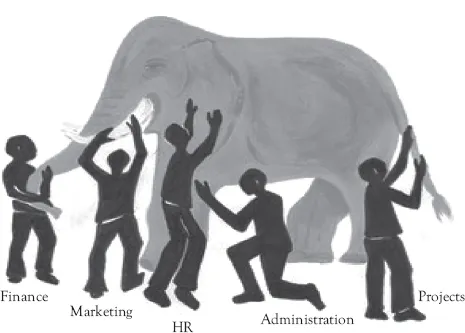
Take a look at Figure 1.1. Does that remind you of a story? Probably, you all have heard this story of five blind men coming across different body parts of an elephant. However, this story highlights the importance of studying the project life cycle from owners’ perspective. Specialists like architects, civil engineers, cost accountants, and finance managers work on big, complex construction projects (during various phases of a construction project, though not at the same point of time). Like the blind men, each of these professionals or experts, may have a different perspective on project management for construction. In large and complicated projects, specialized knowledge is highly beneficial and experts in various specialties provide valuable services. Each of these specialties has contributed to efficient planning and implementation of construction projects. For example, use of Computer Aided Design (CAD) and architectural software in designing buildings has improved planning. However, it is important that these domain experts understand project life cycle and project management phases, to improve the productivity and quality of their work. In the case of emerging economies, projects play an important role in achieving economic growth. Improvement of project management not only can aid the construction industry, but may also be the engine for their national and global economy.
Figure 1.1 Complex construction projects may be perceived in different ways by different specialists, like five blind men encountering an elephant
Project Life Cycle and Phases
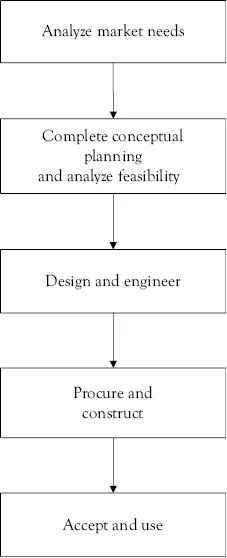
Let us understand the important phases of a construction project till a facility is put in to use. Figure 1.21 shows various phases of a construction project. A construction project starts with the analysis of market demand. These needs may be explicit or implicit (many a time). At the end of this first phase, project objectives and project scope get defined, at a macrolevel. Various possibilities of meeting these objectives will be studied during the second phase, that is, conceptual planning and feasibility studies. Various financing options are also evaluated during this phase. At the end of the second phase, the scope of the project gets clearly defined and a preliminary design is completed. The third phase consists of detailed design and engineering of the facility. This helps you to come out with a detailed blueprint of design and a baseline cost. During the procurement and construction phase, the required material is procured and construction is carried out in a planned and controlled manner. Once the construction is over, the owners may inspect to verify the scope of the work. They may also suggest some changes in the facility. After some trials and errors, the constructed facility is handed over to the owner for use.
Figure 1.2 Phases of a construction project
The earlier discussion relates to a typical construction-project life cycle. The relationship between the phases in a project life cycle may vary depending on application area, speed of execution, and so on. There can be three typical ways in which project phases are related to each other, mentioned as follows:
Sequential relationship, in which the project is divided into separate phases and each phase is carried out successively in sequence
Overlapping relationship, in which phases may be overlapping, such as the use of phased design-construct procedures for fast-track execution
Iterative relationship, which has been used extensively in the recent past for projects with rapidly changing requirements
Major Types of Construction
There can be four major types of construction mentioned as follows. For different types of projects we may have different methods of identifying vendors and contractors, procuring professional services, awarding construction contracts, sponsoring the project, and generating and sharing the revenue.
Residential housing
For example, row houses, bungalows, single-family houses, apartments
Institutional and commercial building construction
For example, schools and universities, hospitals, sports complexes (like football stadiums)
Specialized industrial construction
For example, refineries for crude oil processing, steel mills, chemical processing plants, thermal and wind power plants
Infrastructure and heavy construction
For example, highways, mass transit systems (like Metro rail), tunnels, and sewage treatment plants
Project Management and Areas of Expertise
Project Management Institute, abbreviated as (PMI)®, is the world’s leading not-for-profit professional membership association for the project, program, and portfolio management profession. A Guide to the Project Management Body of Knowledge, popularly known as PMBOK ® Guide, is a book that presents a set of standard terminology and guidelines for project management. PMI’s global standards are the backbone of the profession, making sure you have the project management foundation to succeed. Much of the discussion in this book related to project management processes and so on is based on the PMBOK ® Guide (5th edition).
PMBOK ® Guide defines a project as a temporary endeavor undertaken to create a unique product, service, or result.
Project management is defined as the application of knowledge, skills, tools, and techniques to project activities to meet project requirements. It involves directing and coordinating human and material resources throughout the life of a project by using modern management techniques to achieve project objectives (like scope, cost, time, and quality). It is a project manager’s responsibility to achieve project objectives.
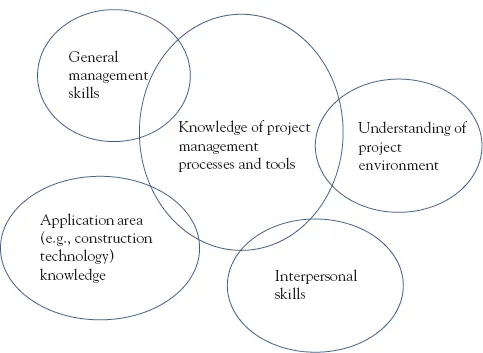
What knowledge and skills are required for the project management team? To manage projects effectively, there are five areas of expertise needed, as shown in Figure 1.3.
These five areas are:
Knowledge of project management processes and tools
Knowledge of application area
Understanding of project environment
General management skills
Interpersonal skills
As you observe from the diagram (Figure 1.3), these areas are not distinct and may generally overlap. While all members may not be conversant with all the areas, it is important to have a team that is conversant with knowledge of project management processes and tools. We shall discuss about knowledge of project management, in the subsequent section.
Figure 1.3 Areas of expertise needed for managing projects
Application areas refer to very specific technical domain or management specializations that are needed for a particular category of projects, for example, construction engineering, urban planning, architecture, and marketing management. Each application area generally has a set of accepted standards and relevant regulations.
Project environment is a cultural, social, and physical environment in which the project is being executed. The project team needs to understand how the project affects various stakeholders like local residents, end users, and consumers (and vice versa). For example, if a project team is associated with infrastructure development in the Middle East, some team members may have to be familiar with the local laws and customs of the Middle East.
General management skills encompass planning, organizing, recruiting, cocoordinating, executing, and controlling skills. These are often essential for the project manager and help in things like defining a suitable organizational structure, defining ground rules, and developing the career path of subordinates.
Interpersonal skills required include leadership, negotiation, and conflict management. For example, a project manager himself or herself may have to negotiate with the customer, vendor, sponsor, and so on.
Knowledge of Project Management
The PMBOK® Guide classifies project management–related processes into five project management process groups and 10 knowledge areas. The 10 distinct areas are mentioned as follows:
Project integration management to ensure that the various project processes are effectively identified, defined, and coordinated
Project scope management to ensure that all the required work and only the required work are included to deliver the project successfully
Project time management to plan and complete the project as scheduled
Project cost management to identify needed resources, estimate the total cost, and maintain budget control to complete the project within approved budget
Project quality management to identify quality policies, objectives, and responsibilities to ensure that the functional requirements of the product or service delivered are met
Project human resource management to develop, employ, and organize project personnel as a team
Project communication management to ensure effective communication with all the stakeholders
Project risk management to identify, analyze, and mitigate potential project risks in a planned manner
Project procurement management ...