eBook - ePub
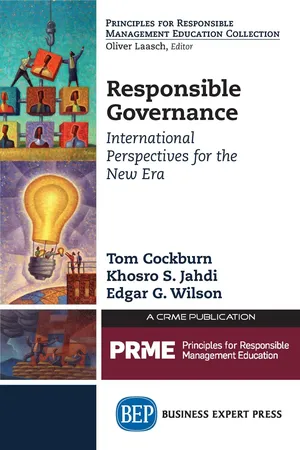
Responsible Governance
International Perspectives For the New Era
- 462 pages
- English
- ePUB (mobile friendly)
- Available on iOS & Android
eBook - ePub
About this book
Evolving stories of governance and change are being written into the emerging custom and practice of all kinds of organizations today, whether they are global or domestic, startup or blue chip, corporate or government agency. Changing ways of 'doing business' are not new, nor is globalization of business, but the velocity and trajectory of both
are rapidly accelerating beyond those seen in previous times. There are increasing concerns and challenges for the boards of directors and other governance systems and processes. They are intended to ensure good stewardship of the diverse organizations in the period following the global nancial crisis. Responsible Governance aims to challenge assumptions and present current debates for readers, grounding the critical issues or descriptions in relevant historical and social contexts as well as suggesting ways forward. Dr Tom Cockburn obtained his rst degree with honors from Leicester University, England, both his MBA and Doctorate were gained at Cardiff University, Wales. Tom is associate fellow of the New Zealand Institute of Management and is currently director-policy for the Center for Dynamic Leadership Models in Global Business and a senior associate of The Leadership Alliance Inc., headquartered in Canada.
Information
CHAPTER 1
Provocations to a Debate
Tom Cockburn
Director (Policy): Center for Dynamic Leadership Models in Global Business, Canada
Khosro S. Jahdi,
Bradford College, U.K.
Edgar G. Wilson
Waikato Institute of Technology, New Zealand
Abstract
This chapter provides a contextual overview to enable the reader to locate the book within the panoramic vista of the rapidly evolving global business environment confronting executives and boards of all organizations whether they are multinational corporations or government agencies. That context is briefly outlined and the significance of the book topic and themes are presented as well as commentary and discussion of the conventional models of the key roles, responsibilities and expectations or assumptions regarding governance and governing bodies. The direction taken and the provocative as well as analytical or descriptive focus of each of the chapters in the book are briefly discussed with respect to key participants, agencies or stakeholders across many countries and regions. The reader is thus enabled to approach the rest of the book with a broader, strategic awareness and compare or contrast the diverse models, cases and themes presented by the authors.
Keywords: leadership, governance, ethics, gatekeepers, corporate social responsibility, sociodigital technologies, complexity.
Introduction
The main overarching rationale for the existence, function, and role of corporate governance (CG) bodies can be briefly summarized as ensuring that enterprises are managed in such a way that their operation does not infringe or inhibit the rights of the wider community or of particular groups of their stakeholders. Today the boards of listed companies in developed countries are generally also seen as a mechanism for ensuring accurate risk intelligence, for directing the company effectively and sustainably while monitoring the agency costs of executive and operational management systems. This involves a notional I owe You (IOU) regarding the future. The future, however, is inherently and increasingly uncertain or ambiguous; hence, the nature and value of any future claim is also uncertain. That is, it is contingent on events that have yet to occur. If the same information is available to all, then informed judgments about the likely future value of assets and their protection may level the playing field for everyone of average intelligence, awareness, and interest. Less capable stakeholders will require additional protection and support from exploitation and loss.
The twenty-first century CG had a relatively poor birth. The metaphorical “gestation” was a period of “gung ho” deregulation and enterprise culture under conservative political leaders such as Reagan and Thatcher. The decade before the new millennium saw a number of high-profile scandals mainly in the United Kingdom and United States, although there were also international repercussions. The year 1990 saw Polly Peck share price crumple as the scandal and CEO Asil Nadir convicted of theft of company funds. In 1995, Barings Bank collapsed and Nick Leeson the futures trader was jailed for his part, though the lax supervision resulted in the senior directors’ disqualification.
The 1990s culminated in an era of excess as well as success and arguably the motto “greed is good” was a core value for many, often justifying excessive, equity-based pay for CEOs and dubious “shortcuts” such as neglecting too close an oversight, enabling obvious manipulations and conflicts of interest to pass without comment or victimization and silencing of potential whistleblowers (Jensen and Murphy 2004; Coffee 2002; Gordon 2002).
The twenty-first century began with a number of corporate scandals such as WorldCom, Enron, and Anderson being exposed in 2001/2002. That happened despite them having developed elaborate ethics codes. The subprime debacle led to the Global Financial crisis of 2007/2008. Often, as in the 1990s, the causes were greed, fraud, accounting malpractice, serious mismanagement, and lax auditing of a number of large corporations’ business practices. At the same time, various potential “gatekeepers” of companies’ moral integrity and probity, such as investment bankers, business lawyers, and rating agencies, often in part, assisted these system and organizational failures (Belcredi and Ferrerini 2013).
There remains considerable diversity and debate around the role of governance boards and their relationship to others, from the C-suite to the shopfloor or the investors. Despite the spread of governance codes, there remains considerable diversity of implementation and functions accorded to the boards as well as who is eligible to be a member even within the European Union (EU) and more so elsewhere in the world. Core issues revolve around the structure and representative composition of boards, the role of independent directors, the unified or separated roles of CEO and chairman, the organization’s ownership structure (including publicly owned organizations), board remuneration policies and practices, shareholder activism, and increasing open CG disclosure. So problems arise with flawed governance systems and with the criminal or incompetent administration of them.
However, the alignment between agents and principals may not be as clear-cut or may be more closely tied to the agents’ personal wealth, or desire to retain control. Some such costs are obvious such as the financial amount of payments and bonuses for senior managers, CEOs, and others are less overt such as the growth of information asymmetries between board and others and undermining accountability to the board’s stewardship. As argued elsewhere,
The issuance of multiple voting shares provided Facebook’s founder Mark Zuckerberg with voting control in excess of his stake in the company. Indeed, he owned approximately 28 percent of his company following the IPO, but the dual class share structure allowed him to exercise 56.9 percent of the voting power, thereby curtailing shareholder rights and reducing the influence of the board of directors (McCahery, Vermeulen and Hisatake 2013).
As these authors state, there are those who agree with Zuckerberg’s dual shares approach—which is not uncommon in many of the social media and related companies. Oracle cofounder Larry Ellison sees the retention of control in this way as a means to protect the company from indifferent, uninterested, or incompetent boards and cites Steve jobs’ sacking from Apple as a case in point (McCahery et al. 2013, 151–2).
Aside from company founders who do not wish to “let go” of the reins of a listed company or other forms of personal aggrandizement in different industries, public service sector, or professions, there are other issues to be addressed. There are currently no universally agreed, enforceable, global governance standards for listed businesses or public bodies in the same way or to the extent that there is with ISO numbers for product specification. Typically, board dynamics and investor relations are often ignored in the CG debate, although as Heskett noted with respect to the United States (2001, 2)
Among board committees, the audit committee has historically received the most attention. Not only are boards expected—and in case of publicly financed organizations required—to have one, independent, so-called “outsider,” director membership on the audit committee has been strongly prescribed. Increasingly, audit committees are called to task for their responsibilities and required to co-sign important communications to shareholders . . .
However, in the same year that WorldCom and Enron scandals erupted, he also remarks that:
While all of this is going on, of course, governance continues to go astray. An organization’s books may be in order, but its performance may be going down the tubes. What’s to be done?
(Heskett 2001, 2)
In the same Harvard Business School paper, Heskett (p2), referring to the Service Profit Chain model, argued that customer and employee satisfaction and loyalty measures are far better predictors of future financial success than are measures of past financial success. Consequently, these kinds of people items should feature strongly in any organization’s balanced governance scorecard, along with the financial measures. He leaves open how often and when such reporting measures should be employed, to whom they must be communicated, and whether (or not) this process ought to be overseen or mandated by the Securities Exchange Commission (SEC). Other matters such as whether the CEO and chair of board should be separated and the extent that company “outsiders” are truly independent rather than spouses or friends of the current CEO (or of new CEOs) are not discussed. There is some research suggesting such friendships feature strongly in the looseness of board oversight. In addition, should investors be briefed on ways that the Initial Public Offering (IPO) listing may be manipulated to favor the current or future leaders retaining more control than other shareholders as in the Facebook example earlier? In light of the rapidly accelerating changes due to the developments in technology, there could be a case for retention of the expertise of such leaders in the early stages of the company post-IPO provided that the information asymmetry is remedied or neutralized in other ways, e.g., by acquiring independent directors or board committees of comparable knowledge and skill as a counterbalance and adding more academics and women to increase independence and board diversity.
Much depends on the scope of corporate laws that apply and on the nature of the company shareholding for public companies. The result is an unstable balance between convergence and divergence, shareholder and stakeholder influence, and European v. national rulemaking (Davies and Hopt 2013). Although several chapters here address the diversity of laws and regulations, established or evolving codes for legal governance alongside leaders’ focus, and capability and will to ensure ethical and responsible governance, we take a much wider perspective. Authors seek to encompass political, social, technological drivers and the impact of the rapid pace of change confronting governance systems.
Although physically the same size as previously, the world is becoming, figuratively speaking, ever-smaller in terms of the global reach of digital communications technologies, global business, and the span of travel and tourism. In cultural, social, and economic or business terms, emerging sociodigital technologies can be disruptive. There are positive and negative effects of this on culture, health, welfare, security, and governance at all levels. So the book has one key theme, which concerns technological drivers of change.
As Nye (2013) states,
World leaders have not yet figured out how to reconcile the moral conviction that all people are equal with the simple fact that all countries are not. In a global information age, governance systems capable of addressing fundamental issues like security, welfare, liberty, and identity will require coalitions that are small enough to function efficiently and a decision concerning what to do about those who are underrepresented.
Other features suggested include forms of knowledge as power such as the development of “Datocracy” where an elite controls the flow of information as well as the smart machines underpinning the conventional or “first economy.” That is achieved by controlling the largely invisible machines that run much of the goods and services in the “second economy” (Arthur 2011).
In the era of big data, artificial intelligence, and smart machines as referred to earlier, we have some proponents of a system of “algorithmic governance” as described by Evgeny Morozov 2014, in an article in “The Guardian Newspaper in the UK.” Basically, “algorithmic regulation” or “cybernetic governance” is a system of control and governance of behavior via an extension of the apps and sensors in much current domestic technology in the home, in the car, in your watch or smartphone, and so on. The governance here is premised upon the ubiquitous and standard installation and “invisibility” of smart sensors in cars, phones, fridges, and other devices. The sensors collect data, which can be analyzed and used to promote, prevent, or forestall certain behaviors by establishing a pattern and “remotely” controlling the negative behaviors or encouraging positive behaviors including purchasing decisions. On the positive side, your fridge, for instance, can tell you that you are running low on some food items or alert health professionals or insurance companies to unhealthy behaviors. Your car can sense and forestall a potential collision by regulating the cars speed, direction, and closeness to hazards. In the United Kingdom, the use of these sensors to control behavior has been proposed by a ThinkTank, for instance, using private car traffic/safety sensors as a means of controlling traffic flows, reducing speeding drivers, or enabling the police to stop the car remotely. Health care and insurance organizations see potential for reducing unhealthy lifestyles in the public and insurance premiums or health care costs (Morozov 2014).
Other themes include the interplay of complex cultural, sociopolitical, legal, and moral imperatives and the impact of global demographic changes on power hierarchies and spheres of influence. Castells (2007) has hypothesized that a number of media trends are converging toward change in the relationship between the leaders and the powerful and between them and those who contest their influence or those who wish to resist or reduce such leaders’ influence in various policy arenas or theaters of action. As a result of these power shifts and social media trends, there have been adaptations in resisters’ and cyber activists’ armory such as “Google bombing” and “Googlewashing,” which Castells (2007, 257) describes as “. . . cultural battles that are fought to a large extent in the communication realm”.
Globally, other critical issues have emerged. For instance, migrations of workers, jobseekers, and refugees have increased the potential talent pool and the potential spread of some diseases and conflicts of various kinds. The social stability and normative “balance” of cultures has tipped into a new rhythm and pace in many areas. Digitization and globalization initiated a process of radical change in business and government effectively rewriting many former norms and implicit “rules” of how things are done. Nevertheless, the disruptive digital technology referred to in this volume is about more than new communications systems.
A new breed of industries has emerged, alongside and parallel to increasing levels and integration of global digital connectivity across all domains of personal and professional life. Smaller players have been able to enter a market and offer online products and services that undercut the preexisting market leaders. On the other hand, scanning for such new frontiers—and related risks—is...
Table of contents
- Cover
- Half Title Page
- Title Page
- Copyright Page
- Contents
- Preface
- Chapter 1 Provocations to a Debate
- Chapter 2 Governance and Agility in Product Development Organizations
- Chapter 3 Rebooting Corporate Governance in India: Understanding the Journey through Institutional and Regulatory Landscape to the Landmark Companies Act 2013
- Chapter 4 The Importance of Enterprise Technology Governance in Effective Corporate Governance
- Chapter 5 Responsible Governance and Financial Accountability: International Perspectives for the New Era
- Chapter 6 Building Trust for the Internal Stakeholder—Governance Footprints within the Organization
- Chapter 7 Corporate Governance and Voluntary Disclosure: A Study on the Banking Industry of Kazakhstan
- Chapter 8 Corporate Governance Disclosures and Firm Performance
- Chapter 9 Disaster Governance—Dealing with an Earthquake
- Chapter 10 The Role of Corporate Governance in Business Performance in Ghana
- Chapter 11 Corporate Governance and Microfinance in Ghana: A Qualitative Insight of Key Stakeholders
- Chapter 12 Multistakeholder Committee for Sustainable Innovation: Creating an Ethical Code in the Jewelry Business. The Experience of the Italian Ethics Committee of Color Gemstones (Assogemme)
- Chapter 13 Understanding Ethical Governance through the Principles of Responsible Management Education— A Literary Study
- Chapter 14 Postscript: Board Dynamics, Market Turbulence, Knowledge Asymmetries, and Long-term Structural Relationships
- Index
Trusted by 375,005 students
Access to over 1.5 million titles for a fair monthly price.
Study more efficiently using our study tools.
Frequently asked questions
Yes, you can cancel anytime from the Subscription tab in your account settings on the Perlego website. Your subscription will stay active until the end of your current billing period. Learn how to cancel your subscription
No, books cannot be downloaded as external files, such as PDFs, for use outside of Perlego. However, you can download books within the Perlego app for offline reading on mobile or tablet. Learn how to download books offline
Perlego offers two plans: Essential and Complete
- Essential is ideal for learners and professionals who enjoy exploring a wide range of subjects. Access the Essential Library with 800,000+ trusted titles and best-sellers across business, personal growth, and the humanities. Includes unlimited reading time and Standard Read Aloud voice.
- Complete: Perfect for advanced learners and researchers needing full, unrestricted access. Unlock 1.5M+ books across hundreds of subjects, including academic and specialized titles. The Complete Plan also includes advanced features like Premium Read Aloud and Research Assistant.
We are an online textbook subscription service, where you can get access to an entire online library for less than the price of a single book per month. With over 1.5 million books across 990+ topics, we’ve got you covered! Learn about our mission
Look out for the read-aloud symbol on your next book to see if you can listen to it. The read-aloud tool reads text aloud for you, highlighting the text as it is being read. You can pause it, speed it up and slow it down. Learn more about Read Aloud
Yes! You can use the Perlego app on both iOS and Android devices to read anytime, anywhere — even offline. Perfect for commutes or when you’re on the go.
Please note we cannot support devices running on iOS 13 and Android 7 or earlier. Learn more about using the app
Please note we cannot support devices running on iOS 13 and Android 7 or earlier. Learn more about using the app
Yes, you can access Responsible Governance by Tom Cockburn,Khosro S. Jahdi in PDF and/or ePUB format, as well as other popular books in Business & Business Ethics. We have over 1.5 million books available in our catalogue for you to explore.