eBook - ePub
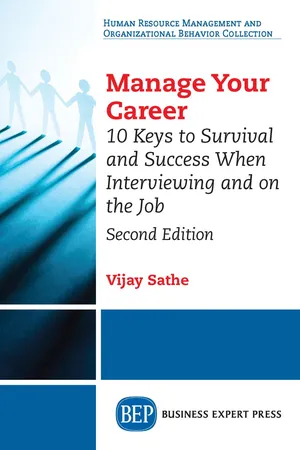
Manage Your Career
10 Keys to Survival and Success When Interviewing and on the Job, Second Edition
- 222 pages
- English
- ePUB (mobile friendly)
- Available on iOS & Android
eBook - ePub
Manage Your Career
10 Keys to Survival and Success When Interviewing and on the Job, Second Edition
About this book
Professor Sathe is a great gift, a passionate teacher who cares deeply about the life arc of each individual student. In his vibrant classroom, he translates strategic management into a personal discipline—and here in these pages, he brings to you and me the bene ts of his wise mentorship. —Jim Collins, author of Good to Great
This book gives the reader the keys to survival and success as his or her career progresses from one job to the next in the same, or a different, organization—be
it for-pro t, nonpro t, government, or volunteer. It is designed to help the reader avoid the many traps and pitfalls encountered along his or her career path and to
help facilitate increased personal effectiveness during all three stages of the job cycle—interviewing, new hire, and long-term employment. Whether preparing to enter the workforce for the first time or in early, middle, or later career stages, this book will show the reader how to avoid jobs and organizations that are not a good fit. It will also go beyond survival and show how to achieve success by doing the job well and making other contributions to the organization in ways that improve job performance, satisfaction, happiness, and personal and professional growth. The keys this book provides will work whether the reader is an independent contributor, a manager
responsible for the work of others, or an executive responsible for the enterprise. Organizational leaders, human resource professionals, career coaches, and mentors can
also utilize this book to educate and train employees to be more productive at work and happy in their worklife.
Information
Topic
Personal DevelopmentSubtopic
CareersPART I
Strive to Create a Positive Impact for Your Organization and Yourself
The first three keys to creating a positive impact for your organization and yourself in any job, in any organization are (1) your fit with the key players and with the organization’s culture; (2) your job challenges in relation to your skills, your effort, and the support you receive to do your job; and (3) the quality of your relationships with the key players and others who are important to your survival and success (Figure 2).

Figure 2 The keys to creating a positive impact for your organization and yourself
Key #1 examines your fit with the key players and with the organization’s culture—that is, the extent to which your beliefs and values are compatible with those of your key players and of others in the organization. The worse your fit, the more difficult it is for you to create a positive impact for your organization and yourself. You will not survive and succeed if your misfit (your “values gap” with the key players and with the organization’s culture) is irreconcilable. If at all possible, you must avoid such an unbridgeable “values gap.”
Key #2 asks whether your skills, the effort you put in, and the support you receive to do your job are adequate given its challenges. If yes, you can perform the job well and enjoy doing it. If not—if there is a “skills, effort, and support gap”—your performance, satisfaction, happiness, and growth will suffer.
Key #3 considers the quality of your relationships with the key players and others who are important to your survival and success. The better your relationships with these people, the more they will support you, and the greater will be your credibility with them. Key #3 is the master key, because it can help you to bridge both your “values gap” and your “skills, effort, and support gap.”
Your credibility (Key #4) is your credit rating in the eyes of the key players and others. It is based on your job performance and other contributions and on how these people perceive these contributions. It can help you to undertake important initiatives that are innovative or politically risky, because the key players and others will support you and even run interference if you have sufficient credibility with them.
The experience of Bob Drake, a new manager, will be used for illustration throughout the book. Here, briefly, is his story.
The first unpleasant surprise for Bob came on his third day with the company when he heard two senior colleagues arguing in public, cursing and shouting at each other. Within the next few weeks he realized this wasn’t aberrant behavior in the company. He was also struck by the very long hours, the infrequent group meetings, and the unusually high amount of rumor and gossip. Bob had previously worked for a company where more polite behavior, shorter hours, more team play, and more openness prevailed. He was disturbed, but said to himself, “It’s too bad they operate this way, but I can live with that without becoming a part of it.”
The next shock was of higher voltage. After about two months with the company, Bob was called into his boss’s office and told he was not being “tough enough.” To “really contribute in this environment,” he was told he would have to become “more aggressive.” Bob was upset but said nothing. For one who prided himself on his competence, the last thing he felt he needed was advice on personal style.
Bob decided he would redouble his efforts to show these people what he could contribute. A large part of Bob’s job involved dealings with peers in another department, and he decided to show them what he could contribute by putting in long hours with them and going out of his way to help them. What Bob experienced, however, was fierce internal competition and the withholding of important information; appeals to various parties were to no avail. At his 6 months’ performance review Bob’s boss told him that he had failed to learn from the feedback given earlier. This was open competition, he was told, and he was not measuring up. Bob got an unsatisfactory rating and was fired.
KEY #1
Your Fit With the Key Players and With the Organization’s Culture
The first key is the extent to which your beliefs and values are compatible with those of the key players and with the organization’s culture.1 The better your fit with the key players and with the organization’s culture, the easier it will be for you to create positive outcomes for your organization and yourself (Figure 3). However, a “perfect fit” is not generally possible because the key players and the organization’s culture can differ from you in many obvious and subtle ways. The bigger your “values gap” with the key players and with the organization’s culture, the more difficult it will be for you to create a positive impact for your organization and for yourself. You must assess the extent of your misfit (“values gap”) and determine if it is irreconcilable (“unbridgeable”).

Figure 3 Your ability to create a positive impact for your organization and yourself depends on your fit with the key players and with the organization’s culture
For example, Bob Drake, the new manager, valued teamwork and a cooperative environment. The key players in his organization believed in cutthroat internal competition. Bob’s misfit with them was irreconcilable; he was unable to survive, let alone to succeed in the organization.
Your list of the key players may change over time (see Exhibit 1, page 4), and your fit with them and with the organization’s culture could get worse or better if their beliefs and values, or yours, change. It is important to assess your fit not only before and after joining an organization but also on a periodic basis thereafter.
If you have an irreconcilable misfit with the key players or with the organization’s culture, it is generally best to move on if you can. Other types of misfits must be managed constructively, as described later.
To assess your fit with the key players and with the organization’s culture, you need to determine the extent to which your personal beliefs and values are compatible with theirs. Key #1 provides the concepts, frameworks, and tools for making these assessments.
Beliefs and Values
Beliefs are assumptions about the world and how it works. They derive from personal experience and are reinforced by it. Individuals also rely to some degree on the judgment and expertise of others whom they trust, or can identify with, to help them decide what to believe or not to believe.
Values are a special class of beliefs, called evaluative beliefs. These are assumptions about what ideals are desirable or worth striving for. Values derive from personal experience and identification with those who have had an important influence on a person’s development since early childhood. Values represent preferences for ultimate end states, such as fairness or compassion.2
Personal Beliefs and Values
Your espoused beliefs and values are what you say (to yourself and to others) are your beliefs and values. However, you may not even be aware of your unconscious beliefs and values. Timothy Wilson explains in Strangers to Ourselves, his authoritative and highly readable book on what we know about the unconscious mind (2002, pp. 6–8), as follows3:
According to the modern perspective, Freud’s view of the unconscious was far too limited. . . . The mind operates most efficiently by relegating a good deal of high-level sophisticated thinking to the unconscious, just as a modern jumbo jetliner is able to fly on automatic pilot with little or no input from the human, “conscious” pilot. . . . It is best to think of the adaptive unconscious as a collection of city-states of the human mind and not as a single, homunculus like the Wizard of Oz, pulling strings behind the curtain of conscious awareness.
Freud argued that our primitive urges do not reach consciousness because they are unacceptable to our more rational, conscious selves and to society at large. . . . According to the modern view, there is a simpler reason for the existence of unconscious mental processes . . . these parts of the mind are inaccessible to conscious awareness—quite possibly because they evolved before consciousness did.
Your unconscious beliefs and values may be revealed (to you and others) by observing your behavior and in particular the choices you make over time.4
Value System
The relative ordering of values is what distinguishes one person’s value system from another’s. Two people may hold many of the same values, but when these values come into conflict, the individuals may prioritize them very differently.5
For example, Bob Drake and the key players in his organization believed that internal competition and cooperation were important for the effective functioning of an organization. However, the others considered internal competition far more important—it ranked far above cooperation in their value system. But for Drake, cooperation was much more important. Drake and the key players had very different value systems.
We sometimes don’t realize what it is we really value till we don’t have it. For example, money was less important to Drake than he thought prior to joining the organization; a congenial work environment was more important to him than he had realized. Thus, our value system gets tested and clarified—and our values sometimes get reordered—when we reflect on the choices we make as we live our lives.
The following classification scheme developed by the German philosopher Eduard Spranger, comprising six ideal types of person, is an illustration of how different people rank their values differently6:
1. The theoretical person is primarily interested in the discovery of truth and the systematic ordering of knowledge. The person’s interests are empirical, critical, and rational. Scientists or philosophers are often of this type (but not exclusively so).
2. The economic person is primarily oriented ...
Table of contents
- Cover
- Half Title Page
- Title Page
- Copyright Page
- Dedication
- Contents
- Figures, Exhibits, and Arts
- Preface
- Advance Quotes From The First Edition
- Introduction
- Part I Strive to Create a Positive Impact for Your Organization and Yourself
- Part II Determine Your “Values Gap” and Your “Skills, Effort, and Support Gap” Before Accepting a New Job
- Part III Talk Less and Listen More for Effective Onboarding
- Part IV Continue to Deliver Results and Make Other Contributions
- Part V How the Keys Work for Those Who Do Not Work in an Organization
- Part VI Secret Sauce for Career Success
- Appendix 1: Template for Self-Reflection
- Appendix 2: Harvard Cases That Can Be Used With This Book
- Notes
- References
- Index
Trusted by 375,005 students
Access to over 1.5 million titles for a fair monthly price.
Study more efficiently using our study tools.
Frequently asked questions
Yes, you can cancel anytime from the Subscription tab in your account settings on the Perlego website. Your subscription will stay active until the end of your current billing period. Learn how to cancel your subscription
No, books cannot be downloaded as external files, such as PDFs, for use outside of Perlego. However, you can download books within the Perlego app for offline reading on mobile or tablet. Learn how to download books offline
Perlego offers two plans: Essential and Complete
- Essential is ideal for learners and professionals who enjoy exploring a wide range of subjects. Access the Essential Library with 800,000+ trusted titles and best-sellers across business, personal growth, and the humanities. Includes unlimited reading time and Standard Read Aloud voice.
- Complete: Perfect for advanced learners and researchers needing full, unrestricted access. Unlock 1.5M+ books across hundreds of subjects, including academic and specialized titles. The Complete Plan also includes advanced features like Premium Read Aloud and Research Assistant.
We are an online textbook subscription service, where you can get access to an entire online library for less than the price of a single book per month. With over 1.5 million books across 990+ topics, we’ve got you covered! Learn about our mission
Look out for the read-aloud symbol on your next book to see if you can listen to it. The read-aloud tool reads text aloud for you, highlighting the text as it is being read. You can pause it, speed it up and slow it down. Learn more about Read Aloud
Yes! You can use the Perlego app on both iOS and Android devices to read anytime, anywhere — even offline. Perfect for commutes or when you’re on the go.
Please note we cannot support devices running on iOS 13 and Android 7 or earlier. Learn more about using the app
Please note we cannot support devices running on iOS 13 and Android 7 or earlier. Learn more about using the app
Yes, you can access Manage Your Career by Vijay Sathe in PDF and/or ePUB format, as well as other popular books in Personal Development & Careers. We have over 1.5 million books available in our catalogue for you to explore.