- 196 pages
- English
- ePUB (mobile friendly)
- Available on iOS & Android
eBook - ePub
About this book
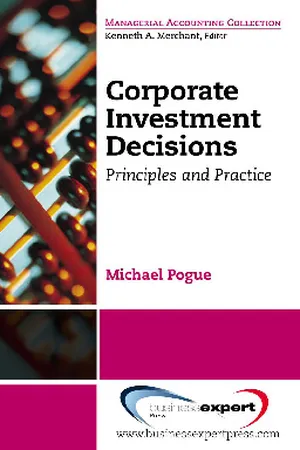
This book is intended for both practising managers who require a thorough knowledge of the principles of making investment decisions in the real world and for students undertaking financial courses whether at undergraduate, MBA or professional levels. The subject matter encompasses relevant aspects of the investment decision varying from a basic introduction to the appraisal techniques available to placing investment decisions within a strategic context and coverage of recent developments including real options, value at risk and environmental investments.
Trusted by 375,005 students
Access to over 1.5 million titles for a fair monthly price.
Study more efficiently using our study tools.
Information
Chapter 1
The Financial Environment
The world economy is currently deeply mired in the most severe financial and economic crisis since the Second World War. At the end of 2008, most economies were experiencing the sharpest fall in consumer and business confidence in 20 years, on top of which, commodities had suffered their steepest decline since 1945. Despite enormous write-downs by banks in the United States and Europe, problems have not gone away and world gross product (WGP) is expected to contract by 2.6% in 2009 (3.9% in the developed economies).1 There is little evidence of any “loosening” in the financial markets despite governments pumping billions into the banking system and, consequently, companies of all sizes struggle to acquire new financing or even maintain existing levels of borrowing. Banks not only are more selective about the clients to which they lend, but also they are charging more, and foreign banks have tended to retrench, thereby reducing borrowing facilities even further. In addition, corporate bond markets are closed to all but the best rated companies. Volatility in the financial markets means that only the most nimble of treasurers will succeed in navigating them. Moreover, lurking in the background, obscured by the difficulties of the financial markets and threatening the stability of the economic and financial systems, is the possibility of an H1N1 pandemic.
Such levels of unpredictability are providing many sleepless nights for CFOs and corporate treasurers, who are tasked with the management of their company’s financial risk. Experts are now unanimous in underlining the fundamental importance of cash, as illustrated by Dev Sanyal,2 group treasurer of British Petroleum: “cash on a balance sheet has moved from being economically inefficient, losing the spread between debt and investment, to being a vital element in the battle to maintain liquidity at times of capital market disruptions.”
The role of the corporate treasurer has never been more important as the attention of company boards is dominated by risk management and cash. Moreover, even if eventual economic recovery is likely, the task of the CFO may become even more complex in predicting the rate of recovery and acquiring the financial resources required to finance growth.
A further influence on the role of the CFO has been the recent attention focused on corporate governance emanating from the accounting scandals in the United States (Enron, Worldcom) and Europe (Maxwell, Parmalat). The growing importance of stock markets and an increasingly dispersed ownership of public companies throughout the world have promoted an increasing governmental interest in shareholder protection and better standards of corporate governance. As a consequence, legislation has been enacted in the form of the Sarbanes-Oxley Act (SOX) in the United States and the Combined Code in the United Kingdom. The regulatory frameworks already adopted in the United States and the United Kingdom have increasingly become the model for systems evolving in other countries. Financial managers are the principal agents for ensuring compliance with these systems.
The Financial Decisions
Every decision made in business has financial implications, and any decision that involves the use of money is a financial decision. When making financial decisions, conventional corporate financial theory assumes that the unifying objective is to maximize the value of the business or firm, often referred to as maximizing shareholder wealth. Some critics would argue against the choice of a single objective and argue that firms should have multiple objectives that accommodate various associated stakeholders. Others would recommend a focus on simpler and more direct objectives, such as market share or profitability, or, in the current economic climate, simply surviving may assume priority.
If the main objective in corporate finance is to maximize company value, any financial decision that increases the value of a company is considered good, whereas one that reduces value is deemed poor. It follows that company value must be determined by the three primary financial decisions—financing, investment, and dividend—and recognizing that the value of a company is determined primarily by the present value of its expected cash flows. Investors form expectations concerning such future cash flows based on observable current cash flows and expected future growth and value the company accordingly. However, this seemingly simple formulation of value is tested by both the interactions between the financial decisions and conflicts of interest that emerge among the stakeholders (managers, shareholders, and lenders).
The Financing Decision
All companies, irrespective of size or complexity, are ultimately financed by a mix of borrowed money (debt) and owners’ funds (equity). The main issues to be considered are the availability and suitability of the various sources of finance and whether the existing mix of debt and equity is appropriate. Debt finance is generally regarded as cheaper than equity due to lower issue costs and tax benefits, but it raises considerations of financial risk. In contrast, equity finance is more expensive, but the financial markets tend, on average, to react negatively to equity issues. In both the United States and the United Kingdom, companies tend to rely heavily on retained earnings as a source of finance in accordance with pecking order theory, which suggests that companies both avoid external financing when internal financing is available and avoid new equity financing when new debt financing can be sourced at reasonable cost.
Once the optimal financing mix has been determined, the duration of the financing can be addressed, with the recommendation being that this should match the duration of the assets being financed. However, companies may elect to finance aggressively (using short-term finance to finance longer term assets) or defensively (matching long-term finance with shorter term assets), depending on cost and risk considerations.
The efficient capital markets hypothesis concludes that a stock market is efficient if the market price of a company’s securities correctly reflects all relevant information. In particular, share prices can be relied on to reflect the true economic worth of the shares. This would imply that attempting to time the issuance of new financing is a futile exercise.
The Investment Decision
In its simplest form, an investment decision can be defined as involving the company making a cash outlay with the aim of receiving future cash inflows. Capital investment decisions are generally long-term corporate finance decisions relating to fixed assets, and management must allocate limited resources among competing opportunities in a process known as capital budgeting. The magnitude of the investment can vary significantly from relatively small items of machinery and equipment to launching a new product line or constructing a foreign production facility. We can distinguish between the assets the company has already acquired, called assets in place, and those in which the company is expected to invest in the future, referred to as growth assets. The latter include internal and external development projects, such as investing in new technologies or entering into joint ventures, thereby potentially creating future investment opportunities in addition to generating benefits from current use. As we shall see, such investments present particular managerial and valuation difficulties, as traditional valuation and capital budgeting techniques are both difficult to apply and may lead to incorrect conclusions.
Projects that pass through the preliminary screening phase become candidates for rigorous financial appraisal. To assist in making investment decisions and ensure consistency, methods of investment appraisal are required that can be applied to the whole spectrum of investment decisions, and that should help to decide whether any individual investment will enhance shareholder wealth. The results of the appraisal will heavily influence the project selection for investment decisions. However, appraisal techniques should not be recognized as providing a decision guide rather than providing a definitive answer.
The investment appraisal process and ultimate decision may also be subject to agency problems arising between the owners and the manager as a result of asymmetric information. It has been suggested3 that managers have an incentive to grow their companies beyond the optimal size and predict that agency conflicts give rise to overinvestment. A contrasting theory4 predicts that asymmetric information between informed managers and the public market causes underinvestment.
The Dividend Decision
The dividend decision is the third major category of corporate long-term financial decision and perhaps the most elusive and controversial. As with the financing and investment decisions, the main research question is whether the pattern (not magnitude) of dividend policy can impact shareholder wealth; that is, does a particular pattern of dividends maximize shareholder wealth?
The apparently simple question facing the board of a quoted company is that of splitting the after-tax cash flows between dividend payments to the shareholders and retentions within the company. The dividend irrelevancy hypothesis5 suggested that dividends should simply be treated as a residual after desired investments had been made. However, such a conclusion is somewhat tautological based on the range of assumptions incorporated into the analysis (perfect capital market, no taxation, no transactions costs, no flotation costs, etc.). Upon relaxation of these assumptions, there could be a marked preference for or against dividends from either the company or the shareholders. Moreover, consideration of the clientele effect and signaling placed exogenous pressure on companies to maintain their dividend payouts. Despite such pressure, the trend during recent years has been for a decreasing number of companies to pay dividends and increased popularity of share buybacks. The current economic climate continues to place further downward pressure on dividend payouts.
While we have discussed the three decisions independently, in practice they are closely linked. A company’s investment, financing, and distribution decisions are necessarily interrelated by the fact that sources of cash equal uses of cash. An increase in operating cash flow could be used to increase capital expenditure. Alternatively, it could be employed to reduce debt, increase dividends, or finance any combination of investment and financing decisions. Some evidence6 suggests that increases in cash flow are predominantly used to decrease debt and have an insignificant impact on capital investment. Similarly, a decision to increase investment can only be accommodated by either reducing dividend payments or raising additional finance. Less obviously, the source of new finance raised may influence the discount rate used in the appraisal and may impinge on the acceptance or rejection of the investment project.
What Is Capital Expenditure?
Capital expenditure is investment in the business with the objective of creating shareholder value. This additional value arises predominantly from the cash flow created by the investment, rather than the physical assets purchased. A capital expenditure arises when a company spends money to either acquire new fixed assets or enhance the value of existing fixed assets. For taxation purposes, capital expenditures are costs that cannot be deducted in the year in which they are incurred and must be capitalized in the balance sheet. Subsequently, the costs are depreciated or amortized over their useful economic life, depending on whether the assets are tangible or intangible.
A business or industry is capital intensive if it requires heavy capital investment relative to the level of sales or profits that those assets can generate. Industries generally regarded as capital intensive include oil production and refining, telecommunications, and transportation. In all of these industries, a large financial commitment is necessary just to get the first unit of goods or services produced. Once the upfront investment is made, there may be economies of scale, and the high barrier to entry tends to result in few competitors. In addition, because capital intensive companies have substantial assets to finance, they tend to borrow more heavily and gearing and interest cover ratios require more attention. The amount of capital required can sometimes be reduced by leasing or renting assets rather than purchasing them, which is particularly prevalent in the airline industry.
Capital expenditure can be analyzed in various ways, with perhaps one of the more useful classifications being into major projects, routine expenditure, and replacement expenditure.
- Major projects generally fall within the category of strategic investment and are nonroutine investments, with significant long-term consequences for the company (see chapter 9). Their significance arises as a consequence of the commitment of substantial amounts of resources (finance, human capital, information, etc.) and, moreover, they can involve a much higher cost commitment than simply the initial investment capital. In addition, the outcome of the project will affect not only the company itself but also competitors and the environment for an extended period of time. For example, investment in a new technology may impact the speed of innovation within the entire industry.
- The more strategic the investment, the more complex and less structured the decision process will be. This arises due to both the wider impact on the company and the involvement of more people in the process, particularly management at higher levels. Senior management not only intervene in strategic investment decisions but also manipulate the decision contexts such as organizational structure, reward systems, and corporate culture.
- Strategic investments can also be distinguished from more routine decisions by their broader consequences. Dynamically, they often give rise to other projects and do not end when the project is implemented. More recently, environmental investing has received prominence, with compliance with legislation and attempts to reduce carbon emissions requiring consideration on investment agendas.
- Routine capital expenditure involves relatively small amounts of financing, is mainly inconsequential for the future of the company, and may be largely discretionary in nature. Its purpose may be to improve working conditions or expenditure on maintenance, or be competition oriented. Working conditions may be enhanced by the replacement or updating of office furniture or computer equipment and software. Maintenance expenditure would be significant for agencies responsible for transportation networks, in which investment in employee training can give a competitive edge. Decisions regarding such expenditure are not likely to be subject to a high level of formal analysis or involve the input of senior management. The discretionary nature of these decisions may mean that cost center or divisional managers are simply allocated a budget and given authority to spend up to that amount.
- Replacement capital expenditure may be necessary for differing reasons, such as obsolescence or simply an asset reaching the end of its useful economic life. Technological advances may lead to more efficient production methods, and the investment may be analyzed on the basis of expected cost savings. Alternatively, certain assets will require replacement after extended use, and company policies may be in place to replace computers or company cars after a specific period of time. This latter type of investment may be subject to formal analysis to determine an optimal replacement cycle (see chapter 8).
Importance of Capex
Of the three financial decisions considered, it is generally accepted that the investment decision is the most significant. Financing and dividend decisions should not be ignored, particularly in the current economic climate, but the investment decision has certain characteristics that merit particular attention.
Resource Usage
By definition, investment decisions involve expenditure, whether financed by retained earnings or by a new issue of equity shares or debt capital. Irrespective of the source of finance, companies must ensure that the optimum benefit is obtained and scarce capital is not wasted. Invariably, the amounts spent are significant and should also be monitored to avoid the common tendency to overspend. Investment projects are also typically intensive in terms of labor resources, in respect to both labor employed on implementing the project and management time spent on the decision process.
Impact on Long-Term Future
Investments, whether of a personal or corporate nature, are transacted with a goal to generating future returns. Companies invest in new product lines or new markets with the objective of generating additional sales and profits, to supplement the declining sales of existing products or traditional markets. Such investments may involve negative cash flows for several years prior to the new product or market being established. Consequently, inappropriate investments that fail to generate the expected returns will result in declining profitability and potential write-offs of the money invested. In the worst-case scenario, the future survival of the company may be endangered, and inevitably its competitive position will deteriorate.
Irreversibility
This refers to the extent to which it is possible to back out and recover expenditure on a project that has been implemented, but subsequently is proven to be an error of judgment. In general, few projects can be reversed without incurring significant cost. The degree of irreversibility is largely determined by the specificity of the investment to the particular industry. If the investment is specific to a single industry, a poor investment is unlikely to prove attractive to other companies in the same industry, thereby limiting the opportunity for disposal. However, if the project is less specific and could find an application in other industries, there is an increased possibility of interest elsewhere.
Impact on Reputation
Impact on reputation concerns the consideration of the impact of a failed venture on market confidence in the company and its overall reputation. The effect of withdrawing from one activity, or a range of activities, needs to be assessed in terms of the general impact on the remaining operations. Any company ceasing operations in one sector needs to avoid damage to its wider reputation, and any withdrawal requires careful management.
Chapter 2
The Appraisal Process
The finance literature tends to view the decision maker as more of a technician than an entrepreneur, with the assumption being that the application of theoretically correct appraisal techniques will result in an optimal choice of projects and, subsequently, maximization of shareholder value. Implicit in this approach is that investment ideas simply emerge; free information is readily available; projects are considered in isolation, devoid of further interactions; and qualitative factors are relatively unimportant.
In reality, managers operate in a very different environment, facing relatively unstructured, complex decisions with ambiguity and irreversibility typically present. Clearly, in such circumstances w...
Table of contents
- Title Page
- Copyright
- Table of Contents
- Acknowledgments
- Introduction
- Chapter 1 The Financial Environment
- Chapter 2 The Appraisal Process
- Chapter 3 The Appraisal Techniques
- Chapter 4 Cash Flows and Discount Rates
- Chapter 5 Risk and Uncertainty
- Chapter 6 Capital Rationing
- Chapter 7 Replacement Decisions and Lease Versus Buy Decisions
- Chapter 8 Strategic Investment Decisions
- Chapter 9 International Capital Budgeting
- Chapter 10 Recent Developments
- Conclusion
- Appendix A
- Appendix B
- Notes
- References
Frequently asked questions
Yes, you can cancel anytime from the Subscription tab in your account settings on the Perlego website. Your subscription will stay active until the end of your current billing period. Learn how to cancel your subscription
No, books cannot be downloaded as external files, such as PDFs, for use outside of Perlego. However, you can download books within the Perlego app for offline reading on mobile or tablet. Learn how to download books offline
We are an online textbook subscription service, where you can get access to an entire online library for less than the price of a single book per month. With over 1.5 million books across 990+ topics, we’ve got you covered! Learn about our mission
Look out for the read-aloud symbol on your next book to see if you can listen to it. The read-aloud tool reads text aloud for you, highlighting the text as it is being read. You can pause it, speed it up and slow it down. Learn more about Read Aloud
Yes! You can use the Perlego app on both iOS and Android devices to read anytime, anywhere — even offline. Perfect for commutes or when you’re on the go.
Please note we cannot support devices running on iOS 13 and Android 7 or earlier. Learn more about using the app
Please note we cannot support devices running on iOS 13 and Android 7 or earlier. Learn more about using the app
Yes, you can access Corporate Investment Decisions by Michael Pogue in PDF and/or ePUB format, as well as other popular books in Business & Investments & Securities. We have over 1.5 million books available in our catalogue for you to explore.