eBook - ePub
Open Innovation Essentials for Small and Medium Enterprises
A Guide to Help Entrepreneurs in Adopting the Open Innovation Paradigm in Their Business
- 168 pages
- English
- ePUB (mobile friendly)
- Available on iOS & Android
eBook - ePub
Open Innovation Essentials for Small and Medium Enterprises
A Guide to Help Entrepreneurs in Adopting the Open Innovation Paradigm in Their Business
About this book
Small and Medium Enterprises (SMEs) have to approach open innovation differently than large companies. This practical guide on open innovation is expressly for entrepreneurs and managers in SMEs. The authors provide strategies, techniques, and Òtricks of the tradeÓ enabling SMEs to practice open innovation systems profitability and enhance the long-term value of their company. Included are tools such as brokers, auctions, crowdsourcing, technology transfer, and spin-ups, making it useful for people already in business, starting businesses, or seeking supplemental material for courses.
Trusted by 375,005 students
Access to over 1 million titles for a fair monthly price.
Study more efficiently using our study tools.
Information
Chapter 1
Introduction
Open Innovation for Small and Medium-Sized Enterprises
Phyllis Speser, JD, PhD, RTTP, and Adriano La Vopa
This book is about how small and midsized companies can make money by leveraging the intellectual assets and intellectual property (IP) of others. In today’s global competition, using external sources and resources for innovation makes sound business sense, no matter what size the company. Up until now, however, most practical guides to open innovation have focused on what large companies should do. While there is a lot of overlap, small and midsized companies face different challenges and opportunities in developing, commercializing, and selling innovations—and thus how they practice open innovation should be correspondingly different.
In this book, we illustrate how open innovation can be effectively and profitably used by small and medium enterprises (SMEs). It is primarily written for managers, entrepreneurs, owners, and investors seeing to increase profitability associated with new product development. It will also be helpful for students and other people interested in a practical look at this aspect of the global “innovation economy.”
We believe this book is particularly timely. There is a glut of good technology on the global market today—a condition that most observers agree will last another decade or two. It is a great time to be a “buyer” (which includes licensee) of IP and technology because it is a buyer’s market. What we show you is how to think about open innovation and where, and how, it makes money in ways that increase your net profit on the income statement and company value on the balance sheet. Please let us know how well we have done that by e-mailing us at [email protected], [email protected].
What Is Open Innovation?
Since its birth back in 2003, open innovation has been a hot topic of discussion. By googling these two simple words, one can easily retrieve more than 86 million of results in half a second, which demonstrates the “buzziness” of the paradigm.
Open innovation has become a kind of umbrella that embraces lots of different practices and methods. Despite the diversity, one key concept runs throughout: Open innovation means opening up the boundaries of an organization and collaborating with others on the outside to share ideas and knowledge and to acquire IP rights in technologies and know-how in order to bring new products to market more profitably.
In the rest of this introduction, we provide a conceptual framework for thinking about open innovation at SMEs. The context for this framework is how companies manage their idea flow, now that external sources are as important as internal ones for bringing new process and product technologies to market.
A useful construct for discussing idea flow is the innovation funnel.The innovation funnel is basically a set of steps to be followed to bring an idea to launch. By launch we mean developing and making available a new service, product, production method, or other useful things.
The management of the funnel is subject to various theories for optimizing it. Some of these theories even have given rise to software implementations that can be used to manage the flow of innovations from idea to something accessible by others. Figure 1.1 is a visual depiction of the innovation funnel. Included are what are commonly seen as major steps and control points (e.g., gates, or milestones in the lingo of project managers). Control points ensure one step only ends after certain deliverables are provided. The deliverables open the gate for the next step to begin. Of course, the approach in the picture is not intended to be the only possible implementation of an innovation funnel. Funnels need to be customized according to each SME’s needs and processes. To use an old adage, “One size does not fit all.”
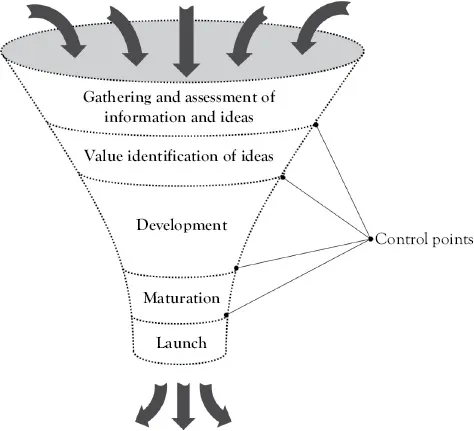
Figure 1.1 The innovation funnel
The use of the term open innovation was developed as a counter-concept to closed innovation (Figure 1.2) by Henry Chesbrough of Harvard University. Chesbrough coined the term open innovation in the book of the same name, although he was building on a body of literature that went back to the 1960s. He contrasted open innovation with closed innovation, which was a common business practice in the economic boom years after World War II (WWII) and up to the Vietnam War. The rebuilding of global economies after WWII provided a rising tide in which many boats floated. In closed innovation, the lessons of secrecy for successful military weapons development were reflected in the paradigm for corporate research and development (R&D) and new product development.
Innovation is closed when the organization does everything within its own walls without disclosing anything outside except after the IP is protected and secured. Confidentiality and noncompete agreements and a culture of secrecy existed in which R&D and new product development was controlled and occurred within the “walls” of companies. In this paradigm, the key to success was to hire the best brains possible under labor contracts that specified full control over labor conditions and stated that the output of their invention and innovation belonged to the employer.
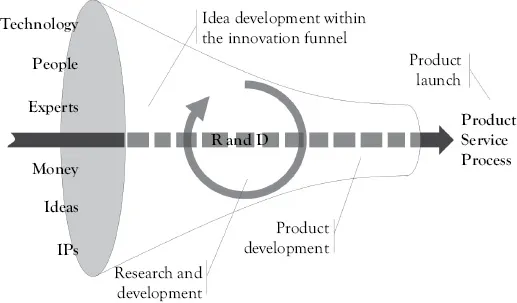
Figure 1.2 Closed innovation model
This way of doing business is associated with the syndrome of “not invented here” (NIH). In one of the first analysis of this syndrome, by Kats and Allen back in 1982, the authors made it clear that such behavior inhibits innovating effectively. At the very beginning of their paper, the NIH syndrome is described as “the tendency of a project group of stable composition to believe it possesses the monopoly of knowledge of its field, which leads it to reject new ideas from outsiders to the likely detriment of its performance.” This definition is important because it summarizes the mindset that the R&D groups of most corporate, government, and nonprofit institutes used to have in the past. Even today, especially where the culture of innovation is not particularly ingrained, this syndrome can be a cause of poor growth by a company. Following common practice, we will call the mindset of NIH the “silo mindset” (Figure 1.3). Silos create walls within the same organization and between it and others, which prevent sharing ideas, knowledge, technology, and know-how.
When the individual has the NIH syndrome, he or she is not prone to learn and share. There is a high possibility that useful knowledge that both that person and others discover will be frozen. Indeed, with the silo mindset, sharing is not considered an option. The potential range of realizations and applications for an idea is limited by what is known inside the walls of the lab where the inventor is employed and by the knowledge of the few people to whom it has been disclosed. While an NIH mindset may have made sense in the age before telephones and the Internet, when knowledge was often de facto localized and territorial, it was doomed to short-circuit company success with the emergence of Internet- and cellular-based instant and ubiquitous electronic communications. Easy access to both real-time and asynchronous communication meant the ways professionals, researchers, engineers, managers, sales staff, service staff, customers, and vendors connected began evolving rapidly.
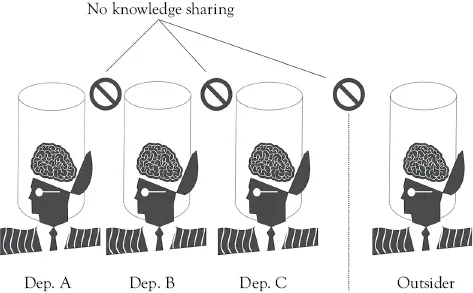
Figure 1.3 Closed silo mindset
Diverse factors have contributed to the crumbling of the “closed innovation.” The Internet with its social networking, easier global travel, and the loss of lifelong job security at a time of increased geographic mobility are a few examples. But such factors were secondary to the impact of closed walls and the silo mindset on younger employees and the students who were tomorrow’s employees. Unable to express their full potentials within 1950s-style organizations, the creative power, innovative brains, and venturesome spirits of the baby boomers and Generation Xers bumped up against “bureaucracy.” Enough smart people quit their jobs or school and started their own business based on the ideas, knowledge, and gumption that a new start-up culture had emerged whose heroes were people like Bill Gates (Microsoft), Herbert Boyer (Genetech), and Mark Zuckerberg (Facebook). They became wealthy and leaders in their markets through innovation. This dispersion of creativity and knowledge into start-ups created the humus out of which the open innovation paradigm grew. The rise of high-tech start-ups presented established big companies broader opportunities to source and benefit from outside innovation. Unlike most university technology, the technology from start-ups was more mature and thus had shorter lead times to market. The more technology there was to license—especially technology mature enough to be ready for market—the more it made business sense to acquire and use it. This wealth of outside technology encouraged companies to reinvent their business models for R&D and product development by opening their doors to external collaborations and intellectual asset and IP acquisitions. Outside ideas, knowledge, technologies, know-how, innovative people, and access to risk capital became tools for successful product innovation and the growth it can bring.
The open innovation paradigm was a consequence of such transformations. In roughly 25 years, the paradigm of R&D and product development has changed from closed to open innovation (Figure 1.4). The management of the innovation funnel has changed forever.
The open innovation paradigm, like closed innovation, is associated with a mindset, this time, “proudly found elsewhere” (PFE). PFE was presented in an article from two Proctor & Gamble (P&G) employees in 2006. Their new innovation model involved “educating” their internal R&D departments in how to find innovations elsewhere and being proud of doing so. One sentence of their article summed up the business case for open innovation: “For every P&G researcher there were 200 scientists or engineers elsewhere in the world who were just as good—a total of perhaps 1.5 million people whose talents we could potentially use.” It is clear that this approach meant a radical change in the way their company innovated and the mindset of employees involved in R&D and new product development (Figure 1.5).
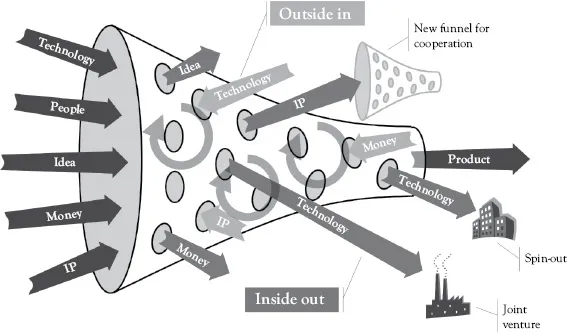
Figure 1.4 Open innovation
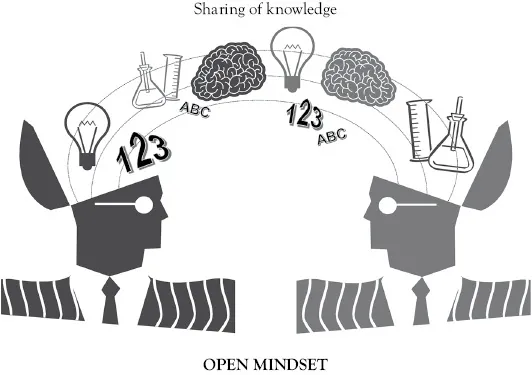
Figure 1.5 Open mindset. When the mindset is open, there is an opportunity for exchanging more knowledge
The open approach, and the open innovation in general, created a different way of exploiting the immense resources outside the company. Open innovators are merchants of intellectual assets and IP. Their mindset endorses exporting and importing those resources via inside-out and the outside-in knowledge sharing and transactions (also shown in Figure 1.4)...
Table of contents
- Cover
- Title
- Copyright
- Abstract
- Content
- About the Contributors
- Acknowledgments
- Chapter 1: Introduction
- Chapter 2: IP Brokerage and IP Auctions
- Chapter 3: Technology Transfer
- Chapter 4: The Power of “Crowdsolving”
- Chapter 5: Emergence of the SME as a Source of Market-Ready Technologies
- Chapter 6: Conclusion
- Index
- Adpage
- Backcover
Frequently asked questions
Yes, you can cancel anytime from the Subscription tab in your account settings on the Perlego website. Your subscription will stay active until the end of your current billing period. Learn how to cancel your subscription
No, books cannot be downloaded as external files, such as PDFs, for use outside of Perlego. However, you can download books within the Perlego app for offline reading on mobile or tablet. Learn how to download books offline
Perlego offers two plans: Essential and Complete
- Essential is ideal for learners and professionals who enjoy exploring a wide range of subjects. Access the Essential Library with 800,000+ trusted titles and best-sellers across business, personal growth, and the humanities. Includes unlimited reading time and Standard Read Aloud voice.
- Complete: Perfect for advanced learners and researchers needing full, unrestricted access. Unlock 1.4M+ books across hundreds of subjects, including academic and specialized titles. The Complete Plan also includes advanced features like Premium Read Aloud and Research Assistant.
We are an online textbook subscription service, where you can get access to an entire online library for less than the price of a single book per month. With over 1 million books across 990+ topics, we’ve got you covered! Learn about our mission
Look out for the read-aloud symbol on your next book to see if you can listen to it. The read-aloud tool reads text aloud for you, highlighting the text as it is being read. You can pause it, speed it up and slow it down. Learn more about Read Aloud
Yes! You can use the Perlego app on both iOS and Android devices to read anytime, anywhere — even offline. Perfect for commutes or when you’re on the go.
Please note we cannot support devices running on iOS 13 and Android 7 or earlier. Learn more about using the app
Please note we cannot support devices running on iOS 13 and Android 7 or earlier. Learn more about using the app
Yes, you can access Open Innovation Essentials for Small and Medium Enterprises by Luca Escoffier,Adriano La Vopa,Phyllis Speser,Daniel Satinsky in PDF and/or ePUB format, as well as other popular books in Business & Entrepreneurship. We have over one million books available in our catalogue for you to explore.