
eBook - ePub
As I Was Thinking....
Observations and Thoughts on International Business and Trade
- 166 pages
- English
- ePUB (mobile friendly)
- Available on iOS & Android
eBook - ePub
As I Was Thinking....
Observations and Thoughts on International Business and Trade
About this book
Political and international affairs directly impact every form of business and affect our daily lives to a significant degree. However, whether professionally active in international business and trade or not, we all are bombarded by a colossal volume of reports and articles. In spite of progress in transparency, it becomes increasingly burdensome to understand the consequences of a global market. As I Was Thinking . . . offers these short commentaries and editorials combined with insightful cartoons, to
encourage comprehension of and thinking about the most important and relevant international business and trade topics today. A clearer understanding allows the reader to hone and better exercise political perspective, so that you know what to support, what to question, and what to contemplate further. "In addition to its scholarly insight and wisdom, Czinkota's book is fun to read, and loaded with anecdotes that reduce the theoretical to the practical so that every player—the manufacturer, exporter, and consumer—can glean real-life application. He's a first class professor who gets it." —From the Foreword by Congressman Donald Manzullo, (Fmr) Chair, House Small Business Committee and Subcommittee on Asia
Trusted by 375,005 students
Access to over 1 million titles for a fair monthly price.
Study more efficiently using our study tools.
Information
SECTION 1
On Commerce and Trade
The Cost of Free Trade
Originally Published by Marketing Management: July–August 2003
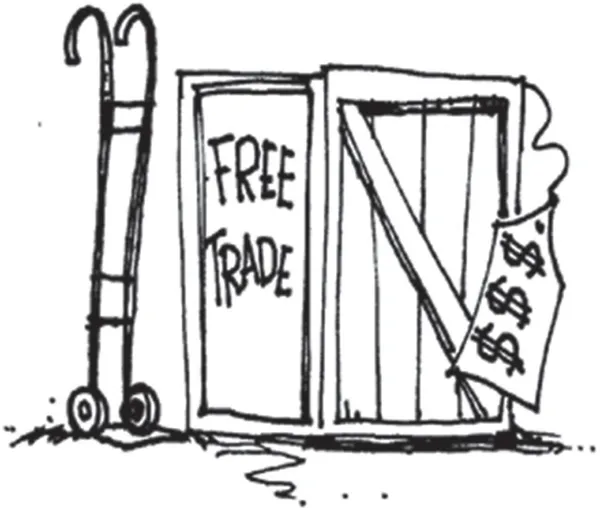
U.S. President George W. Bush’s decision to impose tariffs on steel imports into the United States has been decried as a politically motivated and economically ruinous move that marks the end of free trade and initiates a battle in the World Trade Organization.
We could, of course, dispatch our experts again to WTO hearings and start the traditional international charges and countercharges. The better alternative is to use this occasion to informally delineate a U.S. trade strategy that lets our industry and foreign friends know where we stand and where we are headed. Doing so will provide predictability to the market and consistency to our decision-making, both of which will increase market confidence.
Here are the components of our trade strategy: First is world leadership. The U.S. carries the leadership mantle due to astute policymaking, a willingness to contribute to the greater global good, and fortuitous developments in history. Some of our allies desire to be the leaders when it comes to international economic standards but are happy to let us bear the burden of armed conflict or the risk of terrorism. Global leadership is not a partitionable function, applicable to only a few issues: It is all encompassing.
Next are the benefits of leadership. We don’t know how long the currently unassailable position of the U.S. will last, but world history tells us that positions can change. Past leadership is good for prominence in the history books, or for minor privileges, such as Greece’s position of first flag carrier during the Olympics. Past accomplishments do little when it comes to resources or influence. Just think, in 1948 the U.S. almost launched the International Trade Organization, which would have streamlined global commerce. We didn’t push hard then and the effort failed. It took almost 50 years to relaunch such an institution—now called the World Trade Organization, which still does not have the same strengths as the ITO would have had. It is important to make hay while the sun shines. Britain, long in decline, was able to draw on the resources acquired during the height of empire for more than half a century. The U.S. will get things done now and also acquire bankable resources for a rainy day.
Third, we need ongoing international help in counting our blessings when it comes to free trade. Every elected official has many vocal constituents recount vivid tales of travails caused by imports. The positive effects caused by free trade are not self-evident; they must be explained, defined and provided by industry and our trading partners on a regular basis, particularly when it comes to jobs. As far as congressional votes go, trade-related employment effects are the currency of the realm.
Fourth, in a global world, local issues are important. When it comes to trade, expectations of a perfect track record may be the enemy of good achievements. Trade is only one component of the mosaic of mankind’s activity. Policy needs to reflect the broad scope of human desires and needs. The steel decision needs to be seen in such a context. There is a political price tag associated with strong U.S. support of free trade. The rare and limited protection of a domestic industry with much leverage is such a price.
During the anthrax scare, the U.S. government negotiated rather harshly with Bayer, the producer of Cipro. Some claimed that such an approach was in violation of long-standing support for intellectual property rights. Realistically, it is an emergency-appropriate deviation from the established routine, a necessary price of past and future enforcement consistency.
Fifth, our trade strategy is balanced. The fact that jobs matter also helps the free traders. As the chairman of the congressional House Small Business Committee stated: “I will watch very carefully how the steel tariffs affect the steel users and exporters in my district. And if jobs get lost, I will pounce!” Our representatives have become familiar with global concerns. In the future, international trade actions will perhaps mainly be addressed domestically, after a battle between, say, sugar vs. steel interests.
Was the steel decision political? Of course it was, in the sense of exercising the art of compromise. The decision also defines new boundaries. It has a clear context, provides direction and promises containment. It demonstrates U.S. leadership and, simultaneously, strengthens the world trade framework.
Trade Policy and International Marketing
(With Charles Skuba)
Originally Published by Marketing Management
Originally Published by Marketing Management

THE UNITED STATES IS IN a vulnerable position when it comes to international trade. Since 1975, it has been importing more goods than it has been exporting, therefore running a continuous merchandise trade deficit. Even though overall U.S. exports surpassed $1 trillion in 2001, the deficit in the trade of goods was more than $426 billion. Ongoing annual trade deficits of this magnitude are unsustainable in the long run. Such deficits add to the U.S. international debt, which must be serviced through interest payments and eventually perhaps even repaid. Therefore, an export performance by U.S. firms that matches or even exceeds our imports will become crucial.
Furthermore, exports are also an important contributor to national employment. We estimate that $1 billion of exports supports the creation, on average, of about 11,500 jobs. In its latest benchmark study, the U.S. Department of Commerce reports there were more than 8 million U.S. jobs sustained by the export of manufactured goods, which ties one out of every five U.S. manufacturing jobs directly or indirectly to exports. For example, in the state of Illinois alone, more than 360,000 jobs were linked to manufactured exports. An increase in exports can therefore be a key factor in maintaining domestic job growth.
Many see the global market as the exclusive realm of large, multinational corporations. Overlooked are the hundreds of thousands of smaller firms that have been fueling a U.S. export boom, which has supported the economy in times of limited domestic growth. The latest information from the trade data project at the Department of Commerce indicates that, between 1987 and 1999, the number of U.S. firms that export at least occasionally has more than tripled to more than 231,000. Almost 97% of these exporters were small or mid-sized companies.
The reason for the export success of smaller firms lies in the new determinants of competitiveness, as framed by the wishes and needs of the foreign buyers. Other than price, buyers today also expect an excellent product fit, high levels of corporate responsiveness, a substantial service orientation, and high corporate commitment. Small and mid-sized firms stack up well on all these dimensions, compared to their larger brethren, and may even have a competitive advantage.
Corporate Vulnerabilities
In spite of many advantages, smaller firms face major obstacles to international market prosperity.
Financial issues. All firms worry about getting paid when they ship their merchandise abroad, but small and mid-sized exporters are particularly at risk. They need financing to cover the time lag between shipping and payment receipts as well as to offer credit to buyers. Longer distances, slower transportation, and more accommodating payment terms abroad make international transactions more expensive. These transactions also require more capital and represent a larger portion of the firm’s resources than do domestic transactions. In addition, due to their size, international shipments often represent a larger degree of risk than smaller firms are willing or able to tolerate.
Exchange rate changes present a major source of vulnerability. Time passes between the initiation of an international transaction and its consummation. During that time, the firm is exposed to the effects of currency shifts. Major changes of currency value can transform a good business transaction into a money-losing one.
One particular issue U.S. exporters must cope with is the competition from the Euro zone and its currency volatility. The Euro is the new international trade currency the European Union implemented widely on in 2002. Even though originally introduced at a value slightly higher than the dollar, the Euro was valued at only .88 during most of 2002. Consequently, U.S. imports from Europe became cheaper, but U.S. exporters found it more difficult to compete. During the latter part of last year, the Euro rose in value and now exceeds the dollar. However, this has mainly been a function of different interest rate policies, which have been guided by a flexible U.S. Fed and a very unyielding European Central Bank. Changes in bank leadership, which appear quite likely, may presage new policies and a return to a rapidly rising dollar.
Smaller firms also lack the unfettered access to global capital markets that large firms have. They still rely very heavily on mainly domestic or even local sources of money. As a result, they don’t benefit from the low-cost opportunities of global capital and are not diversified enough in their sources of funds to cope with local interest rate inefficiencies. Given the increasing commoditization of goods, price shifts resulting from interest or exchange rate changes may critically affect the firm’s competitiveness and profits.
Supply chain management. Key concerns here are the development of contacts, relationships, and networks with suppliers and the forging of a systems linkage with intermediaries and customers. In addition, there are the logistics of arranging transportation, determining transport rates, handling documentation, obtaining financial information, coordinating distribution, packaging, and obtaining insurance. The logistics are often handled by intermediaries, such as freight forwarders. This area also includes the overseas servicing of exports, where the firm needs to accommodate returns and provide parts, repair service, and technical advice. Often the solution is to open a servicing or distribution office abroad. Timely communication among the different members of the supply chain is crucial if a firm is to perform competitively. Here again, small and mid-sized firms are particularly vulnerable since they may need to invest heavily in information technology--a major capital outlay. They don’t have the clout of large firms that can require their international supply chain members to adapt to a standardized information system. Smaller firms have to adapt to multiple systems and find ways to make them internationally compatible--incurring additional expenses and technical difficulties.
Firms that developed elaborate just-in-time delivery systems for their international shipments were also severely affected by the border and port closures during the days following the terrorist attacks on the United States. Together with their service providers, they continue to be affected by the increased security measures. Firms now need to focus on internal security and must demonstrate to third parties how much more security-oriented they’ve become. In many instances, government authorities require evidence of threat-reduction efforts to speed things along. Insurance companies have increased their premiums substantially in response to new definitions of risk. Unless policy holders take major steps to reduce such risk (or assume some of it themselves), they are likely to suffer from continued premium increases.
Regulatory issues. Another key vulnerability consists of legal procedures and typically covers government red tape, product liability, licensing, and customs/duty issues. Here, small and mid-sized firms are particularly exposed to changing government policies. The September 11 terrorist attacks have profoundly affected the administration of U.S. export controls and customs procedures. While larger firms have the benefit of a fully staffed department that deals with regulatory affairs, smaller exporters often face new and unfamiliar territory. For them, export control regulations are more burdensome. In addition, customs classifications and rules may require the hiring of specialists who ensure that shipments go out and come in properly reported and on time.
On the regulatory side, U.S. firms also are exposed to the vicissitudes of trade policy. Market access and market performance issues should be taken up in the Doha Round, the new conference of trade liberalization negotiations due to conclude by 2005. However, in existing trade disputes, our firms are also threatened by the retaliatory measures taken by trade adversaries overseas. Even though a conflict may be totally unrelated to their industry, U.S. manufacturers are vulnerable to foreign trade policy actions specifically designed to elicit the largest amount of pain from their victims. For example, when European countries or China react to U.S. import duties on foreign steel products, they do so by placing new (or higher) tariffs on a wide range of U.S. products. This makes many U.S. firms, including smaller producers, noncompetitive in these markets. They, in effect, pay the price for the U.S. protection of the domestic steel industry.
Market contact. Small to mid-sized firms need to cope with advertising, sales effort, and obtaining marketing information. They also need to develop foreign market intelligence on the location of markets, trade restrictions, and competitive conditions overseas. For large firms, such activities are often part of market expansion, where additional activities are carried out in already familiar territory. Small and mid-sized firms, however, are often still at the level of international market entry, where each step requires the dedication of new resources to unfamiliar tasks. It bears remembering that any new entrant into the international market must not only match, but must exceed by far, the capabilities of the local competition overseas. After all, apart from needing to find the spare capacity among its management resources, which permits a corporate focus on and commitment to exports, the newcomer must also carry all the transaction costs associated with the internationalization process. These start with the cost of shipping and special packaging and include duties and other special international burdens.
All these...
Table of contents
- Cover
- Half Title Page
- Title Page
- Copyright
- Dedication
- Introduction
- foreword
- Content
- Section 1 On Commerce and Trade 1
- Section 2 On Innovation in Today’s Global Community
- Section 3 On Daily Life and International Affairs
- Section 4 On Business and Conflict
- Section 5 On Freedom and Economic Growth
- Section 6 On Exports
- Index
Frequently asked questions
Yes, you can cancel anytime from the Subscription tab in your account settings on the Perlego website. Your subscription will stay active until the end of your current billing period. Learn how to cancel your subscription
No, books cannot be downloaded as external files, such as PDFs, for use outside of Perlego. However, you can download books within the Perlego app for offline reading on mobile or tablet. Learn how to download books offline
Perlego offers two plans: Essential and Complete
- Essential is ideal for learners and professionals who enjoy exploring a wide range of subjects. Access the Essential Library with 800,000+ trusted titles and best-sellers across business, personal growth, and the humanities. Includes unlimited reading time and Standard Read Aloud voice.
- Complete: Perfect for advanced learners and researchers needing full, unrestricted access. Unlock 1.4M+ books across hundreds of subjects, including academic and specialized titles. The Complete Plan also includes advanced features like Premium Read Aloud and Research Assistant.
We are an online textbook subscription service, where you can get access to an entire online library for less than the price of a single book per month. With over 1 million books across 990+ topics, we’ve got you covered! Learn about our mission
Look out for the read-aloud symbol on your next book to see if you can listen to it. The read-aloud tool reads text aloud for you, highlighting the text as it is being read. You can pause it, speed it up and slow it down. Learn more about Read Aloud
Yes! You can use the Perlego app on both iOS and Android devices to read anytime, anywhere — even offline. Perfect for commutes or when you’re on the go.
Please note we cannot support devices running on iOS 13 and Android 7 or earlier. Learn more about using the app
Please note we cannot support devices running on iOS 13 and Android 7 or earlier. Learn more about using the app
Yes, you can access As I Was Thinking.... by Michael R. Czinkota in PDF and/or ePUB format, as well as other popular books in Business & International Business. We have over one million books available in our catalogue for you to explore.