eBook - ePub
Drivers of Successful Controllership
Activities, People, and Connecting with Management
- 183 pages
- English
- ePUB (mobile friendly)
- Available on iOS & Android
eBook - ePub
About this book
This book is about drivers of successful controllership. Successful controllership services provide an imperatively required support to managers, especially in times of change
Trusted by 375,005 students
Access to over 1.5 million titles for a fair monthly price.
Study more efficiently using our study tools.
Information
Chapter 1
Introduction
How to Ensure Controllership Success and Where It Matters
Drivers and Impact of Successful Controllership
Controllers play a vital role in maximizing company performance. They support management by supplying information, design management control systems to improve the quality of management decisions, and—as has been shown in empirical studies—significantly enhance firm adaptability.1 But all of these positive influences are only experienced when controllers themselves are successful. This book focuses on the drivers that make controllers successful.
The core mission of controllers is to provide support to managers and other employees to enable them to be efficient and effective, thus contributing to overall firm performance.2 It is when they fulfill this mission that they are most successful; however, in the past, not all controllers achieved this goal. Many controllers were criticized as being irrelevant or, even worse, as being a hindrance to innovation, opportunities, and prosperity.3 This, along with some other reasons, explains the emergence of the “relevance lost”4 debate in the United States, in particular, in the late 1980s. At that time, many managers and academics believed that the performance of controllers left much to be desired, while financial accountants, with their focus on external financial markets, were perceived to be clearly superior. This manifested in a catastrophic consequence for the whole profession of controllers, as the number of people working as controllers dropped sharply during the last few decades.5
During the last few years, however, controllers have regained much of their importance in many companies, as reflected in rising staff counts and management entrusting controllers with additional areas of responsibility. One of the reasons for the newfound popularity is that the role of controllers has changed during the last few years, evolving from that of a “bean counter” to that of a full-fledged business partner6 who makes an essential contribution to the company’s value. But not all controllers have similarly evolved to be regarded as successful and respected, as some are still associated with stereotypes of the past. This book highlights drivers that enable controllers to become (more) successful.
Managers appreciate receiving objective internal information from controllers who have a thorough understanding of the business and who are intimately familiar with the internal information systems they themselves design and maintain. This is just the kind of reliable information managers urgently need if they want to make the best operational decisions in an environment that is becoming ever more competitive. Thus, from this deep-reaching metamorphosis into a business partner, the controller emerges as an indispensable resource within the company. At the same time, controllers have also benefited from an external development: The chief financial officer has gained importance and has almost become an equal partner to the chief executive officer. Controllers have moved up in the slipstream of this development.7
The evolution of controllers from a second-tier position in the company to a desirable partner for management was marked by many experiences highlighting what controllers should do to be successful; other experiences illustrated where they went wrong. We have collected and structured information on both types of events in order to be able to answer the following key question: What can controllers do to become (more) successful?
Studies have shown that controller units themselves can significantly improve their own performance by creating customized services produced and presented by skilful and knowledgeable staff. They can also manage the drivers of the manager-controller relationship and benefit from partnering with management that is willing to engage in a sustainable collaboration. In the following four chapters, we present a rich collection of drivers of successful controllership, organized into activities, people, interaction, and trends. To the best of our knowledge, this is one of only a handful of books that present such a comprehensive collection of relevant drivers of the controller success. It builds on some seminal publications that laid the early foundations of controllership research.8
Activities. In chapter 2, we highlight drivers (as well as factors that turn out not to be drivers) that transform controllership activities into successful controller services. We discuss the relevance of the selection of activities and tools as well as the way these activities and tools are used to satisfy customer (i.e., managers’) needs. It would be easy to assume that, yes, of course, it matters what controllers do. From this, it would logically follow that some activities should be engaged in while others (the less-efficient ones) should be avoided. This perspective underlies a wide array of existing publications by both academics and practitioners that praise the benefits of specific tools such as the Balanced Scorecard, activity-based costing (ABC), and target costing. Chapter 2 presents some surprising findings on this viewpoint.
People. Chapter 3 focuses on the importance of highly qualified staff for optimum controller performance. As in many other areas, the quality of controller output depends on the quality of the inputs the controller commands. Consequently, creating top controllership services depends both on hiring employees with top skills and abilities as well as the motivation to use them. More specifically, we discuss individual controller skills, complementary team skills of controller units, skills specific to top controllers, and, finally, some career paths leading to the very pinnacle of the controller profession. Upon concluding the discussion of skills, we move on to the motivation of controllers, focusing on why motivation is necessary and what its drivers are. (And it is not more money—not exclusively, at least.)
Interaction. Chapter 4 highlights that success for controllers also depends on forging sustainable cooperation with both managers and other internal service providers. Controllership services can only be successful if they are created specifically for management (customer orientation) and in cooperation with management (collaboration). But how closely should managers and controllers work together? Should controllers follow the request to become intimately involved in decision processes, even if such an involvement may threaten the effectiveness of their core fiduciary role? We dedicate a specific section to discussing this tension. As a result of increasing specialization in companies, controllers cannot provide all the required competencies on their own—they need the support of other service providers. However, gaining such support is more easily said than done, as potential partners may follow their own agendas and—in the case of neighboring service providers such as financial accountants, auditors, and strategists—may see controllers as internal competitors. On top of this, different mind-sets may also hinder effective cooperation. We discuss these differences and present paths to successfully bringing both parties to the same table.
Trends. The discussion of trends in chapter 5 focuses on short-term and long-term planning activities and changing roles of controllers as core trends that impact the success of controllership activities. The redesign of budgeting as one of the core activities of controllership and the increasing involvement of controllers in strategic planning represent short-term and long-term planning issues of controllership activity. It is often not immediately apparent how controllers may catalyze improved strategic planning activities, as controllers are often perceived as the personification of hindering innovation and creativity, two crucial characteristics of successful strategic activity. We deliver substantial arguments to correct this stereotype. The section on the changing roles of controllers in this chapter is especially important. There is no clearer path than this to a successful future for controllers—a future that many have already taken part in.
Familiarity with the drivers of successful controllership provides several benefits. For instance, successful controllership activities help to combat trends that threaten the status quo of controllers. More specifically, it helps in addressing stiff intercompany competition that does not stop at the organizational gates and that creates pressure on every internal organizational unit, including controller units. Successful controller units also have the opportunity to engage in more rewarding activities, such as strategic planning and other proactive management accounting tasks. This is a development that both academics and practitioner organizations such as the Institute of Management Accountants (IMA) have called for.9 As a result of these trends, controllers are gaining a more relevant position within the company, and this book presents the drivers of such successful controllership. Fortunately, controllers have the power to shape their own destiny, and, in many companies, controllers have already realized this potential. We are confident this book will help you, too, to create more successful controllership in your own company.
Controllership, Controllers, and Financial Accountants
Throughout the book, we consistently use the term “controller” to refer to an employee who predominantly engages in the “provision of information and analysis to assist management in the running of the business” and who holds a position within the finance function.10 This definition separates controllers from financial accountants and from financial reporting aspects of the overall controllership role. The role of controllers, as the IMA puts it,
differs from that of public accounting, since controllers work at the ‘beginning’ of the value chain, supporting decision making, planning and control, while audit and tax functions involve checking the work after the fact. [Controllers] are valued business partners, directly supporting an organization’s strategic goals.11
More specifically, controllers assume a multitude of roles and perform a host of activities, such as budgeting, planning, forecasting, reporting, and investment appraisals.12 Their activities also include the enactment of management control and supplying management with decision-relevant information.13 Or, as the IMA states, “These professionals are involved in designing and evaluating business processes, budgeting and forecasting, implementing and monitoring internal controls, and analyzing, synthesizing, and aggregating information—to help drive economic value.”14 Combined, these tasks represent controllership activities.
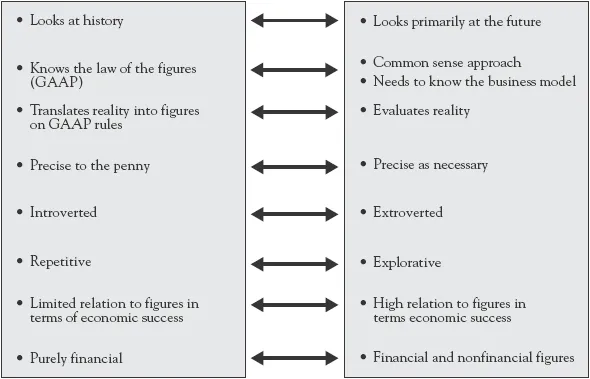
Figure 1.1. Comparison of the personality and characteristics of financial accountants and controllers.
In practice, corporate diversity leads to the use of different terms for persons that deal with controllership activities,15 including cost accountant, corporate or division planner, financial analyst, management accountant, manager decision support, business analyst, and—predominantly in smaller companies—chief financial officer.16
To conclude, we view the drivers of successful controllership from the perspective of a controller who (a) carries out the typical array of controllership activities, such as budgeting, reporting, planning, and supplying management with decision-relevant information; and (b) works in the finance function but does not carry out financial-reporting duties.
Chapter 2
Activities
What Successful Controllers Do
Introduction
Does the success of controllers depend on what they do? Or does it really not make much of a difference how they spend their working hours? These questions sound rhetorical, and the general answer is obviously yes; of course it matters what controllers do. But as you start looking for a more detailed answer, you find yourself pausing to think, what exactly should controllers be spending their limited time on? Should they choose specific, promising tasks and just stop doing others? Should they use more tools? Or is it not so much a matter of what they do as of how they do it?
Finding concrete answers to these questions becomes more difficult the closer you look. Scanning the huge number of publications by academics and practitioners makes it appear that choosing the right tools is what matters most. There are numerous books on the Balanced Scorecard, activity-based costing, target costing, and other similar tools. But would you be able to recognize successful or unsuccessful controllers just by looking at the tools they use?
These questions are addressed in the following sections, and some of the answers are probably not what you would expect. The information presented is based on findings from empirical studies, which cast light on the conditions under which controller activities are successful. The following pages provide a broad overview and illustrate findings that are highly relevant for practice.
Tools and Activities
Selecting specific tools seems to be an obvious lever: If controllers want to be successful, they should use the right tools. Successful controllers are viewed as up-to-date, adopting innovative tools more quickly and using them more intensively than their less successful colleagues. When visiting the dentist, you would not want to go to a doctor who uses outdated tools from the 1960s; instead, you would demand the latest technology. So why should it be any different for controllers? Read on to find out.
In the following, we argue that the selection of particular tools—that is, specific systems that use a common conceptual basis—does not guarantee the success of controllers. This statement may surprise controllers who are absolutely convinced of the effectiveness of specific tools, and it may disappoint those who have been promoting specific tools (such as the Balanced Scorecard) with great enthusiasm for many years.
Assessing the Value of Business Tools
This section describes a way of viewing and assessing the practical benefits of business tools. This is done not so much on the basis of a detailed tool-by-tool comparison but, rather, by introducing a way of engaging with tools on the basis of healthy skepticism. Such an approach is chosen because the number of existing tools is exceedingly great and because a tool’s benefits depend largely on the characteristics of the particular company intending to implement and use it.
Instead of simply providing a list of must-have tools and others that should be avoided, we prefer to make readers aware that caution should be applied when using any tool, and that the potential benefits of a tool strongly depend on designing implementation in a way that is customized and appropriate to a particular company. For more detail on specific tools, we refer you to the many publications that provide such information, such...
Table of contents
- Title Page
- Copyright Page
- Abstract
- Preface
- Chapter 1 Introduction: How to Ensure Controllership Success and Where It Matters
- Chapter 2 Activities: What Successful Controllers Do
- Chapter 3 People: Who Successful Controllers Are
- Chapter 4 Interaction: How Successful Controllers Operate
- Chapter 5 Trends: What Currently Drives Controllership Success
- Chapter 6 Conclusions
- Appendix: Cases Illustrating Leading-Edge Practices
- Notes
- References
Frequently asked questions
Yes, you can cancel anytime from the Subscription tab in your account settings on the Perlego website. Your subscription will stay active until the end of your current billing period. Learn how to cancel your subscription
No, books cannot be downloaded as external files, such as PDFs, for use outside of Perlego. However, you can download books within the Perlego app for offline reading on mobile or tablet. Learn how to download books offline
Perlego offers two plans: Essential and Complete
- Essential is ideal for learners and professionals who enjoy exploring a wide range of subjects. Access the Essential Library with 800,000+ trusted titles and best-sellers across business, personal growth, and the humanities. Includes unlimited reading time and Standard Read Aloud voice.
- Complete: Perfect for advanced learners and researchers needing full, unrestricted access. Unlock 1.5M+ books across hundreds of subjects, including academic and specialized titles. The Complete Plan also includes advanced features like Premium Read Aloud and Research Assistant.
We are an online textbook subscription service, where you can get access to an entire online library for less than the price of a single book per month. With over 1.5 million books across 990+ topics, we’ve got you covered! Learn about our mission
Look out for the read-aloud symbol on your next book to see if you can listen to it. The read-aloud tool reads text aloud for you, highlighting the text as it is being read. You can pause it, speed it up and slow it down. Learn more about Read Aloud
Yes! You can use the Perlego app on both iOS and Android devices to read anytime, anywhere — even offline. Perfect for commutes or when you’re on the go.
Please note we cannot support devices running on iOS 13 and Android 7 or earlier. Learn more about using the app
Please note we cannot support devices running on iOS 13 and Android 7 or earlier. Learn more about using the app
Yes, you can access Drivers of Successful Controllership by Jürgen Weber in PDF and/or ePUB format, as well as other popular books in Business & Management. We have over 1.5 million books available in our catalogue for you to explore.