eBook - ePub
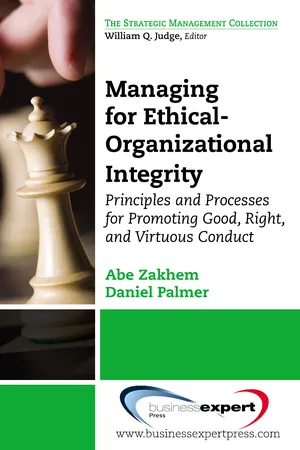
Managing for Ethical–Organizational Integrity
Principles and Processes for Promoting Good, Right, and Virtuous Conduct
- 156 pages
- English
- ePUB (mobile friendly)
- Available on iOS & Android
eBook - ePub
Managing for Ethical–Organizational Integrity
Principles and Processes for Promoting Good, Right, and Virtuous Conduct
About this book
It was once believed that business and ethics constituted separate and
mutually exclusive realms. Businesses that perpetuate such a belief or still
hold that "business ethics" is an oxymoron are at risk.
If you are a manager, you may have been called on to actively promote
ethical-organizational integrity. But this means understanding the defining
principles of and creating an organizational culture that measurably
encourages ethical conduct. This book will help provide you and other
managers with much needed guidelines for ethical decision making in
business that are philosophically sound and strategically advantageous.
This book provides a brief introduction to and general framework for
managing for ethical-organizational integrity in a way that will enable you
to identify those ethical duties that must be fulfilled in order to morally
justify the pursuit of profit. It will help you develop a morally imaginative
and socially entrepreneurial decision making process that is driven
towards generating and sustaining social value.
Trusted by 375,005 students
Access to over 1 million titles for a fair monthly price.
Study more efficiently using our study tools.
Information
CHAPTER 1
Doing What Is Good
In the introduction we mentioned that promoting ethical–organizational integrity requires doing what is good. Indeed, doing what is good typically involves not only caring for one’s self but includes promoting the welfare of others or otherwise promoting that which is deemed valuable (e.g., wealth, health, learning and education, security, sustenance, self-respect, etc.). Thus in business, doing what is good requires more than just advancing private managerial interests or one’s career and, in one way or another, involves doing what is good for one’s company, and at the same time promoting overall social welfare. But, given the fact that managers have limited resources and that there are times when individual and company interests and social responsibilities conflict, this is no easy task. We thus require a framework and some basic principles for understanding and helping to guide managerial decision-making.
Economists, management theorists, and even philosophers have long tried to provide such a framework. Some claim that corporations ought to serve a very narrow set of interests and in doing so best promote company and social welfare. Others argue that corporations ought to be responsible for trying to meet a wider set of ethical objectives and advance various social causes. The neoclassical managerial framework and articulation of the corporate objective function represents a narrower framework and one that has greatly influenced management theory and practice. The neoclassical model states that managers do best for themselves, their company, and best promote overall welfare, by trying to maximize profits for shareholders. We begin this chapter by presenting some of the central arguments that support this conclusion. We then explain why despite the critical emphasis on doing what is good by promoting company success some of the traditional neoclassical arguments are unsound. The second part of this chapter develops a wider, stakeholder oriented framework for doing what is good in business, upon which we believe that attempts to promote ethical–organizational integrity should be founded.
The Neoclassical Account of Doing Good
The neoclassical management framework came to the forefront of more recent debates about business ethics in response to demands for increased corporate social responsibility (CSR). Public demands for socially responsible business conduct date back as far as corporations have existed. It was not until around the 1950s, however, that CSR became an academic discipline in its own right and not until the 1960s and 1970s that the topic received widespread academic, business, and media attention. Although the concept has certainly evolved, CSR advocates in the 1960s and 1970s argued that businesspersons should behave like responsible citizens and look beyond their mere economic interests to support and drive social causes, such as fighting poverty, economic disparity, and environmental degradation.1
Many traditional, neoclassical economists and management theorists found this trend toward a broad conception of CSR quite troubling. As previously mentioned, Milton Friedman offered a sharp and paradigmatic neoclassical response to the call for a wide sense of CSR. For Friedman and others “there is one and only one social responsibility of business—to use its resources and engage in activities designed to increase its profits so long as it stays within the rules of the game, which is to say, engages in open and free competition without deception or fraud.”2 Friedman thus concludes that managers ought to focus their attention on the needs and expectations of company shareholders and make decisions that best drive corporate profitability. The neoclassical criterion for evaluating strategic management initiatives is certainly clear and managerial performance is readily measurable using standard accounting techniques. Simply put, managers who most efficiently maximize company profits are fulfilling their professional and social responsibilities and nothing more is required; doing more than trying to maximize profits leads to marked inefficiencies and undermines the social values that good businesses promote.
The question becomes, what is the relationship between maximizing profits for shareholders and promoting social welfare? Friedman offers several rather sophisticated arguments that support his position. First, Friedman agrees with the basic utilitarian principle that we should act to try to maximize the greatest good for the greatest number of people. All utilitarians agree to as much. Utilitarians differ, however, on how they define and distinguish between “good” and “bad.” Classical utilitarians believe that goodness is synonymous with pleasure and badness with pain. This is not to say, however, that we cannot distinguish between both quantitative and qualitative levels of pleasure and pain. John Stuart Mill, for example, distinguished higher from lower order levels of pleasures.3 For human beings, higher order levels of pleasure may not be immediately experienced but nevertheless are qualitatively better for those who have experienced them. Having a good education is a typical example of a higher order pleasure and one that we may not appreciate until later in our lives. Conversely, eating a tasty meal will produce pleasure that is qualitatively less than experiencing great art. On the classical account we are thus morally obligated to bring about states of affairs that maximize pleasure or happiness and minimize privation and pain in a more cultivated, but still largely hedonistic sense.
Other utilitarians build on these arguments to argue that what is truly good is the satisfaction of preferences and what is truly bad is the frustration of preferences. Advocates of preference utilitarianism thus claim that one is morally obligated to act if and only if said act best promotes preference satisfaction, which may or may not maximize the most qualitative or quantitative levels of pleasure or sensual experience.
The notion that we ought to maximize happiness and that this is somehow related to preference satisfaction plays an important role in neoclassical analysis. This is a very important point about the neoclassical view, and one that is sometimes overlooked even by its supporters. Friedman and other neoclassical theorists agree that business must provide for the overall social good in order to be justified as legitimate elements of a democratic society, which is to say, that they are not claiming that business is somehow an amoral activity. However, their claim is that the primary way in which businesses contribute to the overall social good is by providing the means by which individuals can best maximize their interests collectively. While the particular details of the theory can be quite complex, there are really two essential elements to the neoclassical argument. The first is that individual preferences, which make up the collective good on this view, are best maximized if people are allowed to pursue their own interests or associate to best pursue shared interests, relatively unrestrained. The second is that managers have an agential and fiduciary obligation to maximize the interests of owners of a company, and that extended attempts to engage in CSR undermine this obligation, and thus fail to both maximize wealth and efficiently distribute resources. We will look at both of these claims in turn.
In the tradition of Adam Smith and preference utilitarians, Friedman thinks that the greatest good is promoted in free and competitive markets where individuals rationally pursue and bargain to fulfill their own preferences. Individual preferences define the good of the individual, and the collective good is merely the sum aggregate of individual goods. Free and competitive markets allow individuals to best fulfill their preferences, since, at least theoretically, such individuals will only engage in exchanges that they believe are to their own benefit (assuming they have perfect information and such transactions are transparent). More simply, in this view people will only engage in those economic transactions that they see as in their own interests, and thus as long as there is no deception or fraud, individual preferences will be maximized overall. This does not mean that there will be no losers in the free market, but it does imply maximized preference satisfaction. Such situations are described as reaching a state of Pareto Efficiency, where the happiness of one person cannot be increased without the happiness of another person being diminished. In other words, any attempt to interfere in basic economic transactions to benefit some other party can only come at the cost of violating the preferences of another and overall utility is reduced.
The managerial role that best aligns with Friedman’s vision of the market is clear. In free and competitive markets managers ought to try to most efficiently get products and services into the hands of the consumers that will pay the most for them. This satisfies consumptive consumer preferences. Shareholder interest in exchanging their capital for the promise of maximized return on their investment both reflects and fuels this consumption. And, company profitability captures whether or not a manager is succeeding in this task. It is important to note that for Friedman, successful companies do not merely drive product innovations and satisfy consumer preferences. Successful and profitable companies attract capital that may otherwise leave the market, create and secure jobs and wages, and in turn promote more consumption, provide a tax base for governmental activities and services, and in the end arguably best contribute to overall social welfare. Unsuccessful companies go out of business, thus freeing up any existing capital to be redeployed more efficiently and productively. When all play their respective roles societal preference satisfaction is optimally maximized. The implications of this analysis should not be underestimated. On Friedman’s account businesspersons are not merely morally responsible for their own states of affairs. Their actions, omissions, and more generally how they attend to their professional responsibilities impact societal welfare at large.
In this model, extending managerial decision-making beyond company profitability creates more harm than good. Friedman further explains that while we ought to be concerned about and try to eliminate societal ills, such as poverty, crime, and pollution, managers are simply the wrong persons for the job. He points out that managers typically have no training or expertise in dealing with social problems and would simply be inept stewards of social causes. Furthermore, what would likely occur if we demanded that managers champion social causes is that they would opportunistically direct scarce company resources to whatever social causes or charities that are most dear to them. This would not ensure that the most pressing social issues would be efficiently and effectively addressed. This opportunistic behavior would, however, end up increasing agency costs and, while perhaps fulfilling managerial preferences and best intentions, would detract from social wellbeing.4 The basic point of this view is that managers are not best suited to this task, and that pursuing it would compromise the social obligations for which managers are optimally suited, that is, efficiently pursuing profit. The only acceptable social causes to pursue are those that would provide a return on corporate resources, say through positive marketing, above and beyond other ventures.
Friedman also believes that requiring business managers to champion social causes is socially irresponsible because it undermines the very foundations of a free society. Friedman writes that extending managerial decision-making to help secure social goods beyond profit and wealth is akin to socialism and the “nonsense” spoken in its name “does clearly harm the foundations of a free society.”5 His claim relies on the assumption that there is a direct link between laissez faire oriented free markets and the existence, health, and sustainability of democratic institutions. Undermine the market, and you subvert political freedoms and liberties. In this line of reasoning Friedman is not alone and similar sentiments are echoed by large international institutions, some of the trade liberalization policies of the World Trade Organization included.
It is important to note that Friedman does not, as some charge, think that business and ethics are separate realms or that business ethics is an oxymoron.6 Indeed, Friedman firmly believes that managers best drive company success by focusing their attention squarely on shareholders and profits and this in turn is objectively good for society. When managers lose sight of this objective they are in fact acting unethically and being socially irresponsible. Further, Friedman specifically claims that businesses ought to avoid fraud and deception and obey the normal moral rules of a society. Perhaps somewhat problematically, Friedman does not greatly expand on what those moral rules are, or why companies are obligated in the preference utilitarian view to be bound by them. The very simplicity of the managerial framework presupposed by the neoclassical view may be its greatest strength, but it also may be belied by the complexities, both theoretical and empirical, that even its proponents seem to acknowledge when discussing the nature and scope of ethical decision-making.
Assessing the Neoclassical Model
Charting the various criticisms and subsequent defenses of neoclassical economics are well beyond the scope of this paper. Some argue in favor of Friedman’s laissez faire picture of a free market, others claim that such a view of what a market ought to look like is neither necessary nor sufficient for promoting the greatest good.7 Some even question the soundness of preference utilitarianism as an indicator of economic and social wellbeing.8 Philosophically, it is even questionable whether preference utilitarianism can be consistently and coherently defended. Many questions of philosophical psychology, decision modeling, and social identity can also be raised with regard to the theoretical presuppositions made use of in the neoclassical model. While these debates are philosophically interesting, we will focus on a major problem that arises when neoclassical economic theory is used to frame and guide managerial decision-making.
The general observation is that if not in theory, at least in practice, the model leads to a form of managerial myopia where opportunities for value production are lost and risk is increased. One reason for this is that taking profitability for shareholders as the corporate objective function tends to reduce managerial attention to short-term gains, especially when using standard accounting reports and balance sheets or earnings per share calculations.9 While necessary for managing day-to-day operations, focusing too closely on short-term success does not promote financial sustainability and is not forward looking enough to capture longer term positive and negative trends and opportunities. Strategically and myopically focusing on shareholders, production, and profitability is now seen as a managerial recipe for disaster. This reality poses a distinct problem for new CEOs who tend to regard their function as solely working for the shareholders.10 Additionally, the focus on short-term gain has been seen by many as responsible for the kinds of extremely poor business decisions that led to the economic crises we have recently experienced in financial markets.
To understand why this would be the case one can consider how short-term profitability can negatively impact production processes. As described in the quality management literature, production processes operate on an input–output basis. For example, marketing departments provide input about customer wants and desires in the form of often quite advanced marketing and behavioral studies. Research and development employees take these inputs and design product specifications that meet these perceived desires. Industrial engineers take these specifications and set up...
Table of contents
- Cover
- Title
- Contents
- Abstract
- Introduction
- Chapter 1 Doing What Is Good
- Chapter 2 Rights, Duties, and Other Obligations
- Chapter 3 Ethics Programs
- Conclusion
- Appendix A
- Appendix B
- Appendix C
- Appendix D
- Appendix E
- Appendix F
- Appendix G
- Notes
- References
- Index
- Last_page
Frequently asked questions
Yes, you can cancel anytime from the Subscription tab in your account settings on the Perlego website. Your subscription will stay active until the end of your current billing period. Learn how to cancel your subscription
No, books cannot be downloaded as external files, such as PDFs, for use outside of Perlego. However, you can download books within the Perlego app for offline reading on mobile or tablet. Learn how to download books offline
Perlego offers two plans: Essential and Complete
- Essential is ideal for learners and professionals who enjoy exploring a wide range of subjects. Access the Essential Library with 800,000+ trusted titles and best-sellers across business, personal growth, and the humanities. Includes unlimited reading time and Standard Read Aloud voice.
- Complete: Perfect for advanced learners and researchers needing full, unrestricted access. Unlock 1.4M+ books across hundreds of subjects, including academic and specialized titles. The Complete Plan also includes advanced features like Premium Read Aloud and Research Assistant.
We are an online textbook subscription service, where you can get access to an entire online library for less than the price of a single book per month. With over 1 million books across 990+ topics, we’ve got you covered! Learn about our mission
Look out for the read-aloud symbol on your next book to see if you can listen to it. The read-aloud tool reads text aloud for you, highlighting the text as it is being read. You can pause it, speed it up and slow it down. Learn more about Read Aloud
Yes! You can use the Perlego app on both iOS and Android devices to read anytime, anywhere — even offline. Perfect for commutes or when you’re on the go.
Please note we cannot support devices running on iOS 13 and Android 7 or earlier. Learn more about using the app
Please note we cannot support devices running on iOS 13 and Android 7 or earlier. Learn more about using the app
Yes, you can access Managing for Ethical–Organizational Integrity by Abe Zakhem in PDF and/or ePUB format, as well as other popular books in Business & Management. We have over one million books available in our catalogue for you to explore.