eBook - ePub
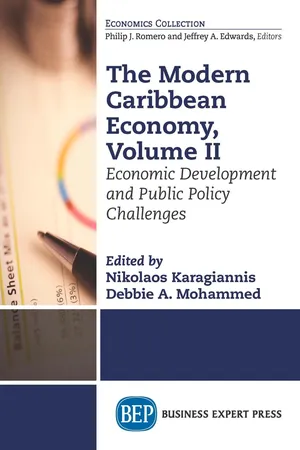
The Modern Caribbean Economy, Volume II
Economic Development and Public Policy Challenges
- 142 pages
- English
- ePUB (mobile friendly)
- Available on iOS & Android
eBook - ePub
The Modern Caribbean Economy, Volume II
Economic Development and Public Policy Challenges
About this book
Caribbean economies have been faced with mounting challenges arising from the increasing pace of economic globalization. The financial crisis of 2007 further exacerbated economic instability due to high foreign debt, lack of competitiveness, declining productivity, and high unemployment and underemployment. This in turn has precipitated increasing social and environmental problems, including poverty, inequality, crime and violence, and environmental degradation, all of which require new perspectives and policy approaches for transformative change and sustainable development. In this two volume multidisciplinary edited book The Modern Caribbean Economy, Volume I provides scholars and practitioners with alternative theoretical perspectives and concrete policy recommendations, while Volume II discusses economic, industrial, and social problems facing the Caribbean along with pragmatic proposals to successfully deal with these, while building local resilience and enhancing institutional strength in the region.
Trusted by 375,005 students
Access to over 1.5 million titles for a fair monthly price.
Study more efficiently using our study tools.
Information
CHAPTER 1
Public Policy and Economic Growth
Some Insights into the Caribbean Experience
Ramesh Ramsaran
Summary
Chapter 1 examines the relationship between public policy and economic and social outcomes in the Caribbean, identifies some of the many factors influencing the expansion and behavior of the government as well as those areas where state intervention has failed to achieve the desired objectives leaving a stymied functional capability and critical weaknesses in the economic structure, and specifies selected policy areas which must be boldly pursued.
Introduction
Whether it is a command economy, a market economy, or a mixed economy, public policy exerts a crucial influence on the creation and distribution of wealth. But public policy is not confined to the discipline of economics or the management of resources. It straddles a broad area which covers issues of a political, social, and economic nature. It speaks to the integrity and efficacy of governance institutions, the functioning of administrative structures, and the balance between social costs and social benefits. It not only encompasses the factors that influence the real and financial sectors, but all the institutional elements that affect the functioning and well-being of society. It defines national social and economic objectives, and also provides strategies, direction, and the framework of incentives for governance in response to changes in the internal and external environment. But consistency, coherence, and effectiveness are often lacking in formulation and implementation. There is good and bad public policy.
In recent years, the private sector has been widely touted as the engine of growth in market-driven economies, but the quality and practice of public policy remain critical to economic performance. The nature of public intervention matters. Though public policy is only one factor affecting growth, the ideas and conduct of governments exert a significant influence on the behavior of other stakeholders in the economy. In an essential sense, public policy can make or break an economy. While drawing on lessons of the past, public policy and the corresponding institutional framework must constantly adapt to changing circumstances, or they become a hindrance to change. In this paper, I focus on only some aspects of public policy, in particular those relating to economic growth.
I am discussing this subject against the backdrop of the vast differences in economic performance among countries in various parts of the world and the enormous shifts taking place in the distribution of global economic power. In this dynamic setting, there are serious questions about whether Caribbean countries can maintain their present living standards, much less improve them. Social divisiveness fostered to some extent by a destructive brand of politics, the loss of trade preferences, the decline of traditional exports, the lack of economic diversification, highly uncompetitive economies, increasing dependence on food imports, low savings rates, high levels of public debt, and falling levels of foreign aid create a daunting challenge for these states. Yet, it is difficult to discern an objective and unemotional discussion on the economic concepts traditionally used to define the problems, or the relevance of current strategies in the context of the changes sweeping the world and the vast accumulation of knowledge and experience. The revolutionary developments in non-Western cultures have opened new vistas and created major cracks in economic thinking emanating from the traditional centers of economic power. There are different paths to the promised land.
In presenting my thoughts on the Caribbean growth experience, I use the following sequence. I begin by offering some tentative views on the evolving concept of the state. In the second section, I outline the development objectives and the prevailing economic structure in the early post-independence years. I follow this by discussing broad economic strategies pursued and economic performance since the 1960s. In the fourth section, I look at developments in saving and investment trends. In the fifth section, I outline some salient issues connected to foreign savings, in particular borrowing and the public debt, aid, and foreign investment.
The Concept of Economic Growth
As an indicator of overall economic performance, economic (or GDP) growth occupies an eminent position in policy analysis. The concept, however, is associated with a high degree of elusiveness and does not often give us a complete picture of developments taking place in an economy. An economy may be growing, but key variables may be moving in undesirable directions. From experience, there are many things we can say about growth. For example:
1. It is unpredictable.
2. It is driven by economic and noneconomic factors.
3. It may incur social and environmental costs.
4. The economy may grow or decline in spite of government efforts.
5. Growth is not necessarily development. Put differently, it may not lead to the transformation of the economy or to a higher standard of living for the general population.
6. It may not lead to greater employment or improve the distribution of income.
7. Our knowledge of the growth process is increasing every day, but it is far from complete. We have difficulty explaining why Brazil has been taking off since the 1960s, but is still on the tarmac; why Argentina with all its resources moves from crisis to crisis; or why Taiwan and Singapore with little natural resources are Tiger economies, while well-endowed countries like Belize, Suriname, and Guyana are so low down on the development scale. That is my point of departure.
The Relevance of the State to Growth
The deep and continuing crisis in the global economy has drawn increasing attention to the relationship between public policy and the expansion of income and employment. But that relationship is a complex and changing one, shaped by history and circumstances. In the early postwar years, central planning in Eastern Europe demanded a highly authoritarian state which has now largely given way to more democratic arrangements. In other western industrial countries, a strong welfare function took root, and that state too is under fiscal pressure. In the 1960s, perceptions of market failure, underdevelopment, and nationalist sentiments prompted strong government intervention in the economy. Since the 1980s with the emergence of debt and fiscal problems, the interventionist state, guided by the doctrine of the Washington-based international financial institutions (IFIs), has largely become a regulator and facilitator. Of course, we also have examples of captured states, ruled by unpopular or illegal regimes on the basis of force or support provided by foreign governments for strategic or economic reasons.
The collapse of the Soviet Union and Eastern Europe in the late 1980s/early 1990s provided a major boost to the idea that deregulation and unfettered market forces held the key to financial and economic development; that was until 2008. But history has shown that growth can take place under a variety of political and economic arrangements. China and the United States, for example, are of different political persuasions, but China has the second largest economy and the largest foreign currency reserves in the world and is also the world’s largest trading nation. One might add that it is also the United States’ biggest creditor. All the high performers come from different backgrounds in terms of history, culture, and tradition, and embrace different views of the market. There are some things, however, common to all of them, and we will come back to these.
The state is not a private entity and it constantly has to juggle the interests of the public and private sectors in the presence of a range of competing pressures emanating from the structure of the society and the demands of external agencies. It constantly has to make choices that straddle growth imperatives and welfare functions. For example, some believe that efficiency and income distribution should be treated separately, while others argue that they need to go hand in hand. Also, given the finite nature of resources, there is a legitimate question over whether exploitation should be aimed at maximizing present consumption or should take into account the needs of future generations. The poor often see the state as representing the interests of the rich and business classes, while others question whether the Robin Hood role of the state has a moral basis. Whether the state should discriminate between rich and poor in the provision of goods and services (say, education and water) is a question that rears its head in discussions on increasing fiscal deficits and bourgeoning subsidies. In many countries the lack of a proper discourse on the role of the state in a mixed economy has created an environment of confusion and ambivalence in the formulation of public policy.
Based on experience, we know, or ought to know, that the issue is not about a large state or a small state; a right-leaning state or a left-leaning (a socialist) state; or even an interventionist state. Current domestic and global challenges require a more effective and caring state, capable of responding to a dynamic environment and providing a conducive framework for economic change. Why some states grow while others stagnate or regress has nothing to do with miracles, luck, or divine intervention. Some of the richest countries in the world in terms of resources are among the poorest. Others less endowed have blazed a path to wealth in three to four decades based on a combination of locally designed policies, capital accumulation, and technology, where vast advances have been made in food production, in energy, in health and medicine, in communications, and in transport. One of the tragic features of the modern world is that many states capable of doing better are imploding or stagnating, because of internecine warfare arising from racial, tribal, and religious differences, or from struggles for state control. Man-made disasters have compounded those resulting from natural phenomena.
Caribbean Economic Performance
The countries of the Caribbean region have not done as well as the fast-growing countries of East Asia, but they have not done as badly as sub-Saharan Africa. Jamaica and Trinidad and Tobago celebrated over 50 years of independence from colonial rule. Barbados and Guyana have been independent for over 50 years. The experience of other CARICOM countries as independent states ranges from 33 for St Kitts-Nevis to 43 years for The Bahamas. Suriname is somewhere in between, having achieved statehood some 41 years ago. A major consideration driving the independence movement, besides the psychological lift that accompanies statehood, was that it would bring additional capabilities to transform the colonial economy and improve the standards of living. The power to shape their own economy and political arrangements, and to access aid and loan funds were attractive prospects. One effect of the replacement of the colonial powers by national governments was a considerable rise in expectations. If all went well, a stable and progressive society was expected to emerge from the diverse and competing social groupings. Independence was expected to unlock powerful synergies long suppressed by colonialism. The new flags, anthems, and national currencies were really incidental. Some would disagree. Independence also warranted an enormous expansion in state bureaucracy. Not unexpectedly, political independence raised issues of size, economic viability, and survival in a world dominated by large states. There was no blueprint to follow. A narrow resource base, highly open economies, small markets, dependence on foreign trade and foreign investment, and specialization in primary production provided the basis for immense speculation on development possibilities. Their reality as mini-states or island economies in some cases located in a zone prone to natural disasters introduced a challenging dimension to the debate. Notwithstanding the political optimism, the future was uncertain.
Interestingly, some of the remaining small British dependencies such as Anguilla, the British Virgin Islands, the Turks and Caicos Islands, and the Cayman Islands enjoy per capita income and employment levels higher than those of the independent Caribbean states (Bourne 2010). Not surprisingly, this fact, combined with other issues such as crime and debt, often invite comments to the effect that political independence has not enhanced the economic prospects or the quality of governance in the independent countries to the extent expected. Was the case for independence overstated? Or, were the Caribbean countries, like many others elsewhere, simply unable to put together all the political and economic elements in a framework capable of reducing strife and meeting the post-independence challenges with the effective use of human and physical resources? By today’s reckoning, 50 years is not young. In 50 years a country must be giving strong indications of the kind of nation it is going to be, and the base of the future economy should already be apparent.
A prevailing view in the early post-independence years was that underdevelopment and poverty were not a natural state of affairs (they were man-made), and they could be overcome by will and proper policies. Despite differences among CARICOM countries, a perusal of the early post-independence plans reveals many common economic objectives which have been repeated in annual budgets and other documents over the years. Among them are:
1. Achieving higher GDP growth rates and improving the standard of living for the general population
2. Reducing poverty, inequality, and unemployment; in some cases, full employment was embraced as a goal
3. Developing a more resilient and self-reliant economy by diversifying the economic base and export structure to counter the adverse terms of trade effect; to this end, high emphasis was placed on the growth of the manufacturing and tourism sectors
4. Reducing dependence on imported food by reorganizing and modernizing the agricultural sector; food security was seen as an essential objective
5. Strengthening the local economy by developing greater intersectoral linkages, particularly among manufacturing, tourism, and agriculture
There were others, perhaps less important. Underlying all these objectives, however, was a conviction that for political independence to make sense it had to be reinforced with greater economic self-reliance. The post-colonial economy, it was felt, needed to be built on greater local participation and ownership, and development policies came to embrace various degrees of nationalistic sentiments. The countries in the region were not really interested in being in any ideological camp, even in the height of the cold war, which had a deep influence on aid dispensation. They generally would have described themselves as nonaligned. Nationalism is now more subdued and the concept of sovereignty has been greatly revised. Interestingly, four or five decades ago, not much was said about the quality of the society Caribbean countries wished to construct, or the values that should guide the drive to material development. This was taken for granted. Increasing levels of crime and indiscipline, endemic corruption, and declining competitiveness seem to have a strong correlation with economic growth and performance in the Caribbean.
On some objectives the Caribbean has made progress; but in a number of areas it has fallen short. The main economic objectives have not been supported by a consistent set of policy initiatives capable of effecting change in a rapidly changing environment. There is a great deal of disagreement on how much of the Caribbean failure can be attributed to smallness and structural features, exogenous shocks, natural disasters, corrupt and incompetent administrations, or simply bad policy and poor use of resources. What distinguishes one performer from another is often the choice of policies and the political and economic path embraced. The early vision of development has been elusive, and in some ways regional economies have become weaker and more dependent and vulnerable. With the decline of traditional activities, the faith placed by some states on offshore banking as a strategy of development seems to be highly misplaced, given the position taken by the developed countries. As we shall see later, growth has deteriorated since the 1960s while foreign exchange earnings continue to be centered around a few activities, and the objective of greater food security remains a dream. Because of the dependence on imports for food, consumer goods, and intermediate and capital goods, foreign exchange is the fuel that drives these economies.
But there have been some accomplishments. Life expectancy has increased. The number of years that people are expected to live now varies between 70 and 77 years in CARICOM countries compared to over 80 in developed countries. Per capita real income has also been increasing. The most recent figures provided by the UNDP range between just over US$3000 (ppp) for Guyana to over US$23,000 for Trinidad and Tobago and The Bahamas. The average for the ECCU (the Eastern Caribbean Currency Union) which is without mineral resources, is around $9000, which is higher than that of Guyana, Jamaica, Suriname, and Belize—countries with greater physical and mineral resources (St Kitts-Nevis and Antigua are significantly above the ECCU average of US$9000). These figures would put the Caribbean in the upper lower-lower middle-income group. The average for the Latin American/Caribbean region is around US$10,000, which is above the US$ 2000 for sub-Saharan Africa but way below the $ 30,000 for most developed states. The United States, Hong Kong, and Singapore are associated with figures above US$40,000. Liechtenstein with $84,000 and Qatar with $107,000 are in a league of their own. These figures are rounded and are based on PPP methodology and constant dollars.
Per capita income, as we well know, does not tell the full story of development. In several countries of the region (Guyana, Belize, Grenada, Dominica, and St Vincent among them) the number of persons living below the poverty line exceeds 30 percent of the population. Among the better placed are The Bahamas and Barbados with less than 15 percent. The distribution of income is an important indicator of changes in well-being. The most recent estimates of the Gini coefficient, which measures income inequality, range from 0.23 for the British Virgin Islands to over 0.50 for The Bahamas and St Vincent. The others range between 0.3 and 0.5 (Bourne 2010). Theoretically, the coefficient can vary from zero (complete equality) to one (complete inequality). The smaller figures would represent less inequality. The problem with the Gini coefficient, however, is that two countries with the same coefficient may have different distributions of income.
• The UNDP has a broader development index which includes indicators relating to education and health, and ranks countries in four categories: “very high human development,” “high human development,” “medium human development,” and “low human development.” The mean years of schooling in the countries with very high human development is 12 years on average, compared to eight to nine in CARICOM countries. The expected years of schooling in the developed countries is about 14, compared to 13 in CARICOM countries.
• In its 2011 Human Development Report which looks at 187 countries, only Barbados (ranked 47) is in the first 50 which are regarded as countries with very high human development. Most of the other CARICOM countries, ranked between The Bahamas at (53) and Belize at (93) are in the second tier, i.e., the high human development group. In the medium development group are Suriname (104) and Guyana (117). With most of them ranked in th...
Table of contents
- Cover
- Half Title Page
- Title Page
- Copyright Page
- Contents
- Acknowledgements
- Introduction
- Chapter 1 Public Policy and Economic Growth: Some Insights into the Caribbean Experience
- Chapter 2 Towards an Alternative Industrial and Trade Profile for Caribbean Economies: The Challenge of the Developmental State Approach
- Chapter 3 Crime, Criminal Activity, and Tourism Performance: Issues from the Caribbean
- Chapter 4 Economic Globalization and the Transnational Crime of Drug Trafficking and Lottery Scamming: Evidence from Jamaica
- About the Contributors
- Index
Frequently asked questions
Yes, you can cancel anytime from the Subscription tab in your account settings on the Perlego website. Your subscription will stay active until the end of your current billing period. Learn how to cancel your subscription
No, books cannot be downloaded as external files, such as PDFs, for use outside of Perlego. However, you can download books within the Perlego app for offline reading on mobile or tablet. Learn how to download books offline
We are an online textbook subscription service, where you can get access to an entire online library for less than the price of a single book per month. With over 1.5 million books across 990+ topics, we’ve got you covered! Learn about our mission
Look out for the read-aloud symbol on your next book to see if you can listen to it. The read-aloud tool reads text aloud for you, highlighting the text as it is being read. You can pause it, speed it up and slow it down. Learn more about Read Aloud
Yes! You can use the Perlego app on both iOS and Android devices to read anytime, anywhere — even offline. Perfect for commutes or when you’re on the go.
Please note we cannot support devices running on iOS 13 and Android 7 or earlier. Learn more about using the app
Please note we cannot support devices running on iOS 13 and Android 7 or earlier. Learn more about using the app
Yes, you can access The Modern Caribbean Economy, Volume II by Nikolaos Karagiannis,Debbie A. Mohammed, Nikolaos Karagiannis, Debbie A. Mohammed in PDF and/or ePUB format, as well as other popular books in Economics & Development Economics. We have over 1.5 million books available in our catalogue for you to explore.