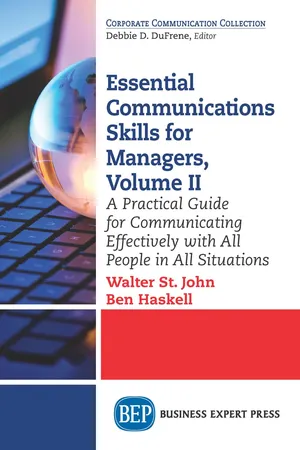
eBook - ePub
Essential Communications Skills for Managers, Volume II
A Practical Guide for Communicating Effectively with All People in All Situations
- 217 pages
- English
- ePUB (mobile friendly)
- Available on iOS & Android
eBook - ePub
Essential Communications Skills for Managers, Volume II
A Practical Guide for Communicating Effectively with All People in All Situations
About this book
The purpose of this book is to provide practicing and aspiring managers and students of management a practical and comprehensive reference source for communicating on the job with all people in all situations. This "how-to" book provides readers with the essential knowledge, attitudes, and skills to perform the communicating aspects of their routine and special duties. The information is presented in two volumes and each topic is divided into "Things to Know" and "Things to Do."
Trusted by 375,005 students
Access to over 1.5 million titles for a fair monthly price.
Study more efficiently using our study tools.
Information
SECTION 1
TOPIC 1
Sending Effective Messages
“Failure to emphasize any words or the wrong words robs your message of meaning”
—John Irwin and Marjorie Rosenberger
A. Things to Know
1. Content Factors to Consider
• A message is defined as the content or information that you are communicating.
• Messages must meet three requirements for you to get the results you desire: (1) be understood; (2) be believed; and (3) be accepted.
• Be certain that the message you send actually says what you intend to say.
• The message you send isn’t necessarily the same message people receive, so never assume you have been understood.
• Secure prompt feedback to determine how well your message has been understood and accepted.
• People are more likely to respond favorably to a message you send them when it is received in a setting free of noise and distractions.
• The status or importance of the sender of a message also influences how a message is responded to.
• There is frequently a difference between the information managers sent to employees compared with the information employees want to receive.
• Managers need to find out the information employees need and want in order to communicate effectively (please see the listing of the information managers and employees need in the information section of this book).
• Managers need to know how their employees view them as this has a strong influence on how their messages are received. In this regard, remember this relevant quotation, “How can I hear what you are saying when there is so much of you saying it?”
• Realize that both the quality and quantity of messages are important, so neither over nor under communicate.
• Limit the scope of any single message. You need to avoid overloading your message by including too much information at one time or you may overwhelm the recipients.
• Communicate only worthwhile information; if you have nothing to say, it is best to say nothing.
• Be sure that your message contains current, complete, and correct information as well as answers the five “Ws”: who, what, when, where, and why (as well as how).
• Put your most important information at the beginning and ending of your message to enhance retention by your listeners and readers.
• Promote understanding by presenting all information in a logical order.
• Realize that your listeners and readers are often influenced more by how you say or write something than what you say.
• Keep these points in mind when wording your messages:
1. Be sensitive to the overtones of a message as well as to its actual wording.
2. Make certain that the attitudes, body action, and wording accompanying a message match and send the same message (avoid sending mixed or contradictory messages).
3. Say everything as clearly, plainly, and simply as possible.
4. Make clear and definite transitions when moving from one point to the next in your message.
5. Use common words that are familiar to the recipients.
6. Be brief—get directly to the point and stick to the point. Omit any unnecessary words, irrelevant statements, and repetitive statements.
7. Provide frequent examples, explanations, and anecdotes.
8. Use active and lively words as well as words that create a mental image in the minds of the listeners and readers.
9. Be especially vigilant when selecting your words in sensitive situations by wearing this sign at the front of your mind “Danger! words at work.”
B. Things to Do
1. Factors to Consider When Preparing Your Message:
• Plan all important communications carefully before sending them to people.
• Think before deciding on the content of your message.
• Emphasize important information by repeating words, using different words, and pausing to let your listeners digest what you have said.
• The first step is to decide on the specific purpose (this should be clear to both the sender and receiver).
• Analyze your image, credibility, and relationship with your target group.
• Decide on exactly what you need to say and how to best say i...
Table of contents
- Cover
- Half Title Page
- Title Page
- Copyright Page
- Contents
- Acknowledgments
- Section 1
- Section 2 The Four Methods of Communicating
- Section 3 Planning and Conducting Productive Meetings
- Section 4 Communicating Skills for Dealing with Special Situations
- Section 5
- Index
Frequently asked questions
Yes, you can cancel anytime from the Subscription tab in your account settings on the Perlego website. Your subscription will stay active until the end of your current billing period. Learn how to cancel your subscription
No, books cannot be downloaded as external files, such as PDFs, for use outside of Perlego. However, you can download books within the Perlego app for offline reading on mobile or tablet. Learn how to download books offline
Perlego offers two plans: Essential and Complete
- Essential is ideal for learners and professionals who enjoy exploring a wide range of subjects. Access the Essential Library with 800,000+ trusted titles and best-sellers across business, personal growth, and the humanities. Includes unlimited reading time and Standard Read Aloud voice.
- Complete: Perfect for advanced learners and researchers needing full, unrestricted access. Unlock 1.5M+ books across hundreds of subjects, including academic and specialized titles. The Complete Plan also includes advanced features like Premium Read Aloud and Research Assistant.
We are an online textbook subscription service, where you can get access to an entire online library for less than the price of a single book per month. With over 1.5 million books across 990+ topics, we’ve got you covered! Learn about our mission
Look out for the read-aloud symbol on your next book to see if you can listen to it. The read-aloud tool reads text aloud for you, highlighting the text as it is being read. You can pause it, speed it up and slow it down. Learn more about Read Aloud
Yes! You can use the Perlego app on both iOS and Android devices to read anytime, anywhere — even offline. Perfect for commutes or when you’re on the go.
Please note we cannot support devices running on iOS 13 and Android 7 or earlier. Learn more about using the app
Please note we cannot support devices running on iOS 13 and Android 7 or earlier. Learn more about using the app
Yes, you can access Essential Communications Skills for Managers, Volume II by Walter St. John,Ben Haskell in PDF and/or ePUB format, as well as other popular books in Business & Business Communication. We have over 1.5 million books available in our catalogue for you to explore.