- 254 pages
- English
- ePUB (mobile friendly)
- Available on iOS & Android
eBook - ePub
About this book
Russia is a major economy and important power in the global political-economic landscape. Following the dissolution of the USSR, Russia has become a premier global marketplace despite remaining enigmatic and challenging. The book serves as a concise guide in understanding Russia from an international business perspective. It explores strategic issues, drivers, constraints, costs, and risks of international expansion and includes analytical tools, practical applications, sources of information, and assistance in international business research. These are supplemented by analysis of Russia's macro-economic profile, drivers, strategic strengths and weaknesses in the comparative context, including its international market attractiveness and opportunities for U.S. companies. The book examines Russia's main industries, their profiles, trends and business attractiveness, trends, and marketing strategies. The discussion of Russia's regions covers regional subdivisions and economic profiles with the focus on Moscow, the leading economic region. The book also covers the drivers and trends of the Russian small business sector and entrepreneurial business venturing. Despite the onslaught of capitalism, Russia retains its relationship-driven culture. The book provides insights by evaluating the determinants of Russian culture, its national profile in major global cross-cultural studies, and practical cultural applications in business, negotiations, and communications. The book's pedagogy includes skill development exercises and cases on doing business in Russia.
Trusted by 375,005 students
Access to over 1.5 million titles for a fair monthly price.
Study more efficiently using our study tools.
Information
CHAPTER 1
Russian Regions
Business Dynamics and Attractiveness
The best thing we can do if we want the Russians to let us be Americans is to let the Russians be Russian.
—George F. Kennan
US diplomat, historian, explorer, and war correspondent US Ambassador to the Soviet Union, May 14, 1952– September 19, 1952
Main Points in This Chapter
- Russia: Regional subdivisions and economic profiles.
- Business environment and investment climate in the City of Moscow: Domestic and international perspective.
Regional analysis is an integral part of business research or a feasibility study preceding the company’s international strategic expansion to the target country. Regional analysis is particularly important when it comes to large countries characterized by multifaceted demographics and complex politico-economic landscape.
For example, Japan is one of the world’s major markets and most ethnically homogenous countries.1 From the distance of New York or Los Angeles, Japan may well seem just that—a large and very homogenous marketplace. However, two of Japan’s major metropolitan districts with the capitals of Tokyo and Osaka that are only 246 miles (396 km) apart, are quite different in their market dynamics, business practices, and strategic approaches. Variations in market dynamics require different approaches to formulating a company marketing mix, the 4Ps (Consumer Lifestyles in Japan 2016). Such variations in the marketing mix are also common in Belgium, a small, ethnically diverse European country with a population of 11.3 million that is 58 percent Fleming, 31 percent Walloon, and 11 percent mixed or other. Yet another example is Singapore, a small Asian country-city of just 5.7 million people. Despite its small geographic size,2 Singapore is also ethnically diverse—74 percent Chinese, 13 percent Malay, 9 percent Indian, and 3 percent comprised of other ethnic groups (Central Intelligence Agency 2016). In large but ethnically homogenous countries such as Japan or small but demographically diverse countries such as Belgium and Singapore, there is an evident need for differentiation in marketing strategies and business practices. For a country as large and diverse as Russia, the needs for regional, ethnic, demographic, and other regional variations in marketing strategies and business approaches and practices tend to be even greater (Russia 2016; Russia: Country Profile 2016).
Russia’s Regional Subdivisions and Economic Profiles
Russia’s current governing-administrative system and regional subdivisions have come a long way, originating from the nation’s complex geography, history, political economy, sociocultural, and military developments (A Country Study: Russia 1998).
As of 2016, there were 85 federal administrative subjects that are constituent members of the Russian Federation.3 Russia’s federal subjects can be categorized into six types: 22 republics, 9 krais (large districts, plural—A.Z.), 46 oblasts, 3 federal cities, 1 autonomous oblast, and 4 autonomous okrugs (districts, plural—A.Z.) (Russian Investment Agency 2016) (Figure 1.1).
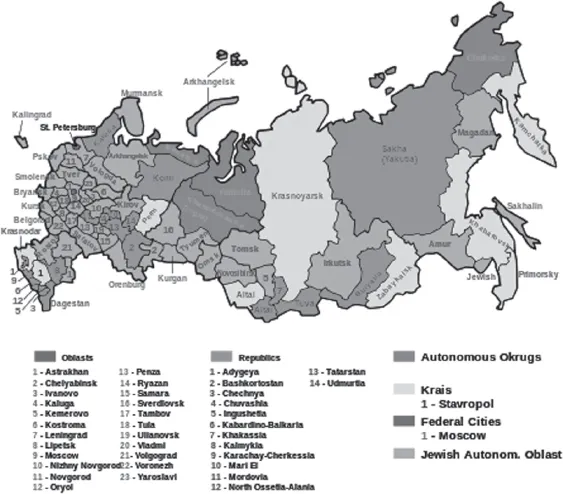
Figure 1.1 Federal subjects of Russia
Along with the federal subjects, Russian regional structure is comprised of 9 federal districts,4 12 economic regions5 (Figure 1.2), 4 military districts,6 and a multitude of municipal divisions. Additionally, there are 29 special economic zones set up to facilitate foreign investment through tax breaks, insurance privileges, relaxed customs regime, ready-to-use infrastructure, and other incentives (Special Economic Zones of the Russian Federation 2011). Until recently, the regional governance and development on the federal level had been under the jurisdiction of the Ministry of Regional Development of Russia (Министерство регионального развития Российской Федерации—Минрегион России). In 2014, the Ministry of Regional Development was abolished and its responsibilities redistributed across other ministries. The task of facilitating foreign investments in Russia was assigned to the newly created federal Russian Investment (Invest in Russia) Agency (Российское инвестиционное агентство).7
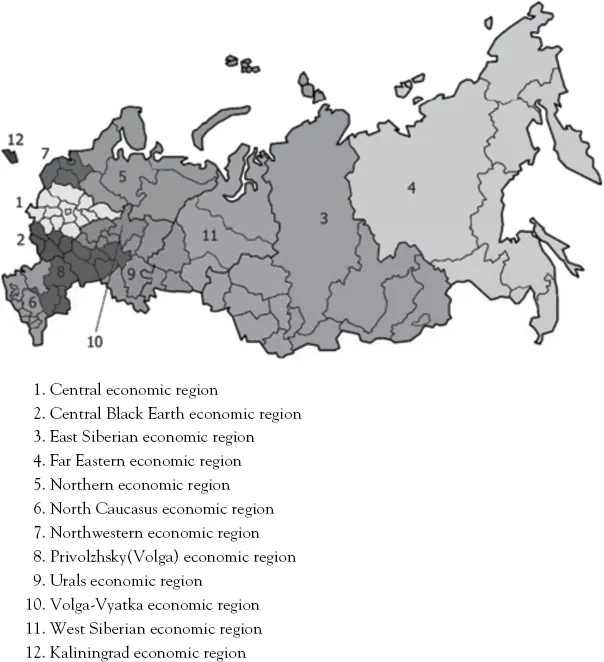
Figure 1.2 Economic regions of Russia
As noted earlier, an international corporate business expansion to Russia or any other country is typically driven by either export-based international marketing or foreign direct investment–based manuf...
Table of contents
- Cover
- Title
- Copyright
- Acknowledgments
- Chapter 1. Russian Regions: Business Dynamics and Attractiveness
- Chapter 2. Small Business, Entrepreneurship, and Business Venturing in Russia
- Chapter 3. Russian Business Culture
- Appendix I: Information Sources on Doing Business in Russia
- Appendix II: Skill Development Exercises and Cases on Doing Business in Russia
- Index
- Adpage
Frequently asked questions
Yes, you can cancel anytime from the Subscription tab in your account settings on the Perlego website. Your subscription will stay active until the end of your current billing period. Learn how to cancel your subscription
No, books cannot be downloaded as external files, such as PDFs, for use outside of Perlego. However, you can download books within the Perlego app for offline reading on mobile or tablet. Learn how to download books offline
We are an online textbook subscription service, where you can get access to an entire online library for less than the price of a single book per month. With over 1.5 million books across 990+ topics, we’ve got you covered! Learn about our mission
Look out for the read-aloud symbol on your next book to see if you can listen to it. The read-aloud tool reads text aloud for you, highlighting the text as it is being read. You can pause it, speed it up and slow it down. Learn more about Read Aloud
Yes! You can use the Perlego app on both iOS and Android devices to read anytime, anywhere — even offline. Perfect for commutes or when you’re on the go.
Please note we cannot support devices running on iOS 13 and Android 7 or earlier. Learn more about using the app
Please note we cannot support devices running on iOS 13 and Android 7 or earlier. Learn more about using the app
Yes, you can access Doing Business in Russia, Volume II by Anatoly Zhuplev in PDF and/or ePUB format, as well as other popular books in Business & International Business. We have over 1.5 million books available in our catalogue for you to explore.