eBook - ePub
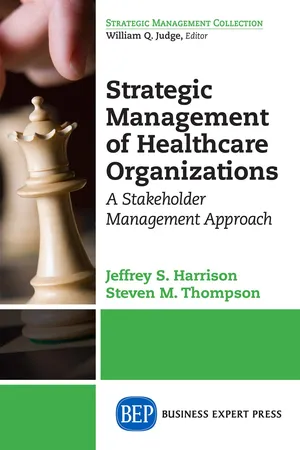
Strategic Management of Healthcare Organizations
A Stakeholder Management Approach
- 125 pages
- English
- ePUB (mobile friendly)
- Available on iOS & Android
eBook - ePub
Strategic Management of Healthcare Organizations
A Stakeholder Management Approach
About this book
Few industries are buffeted from as many strong forces as healthcare. The industry is highly regulated, thus dramatically increasing costs and sometimes even interfering with the ability to deliver healthcare. New drugs, treatments, and medical technologies are so common that keeping track of them can be overwhelming, and incorporating them into patient care or administration can be costly and complicated. This book lays a stakeholder foundation for managing a healthcare organization strategically. It contains step-by-step tactics as well as examples of HCOs that are having success with various aspects of the stakeholder approach in their organizations. As any experienced healthcare executive knows, making changes to a healthcare delivery system is like trying to modify an aircraft while it is in flight. The process is complicated and the consequences of mistakes can quickly lead to disaster. With this book, you'll get a new approach to managing healthcare within your organization, an approach that will unlock innovation and create more value for a broad group of industry participants.
Trusted by 375,005 students
Access to over 1.5 million titles for a fair monthly price.
Study more efficiently using our study tools.
Information
CHAPTER 1
A Practical Approach to Strategic Management of Healthcare Organizations
In healthcare, effective leadership and the successful implementation of new initiatives are the result of collaboration among a variety of constituencies inside and outside the firm. While this statement may be true in other settings, healthcare administrators face an especially complex environment in which any one unit within an organization or even an entire organization rarely possesses all of the resources required to achieve its goals; consequently, effective collaboration with stakeholders both within and outside the organization is absolutely critical to goal achievement. Also, organizations in other industries often enjoy the benefits of unambiguous objectives among the various groups and individuals that must come together in order to achieve a goal. For instance, even though the various business units and employees of a multinational company such as General Electric Inc. have different priorities and compete in very different markets, they are all focused on maximizing earnings. While opinions may differ on how to achieve that objective, the presence of a shared ultimate objective serves to focus attention and sustain commitment.
Healthcare organizations (HCOs) face an environment in which the groups and individuals that need to come together are often not part of the same organization and, infrequently have a shared objective to guide them in a common direction. This fragmentation creates a management environment where decisions are rarely based on the interests of a single organization, and mutual agreement amongst key players is required in order to make progress on any significant initiative. Finding common ground can be one of the most difficult challenges for healthcare managers.
This book is focused on providing perspectives and techniques that can help managers develop solutions in collaboration with key players, whom we will refer to from here on as stakeholders. We will define a stakeholder as any group or individual that helps an organization create value, receives value from the organization, or does both. In healthcare, it is very common for a given group of stakeholders, for example, affiliated physicians, to be value creators and value recipients. When managing stakeholders, we must first determine who the key stakeholders are and then understand their objectives and priorities. The complexity of the healthcare environment can make that task seem daunting.
For example, consider Bon Secours Health System, a not-for-profit Catholic health system headquartered in Marriottsville, Maryland, with annual revenue of more than $3.3 billion. The organization owns, manages, or has joint ventures with 19 acute-care hospitals, 1 psychiatric hospital, 5 nursing care facilities, 4 assisted living facilities, and 14 home care and hospice services. Bon Secours, like virtually every other healthcare provider, faces a significant challenge to which it must respond. The financing and evaluation of healthcare delivery in the United States, the foundation of all prior strategic plans and growth initiatives, has shifted dramatically. On March 23, 2010, President Barack Obama signed the Patient Protection and Affordable Care Act into law. The new law was expansive and contained provisions impacting everything from how reimbursements are calculated, to how quality and outcomes are measured, to establishing incentives for the development of new delivery and financing models. Reporting and compliance mandates were overhauled and all 50 states and the District of Columbia would eventually have to offer insurance exchanges to improve affordability and accessibility of health insurance while expanding the availability of Medicaid programs.
Bon Secours’ world had been completely transformed and they needed to determine both how to respond and how to proceed with their response plan. Many factors add complexity to the planning process, not the least of which is the extreme fragmentation of the U.S. healthcare system.
Even as it contemplates how to react to health reform legislation, Bon Secours must consider how to balance that response with current initiatives that may involve a number of stakeholders. Consistent with its mission “…to help bring people and communities to health and wholeness…,” Bon Secours must invest in state-of-the-art medical technology.1 If they fall behind, other acute- care hospitals in their local markets will exploit their lack of technological sophistication, and Bon Secours would risk losing their status as the preferred provider in the communities they serve. At the same time, commitments to major technology investments can imply prioritizing certain service lines over others. For example, purchasing a Da Vinci Robotic Surgical System would compel an organization to focus on patient populations that can be treated with that technology, such as urology and gynecology. As a result, other service lines that do not utilize that technology, such as diabetic care, may receive lower priority and fewer resources, even though they are greatly in need. This illustrates an unfortunate reality—economic concerns can force organizations to make decisions that are necessary for their ongoing viability, but simultaneously result in a situation where certain at-risk populations are underserved, resulting in suffering and dissatisfaction.
The potential backlash goes far beyond patient dissatisfaction and can cascade even further as firms find themselves victims to costly, reputation-hurting bad press, boycotts, or legal suits. They may also alienate nongovernmental organizations (NGOs) formed to protect the interests of particular constituencies, and if firms rely on those constituencies for what they do, they can suffer tremendously. While harsh economic realities can force difficult decisions, societal forces and public opinion can be as much an influence on the final outcome as the underlying financial circumstances. Clearly, Bon Secours’s ongoing strategic responses to industry changes will have to be the result of detailed planning and discussion with numerous stakeholder groups that will be impacted by the choices that are made.
Chapter 2 provides a detailed examination of the underlying principles of stakeholder theory and how they can be applied to create enhanced value. However, we would like to lay an appropriate foundation in strategic management and strategic thinking before moving to the specifics of stakeholder theory and how they can be used to enhance the strategic management process.
Strategic Management
The Industrial Revolution ushered in a wave of new business practices that formed a foundation upon which modern business management was established. Eventually, business (beyond economics) was accepted as a legitimate area of study in universities, and some of the topics that were first embraced included financial management and accounting, production and operations management, marketing management, and personnel management (now human resources management). However, it was not until the middle of the last century that managers (and business schools) started to realize that there was no discipline that tied all of the other disciplines together in a meaningful way.2 A field called business policy, fostered by major business schools such as Harvard and consulting firms such as Boston Consulting Group, began to emerge. In the 1970s, business policy morphed into what is now called strategic management. Strategic management describes efforts to guide organizations in an integrated manner, and to do so with purpose and over a long time horizon.
Effective strategic management entails both a process and a way of thinking. The strategic management process includes activities such as analysis of the firm and its environment, establishment of a strategic direction, evaluation of alternative strategies the firm might pursue to achieve this direction, and implementation planning. It is a step-by-step process for directing the firm’s strategies, with the ultimate objective of guiding firm constituencies toward common goals. This process is important, especially in an environment that is complex and turbulent. However, a process like the one we just described is not enough in itself to ensure success. In fact, we have seen organizations stifled by their own rigid strategic management processes. For example, we were participating initially as observers in the strategic planning process of a large organization (to remain nameless for obvious reasons). For a day and a half, managers of this organization presented detailed plans to the president for the areas over which they had responsibility, using templates provided by the organization’s planning department. After observing several presentations, we suggested to the president that this whole process was an exercise in futility. To our surprise, he agreed. Fortunately, this organization has come a long way since then.
What was wrong with the process? After all, the numbers were there, with detailed plans to support them. The problem was that the creative aspects of the planning process were almost completely absent. Instead of meetings to generate and evaluate novel solutions to challenges these managers faced in their varied market settings, the whole program represented a reinforcement of previously held assumptions and strategies for dealing with them. Strategic thinking, the creative side of strategic management, was missing. We will discuss strategic thinking first and then incorporate this sort of thinking into a model of the strategic management process.
Strategic Thinking
Excellent strategic decisions have a creative as well as a rational process component. The creative component is what moves an organization to innovate. In a complex, turbulent, and highly regulated industry such as healthcare, this creative component is even more essential than in a more stable setting. In fact, some wrongly assume that heavy regulation reduces the need to innovate. Instead, heavy regulation just creates boundaries that make good ideas harder to find. You don’t want managers to sit back and follow the rules; you need highly creative managers who can dream up new ways to create value. Regulations can be complex and daunting but they are not barriers to progress. They are essentially constraints that preclude certain courses of action. For example, the Stark Law places a number of constraints on things such as payments for referrals. State laws on clinical licensure define scopes of practice for clinicians and place constraints on what certain types of employees can be asked to do. The Emergency Medical Treatment and Labor Act (EMTALA) places constraints on how hospitals handle emergency department crowding and uninsured patients. So how can managers navigate a complex web of regulations, resource constraints, and the different priorities of different stakeholders and develop viable, innovative solutions?
One of the keys to innovation is to foster strategic thinking.3 Strategic thinking is the term used to describe the innovative aspects of the strategic management process. As we suggested in the previous section, a rigid strategic planning process can drive out strategic thinking. For example, some firms require their managers to establish and follow very detailed plans that do not allow for deviations. Other firms harshly penalize their managers for failure, so they are afraid to try new ideas.
One challenge associated with fostering innovation is that energized brainstorming sessions and blue sky planning can result in ideas that, while creative, stray from the strategic objectives. To keep on track, thought processes should reflect six characteristics.4
1. Purpose focused. Some people think of creative processes as purely random and unstructured, much like brainstorming. However, strategic thinking is not a random process. It is based on the purpose of the HCO, its vision and objectives. This is sometimes called strategic intent—what are we intending to do? What does success look like?
2. Long-term oriented. Some managers are so concerned about short-term operating details that they have a hard time focusing on where the firm is going. While it is true that efficiency often requires attention to details, it is also true that sometimes managers need to mentally step away from their day-to-day problems in order to focus on the future.
3. Consideration of past and present. Although strategic thinking is long-term oriented, it also includes learning from the past and recognizing the present situation and the constraints it imposes.
4. Systems perspective. The HCO sits at the center of a system of stakeholders. Furthermore, the system of stakeholders exists in the broader context of the sociocultural, economic, technological, political and legal, and competitive environment (see Chapter 5). Strategic thinking considers the whole system and how the actions a firm is taking, or might take, are being influenced by, or influence, its system of stakeholders and the broader environment. This approach helps in the generation of st...
Table of contents
- Cover
- Title
- Copyright
- Contents
- Preface
- Chapter 1 A Practical Approach to Strategic Management of Healthcare Organizations
- Chapter 2 Managing for Stakeholders
- Chapter 3 Strategic Direction
- Chapter 4 Analysis of the Organization and Its Stakeholders
- Chapter 5 Analysis of the External Environment
- Chapter 6 Strategic Factors and Performance Measures
- Chapter 7 Strategic Alternative Generation and Evaluation
- Chapter 8 Implementation Planning and Execution
- About the Authors
- Notes
- References
- Index
- Adpage
- Backcover
Frequently asked questions
Yes, you can cancel anytime from the Subscription tab in your account settings on the Perlego website. Your subscription will stay active until the end of your current billing period. Learn how to cancel your subscription
No, books cannot be downloaded as external files, such as PDFs, for use outside of Perlego. However, you can download books within the Perlego app for offline reading on mobile or tablet. Learn how to download books offline
Perlego offers two plans: Essential and Complete
- Essential is ideal for learners and professionals who enjoy exploring a wide range of subjects. Access the Essential Library with 800,000+ trusted titles and best-sellers across business, personal growth, and the humanities. Includes unlimited reading time and Standard Read Aloud voice.
- Complete: Perfect for advanced learners and researchers needing full, unrestricted access. Unlock 1.5M+ books across hundreds of subjects, including academic and specialized titles. The Complete Plan also includes advanced features like Premium Read Aloud and Research Assistant.
We are an online textbook subscription service, where you can get access to an entire online library for less than the price of a single book per month. With over 1.5 million books across 990+ topics, we’ve got you covered! Learn about our mission
Look out for the read-aloud symbol on your next book to see if you can listen to it. The read-aloud tool reads text aloud for you, highlighting the text as it is being read. You can pause it, speed it up and slow it down. Learn more about Read Aloud
Yes! You can use the Perlego app on both iOS and Android devices to read anytime, anywhere — even offline. Perfect for commutes or when you’re on the go.
Please note we cannot support devices running on iOS 13 and Android 7 or earlier. Learn more about using the app
Please note we cannot support devices running on iOS 13 and Android 7 or earlier. Learn more about using the app
Yes, you can access Strategic Management of Healthcare Organizations by Jeffrey S. Harrison,Stephen Thompson in PDF and/or ePUB format, as well as other popular books in Business & Business Strategy. We have over 1.5 million books available in our catalogue for you to explore.