![]()
Part 1
Three Main Cross-Cultural Management Challenges
![]()
Chapter 1
Does Culture Really Matter?
Globalization comes with many cross-cultural challenges. A few decades ago multinational companies could assume that the international business world was based on Western standards and they could export their traditional management styles around the world. But the picture in recent years has changed fundamentally. In particular, the rapid and successful development of former developing countries has strengthened the confidence of companies in these markets and will lead to the development of many culturally different management styles. Today these markets still present great business opportunities for many Western firms, as the attitude toward business and management practices have changed very much.
To succeed in international business these new expectations must be met. Many emerging markets show a lot more confidence in their “own way of doing things” and expect their suppliers in the West to do so as well. Cross-cultural issues therefore invade every aspect of business and will continue to do so. Western managers need to question their traditional and familiar management practices and may have to adjust them to conform to other cultures to secure long-term business success.
But this is a lot more challenging than many multinational corporations realize. For example, Toyota, a company that very successfully internationalized and adapted to consumer wishes worldwide, still found it extremely difficult to react in a Western (or non-Japanese) way to a public-relations disaster. Even if companies perceive themselves as modern and international, their corporate culture and management operations are dominated by the home country culture of the organization.
Cross-cultural management processes therefore play an increasingly important role in international management. But only in recent years, culture and cultural difference between management styles are being more widely discussed in international management research and in organizations. The reason: too big the financial losses based on cross-cultural mistakes, too high the number of misunderstandings or conflicts.
Although the idea of “cross-cultural management” is more accepted, it is very difficult to develop this fundamental theory or to define rules or measures to prevent errors. The reasons are found mainly in the complexity and exoticism of the subject. The more markets in which a company operates, the more multicultural staff, and their attitudes must be observed and learned. This makes it even more difficult for companies to prepare employees for possible challenges in international business.
This chapter introduces basic ideas about culture and how influential it is on management processes. The focus lies on national culture, and I will explain major aspects to consider when doing business overseas. Upon completion you will understand
- why business is not the same in every country;
- why culture plays an increasingly important role in international management;
- which aspects of culture are most important when managing overseas;
- why we experience cross-cultural conflicts; and
- why it is so difficult to change your cultural program.
Doing Business in Foreign Countries
“Business is the same all over the world” is a statement that we still hear very often. But this is not quite true anymore. As the following case study shows, business is very clearly about money all over the world, but the way it is conducted differs according to culture. The following conversations are typical cross-cultural negotiation between U.S. and Asian business people.
So why did Sam not get the deal? From his point of view he did everything right. He was on time, talked openly and in a friendly way about the company and its products, promoted and praised the product, and even gave a discount in the end. He is a successful salesperson, and his style has proven very effective over the past years. Mr. Yamamoto, however, did not perceive the meeting with Sam the same way. He and his colleagues did not know the U.S. company very well yet. He was expecting to build a stronger relationship with Sam, learn more about the company and its products, and after this, go back to his colleagues to report. They would then make a decision about whether to buy the product or not and let Sam know in a few weeks. Sam’s direct selling was perceived as aggressive and impolite and left a bad impression with Mr. Yamamoto.
Stories like this are common in today’s international business. Deals fail and the reasons are unclear. Both negotiators, Sam and Mr. Yamamoto have a very particular idea about how business is done. In the past and during most of their careers both have been very successful with this approach, advanced far in their careers, and cannot imagine that business can be completely different somewhere else. So they both continue in their traditional ways and when meeting, obvious differences cannot be dealt with.
Experiencing Cultural Challenges When Doing Business
At the beginning of every cross-cultural management process is an encounter between two or more members of different cultures. In this encounter both participants communicate, watch, and react to each other’s behavior. This behavior and communication is often not interpreted in the correct way, but according to the cultural program of the observer. Because it is difficult to understand the other’s thinking, interpretation is often wrong and does not allow insights into the attitudes and values of the communicators or interactors.
These misunderstandings do not lead to the expected outcome. Sam did not sell his product; Mr. Yamamoto, on the other hand, experienced frustration with the U.S. negotiation style. Future business interaction may also be impossible after that meeting. This cross-cultural business negotiation clearly failed. Many international business encounters end in emotional stress and the feeling of helplessness. And, even worse, both communicators do not get information on how to behave differently or to interpret the situation. Negative stereotypes or prejudices are strengthened and can even lead to a complete collapse of the business relationship between the two companies.
In international management culture is certainly not the only important factor.1 Next to cultural differences, local industry structure and business practices, laws and the economic situation, and customer taste and consumer behavior also play important roles when developing business practices for overseas markets or when attempting to sell a product in a foreign country. Thus, cross-cultural management is a topic often neglected in business schools and management programs or considered a “soft skill,” less important than hard skills like operations management or other classic management disciplines. Many managers still believe that business practices and industry rules are the same in most places and cannot really differ so much even when doing it on the other side of the globe. So, culture and cultural differences do matter in international business and if ignored can pose serious barriers to international business success. But what is culture really about and how does it influence our management practices?
Does Culture Really Matter?
There are numerous concepts describing culture and how it influences our behavior. The most popular is the iceberg model, in which we can see that only some aspects of culture are visible to us and many more are hidden. Like an iceberg where we can only see the top reaching out of the water, culture only shows us a few visible aspects and hides most of it under the sea (or in our case in societies that we visit or encounter).
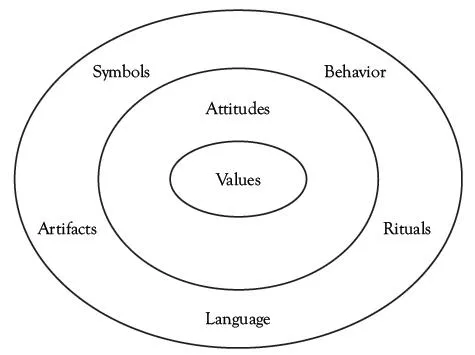
Culture can best be described through three main concepts: values, attitudes, and behavior. All three signify culture and allow us to differentiate from other cultures. “The cultural orientation of a society reflects the complex interaction of values, attitudes, and behaviors displayed by its members.”2 Values and attitudes shape and influence actions and behavior of human beings. They cannot be seen and understood easily. The visible parts of culture are behavior, language, symbols, rituals, and artifacts.
Values
“Values … reflect general beliefs that either define what is right and wrong or specify general preferences.”3 Values clearly define priorities set in a society; they tell us which behavior is accepted in a society or country and which is not. They are often expressed in forms of goals or ideals and give us guidelines for orientation. On top of a societal value system each person may have a personal value system based on upbringing or religious orientation. Values are so deeply embedded in our psyche that we do not question them at all. A classic example of a Western value is self-fulfillment or the wish, intention, or even the feeling that it is an individual’s right to live exactly the way he or she thinks is most fulfilling. Many Asian cultures, however, do not look at the world in the same way; living in cooperation and harmony with other members of society is most important, even if one’s own wishes cannot always be fulfilled.
Attitudes
The second layer is attitude, which can be described as that which “expresses values and disposes a person to act or react in a certain way toward something. Attitudes are present in the relationship between a person and some kind of object.”4 Attitudes express how certain aspects are managed; for example, the cooperation between people in a firm or the interaction between individuals. They can be best expressed with the phrases, “It is better to” or “I should” or “I’d rather.” In our example we can define the attitudes in U.S. society as follows. “It is better to fulfill my dreams even if other members of society do not agree,” meaning that it is socially acceptable to take care of one’s well being first, not thinking of others right away (of course this does not naturally mean that other individuals have to be treated badly).
In Asian societies, however, this is not an acceptable attitude. Here taking care of one’s own wishes without considering others is considered selfish and ignorant and will lead to strong negative reaction in these societies, such as dismissal from the group or organization. The attitude most acceptable here is, “It is better to find solutions for individual problems that are in accordance with other members of society” or “I’d rather listen to my peers, parents, and group members to support society by appropriate actions.”
Behavior
Both values and attitudes build the foundations of our behavior. Behavior can be defined as “any form of human action.”5 This behavior also includes communication and any form of human interaction. Behavior is the visible part of culture—it is the tip of the iceberg. In our case study differences in values and attitudes lead to very different actions in the end. Whereas Sam likes to promote his ideas and consequently his product, his Japanese counterpart expects to be treated and taken care of as a group member. Sam speaks out openly about what he expects, would like to happen, and can do, but Mr. Yamamoto is vague and refers to group members.
Other Visible Parts of Culture
Next to behavior and communication, which we can easily observe in our business lives, there are other visible parts of culture that should not be neglected.
| Table 1.1. Behavior, Attitudes, and Values as Expressions of Cultural Programs |
|---|
| Layer of culture | Example of Western culture (USA) | Example of Asian culture (Japan) |
| Behavior and communication (visible) | Contradiction, if an opinion is not shared, pushing one’s idea or opinion | No open contradiction, attempts to ease conversation |
| Attitude (invisible) | It is better to fulfill one’s dreams even if other members of society do not agree or like it | It is better to find solutions for individual problems that are in accordance with other members of society |
| Values (invisible) | Self-fulfillment | Living in harmony with other members of society |
Artifacts
Artifacts or things play an important role in every culture. Things surround us and often have similar meanings in many cultures. Status symbols also fall in this category. They show and communicate a certain status of their owners and allow them to communicate aspects of their lives nonverbally. Cars, for example, are used to transport individuals, but can also ...