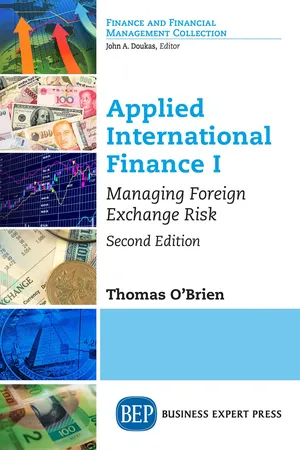
This volume is part of a three-volume set designed for use in a course in applied international corporate finance for managers and executives. Instead of the "encyclopedic" approach, the volumes focus on main issues of interest to managers who deal with overseas operations. This volume's issue is how uncertain foreign exchange (FX) rate changes affect a firm's ongoing cash flows and equity value, and what can be done about this risk. Numerous examples of real-world companies are used. The volume contains a hypothetical case that aims to tie the material together. The case company has overseas operations and is faced with ongoing FX exposure in corporate revenues. The decision maker estimates the FX exposure and considers financial hedging using foreign currency debt and currency swaps. The accounting implications are also considered. The volume reviews some basics of FX rates; for more information, see the first volume: Introduction to Foreign Exchange Rates, 2nd edition, Business Expert Press, 2016. The third volume deals with the estimation of the cost of capital for international operations and the evaluation of overseas investment proposals: Applied International Finance: International Capital Budgeting, 2nd edition, Business Expert Press, 2017.
Trusted by 375,005 students
Access to over 1.5 million titles for a fair monthly price.
Many companies operate globally, taking raw materials from some countries, producing parts in other countries, assembling in still other countries, and competing to sell final products in markets at various places in the world. Many other companies operate only in their home country or have only limited international operations. But regardless of the scope of a firm’s international operations, volatile foreign exchange (FX) rates can impact profitability and growth.
The risk that future FX rate uncertainty poses to a company is determined by both the volatility of the FX rate and the company’s FX exposure, which is the sensitivity of its operating and financial results to the FX rate changes. In 2001, for example, the unexpected depreciation of the euro severely affected the revenues and earnings of many U.S. companies, including DuPont, Merck, Minnesota, Mining and Manufacturing (MMM), Johnson & Johnson, and Procter & Gamble. In general, the FX exposure we will cover is more complex than the FX transaction exposure of a single foreign currency revenue or disbursement, which is covered elsewhere.1
A recent study of approximately 2,400 companies from 55 countries finds that 76% of the firms report that they are exposed to FX risk. The study finds that even 63% of purely domestic firms are affected by FX risk. Of the firms engaged in international trade—exporting, importing, or both—at least 7 of every 10 report that they are exposed to FX risk.2
FX Operating Exposure
It is useful to view FX exposure as an elasticity: the percentage change in a firm’s variable of interest (cash flow, earnings, equity value, and so forth), measured in the home currency (H), given the percentage change in the FX price of the foreign currency (C) versus H. This elasticity definition is consistent with the notion of FX exposure as a regression coefficient.3 We’ll use the Greek symbol γ (gamma) to denote FX exposure.
This chapter covers FX operating exposure, which is the effect of FX rate changes on a firm’s ongoing operating cash flow stream, measured in the firm’s home currency. The notation
denotes the FX operating exposure to the euro, measuring the operating cash flow in US dollars. The O subscript indicates that the FX exposure is the FX operating exposure; other letters will be used later to denote other types of FX exposure. The € subscript indicates that the FX exposure is to the euro. The superscript denotes the home currency in which the financial results are expressed, which in this case is the US dollar.
Thus,
denotes the following elasticity: the percentage change in the operating cash flow, measured in US dollars, given the percentage change in the spot FX price of the euro versus the US dollar. The FX operating exposure to the euro, from the perspective of US dollars, is thus shown in equation (1.1), where %ΔO$ denotes the percentage change in the operating cash flow, measured in US dollars,
, and x$/€ denotes the percentage change in the spot FX price of the euro versus the US dollar.
FX Operating Exposure
For example, assume that operating cash flow (in US dollars) tends to rise by 10% when the euro appreciates by 5% versus the US dollar, and tends to fall by 10% when the euro depreciates by 5% versus the US dollar. As per equation (1.1), we’d say that the FX operating exposure to the euro is 0.10/0.05 = −0.10/−0.05 = 2.
A U.S. company projects an operating cash flow in US dollars of $5 million, given a current spot FX rate of 1.25 $/€. Assume that the company has FX operating exposure to the euro,
, of 0.80. If the euro unexpectedly depreciates by 20% versus the US dollar, all else the same, what is the firm’s new projected operating cash flow in US dollars?
Answer: The projected operating cash flow drops by 0.80(20%) = 16%. So, the new projected operating cash flow is (1 – 0.16)($5 million) = $4.2 million.
A positive FX operating exposure often characterizes an exporter, where the revenues are in a foreign currency. If the foreign currency appreciates (depreciates) versus the company’s home currency, the operating cash flow (measured in the home currency) rises (drops), so the FX exposure is positive. A firm with a foreign subsidiary that generates foreign revenues usually has a positive FX operating exposure to the foreign currency.
What Industries Have High/Low FX Exposures?
A 2003 UBS study of U.S. companies reported that the automobiles and components industry had the highest FX exposure. The industries with the next highest FX exposures were, in order, materials, energy, and health care equipment. Also with substantial FX exposures were household products, consumer durables and apparel, pharma and bio-tech, technology hardware, capital goods, telecommunications, and food, beverage, and tobacco. At the low end of estimated FX exposures were retailing (lowest), semiconductors, transportation, hotels, restaurants and leisure, commercial services, and media.4
A company with a positive FX operating exposure is sometimes said to have a long FX operating exposure. The European airframe manufacturer Airbus does not export to the United States, but has a long FX operating exposure to the US dollar anyway, because the revenues are in US dollars; see the box “Airbus.”
Airbus
The European aircraft manufacturer, Airbus, prices commercial aircraft in the standard currency of the industry, US dollars. With manufacturing, production, subassembly, and assembly primarily in Europe, Airbus’s operating costs are largely in euros.
In 2005, Airbus’s management estimated that a 10% drop in the US dollar relative to the euro would be enough to wipe out half of the company’s annual operating income. Using operating income as a “proxy” for operating cash flow, this estimate is the same as saying that Airbus’s FX operating exposure to the US dollar, from the point of view of euros, denoted
, is −0.50/−0.10 = 5. That’s a high number, but Airbus perhaps has the highest FX operating exposure of any company in the world.
Not all companies’ FX operating exposure is positive. A negative FX operating exposure often characterizes an importer, because as the foreign currency appreciates, an importer’s operating costs rise, and so the operating cash flow drops. A firm with a negative FX operating exposure is said to have a short FX operating exposure. Short FX operating exposures may be found in other scenarios as well. For example, consider a U.S. company whose Swiss subsidiary manufactures products that are sold primarily in the Eurozone. Since the subsidiary’s operating costs are mainly in Swiss francs, the U.S. parent company has a short FX operating exposure to the Swiss franc, in addition to the long FX operating exposure to the euro.
“What If” Analyses
Although many companies have FX operating exposure, quantifying that exposure is extremely difficult to do with precision. To help you better understand FX operating exposure, we’ll look at a few hypothetical examples using a “what if” sensitivity analysis with simple pro forma cash flow statements. In the examples, measuring the exact FX exposure looks easy. But this is only to help you understand the idea.
The hypothetical company is the U.S. exporter United Valve Co., which produces aluminum pipe valve fittings in the United States.5 All sales are in the Eurozone, predominantly to construction companies. This year the company projects ...
Table of contents
Cover
Title
Copyright
Acknowledgments
Review of Foreign Exchange Rates
Chapter 1 FX Operating Exposure
Chapter 2 FX Economic Exposure
Chapter 3 FX Business and Equity Exposure
Chapter 4 FX Translation Exposure
Chapter 5 Foreign Currency Debt
Chapter 6 Currency Swaps
Case Study: Adventure & Recreation Technologies, Inc.
Appendix
Notes
References
Index
Adpage
Backcover
Frequently asked questions
Yes, you can cancel anytime from the Subscription tab in your account settings on the Perlego website. Your subscription will stay active until the end of your current billing period. Learn how to cancel your subscription
No, books cannot be downloaded as external files, such as PDFs, for use outside of Perlego. However, you can download books within the Perlego app for offline reading on mobile or tablet. Learn how to download books offline
Perlego offers two plans: Essential and Complete
Essential is ideal for learners and professionals who enjoy exploring a wide range of subjects. Access the Essential Library with 800,000+ trusted titles and best-sellers across business, personal growth, and the humanities. Includes unlimited reading time and Standard Read Aloud voice.
Complete: Perfect for advanced learners and researchers needing full, unrestricted access. Unlock 1.5M+ books across hundreds of subjects, including academic and specialized titles. The Complete Plan also includes advanced features like Premium Read Aloud and Research Assistant.
Both plans are available with monthly, semester, or annual billing cycles.
We are an online textbook subscription service, where you can get access to an entire online library for less than the price of a single book per month. With over 1.5 million books across 990+ topics, we’ve got you covered! Learn about our mission
Look out for the read-aloud symbol on your next book to see if you can listen to it. The read-aloud tool reads text aloud for you, highlighting the text as it is being read. You can pause it, speed it up and slow it down. Learn more about Read Aloud
Yes! You can use the Perlego app on both iOS and Android devices to read anytime, anywhere — even offline. Perfect for commutes or when you’re on the go. Please note we cannot support devices running on iOS 13 and Android 7 or earlier. Learn more about using the app
Yes, you can access Applied International Finance I by Thomas J. O'Brien in PDF and/or ePUB format, as well as other popular books in Business & Finance. We have over 1.5 million books available in our catalogue for you to explore.