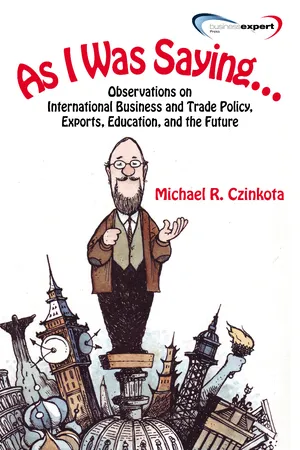
eBook - ePub
As I Was Saying...
Observations on International Business and Trade Policy, Exports, Education, and the Future
- 118 pages
- English
- ePUB (mobile friendly)
- Available on iOS & Android
eBook - ePub
As I Was Saying...
Observations on International Business and Trade Policy, Exports, Education, and the Future
About this book
This exciting new title by Michael Czinkota is the perfect read for businesspeople to better understand just what is at stake in understanding and strategizing about international issues and opportunities.
Information
On Trade Policy
Time for A North American Trade Policy
Originally published in Roll call, August 7, 2009. Used with permission of Michael R. Czinkota and Roll call.
When the leaders of Mexico, Canada and the United States meet for a summit in Mexico this weekend, the agenda will include a largely predictable list of topics ranging from the presidency of Honduras to the swine flu. The historic significance of the meeting, however, will flow from what is said, or not said, about the still-undefined U.S. trade policy.
Mexican President Felipe Calderon will protest the U.S. administration’s failure to honor its North American Free Trade Agreement commitment (now 14 years overdue) and permit Mexican trucks to operate on U.S. highways. At the same time, Canadian Prime Minister Stephen Harper is likely to press the President Barack Obama on “Buy America” provisions in the U.S. stimulus package that discriminate against non-U.S. suppliers and violate a host of U.S. international commitments—from the Word Trade Organization to NAFTA.
But the crucial issue will be whether there will be a new vision and consensus for a North American trade policy. The past decades have seen many bilateral agreements. Increasingly, however, the problems to be addressed and solved are larger than the individual capabilities of such bilateral agreements. If there is to be success in solving major problems, then there needs to be close collaboration between the three nations in recognition and acceptance of their interdependence.
In conjunction with their legislatures, each of the three governments has drawn up important plans. The goals range from improved competitiveness to energy independence, leadership in green technologies, migration control and health care reform. All of these issues require close cooperation between the North American partners.
The talks in Mexico must become a teachable moment on the subject of trade policy and, specifically, how trade liberalization and open markets are key to building a new kind of competitiveness. In the past, any definition of competitiveness depended on whether the perspective taken was that of the government, the firm or the individual. Typically, the government was mainly concerned about tax revenue, companies were worried about profitability and individuals were focused on keeping their jobs. Today’s definition of competitiveness newly includes and reflects one’s neighbors. Even though such transborder perspective may be difficult for Congress—and for legislators in Mexico and Canada—there needs to be a recognition that it is geographic proximity that affects housing prices, trust and perceptions of risk and prosperity. If several houses in a neighborhood go up for public auction, prices of all other houses suffer. Collaboration creates jobs, promotes energy independence and environmental sustainability, and makes use of the economic power of the world’s largest regional market. Proximity matters.
Obama, Calderon and Harper have a unique approach to articulate a new vision of global competitiveness based on a North American platform. Major elements should include:
- A credible commitment to reject protectionist measures. One step in this direction would be a solution to unjustified restrictions against the Mexican trucking industry and to “Buy America” issues. Congress needs to overcome parochialism and accept ‘local’ politics that are inclusive of our neighbors. Given the complementary nature of the three countries—in terms of human, capital and technological resources—we need new ways to deepen economic integration, not to raise barriers.
- Recognition of the critical role that energy plays in our collective competitiveness through an action plan which eliminates distribution inefficiencies and creates a more effective integration of the North American energy grid.
- A plan for a single North American effort for clean energy development, a common approach to carbon offsets and the use of energy leadership as a key joint competitive tool.
- An insistence on joint leadership in the creation and enforcement of global standards for corporate veracity, public accountability and decisions regarding what’s for sale and what shouldn’t be.
- A Congressional acknowledgement that migration flows and economic success are linked. Doing so will redefine return on investment calculations for economic development spending. It will also broaden the Congressional perspective when tradeoffs between international economic liberalization and national security are considered.
- Options for health care treatment for patients on a North American basis. Here Congress can find new options that maintain quality of care standards while giving proper consideration to variations in cost structure within the region. While one does not want to see the emergence of unregulated and unrestricted regional medical tourism, it is important to make use of existing regional health technology assets and capabilities.
Economic and trade concerns have grown in size. We need a cluster of collaboration that enables us to find solutions which are reflective of North American needs, accepted by the local culture and affordable with regional resources. Congress and the administration should consider a tie-in with our North American neighbors to broaden the horizon of possible improvements in our society.

Doomsayers Are Wrong: Don’t Count Out U.S. Economy
Originally published in t he Washington Times, January 14, 2008. Used with permission of Michael R. Czinkota and t he Washington Times.
Worldwide commentary would make it appear as if the United States has become a global economic burden. The current decline of the dollar leads to dire predictions of sharply reduced military strength and shrinking political influence. These commentators are sadly mistaken.
For them, endurance typically refers to the upcoming weekend. Such forecasters need to consider for the United States what other nations have long asserted for themselves—a perspective framed by the long term. For example, in a recent discussion of global economics, a Chinese acquaintance readily agreed that his nation had perhaps had a bad century -but he asserted that China was now ready to again become the center of the world. In discussing Turkey’s desire to become part of the European Union, an Austrian friend repeatedly recalled the Ottoman Empire’s attack against Vienna—in 1683.
Leading powers always suffer from voices of discontent. But other than key players in the past, U.S. encouragement offree speech leads to global discussion rather than underground communication. Think of how the United States was attacked globally in word and action in 1917, in 1941 and many times since then. Though President Reagan was greatly mourned on his passing, when he held office, cartoons showed him as a cowboy drawing his gun. Only rarely would there be a picture showing the positive impact of U.S. strength and determination on the architecture of the global economy.
Over the past 60 years, the United States has consistently been the key contributor to world economic growth and welfare. In the 1940s, its leadership created the World Bank, the International Monetary Fund and the General Agreement on Tariffs and Trade—now the World Trade Organization. These three pillars reduce global poverty, support financial flows and set fair rules for all participants in international trade. In the 1970s, U.S. courage and conviction led the move from gold-related fixed exchange rates to floating ones. This shift allowed the money supply to grow and gave rise to world economic abundance.
The United States has continued to set an example for the world of how market-based actions consistently produce very efficient and effective results. For decades, the country has been the economic locomotive, absorbing growing foreign production within a large and wealthy domestic market. Of course there have been missteps—as one would expect to encounter with any pioneering efforts—but the U.S. approach has worked better than any others when it comes to economic improvement.
Economic stability has been a hallmark for the United States. Consider the effect of political discord or the transfer of power on an international level. Sadly, such events are all too often accompanied by descriptions such as “smoke was rising over villages and cities.” In the United States -even though sometimes there appears to be a tearing of hair shirts and the threat of emigration—political transitions and changes come about smoothly, without bloody battles or economic destruction.
U.S. society tends to admire the “winners” of economic competition and appreciates the accumulation of wealth. Government, in turn, typically does not try to take away from achievers. There is, of course, the government tax bite, but you pretty much get to keep what you’ve accumulated. That sounds like a minor issue until one observes that in many countries over the course of several generations such experiences are quite unusual.
These are the factors which set the United States apart from other nations and affect the investment behavior of the world. For decades, experts predicted the crash of the dollar. Now, the “chickens coming home to roost” arguments predict major economic decline. Some forecasters have even breathed a sigh of relief that their dismal future has finally been sighted.
There is no reason to lose heart due to temporary setbacks. The United States continues to present new and special opportunities to the world. It offers the security and safety that have sadly been unattainable for most people on earth. It presents a vision, flexibility and capability to adjust to new conditions which are envied around the globe.
Let us use a long-term perspective to appreciate past effects and future prospects. Global investors are not foolish when they show their reluctance to turn away from the dollar. What determines the value of money in the long term is the trust, the promise and the future that a nation offers to those holding its currency. To the forecasters full of dismay, I suggest: Don’t write the United States off too soon—remember that the Roman Empire lasted more than 700 years—the Ottoman Empire almost 600. Yes, sometimes it is lonesome at the top.
Currency Flow and Trade: Implications of the Port Debate
Originally published in The Washington Times, March 26, 2006. Used with permission of Michael R. Czinkota and The Washington Times.
The policy eclat over the acquisition of selected U.S. port operations by Dubai appears to be over. There were threats by Congress to pass legislation prohibiting such ownership, countered by statements that President Bush would veto any such legislation. Now, the Dubai owners have decided to spin off the U.S. operations from the global conglomerate which they have purchased. Yet, there may be significant long-term consequences for currency values and trade practices. Most of the public discussion of this sordid affair has reflected the growing sensitivity in the United States to ownership and control of assets by non-domestic entities. The debate has focused heavily on possible discrimination against Muslim investors, protection against terrorism in U.S. ports and retaliation against U.S. investors abroad.
What appears to be not yet widely understood are the potential effects that these and similar policy decisions (such as the Unocal walk-away by China) can...
Table of contents
- Cover
- Contents
- Foreword
- Introduction
- Part I: On Trade Policy
- Part II: On Exports
- Part III: On Education
- Part IV: On Thinking Ahead
- Index
Trusted by 375,005 students
Access to over 1.5 million titles for a fair monthly price.
Study more efficiently using our study tools.
Frequently asked questions
Yes, you can cancel anytime from the Subscription tab in your account settings on the Perlego website. Your subscription will stay active until the end of your current billing period. Learn how to cancel your subscription
No, books cannot be downloaded as external files, such as PDFs, for use outside of Perlego. However, you can download books within the Perlego app for offline reading on mobile or tablet. Learn how to download books offline
Perlego offers two plans: Essential and Complete
- Essential is ideal for learners and professionals who enjoy exploring a wide range of subjects. Access the Essential Library with 800,000+ trusted titles and best-sellers across business, personal growth, and the humanities. Includes unlimited reading time and Standard Read Aloud voice.
- Complete: Perfect for advanced learners and researchers needing full, unrestricted access. Unlock 1.5M+ books across hundreds of subjects, including academic and specialized titles. The Complete Plan also includes advanced features like Premium Read Aloud and Research Assistant.
We are an online textbook subscription service, where you can get access to an entire online library for less than the price of a single book per month. With over 1.5 million books across 990+ topics, we’ve got you covered! Learn about our mission
Look out for the read-aloud symbol on your next book to see if you can listen to it. The read-aloud tool reads text aloud for you, highlighting the text as it is being read. You can pause it, speed it up and slow it down. Learn more about Read Aloud
Yes! You can use the Perlego app on both iOS and Android devices to read anytime, anywhere — even offline. Perfect for commutes or when you’re on the go.
Please note we cannot support devices running on iOS 13 and Android 7 or earlier. Learn more about using the app
Please note we cannot support devices running on iOS 13 and Android 7 or earlier. Learn more about using the app
Yes, you can access As I Was Saying... by Michael R. Czinkota in PDF and/or ePUB format, as well as other popular books in Business & International Business. We have over 1.5 million books available in our catalogue for you to explore.