eBook - ePub
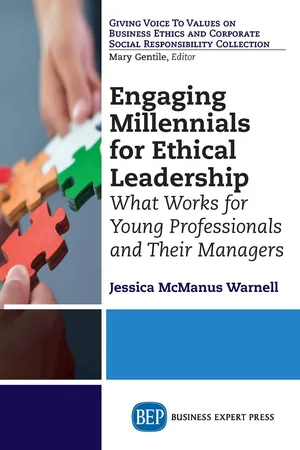
Engaging Millennials for Ethical Leadership
What Works For Young Professionals and Their Managers
- 220 pages
- English
- ePUB (mobile friendly)
- Available on iOS & Android
eBook - ePub
Engaging Millennials for Ethical Leadership
What Works For Young Professionals and Their Managers
About this book
"[This book] brings broad perspective to the discussion of millennial at work. As organizational models continue to evolve, her analysis points to more robust, values-based talent development strategies that optimize engagement and performance. This is essential reading for all who believe that unyielding integrity is the ultimate competitive advantage."—Susan P. Peters, Senior Vice President, Human Resources, GE "In this book, McManus sheds highly focused and well-grounded light on this issue with respect to how to best prepare today's emerging leaders to handle the ethical challenges they are likely to face at work It is a must read for educators, managers, coaches and trainers who face this emerging challenge."—Edward J. Conlon, Sorin Society Professor of Management & Director, Notre Dame Deloitte Center for Ethical Leadership, Author of Getting It Right: Notre Dame on Leadership and Judgment in Business By 2020, half of America's workforce will be millennials. In this era of transparency and accountability, explorations of effective organizations are inseparable from considerations of ethical leadership. Engaging Millennials for Ethical Leadership provides strategies for optimizing performance, drawing on emerging research and complemented with perspectives gleaned from students at a top-tier business school and from a diverse group
of corporate executives.
Information
CHAPTER 1
Millennials at Work

All photographs used with permission, Copyright © 2014 by Della Dewald
Why Business? A Prosocial Conception
Young professionals and those who manage them are working in a challenging and tremendously exciting environment. In the public sphere, business is typically presented representing two extremes—first, the province of crooks, pursuing personal gain at the expense of societal well-being, and second, those who seek to answer to the woes of society, through diverse efforts including mega-philanthropy and social enterprise. As the business-scandal-of-the-day ticks along the bottom of our television screens and the economy lumbers out of the financial crisis, the ranks of students studying management, finance, accountancy, and marketing swell.4 In the last several years, in the United States, more undergraduate and graduate business degrees were awarded than any other type of undergraduate or masters-level degree. Nearly one in three international undergraduates studying in the United States majors in business, management, or marketing.5 As increasing calls for business accountability are offered alongside exciting movements that illustrate the business community’s remarkable potential for good, emerging professionals may be left shaking their heads. Are business schools producing nothing more than “jargon-spewing economic vandals”6 or is business, the institution with the agility, scale, reach, resources, and innovation to solve the world’s most pressing problems, part of society’s salvation?
Perhaps not surprisingly, my perspective is that business is one of the most critical components of solutions required for today’s societal challenges. These two extremes—scourge or salvation—do not adequately account for business’s role in our society. Effective, ethical business is a primary means to economic progress. It is instrumental to personal and community wealth, necessary new products and services, development of peaceful societies with adequate access to resources, new technologies that can address critical health needs, and so many other contributions toward personal, community, and global well-being. Equipping students studying business with the tools to channel their efforts accordingly recognizes the vast space in between these two extremes—the space in which most of us operate. So how do we prepare young professionals—today’s students and workforce, tomorrow’s leaders—to contribute in a sector in which the stakes are so high?
As we consider the impact of business in society, we must acknowledge the formative role of our business schools. Is teaching “business ethics” the answer to societal ills? These days, it is a rare business school that does not include some explicit attention to ethics in the curriculum. Yet pedagogy and practice differ tremendously. Consistent with outcomes from other studies,7 students who have completed a course with substantive ethics content at one top-tier business school show a solid grasp of the concepts and theoretical foundations of ethical decision making, but still display room for growth in translating “knowing” to “doing.”8 Resembling the progression from memorizing theoretical management approaches to developing the acumen to execute them in the real world, opportunities exist around developing skills necessary for translating moral intention (a principled, reasoned analysis of an ethical dilemma: “I know what should be done!”) to application and behavior (ethical action: “I did it, successfully!”) in the business context. Scholars offer models for ethical decision making—we provide one model later in this volume—and management techniques for problem solving. Yet schools often struggle to teach strategies for effectively acting on those decisions—the critical step. We fail if we teach students how to discern the “right” thing to do, but then leave them unequipped to put their decision into action.
The call for actionable skills in values-based decision making also comes from the business community. Corporate studies indicate the market’s demand for emerging leaders to possess proficiency in application, integration, problem solving, and fluency in broadly defined sustainability solutions.9 Legislation such as Sarbanes-Oxley and Dodd-Frank arises, attempting to fill the void between ethical intention and action, and companies scramble to create a culture of internal resolution in the face of increasing incentives for whistleblowing. Urgent societal challenges—sustainability and global climate change, and globalization of business in the context of political, economic and social inequity and instability, among others—prompt business toward a triple bottom line approach to management that pursues financial, social, and environmental goals in the changing, global context.
Research tells us that millennials studying business display a strong commitment to prosocial enterprise.10 They intend and expect to work for organizations whose missions align with their values of social engagement, sustainability, and other ethical considerations. At the same time, we know that managers often express struggles with engaging these emerging professionals in a way that channels this interest into productive organizational development. Today’s global business demands actionable skills for ethical decision making and leadership. A common refrain from recruiters and managers of these young people is the gap between a firm grasp of theoretical business principles, and the skills to move toward action and implementation.
Educating and managing millennials in a way that bridges the gap between intention and action is critical. This challenge of translating the skills and content of “learning” to “doing” is a feat that all new professionals must master. In this era of nonstop information flow and global connectedness, the challenge of navigating and applying this information toward effective business is even more acute. Student proclivity, the need, and the demand for these skills are there. Millennials often can and do act on their values, and businesses can implement mechanisms to foster values-based decision making toward organizational culture and shared goals. As we consider strategies for equipping young professionals to operate successfully in this context, a promising approach is a framework called Giving Voice to Values (GVV). The GVV approach provides explicit and actionable professional development toward these goals and we will explore its key concepts and action items for millennials and their managers. We can recognize that the ways that millennial traits are experienced and expressed are critical, and through strategic attention to hiring, training, and development, organizations can capitalize on the promise of these new professionals.
So we begin in the spirit of optimism. When the topic of millennials at work arises at academic and professional conferences, and, as we will explore, in interviews with corporate leaders, it is inevitable that participants have horror stories of social media mavens gone rogue, demanding or unreliable new hires, and other grievances. These issues are real and they matter. Such frustration can easily dominate the dialogue and become immobilizing. In contrast, channeling the energies and talents of young professionals can help us create stronger, more vibrant, forward-looking organizations. Both sides have a role, with young people respecting organizational requirements—show up, work hard, learn from others, be committed—and managers fostering a culture of engagement and shared goals, incorporating the values of sustainability, values-based work, and balance. Our business schools can help prepare these young professionals. Our corporations can recognize, incentivize, and foster their gifts, talents, and passions. Both can prosper.
Who Are the Millennials?
Generally defined as young people who have graduated high school since the year 2000, or those born after 1980 but before 1995, these young professionals will soon represent a majority of the global workforce. As with most attempts to standardize large groups, scholars disagree on the boundaries, with the empirical data suggesting often contradictory characteristics of this cohort. Readers of this book, millennials or otherwise, may see themselves and this cohort in these pages, or not at all. The variance in empirical results reflects a gift of this generation—this may be the most diverse group of emerging businesspeople ever seen. Our exploration is about generalities, and is undertaken in the spirit of maximizing professional and organizational effectiveness. Young professionals are working in an environment in which these generalities are widely perceived, so by exploring them, we can enhance our capacities together. Thus, despite some differences in the values and virtues ascribed to this generation, a general consensus emerges around several key characteristics that can drive our strategies for effective engagement. These characteristics include the following:
• technological fluency and facility with social media;
• proclivity to multitask;
• teamwork capacities;
• a preference for training and mentorship to reflect sustained and personal attention;
• a desire for meaningful and fulfilling work;
• an increasing awareness of social and environmental sustainability issues.11
In addition, immediacy might be a helpful term to frame our thinking around this cohort. Identified as a core value of the millennials,12 a desire for rapid response to queries, reaction to achievement, connection with others, and other manifestations of an open, quick, and continuous feedback loop characterize millennials more than any generation before. This desire, of course, can pose challenges for managers. As we will explore in Chapter 2, it can be channeled more positively toward ethical, effective organizations.
The reality is that most of us operate in multigenerational workplaces. Much is made (including in this volume!) about differences by generational cohort. But the nature of the challenge prompts critical considerations for professional and organizational development. A research finding with helpful implications can be considered here. Thus, although broad differences can be observed between generational groups at work, interestingly, specific characteristics seem to differ by institution.13 These generational traits and characteristics manifest themselves in different ways depending on the organizational culture and conditions. This finding suggests that how these differences are experienced and expressed matters, and that the ways these traits are managed makes a difference. Managers have tremendous potential for impacting the ways millennials engage with their work, and are encouraged to interpret these generalizations as they apply to their specific companies.
Thus, the ways these intergenerational differences are acknowledged and translated into employment skills can be enhanced strategically by the organization through the approach to hiring, training, and developing its talent. GVV is an approach that provides tangible strategies to enhance engagement of millennials and to effectively manage multigenerational cultures.
Why Now?
The question may be raised—is the “back in my day” plaintive view of the next generation simply cyclical? Does not every generation lament the one that follows? While certainly this dynamic is not exclusive to the ascension of the millennials, several features of this generation and the era in which they are coming of age merit our close attention and demand response from business leaders. First, millennials, as children of the baby boomers, numerically represent a proportion of the business community—employees, managers, and consumers—that will be unmatched. There are nearly 90 million people in this age group in the United States alone. This bodes well for the American economy—the youngest of these young people (there are more 23-year-olds than any other age group in the United States14) are the most aggressive about avoiding and paying down consumer debt, are starting their careers largely missing the worst of the economic recession, and through sheer size will help create and sustain employment and wealth.15 The ranks of millennials in management are increasing tremendously. As noted above, business degrees are being awarded now more than ever—in the United States, more than any other type of degree.
Yet other issues are perhaps even more important. Critically, technology is a multiplier. These generational characteristics are more acute and impactful because their reach and scope are much broader. Relatedly, we are in an era of transparency never before experienced. Corporate responsibility (and lack thereof) is regularly tweeted around the world in less time than it takes us to complete this sentence. In some cases, we know, minutiae by minutiae, what one another are doing like never before. Privacy challenges abound. This transparency and constant communication influences who we are and what we do. It changes the playing field for employee recruitment and retention, as job seekers (and, of course, consumers, investors, competitors, and other stakeholders) have instant access to information on policies and procedures of companies—those they desire, and those they seek to avoid. Accountability has changed—pro- and antisocial behavior is visible and we, as individuals, and as corporations, are increasingly subject to infl...
Table of contents
- Cover
- Half Title Page
- Title Page
- Copyright Page
- Dedication
- Contents
- Acknowledgments
- Introduction “The Millennials Are Coming!”
- Chapter 1 Millennials at Work
- Chapter 2 Always On: Technology & Voice
- Chapter 3 Altogether, Now: Engagement & Multigenerational Workplaces
- Chapter 4 Mentor Me, Please!
- Chapter 5 Must Be Meaningful
- Chapter 6 The Millennials Speak
- Chapter 7 Corporate Best Practices
- Conclusion
- Appendix A “A Tale of Two Stories” Facilitator Debrief Questions/Reflection
- Appendix B Personal-Professional Profile
- Appendix C A Framework for Ethical Decision Making
- Appendix D Case Studies
- Endnotes
- Index
Trusted by 375,005 students
Access to over 1.5 million titles for a fair monthly price.
Study more efficiently using our study tools.
Frequently asked questions
Yes, you can cancel anytime from the Subscription tab in your account settings on the Perlego website. Your subscription will stay active until the end of your current billing period. Learn how to cancel your subscription
No, books cannot be downloaded as external files, such as PDFs, for use outside of Perlego. However, you can download books within the Perlego app for offline reading on mobile or tablet. Learn how to download books offline
Perlego offers two plans: Essential and Complete
- Essential is ideal for learners and professionals who enjoy exploring a wide range of subjects. Access the Essential Library with 800,000+ trusted titles and best-sellers across business, personal growth, and the humanities. Includes unlimited reading time and Standard Read Aloud voice.
- Complete: Perfect for advanced learners and researchers needing full, unrestricted access. Unlock 1.5M+ books across hundreds of subjects, including academic and specialized titles. The Complete Plan also includes advanced features like Premium Read Aloud and Research Assistant.
We are an online textbook subscription service, where you can get access to an entire online library for less than the price of a single book per month. With over 1.5 million books across 990+ topics, we’ve got you covered! Learn about our mission
Look out for the read-aloud symbol on your next book to see if you can listen to it. The read-aloud tool reads text aloud for you, highlighting the text as it is being read. You can pause it, speed it up and slow it down. Learn more about Read Aloud
Yes! You can use the Perlego app on both iOS and Android devices to read anytime, anywhere — even offline. Perfect for commutes or when you’re on the go.
Please note we cannot support devices running on iOS 13 and Android 7 or earlier. Learn more about using the app
Please note we cannot support devices running on iOS 13 and Android 7 or earlier. Learn more about using the app
Yes, you can access Engaging Millennials for Ethical Leadership by Jessican McManus Warnell in PDF and/or ePUB format, as well as other popular books in Economics & Sustainable Development. We have over 1.5 million books available in our catalogue for you to explore.