eBook - ePub
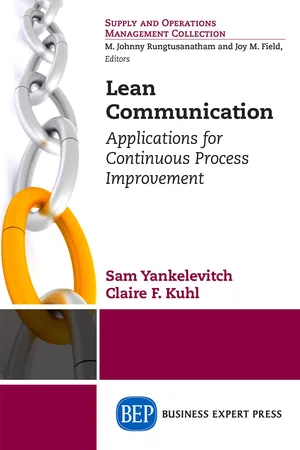
Lean Communication
Applications for Continuous Process Improvement
- 92 pages
- English
- ePUB (mobile friendly)
- Available on iOS & Android
eBook - ePub
About this book
Today, with a kaleidoscope of disruptive forces affecting business transactions, the speed of commerce, and the ferocious level of competition for consumer loyalty and business survival—the cost of an enterprise's faulty communication can literally make or break a product. This book is an introduction to concepts associated with Lean
methodologies and how these can be adopted to uncover waste and drive improvements in the interactions between participants in an organization. Lean Communication provides the reader with analyses and solutions that can help frontline teams in today's global supply chains, which are characterized by inherent problems rooted in
time zone, language, and cultural differences.
Trusted by 375,005 students
Access to over 1 million titles for a fair monthly price.
Study more efficiently using our study tools.
Information
Chapter 1
The Cost of Complexity: The Impact of Language, Culture and Distance on Operations
The more complex a work environment becomes, the more important it is for all parties to communicate effectively.
You have heard it—or said it—a million times: “Keep it simple, stupid.” Great advice, but not always doable in today’s 24/7/365 global economy. Political changes have opened the door to long-distance trade relationships that were unthinkable in the past. Even had they been thinkable, it is only in the past 20 years or so that advances in technology have made it practical for average companies to build just-in-time supply chains and distribution channels that span the globe.
The world is the new shop floor.
Of course, as soon as you have multinational business networks, you have the additional complications of cultural and linguistic differences. And all that added geographical distance makes lead times longer. Even today, it takes more than 30 days for a ship to cross the Pacific Ocean, versus waiting an hour for a truck to carry components 30 miles from across town.
Shorter lead times allow for faster solutions. Cause and effect are closer together.
The more complex a work environment becomes, the more important it is for all parties to communicate effectively. Orville and Wilbur probably did not have too much trouble reconciling their engineering drawings for the first airplane or agreeing on adjustments to a particular component after testing it.
The Airbus people found things to be a bit more challenging. First, they were dealing with an engineering marvel of staggering complexity. The electrical system alone comprised more than 100,000 wires and 40,300 connectors performing 1,150 separate functions. The team struggled to share ideas, refine designs, and make decisions while working across 16 sites located in 4 different countries with 4 different native languages and customs, reflecting two not-well-merged corporate cultures. And, of course, there was the issue of the incompatible software releases.
According to Andrea Rothman, writing for Bloomberg.com in 2006:
…engineers in Germany and Spain stuck with an earlier version of Paris-based Dassault Systemes SA’s CATIA design software, even though the French and British offices had upgraded to CATIA 5. That meant the German teams couldn’t add their design changes for the electrical wiring back into the common three-dimensional digital mockup being produced in Toulouse, Champion says. Efforts to fiddle with the software to make it compatible failed, meaning that changes to the designs in the two offices couldn’t be managed and integrated in real time, he says. The situation worsened when construction and tests of the first A380s generated demands for structural changes that would affect the wiring. The changes in configuration had to be made manually because the software tools couldn’t talk to each other (2006; emphasis added).
Manually changing the configuration for 100,000 wires and 40,300 connectors? You do not need a degree in probability to predict problems when dealing with that many potential points of failure.
In my experience, you do not even have to be at that extreme level of complexity to encounter costly problems. Let us consider how complexity creep affects communication efforts.
Early Days at Toyota
Lean Lingo
The seven forms of muda:
- Overproduction
- Inventory
- Motion
- Waiting
- Conveyance
- Overprocessing
- Not right first time
In the earliest days, when lean concepts were first emerging at Toyota, the supply chain was very local—Japanese client and suppliers sharing one language, one set of cultural norms (Newton 2006). Most of the suppliers were within a 50-mile radius of the assembly plant. That helped keep lead times short, which made the concept of pull strategy and just-in-time inventory quite workable.
Any communication issues they had were probably minimal compared to all the other sources of muda, which they were discovering and battling. This muda was later categorized into the now well-known seven types of waste of manufacturing environments. And you will note that they found all of this even in their compact universe of short distances, short lead-times, shared language, and common culture.
New World, New Lean
Fast forward 60 years. Consider now the challenges and opportunities of globalization and the impact it has on companies and people. The world is the new shop floor!
Although it has been around for a while, globalization has accelerated significantly over the past several years, compounding the collision of cultures and customs, and creating whole new communication hurdles.
As companies and supply chains grow ever larger and more complex, they present their people with barrier after barrier that block true understanding and agreement. A great number of 21st century products depend on materials and components fabricated thousands of miles away from where they are assembled. To navigate each component through its many stops on the road to the final customer takes constant interaction between people and systems.
Possibilities for miscommunication among people abound. Certainly, people from different cultures and backgrounds who speak different languages may encounter challenges in coordinating multiple products across continents and time zones. But even beyond international and ethnic barriers, remember that the Baby Boomers do not understand the Millennials. The men do not understand the women. The bosses do not understand the workers. The driven type As do not understand the laid-back type Bs. And the list goes on.
Communication is the next frontier for lean implementation in our global supply chain.
As the Airbus story has already highlighted, systems and technologies also encounter difficulties in trying to share information. Do we need EDI or XML to share ERP data? Can your PC handle my Mac files? Can we both maintain your cloud-based database in real time? Can you run this Apple app on your Android? Again, the list goes on.
Despite the difficulties, effective communication is absolutely essential. So how do we overcome these gaps?
The same continuous improvement methodologies we have learned and adopted from Toyota can also detect communication muda that has crept in because of globalization and increasing complexity.
Fortunately, the same continuous improvement methodologies we have learned and adopted from Toyota can also detect communication muda that has crept in because of globalization and increasing complexity. If we focus our new lean thinking on communication at the operational level, where things actually get done, we should be able to have a significant positive impact on actions and performances.
Lean, when it becomes the cultural communication norm, can be a bridge to overcome barriers and build connections among different stakeholders, regardless of their origin, background, and upbringing. In this book, we will explore how to embed lean communications into an organization.
For now, envision the end result of working in a culture where lean communication practices are fully in play:
- Every conversation 1 ultimately has the customer in mind and contains as li...
Table of contents
- Frontcover
- Halftitle
- Title
- Copyright
- Abstract
- Content
- Acknowledgments
- Introduction
- Chapter 1: The Cost of Complexity: The Impact of Language, Culture and Distance on Operations
- Chapter 2: A Process Called Communication: An Opportunity for Waste in Our Daily Interactions
- Chapter 3: Acts of Unintended Communication: Our Actions and the Messages They Send
- Chapter 4: Continuous Improvement of the Communication Process: VSM, 5S, PDCA, and More
- Chapter 5: The Tip of the Tip of the Iceberg: Bringing the Issue to the Surface
- Chapter 6: A Leadership Challenge: Use Lean Thinking in Global Communication
- References
- Index
- Ad page
- Backcover
Frequently asked questions
Yes, you can cancel anytime from the Subscription tab in your account settings on the Perlego website. Your subscription will stay active until the end of your current billing period. Learn how to cancel your subscription
No, books cannot be downloaded as external files, such as PDFs, for use outside of Perlego. However, you can download books within the Perlego app for offline reading on mobile or tablet. Learn how to download books offline
Perlego offers two plans: Essential and Complete
- Essential is ideal for learners and professionals who enjoy exploring a wide range of subjects. Access the Essential Library with 800,000+ trusted titles and best-sellers across business, personal growth, and the humanities. Includes unlimited reading time and Standard Read Aloud voice.
- Complete: Perfect for advanced learners and researchers needing full, unrestricted access. Unlock 1.4M+ books across hundreds of subjects, including academic and specialized titles. The Complete Plan also includes advanced features like Premium Read Aloud and Research Assistant.
We are an online textbook subscription service, where you can get access to an entire online library for less than the price of a single book per month. With over 1 million books across 990+ topics, we’ve got you covered! Learn about our mission
Look out for the read-aloud symbol on your next book to see if you can listen to it. The read-aloud tool reads text aloud for you, highlighting the text as it is being read. You can pause it, speed it up and slow it down. Learn more about Read Aloud
Yes! You can use the Perlego app on both iOS and Android devices to read anytime, anywhere — even offline. Perfect for commutes or when you’re on the go.
Please note we cannot support devices running on iOS 13 and Android 7 or earlier. Learn more about using the app
Please note we cannot support devices running on iOS 13 and Android 7 or earlier. Learn more about using the app
Yes, you can access Lean Communication by Sam Yankelevitch,Claire F. Kuhl in PDF and/or ePUB format, as well as other popular books in Business & Operations. We have over one million books available in our catalogue for you to explore.