Foreign firms typically engage China as a sourcing location or as a market to sell their goods. China is increasingly taking on a more prominent role in global business. After 30 years of economic reforms that have enabled China to become the workshop of the global economy, we are now witnessing the transformation of the "Middle Kingdom" into one of the world's largest consumer markets and one of the world's most productive centers of innovation. If you are interested in doing business in China, you'll need this book. This book details the history, culture, economy, marketing, sourcing, staffing, etiquette, negotiation, and daily life. Anyone hoping to achieve global business success in the 21st century must be familiar with these concepts. Strother takes you inside the requirements; what works; what won't; and so much more.
Trusted by 375,005 students
Access to over 1 million titles for a fair monthly price.
“Gan bei!” Wang announced, raising then downing his glass. We had just finished a sumptuous feast of shrimp, chicken, beef, pork, vegetables, fresh fruit, and about a dozen other delicious if unidentifiable dishes. I stood up, raised my own small beer glass and drained it. “Gan bei!” indeed.
The 21st century is the Chinese century. After 30 years of economic reforms that enabled China to be the workshop of the global economy, we are now witnessing the Middle Kingdom transform into one of the world’s largest consumer markets and one of the world’s most productive centers of innovation.
The forces of globalization have shrunk our world, such that economic activity easily stretches across national borders. Companies can expand beyond their home country to foreign locations for low-cost production sites, and additional markets for their products.
Anyone hoping to have global business success in the 21st century must engage China. Despite the fact that over half a million foreigners visit China each year, many know very little about Chinese business, life, language, and culture. As China takes a more prominent role in the global hierarchy and rewrites many of the rules of the game of business, it is essential for Western businesspeople to learn about China.
The rapid development of Shanghai’s Pudong New Area is just one of many modernization projects propelling China into superpower status in the 21st century.
Foreign firms generally engage the China market for two reasons: sourcing and selling. When China opened its Special Economic Zones in the mid-1980s foreign firms flocked to China to take advantage of the cheap labor. A great migration ensued as young people left village life behind and followed the mighty Pearl, Yangtze, and Yellow rivers to the coastal cities where factories were springing up like bamboo after the rain. The cities developed rapidly. Many entrepreneurs found their fortune and a nouveau riche middle class emerged.
China’s enormous consumer market is the second reason foreign firms are flocking to China. China’s 1.3 billion citizens make up one seventh of the world’s population. Half are in cities and the rest in the countryside. As a comparison China has twice as many urban consumers as the US has total population. Aggregate national statistics fool us into seeing China as a poor developing nation, but if you isolated China’s wealthiest 300 million urban consumers you would find a consumer market the same size as that in the US with similar amounts of discretionary income.
Sadly, the graveyard of foreign firms in China has many members. And of those who survive, recent research found that only a third of foreign firms in China actually made a profit.1 If the labor is so cheap, and the consumers’ wallets so fat, why then do foreign firms fail?
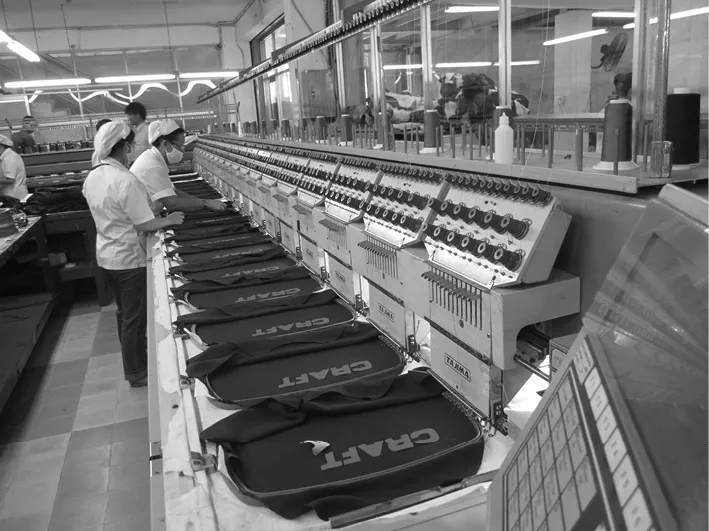
Many foreign textile companies engage the China market for its sourcing advantages, especially low cost labor.
Foreign firms fail in China for a number of reasons. Some fail because they don’t understand the time and relationship commitment aspects of China business. Many companies just want to source cheap parts and don’t care to learn Chinese business culture and its emphasis on mutually beneficial relationships. Every relationship with suppliers, customers, and regulators should be carefully developed. Avoid backroom deals but keep all relationships in harmony. You never know who might be the one person to open a key door for you. Be willing to spend time socializing and forgo contract talks for a while. Danone’s well-publicized defeat in their JV with Wahaha is largely due to Danone managers’ unwillingness to develop relationships with Wahaha leaders.
“Gan bei! ” I replied draining my small beer glass. Every year Dr. Wang, the dean of the international college, throws us a banquet celebrating many years of partnership between Zhejiang University and our university in California. Two or three times each year we exchange students and faculty in short term programs, and the banquet is an essential part of the relationship between the two organizations.
Some foreign firms have failed due to a lack of understanding of the legal environment. In the absence of a reliable legal system the guanxi system emerged wherein business relationships are based on mutually beneficial exchanges rather than legally binding contracts. Speaking of contracts, don’t expect the rule of law to bail you out. Personal guanxi is important, but ultimately the business relationship must be win-win for both sides. A well-written contract helps define each side’s commitments, but it is unlikely to bind either party in a Chinese court. Fifty years from now maybe, but not today. That’s what they mean by “developing” country.
Many foreign firms have failed in China because they refuse to localize their product. Here Barb demonstrates a small washing machine you might find in a typical Chinese household.
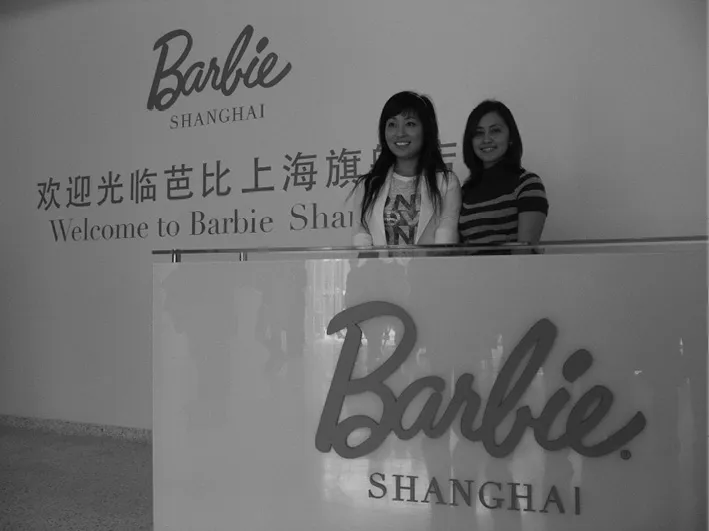
An innovative concept combining a little girl’s fashion runway, and pink martinis for the older girls, Shanghai Barbie eventually succumbed after just two years.
Coca Cola has set up bottling plants across China, but remains a minority partner in all the ventures except its Shanghai WFOE that produces the secret recipe syrups.
Foreign firms also fail in China because they fail to localize their product. Despite the modest market share back in the US, KFC has more outlets in China than any other business. Some of their success is based on their willingness to localize their products, whereas McDonald’s sticks with Quarter Pounders and is only one-third the size of KFC in China. Mattel also struck out recently with its Shanghai Barbie launch due to brand schizophrenia. The Barbie store sold pink martinis targeting a somewhat older more sophisticated consumer than the young girls popping in to buy the latest doll. Whirlpool failed by offering washing machines with too many options, whereas Haier, a local brand, dominates the market with its no frills washing machines.
Some foreign firms in China struggle with their impression management. The initial Chinese translation of Coca Cola’s name had something to do with “wax tadpoles” whereas they’ve since chosen a more suitable name. How will the Chinese view you and your company?
How the Chinese See You
For much of modern history, the Chinese have been suspicious of outsiders. During the colonial era, many Chinese observed the pale skin, pointy noses, and funny ways of their Western visitors and called them
yang gui zi meaning “foreign devil.” Merchants were out to make a buck and missionaries were saving souls, but since they looked alike, hung out in expat ghettos, and together meddled in China’s internal affairs it was easy to stereotype them all as foreign devils.
After being humiliated by Western powers in the Opium Wars, and regular invasions by Japanese soldiers and pirates, it is clear why Chinese came to distrust foreigners. Brits and Yanks regained some of their lost face by helping dispel the Japanese invaders from Chinese soil during the Second World War, but after the Commies took over in earnest, it was time for a fresh start and foreigners had to repatriate themselves as China figured out how to rebuild itself.
The Chinese people have not forgotten their troubled past, and apparently have forgiven their foreign aggressors, as these days foreigners are warmly welcomed in the Middle Kingdom. In general, Chinese perceive Westerners as competent individuals from modern successful societies. There is much about Western civilization the Chinese find appealing but especially technology and culture. Nonetheless, too many of us make it easy for the Chinese to form a negative impression of foreigners, especially if we don’t know their language, culture, and daily customs. Couple these incompetencies with our foreign looks; it’s no wonder many Chinese view us as illiterate, fat people, with fat wallets. Hopefully we can engage the Chinese with humility, patience, and a teachable spirit, and the international partnership can blossom.
Most people will warmly welcome you to China, including Leah, the owner of Central Perk, a coffee shop based on the “Friends” sitcom.
The Plan of This Book
This short book introduces business travelers to key information about China that is essential for successful interactions with Chinese people and companies. The book begins with background information on history, culture, and economy, and then covers more practical matters of business including marketing, sourcing, business structures, staffing, etiquette, and negotiation. Each topic is described with brevity and clarity, and illustrated with a number of anecdotes, many of them first-hand experiences of the author, or experiences of foreign businesspeople in China. While it may take a lifetime of study to fully understand the complexities of such an ancient society, this book is a useful first step down the path to competent engagement of the Middle Kingdom.
The second chapter of this book offers a short description of China’s history, philosophies, and religion. While...
Table of contents
Cover
Halftitle
Title
Copyright
Abstract
Contents
Chapter 1: Introduction
Chapter 2: History, Philosophy, and Religion
Chapter 3: Culture
Chapter 4: Economy
Chapter 5: The Consumer Market
Chapter 6: Marketing Strategy
Chapter 7: Sourcing in China
Chapter 8: Business Structures
Chapter 9: Staffing and Employment
Chapter 10: Business Etiquette
Chapter 11: Negotiation
Chapter 12: Daily Life
Notes
References
Index
Announcing the Business Expert
Frequently asked questions
Yes, you can cancel anytime from the Subscription tab in your account settings on the Perlego website. Your subscription will stay active until the end of your current billing period. Learn how to cancel your subscription
No, books cannot be downloaded as external files, such as PDFs, for use outside of Perlego. However, you can download books within the Perlego app for offline reading on mobile or tablet. Learn how to download books offline
Perlego offers two plans: Essential and Complete
Essential is ideal for learners and professionals who enjoy exploring a wide range of subjects. Access the Essential Library with 800,000+ trusted titles and best-sellers across business, personal growth, and the humanities. Includes unlimited reading time and Standard Read Aloud voice.
Complete: Perfect for advanced learners and researchers needing full, unrestricted access. Unlock 1.4M+ books across hundreds of subjects, including academic and specialized titles. The Complete Plan also includes advanced features like Premium Read Aloud and Research Assistant.
Both plans are available with monthly, semester, or annual billing cycles.
We are an online textbook subscription service, where you can get access to an entire online library for less than the price of a single book per month. With over 1 million books across 990+ topics, we’ve got you covered! Learn about our mission
Look out for the read-aloud symbol on your next book to see if you can listen to it. The read-aloud tool reads text aloud for you, highlighting the text as it is being read. You can pause it, speed it up and slow it down. Learn more about Read Aloud
Yes! You can use the Perlego app on both iOS and Android devices to read anytime, anywhere — even offline. Perfect for commutes or when you’re on the go. Please note we cannot support devices running on iOS 13 and Android 7 or earlier. Learn more about using the app
Yes, you can access China by Stuart Strother in PDF and/or ePUB format, as well as other popular books in Business & International Business. We have over one million books available in our catalogue for you to explore.