- 219 pages
- English
- ePUB (mobile friendly)
- Available on iOS & Android
eBook - ePub
About this book
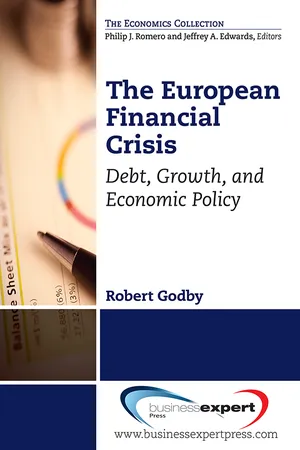
The European debt crisis has posed a challenge for many people to understand, both non-Europeans and Europeans alike. Even economists, finance specialists and market commentators are often uncertain of its causes or in the interpretation of events ongoing, or of past events that have taken place that then shaped the current situation. Typically this lack of understanding results from a lack of understanding of how European institutions work, the structure of European politics and the Eurozone, the economics of the financial system, or the relationship of debt markets to current government policies in the EU. The purpose of this book is to describe the causes and outcomes of the European debt crisis (to the date of publication) within the context of three questions most often asked about the debt crisis: (i) what happened? (ii) why did it happen? and (iii) why has the crisis been so difficult for policy-makers to address? The book attempts to answer these questions in a straightforward, scholarly and thoughtful fashion, thereby developing a wider understanding of the crisis in its entirety for the reader. The book is by no means meant to be an exhaustive treatment on any of the issues it discusses. But the approach taken should be useful for those people who wish to better understand the events of the European financial crisis over the past three years but who do not need to acquire an exhaustive background in European institutions, debt markets, history and economic policy-making. For that reason the proposed book would have appeal to undergraduate students in business, economics, politics or interdisciplinary studies looking for an approachable yet detailed overview of the crisis, for graduate classes seeking similar goals and lay-people or professionals interested generally in the topic and/or with a need to acquire a basic understanding of the topic. Further, the book could serve as an introduction in courses or settings that lead to deeper discussion of the economic, political, and financial issues it presents.
Information
PART I
Introduction: Understanding the Problem—Why Is This So Hard?
CHAPTER 1
Introduction: Where There’s Smoke, There’s Fire
August 2009
Smoke hung heavily over Athens. Unforgiving winds blowing out of central Europe spread searing flames toward Greece’s ancient capital. As residents fled the scorching embers and deadly heat, leaving homes and livelihoods behind to escape late August wildfires, none could have known that the conflagration pursuing them would cause the beginning of an ordeal that would dash the dreams of millions, ruin personal fortunes, topple governments, and threaten to destroy the aspirations of an entire continent long after the blaze engulfing the forests north of democracy’s birthplace was extinguished. The ashes of the pine trees, olive groves, and burned foundations left after the Greek wildfires of 2009 would eventually cultivate the seeds of an economic and political crisis with repercussions affecting financial markets across the globe. This would also not be the last time Athens would be aflame, although future fires would be fueled by economic desperation and political frustration instead of tinder-dry woods.
In September 2009, perceived failures in the Greek government’s response to the wildfires, coupled with years of apparent neglect of the firefighting service and suspicions that the forest fires were the arson of unscrupulous land developers ignited new calls for the ouster of Greece’s sitting center-right New Democracy party. The government was not in a strong position, having already been stung by a string of earlier corruption scandals. Holding only a one-seat majority in the Greek Parliament, Prime Minister Kostas Karamanlis called a snap election in hopes of consolidating his party’s power over the main opposition Pan Hellenic Movement (PASOK) and several smaller parties. That early-September decision proved a disaster. New Democracy was punished by voters, receiving its lowest vote share in party history (up to that time), and the returns of the Greek legislative election of October 2009 set in motion the events of the what has since become known as the Euro crisis.
To many, it is hard to believe, but the seemingly never-ending Euro crisis has been an ongoing headline for 4 years. Germany’s chancellor Angela Merkel once warned it would be a marathon.1 It began in late 2009 in the shadow of the financial crisis of 2008. After the October election, the new center-left Greek government of George Papandreou assumed office and began to sort through the ledger of the previous government. In doing so, it was shocked to find a deficit much larger than expected. The required restatement of the government’s fiscal position revealed that, for years, previous Greek governments had hidden massive debts from the rest of the European Union (EU) and had obscured the fact that Greece had not met debt and deficit commitments that all countries in the “Eurozone,” the 17 EU member states using the euro as their common currency, are required to meet.2
Missing the targets was not surprising. Other countries in the past, including the largest economies in the bloc, France and Germany, had also failed to meet these targets, especially the deficit target set at 3% of gross domestic product (GDP). The recent global financial crisis and subsequent government actions taken across the continent to stabilize markets had left several other Eurozone governments outside of the EU-mandated fiscal guidelines. Deficits were not new. What shocked markets was the scale of the revelation; Greece’s estimated government deficit for 2009 was more than tripled, revised from a previous 3.7% of GDP to 12.5% shortly after the new government took office. By April 2010, new EU figures suggested the deficit was even larger—nearer to 14%.3 The implications of this admission forced investors worldwide to reconsider their faith in the safety of sovereign debt, a faith that had been used to rescue the world financial system in the aftermath of the 2008 global market crash. Questioning the solvency of sovereign debt threatened to undermine the greatest source of strength and until now seemingly the only source of certainty in a still fledgling world financial recovery.
Such revisions in official statistics are typically very rare. In Greece, however, such revisions were part of a repeated pattern that in hindsight make the revelations of 2009 seem less surprising. Since 2005 the EU had expressed reservations no less than five times regarding the biannual reporting of Greek debt and deficit figures. The EU’s own statistical agency Eurostat had first suggested Greece was guilty of misreporting its numbers in 2004. World circumstances had changed since the early part of the decade, and concerns that had once been ignored now became deadly serious, threatening still fragile international markets.
On November 10, 2009, the European Economic and Financial Affairs Council (ECOFIN) issued a statement demanding the Greek government rectify its reporting issues and calling for an investigation of the ongoing reporting problems.4 In its August 2010 follow-up report, the European Commission identified two primary problems that had caused the repeated pattern of upward revisions including the most serious one the previous October: poor accounting procedures and poor governance influencing fiscal reporting. The latter problem was far more troubling than the former as it implied the reported state of Greek finances could be more dependent on electoral and political cycles than on the true state of affairs. While stated more diplomatically, Greece was charged with allowing official agencies to “cook the books” when politically expedient. This had been a quiet suspicion all along, but the new deficit revisions in 2009 created a tipping point in financial markets. Such problems would no longer be ignored. What else had been overlooked or misreported in other states? Was sovereign debt really as safe as credit agencies had rated it? This was all too eerily similar to the mistakes made in the U.S. housing crisis that led to the failure of the investment bank Lehman Brothers and the world financial crisis just ended. The Euro crisis was now well underway.
The newest Greek revisions and their scale forced many observers to question whether Greece could remain solvent for long, or if, in fact, the country was solvent at all given all official figures were now in question. While very serious concerns, these questions also had important implications for the fledgling financial recovery still underway after the world financial crisis that had followed the Lehman collapse. What might have seemed in the past like only an arcane statistical adjustment to the general public had shocked the financial world, whose attention had previously been occupied mostly by the fallout of the U.S. financial crisis and subsequent global recession. Markets had become risk averse following that crisis, a dramatic change from market sentiments prior to 2008 when problems of accounting or debt were often overlooked by many market participants.
As markets in the United States and elsewhere collapsed after the investment bank Lehman Brothers failed in September of that previous year, the ensuing credit crisis and market deleveraging was only staunched by the combined efforts of the world’s major economies, using their own sovereign credit to fill the void left when private institutions stopped lending. Panicked by the insolvency of major international institutions, private credit markets had dried up as creditors questioned the solvency of all private debtors and stopped lending altogether. Without access to credit, the world financial economy had come to a sudden stop. Only credit extended by sovereign governments broke the freeze, with the credit backed by what the world saw as the only remaining safe asset—sovereign debt. Backed by these efforts and despite a global recession, the worst since the Great Depression, the financial crisis of 2008 began to turn in early 2009 when world markets began a tentative recovery, finding their feet again only with the aid and reassurance that countries would backstop their economies and financial systems using their own good credit.
In this context, one can understand why Greece’s revelations had been such a shock. The lifeline that had saved the world economy suddenly seemed much less secure, or at least potentially so. After the Greek debt and deficit disclosures, the assumption of sovereign debt’s perceived safety was now clearly questionable. Sovereign debt crises are never pretty and have a tendency to spread. Admissions that the books had been cooked and that Greek debt was not the safe asset once imagined gave rise to what had been previously unimaginable or at least unspoken—the safety of sovereign debt was potentially uncertain, and with it the nascent financial recovery underway worldwide. Although the troubles of Greece in and of themselves were serious, the implication that the assets used to backstop recent global financial rescues could be questioned implied that those efforts could all become undone. Greek debt, which had been considered investor-grade by ratings agencies and comparable to the major economies’ in the EU as late as 2009, was soon downgraded to junk in the months following.
In many ways, this new sovereign debt crisis appeared to be a replay of what had only just recently happened 2 years earlier to cause the U.S. financial crisis when another unquestioned asset, mortgages, had been revealed to be far less safe than assumed. Markets worldwide feared another “Lehman moment” could be just around the corner, with predictable financial fallout. They reacted accordingly. In the first summer of this new crisis, the euro’s exchange rate plunged by 20% and major market declines were seen from New York to Tokyo.
As the crisis unfolded in late 2009 and early 2010, the costs of refinancing Greek debt soared, doubling from a year earlier and reaching yields of almost 10% on 10-year bonds and triple that of Germany, the union’s strongest economy. After a series of denials from both the EU and the Greek government regarding the need for a bailout, the Greek government in Spring 2010 was forced to admit defeat and approach the EU and the International Monetary Fund (IMF) for €110 billion in aid. The country could no longer afford to finance their national debt or raise liquidity in private markets. The group that would later be referred to as “the Troika”—the European Central Bank (ECB), the EU and the IMF, administered the first of what would eventually be six bailouts by mid-2013. What had been unimaginable only a year before was now a shocking reality. A member of the EU was on the verge of national default. The threat of such a default endangered the entire global economy. After the Lehman Brothers’ failure of 2008 the danger was clear. The collapse of a country that was integral to the EU and completely integrated into the world financial system could have cascading effects far beyond what a single bank failure like Lehman’s had caused. The financial systems of Europe and even the world could come unraveled. It could even lead to the demise of the euro itself.
For many though, such fears are hard to understand. Why would the near failure of a small economy that makes up only 2.5% of Eurozone economy threaten to unravel the whole currency union? It is a good question, and the effects Greece’s disclosures have had on the euro and Portugal, Italy, Ireland, Spain, and the rest of the currency union are not easily or simply explained. The answer and the questionable stability of Europe’s common currency revealed by those Greek revelations reflect real problems in the concept and construction of the Eurozone. Although blame for the Euro crisis has most often been on the countries derisively referred to by the acronym “PIIGS” or “GIPSI” both inside and outside Europe, culpability for the crisis can be apportioned much more widely.5 Beginning with flaws in the design and governance of the Eurozone, understanding how the Euro crisis arose and therefore what can be done to solve it requires much more than simply pointing the finger at those countries now at its center. The concept of the euro as a common currency came from high ideals and lofty ambitions for Europe and its citizens. From an economic perspective though, its implementation was always a compromised project, one in which policies and practices for economic governance were created as much for political expediency as for economic and financial prudence. To understand how the problems of a small nation often credited as the cradle of democracy could threaten an entire global financial system requires careful examination and the answers are not simple.
Four years after the crisis began, five additional bailouts in Europe have been required—for Ireland in 2010; for Portugal in early 2011; for Greece again in spring of 2012; for Spain’s banking system in summer of 2012; and then for Cyprus in spring of 2013. As the crisis has marched on, focus has turned from national debt levels of member states to banking and liquidity problems caused by the Euro-system’s structure, to structural imbalances in the Eurozone and the need for political reforms in the common currency area’s fiscal governance. When conditions finally began to improve in Europe’s sovereign debt markets in late 2012, they did so only after the ECB was forced to take an action that would never have been possible politically 3 years earlier. The ECB accomplished what four previous bailouts had failed to by unveiling its “big bazooka” and announcing it would provide potentially unlimited liquidity to support the euro and the debt of Eurozone members if necessary.
To those unfamiliar with the Eurozone but familiar with financial crises, such a solution to a financial crisis seems obvious, but it requires an understanding of how the EU and the Eurozone works to understand why this action was only taken 3 years after the crisis began. The policy also addressed only the liquidity shortage in the Eurozone that had been present since the first Greek revelations, lifting crisis conditions in most sovereign debt markets. It came far too late though to avoid the damage 3.5 years of crisis had wrought on European economies. By the end of 2012, the entire region was collectively in recession and unemployment rates in some states had topped 25%.
The past 4 years have seen riots in the cities of Portugal, Ireland, Spain, and Greece. Governments have fallen as severe recessions have bred political instability. Only time and additional action will determine whether solvency risk in Europe has also been addressed, but crisis conditions there have spread well beyond financial markets. Despite billions of euros in bailout aid, years of political wrangling over financial firewalls, fiscal reform, and new banking unions, and the continued suffering of millions of newly unemployed people, lost fortunes, and dashed dreams, the question still remains whether default will be limited to losses already incurred in the crisis or whether defaults will continue and become more disorderly, increasing the threat to European and world markets as time goes on. Although the euro seems safer than it has at some points during the crisis, it still remains to be seen whether the currency union will survive, and whether the grand project begun 50 years ago toward European political and economic integration will continue.
The following attempts to describe the events of the Euro crisis and to interpret why the crisis has unfolded as it has. It further attempts to describe the background of the crisis. Fundamentally, the crisis arose, as with the financial crisis in 2008, due to a worldwide misperception of financial risk, but its roots begin long before 2008. To understand the crisis one has to understand the EU and have a sense of history to understand what it was meant to accomplish. Furthermore, understanding the crisis requires understanding why the EU and the Eurozone operate as they do. One has to understand the design of its common currency, and have an understanding of the economic concerns that might affect a common currency’s stability. Finally, in the context of these constraints, one needs to understand the economic circumstances that brought the crisis about.
Unlike the world financial crisis of 2008, whose causes may be traced to imperfect and lax regulation, new and exotic financial instruments, myopic and even reckless decision making by market participants and institutions, and the scale and complexity of international financial markets, the Euro crisis is even more complex. It has never been merely an economic or financial crisis, one that could be solved by engineering a clever economic, financial, or regulatory response. It has, at its heart, been an economic and political crisis, and its solution requires both appropriate and complex economic responses, but more importantly, difficult political reforms. European reaction and policy making since the crisis began has been constrained by the principles and design of its political and institutional framework, a framework that did not imagine such a crisis would occur. The following attempts to describe the complexity of that framework, the implications for policy making throughout the crisis it has imposed and potential reforms that could help circumstances moving forward. The book also attempts to describe the conditions that led to the crisis, and how the structural flaws in the implementation of the common currency affected those conditions. Finally, the book attempts to briefly outline problems that lie ahead for the Eurozone and in doing so attempts to assess where its future might lie.
Throughout, the book will refer to specific countries as necessary but will also refer to collections of countries in an effort to generalize the effects of the crisis. It will also focus mainly on the original 12-member countries of the Eurozone in describing outcomes that preceded the crisis and in describing outcomes since. This is for two reasons. First, the five countries that have joined the Eurozone since 2007 (in order—Slovenia, Malta, Cyprus, Slovakia, and Estonia as of 2013) have acceded relatively recently, between 2008 and 2011. Secondly, the newest five member states are very small, with a combined output accounting for only 1.5% of the total value of 2009 Eurozone output.6 Although the effects of the crisis have been severe not only in the original 12-member states but also in these new countries, notably Cyprus, only Cyprus will be discussed as crisis fallout in that country has been a direct result of decisions made to aid Greece.
With respect to the original 12 states to use the Euro, the five most problematic will be referred to as the “GIPSI” states to denote the order in which Greece, Ireland, Portugal, and Spain received bailouts or aid, and Italy, the largest and most threatening country in the crisis, but which has not yet (as of this writing) received any official aid-package. To differentiate and define groups of countries further, “southern” countries will refer to those troubled economies on the southern Eurozone periphery (Portugal, Spain, Italy, and Greece), and northern countries to the Netherlands, Germany, Austria, and Finland, which have been the strongest economies throughout the crisis.
As the Euro crisis nears a half decade, it is possible we may be approaching a new stage in the drama, one that might allow ...
Table of contents
- Cover
- Half Title
- Title Page
- Copyright Page
- Dedication Page
- Abstract
- Contents
- Acknowledgements
- Part I Introduction: Understanding the Problem—Why Is This So Hard?
- Part II The Imperfect Architecture of the Eurozone
- Part III Evolution of the Euro Crisis
- Part IV Moving Forward
- Notes
- References
- About the Author
- Index
- Adpage
- Backcover
Trusted by 375,005 students
Access to over 1.5 million titles for a fair monthly price.
Study more efficiently using our study tools.
Frequently asked questions
Yes, you can cancel anytime from the Subscription tab in your account settings on the Perlego website. Your subscription will stay active until the end of your current billing period. Learn how to cancel your subscription
No, books cannot be downloaded as external files, such as PDFs, for use outside of Perlego. However, you can download books within the Perlego app for offline reading on mobile or tablet. Learn how to download books offline
Perlego offers two plans: Essential and Complete
- Essential is ideal for learners and professionals who enjoy exploring a wide range of subjects. Access the Essential Library with 800,000+ trusted titles and best-sellers across business, personal growth, and the humanities. Includes unlimited reading time and Standard Read Aloud voice.
- Complete: Perfect for advanced learners and researchers needing full, unrestricted access. Unlock 1.5M+ books across hundreds of subjects, including academic and specialized titles. The Complete Plan also includes advanced features like Premium Read Aloud and Research Assistant.
We are an online textbook subscription service, where you can get access to an entire online library for less than the price of a single book per month. With over 1.5 million books across 990+ topics, we’ve got you covered! Learn about our mission
Look out for the read-aloud symbol on your next book to see if you can listen to it. The read-aloud tool reads text aloud for you, highlighting the text as it is being read. You can pause it, speed it up and slow it down. Learn more about Read Aloud
Yes! You can use the Perlego app on both iOS and Android devices to read anytime, anywhere — even offline. Perfect for commutes or when you’re on the go.
Please note we cannot support devices running on iOS 13 and Android 7 or earlier. Learn more about using the app
Please note we cannot support devices running on iOS 13 and Android 7 or earlier. Learn more about using the app
Yes, you can access The European Financial Crisis by Robert Godby in PDF and/or ePUB format, as well as other popular books in Economics & Economic History. We have over 1.5 million books available in our catalogue for you to explore.