- 175 pages
- English
- ePUB (mobile friendly)
- Available on iOS & Android
eBook - ePub
About this book
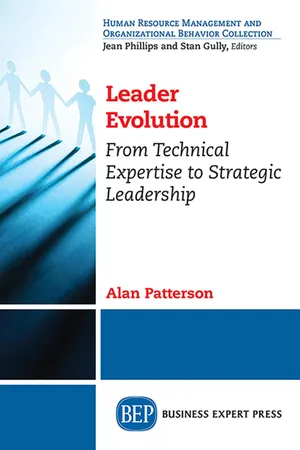
Most individuals who move into leadership positions expe-rience the modern day version of trial by ordeal. It's sink or swim. To reduce the learning curve and create a more effec-tive process, this book describes a road map for leadership development, a series of four stages that expand personal competence as well as create a broader impact on the orga-nization or business. Each stage requires unique changes in thinking, perspective taking, and behavior, both those needed to acquire as well as those needed to jettison. The book is a pragmatic approach for self-motived individuals to take con-trol of their professional development by giving them the concepts, tools, techniques, and assignments to develop their leadership effectiveness where it counts the most—on the job. While highly relevant to new and existing managers, the book is ideally suited for technical professionals and leaders in technical organizations looking to develop critical lead-ership skills distinct from technical expertise. The concepts and principles are directed toward the individual for on-the-job application, however, this also serves as an organi-zational and leadership development resource for Executive MBA programs, as well as a blueprint for in-house leadership development programs.
Trusted by 375,005 students
Access to over 1 million titles for a fair monthly price.
Study more efficiently using our study tools.
Information
CHAPTER 1
A Context for Leadership Development
What is leadership? Often leadership is equated with people skills or described as “soft skills.” Sometimes, leadership is distinguished from management, where experts like John Kotter link leadership with change and management with predictability and order.1 For our purpose, leadership is the ability to influence the ways people think and feel to the point that they take decisive and responsible action. Leadership is selling ideas, motivating teams, gaining commitment, modeling behavior, engaging in dialogue, aligning organizations, and getting results. It’s a skill set that runs the gamut from easy to train to downright difficult to develop. Some people acquire these naturally, but most acquire them through practice and application. Some learn leadership through role models and mentors if they’re lucky, others through training programs, and most by osmosis. The point is that we can define leadership as a set of behaviors, and as behaviors, new and existing leaders can see it, learn it, and get better at it.
A Brief History of Leadership Theory
Leadership was not always considered as behaviors related to influence. For more than two centuries, people have studied leadership to understand its origin, characteristics, and effectiveness.2 Beginning in the mid-19th century, the prevailing leadership concept was that of the “great man,” a generalized yet nonscientific acceptance that, as the name implies, only certain people were capable of leadership. Writer and historian Thomas Carlyle popularized this concept in his book On Heroes, Hero Worship, and the Heroic in History.3 In the 1930s and 1940s, the American psychologist Gordon Allport described certain personality characteristics that are indicative of successful leaders.4 Allport claimed that leaders are born with certain traits and exhibit them in certain combinations that make them successful. As the field of psychometrics grew from the 1930s to 1950s, however, additional scientific researchers had difficulty showing consistent results when using traits to define leadership success.5
Behavior Theory
The failure to show reliable and consistent correlations between traits and leadership gave rise to new concepts. Researchers began looking at behavior rather than trait to measure leadership effectiveness. Since behaviors are observable, it makes them much easier to study and understand. One understands leadership by how someone acts, not simply by the traits they may or may not possess.6
Most notably in this era were two key university studies conducted at Ohio State University and the University of Michigan.7 The Ohio State studies used a series of statements to measure leadership on nine behavioral dimensions. The two most highly correlated sets of behaviors were characterized as “consideration” or people-related issues, and “initiating structure” or task-related issues. Dr. Rensis Likert at the University of Michigan undertook a similar approach to the study of leadership. Likert’s research identified three critical types of leadership behavior:
• Task–oriented behavior such as planning, organizing, and monitoring
• Relationship–oriented behavior such as supporting, motivating, and rewarding
• Participative leadership such as facilitating rather than directing the team8
Contingency Theory: One Size Does Not Fit All
By the mid-20th century, a new interest in understanding leadership behavior emerged. Rather than focus on the either–or characteristics of task-related and relationship-related behaviors, R.R. Blake and J.S. Mouton used both sets to determine leadership effectiveness based on situational requirements. This approach was known as the managerial grid, and it provided a conceptual framework for leadership styles.9 Styles are collections of behaviors dependent on the situation and needs of people involved. Hersey and Blanchard popularized this concept as “situational leadership.”10
Contingency theory continues to impact our modern-day perspective on leadership effectiveness in two ways:
1. Leadership requires both managing tasks and managing people.
2. There is no one “correct” style of leadership. Instead, the “correctness” depends on the leader’s ability to scope out the situation and use the behaviors suited to the individuals involved.
Transformational Leadership Theory
In the 1970s and 1980s, a different leadership concept known as transformational leadership came to light from researchers such as Bass11 and Burns.12 In transformational leadership, the leader’s role is to create and sell a compelling vision that (a) motivates people to operate at a higher level and (b) creates a greater sense of purpose. Transformational ...
Table of contents
- Cover
- Half Title
- Title Page
- Copyright Page
- Dedication Page
- Abstract
- Contents
- Preface
- Acknowledgments
- Chapter 1 A Context for Leadership Development
- Chapter 2 Stage One: Expertise
- Chapter 3 Stage Two: Credibility
- Chapter 4 Stage Three: Alignment and Execution
- Chapter 5 Stage Four: Strategy
- Chapter 6 Defying Gravity
- Chapter 7 Coda
- Notes
- References
- Index
- Ad Page
- Back cover
Frequently asked questions
Yes, you can cancel anytime from the Subscription tab in your account settings on the Perlego website. Your subscription will stay active until the end of your current billing period. Learn how to cancel your subscription
No, books cannot be downloaded as external files, such as PDFs, for use outside of Perlego. However, you can download books within the Perlego app for offline reading on mobile or tablet. Learn how to download books offline
Perlego offers two plans: Essential and Complete
- Essential is ideal for learners and professionals who enjoy exploring a wide range of subjects. Access the Essential Library with 800,000+ trusted titles and best-sellers across business, personal growth, and the humanities. Includes unlimited reading time and Standard Read Aloud voice.
- Complete: Perfect for advanced learners and researchers needing full, unrestricted access. Unlock 1.4M+ books across hundreds of subjects, including academic and specialized titles. The Complete Plan also includes advanced features like Premium Read Aloud and Research Assistant.
We are an online textbook subscription service, where you can get access to an entire online library for less than the price of a single book per month. With over 1 million books across 990+ topics, we’ve got you covered! Learn about our mission
Look out for the read-aloud symbol on your next book to see if you can listen to it. The read-aloud tool reads text aloud for you, highlighting the text as it is being read. You can pause it, speed it up and slow it down. Learn more about Read Aloud
Yes! You can use the Perlego app on both iOS and Android devices to read anytime, anywhere — even offline. Perfect for commutes or when you’re on the go.
Please note we cannot support devices running on iOS 13 and Android 7 or earlier. Learn more about using the app
Please note we cannot support devices running on iOS 13 and Android 7 or earlier. Learn more about using the app
Yes, you can access Leader Evolution by Alan Patterson in PDF and/or ePUB format, as well as other popular books in Business & Human Resource Management. We have over one million books available in our catalogue for you to explore.