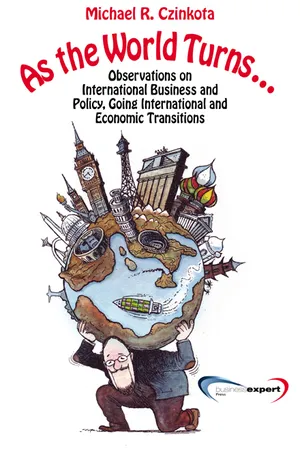
eBook - ePub
As the World Turns…
Observations on International Business and Policy, Going International and Transitions
- 136 pages
- English
- ePUB (mobile friendly)
- Available on iOS & Android
eBook - ePub
As the World Turns…
Observations on International Business and Policy, Going International and Transitions
About this book
We hear a lot about the growth of world trade, globalization, and imbalanced distribution of incomes. Yet, how does one understand all the issues, thoughts, and arguments? How does one develop a time frame and context for these issues? This book helps you to do so. Following on the heels of his successful book on opinions and insights (As I Was Saying…Observations on International Business and Trade Policy, Exports, Education, and the Future, March 2012), Michael Czinkota has invited us into his world again, to get a better perspective of issues, campaigns, and phenomena. Each article and the accompanying cartoon (remember, a picture can be worth a thousand words) represent a delicious thought opportunity to chew on.
Information
On Transitions

Middle East Instability: Thoughts for Managers
With G. Knight. Originally published in The Korea Times, February 7, 2011. Used with permission of Michael R. Czinkota and The Korea Times.
How does the newly visible instability in the Middle East affect international managers and their firms? What strategic adjustments are needed for managers to cope with possibly hostile business environments abroad?
Business is more interconnected today than ever before. Specifically, global commerce today relies on layers of suppliers, distributors, and customers, located all around the world. Such extensive networks increase firms’ exposure to events that occur at distant locations. Even firms that rely little on international business may depend on the receipt of imported goods. We have asked several hundred international corporations and their managers about their responses to crises. What international businesses repercussions do we need to watch out for?
Managers respond not necessarily to reality, but to widespread perceptions of reality. In times of conflict, the “winner” may well be the side that most effectively communicates their victory.
If all anticipate major uncertainty, then times will be uncertain. If threats to personal fortunes are expected, then capital flight will take place. And therein turns the wheel of fortune—if enough believe in a condition, it may well become reality.
Though authoritarian regimes may have been able to minimize local terrorism, new instability may lead to ungoverned spaces. Civil unrest is a fertile breeding ground for the emergence of violence and terrorism. Thus, the instability we are witnessing overseas may give rise to “exogenous shocks” that threaten global supply chains, distribution channels, and other infrastructure that firms need to conduct their international operations.
Managers will adjust their planning activities—higher risks will be assumed not just in the disrupted locality, but globally. Lenders and insurance companies will expect higher premiums. The return-on-investment expectations for new investments will rise. As a result, global investment plans may be significantly delayed or even terminated.
Crises will disrupt local conditions and lead to unemployment. There may not be enough bread, and insufficient delivery of alimentation, leading to hungry masses. For the multinational firm it means there will be disruptions of global supply chains and distribution networks.
Crises typically also lead to a depression of buyer psychology and reduced consumption. Local markets may shrink, (just imagine possible effects on the Suez Canal, which handles 8 percent of global sea trade and over 2 million barrels of oil daily), and supplies of international markets will be reduced.
Accessing markets will be more difficult and less efficient. There is likely to be more security scrutiny, and increased exposure to perils when delivering goods to crisis zones. The safety cost of such deliveries may increase logistics expenses by up to 15 percent.
Firms will encounter rising transaction costs. Managers will need to find new suppliers, whose products will cost more. New shipping routes will be more expensive. Routine processes lose their routine since new participants in a new setting are inexperienced and prone to mistakes. Coordinating costs between suppliers and distributors are likely to surge.
Larger inventories will have to be held, particularly by companies with just-in-time systems, in order to assure flexibility and production continuity. These inventories will cost more money, with increases of 10 percent or more.
All of these changes add up. Smaller firms may withdraw from markets to avoid intolerable risk levels. For the U.S., the aim to double exports by 2014 will be in jeopardy. Rising costs of energy, food and commodities will affect inflation and levels of economic balance.
Consider today’s U.S. current account, which measures all the inflows and outflows of the economy. Almost 25 percent of U.S. imports consist of oil. Even if one can stabilize import quantity, a higher price per barrel will further increase this burden.
Today, firms need a big-picture perspective, and choose between short-term gains and long-term success. Managers need to explore opportunities for collaboration, using a planning umbrella that considers customers, suppliers, and suppliers’ suppliers.
In the wake of major shifts, firms need to become part of the solution. Businesses need to move away from focusing only on self-serving or localized concerns and ensure the survival of the organization by examining its long-term future fit within the societies where it operates.

Terrorism Preparedness: We Can Pay Now or Pay Later
Originally published in The Japan Times, November 28, 2005. Used with permission of Michael R. Czinkota and The Japan Times.
International terrorists attack businesses far more than any other target, and when they strike, they aim to disrupt the flow of supply and demand and to destroy our way of life.
A survey of 642 global firms found that terrorism is the third most important concern to management, after energy prices and exchange-rate volatility. The companies surveyed reportedly spent on average about $147,000 on terrorism preparedness and hired about five new employees to deal with the issue. Yet many other corporations do not believe their shareholders would reward these investments, and therefore remain unprepared for the impact of terrorism.
With today’s global competition, firms no longer have the luxury of just aiming for “survival” in the face of an emergency or a terror attack. Firms must offer continuity to their suppliers, their clients and their employees in order to inspire confidence in the relationship. Flexibility allows firms to recover more quickly in the aftermath of terrorism’s direct and indirect consequences.
Preparedness is of key importance to any firm. For example, after hurricane Katrina, many displaced students and faculty members from New Orleans found continuity in Georgetown University classrooms immediately because contingency plans had been made. Even relatively small and local events can cause major dislocations. Suppliers can go out of business or have their facilities burn to the ground. Employees may be struck by illness or a labor dispute may halt shipments.
To safeguard the investment of shareholders and assure the viability of their firm, managers must prepare contingency plans that respond to system shocks. We have developed a model of corporate readiness for international terrorism that links people, activities and society, and identifies opportunities for improvement. We propose a model of the different levels of corporate readiness for international terrorism by linking the relationship among conditions, activities and people, and identifying the leverage points to initiate improvement and change. It also helps to evaluate policy approaches to emergency preparedness in general.
We start with a terrorist threat or incident that causes both direct and indirect effects. They trigger the actions of responders, who can be either internal or external to the firm. These responders and the media shape the information, experience and perception of society and the firm. One consequence is the creation of friction that slows down international business transactions.
The availability of resources and the firm’s willingness to employ them affects the level of preparation. Managers typically are totally unprepared for the effects of terrorism on their firms, and are not willing to undertake any kind of investment. With sufficient input, managers change their attitude but are still not ready for any action. As concern grows, management searches for input such as checklists or audits. Eventually managers plan at a tactical and strategic level, and integrate stakeholders such as employees, suppliers, banks and legislators. Finally, management actually prepares the firm for terrorism by, for example, making provisions for emergency relocation of employees and ensure that they have employment, and that they get paid when the ...
Table of contents
- Cover
- Halftitle
- On International Business and Policy
- On Going International
- On Transitions
- Index
- Last Page
- Backcover
Trusted by 375,005 students
Access to over 1.5 million titles for a fair monthly price.
Study more efficiently using our study tools.
Frequently asked questions
Yes, you can cancel anytime from the Subscription tab in your account settings on the Perlego website. Your subscription will stay active until the end of your current billing period. Learn how to cancel your subscription
No, books cannot be downloaded as external files, such as PDFs, for use outside of Perlego. However, you can download books within the Perlego app for offline reading on mobile or tablet. Learn how to download books offline
Perlego offers two plans: Essential and Complete
- Essential is ideal for learners and professionals who enjoy exploring a wide range of subjects. Access the Essential Library with 800,000+ trusted titles and best-sellers across business, personal growth, and the humanities. Includes unlimited reading time and Standard Read Aloud voice.
- Complete: Perfect for advanced learners and researchers needing full, unrestricted access. Unlock 1.5M+ books across hundreds of subjects, including academic and specialized titles. The Complete Plan also includes advanced features like Premium Read Aloud and Research Assistant.
We are an online textbook subscription service, where you can get access to an entire online library for less than the price of a single book per month. With over 1.5 million books across 990+ topics, we’ve got you covered! Learn about our mission
Look out for the read-aloud symbol on your next book to see if you can listen to it. The read-aloud tool reads text aloud for you, highlighting the text as it is being read. You can pause it, speed it up and slow it down. Learn more about Read Aloud
Yes! You can use the Perlego app on both iOS and Android devices to read anytime, anywhere — even offline. Perfect for commutes or when you’re on the go.
Please note we cannot support devices running on iOS 13 and Android 7 or earlier. Learn more about using the app
Please note we cannot support devices running on iOS 13 and Android 7 or earlier. Learn more about using the app
Yes, you can access As the World Turns… by Michael R. Czinkota in PDF and/or ePUB format, as well as other popular books in Business & International Business. We have over 1.5 million books available in our catalogue for you to explore.