- 200 pages
- English
- ePUB (mobile friendly)
- Available on iOS & Android
eBook - ePub
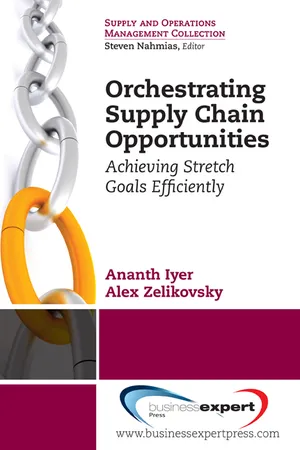
Orchestrating Supply Chain Opportunities
About this book
Efficient planning and superior execution against clear objectives is the way companies operate best. For many companies, the planning process is carefully orchestrated, objectives are set, budgets are negotiated, resources are allocated, and then it's up to the organization to execute. But what happens when the unexpected occurs? Say, an event occurs that throws the status quo into turmoil. What if your business declines by 40% in 1 month, what do you do? Conversely, what if your demand spikes by 50% in just a few months, what then? Suppose a natural disaster happens, or a new technology creates a significant, but unplanned opportunity? We call these events 'stretch opportunities'. This book will focus on strategic thinking and tactical examples of how best to prepare for such events. We will outline common themes across all such challenges. We will introduce three key management concepts: Flexibility, Agility and Real Options. We also include a specific chapter on how to structure supply chains to capitalize on stretch opportunities and we provide specific tactical frameworks to build in agility, flexibility and real options into a supply chain. We will end with a checklist that managers can use to ensure that the right questions are asked in developing supply chains so that the ability to "surge" at profitable opportunities is nourished.
Information
Chapter 1
Amazon.com—Orchestrating Stretch Demand
How Amazon.com Saved Christmas
During the height of the “Internet bubble,” Amazon.com was one of the hottest new companies around. Jeff Bezos, Amazon’s charismatic founder, had a vision that was at the core of Amazon’s success: to get big, fast! He fundamentally believed that the 1990s were a unique time in history, when a new channel called the Internet would gain consumer awareness and become monetized. Bezos also believed that the window of opportunity to get a foothold in the Internet commerce space (or e-commerce, as we now call it) would be short lived. He instinctively knew that the first-mover advantage was absolutely critical to success. Moreover, his vision for Amazon, even in the early days of the company, was that it should be a place where the consumer could discover and purchase anything online. Yes, anything!
In order to make the dream a reality, Amazon focused on adding new products and services at an alarming rate. During this time, spending on overhead outpaced the investment in growth and the financial losses started to mount. Ironically, Amazon’s stock was on the rise, but it was mostly due to the forgiving capital markets during the Internet bubble.
It is important to note that Bezos’s strategy of focusing on gaining market share never blurred his ultimate vision of building a profitable business. In 1999, during the employee quarterly update, he was asked this question: “Our losses continue to mount; will we ever get to profitability?” Bezos gave a very passionate answer. He first asked, “Is there anyone in the audience who believes that I don’t think profitability is important?” A short silence followed. “Please speak up, because if you do, you do not belong here.”1 There was another pause. Bezos was facing a classic CEO trade-off scenario between market share and profitability. Following a strategy focused on rapidly increasing market share required Amazon.com’s supply chain to meet “stretch” growth goals and position the organization to capitalize on “stretch” opportunities.
In line with his “getting big, fast” strategy, the only parameters Bezos set concerning the variety of potential products that would be handled by the system were “we will not ship cement or gasoline.” In the face of such a broad description of the company’s operations and logistics strategies, Amazon’s chief logistics officer, Jimmy Wright, remarked to Bezos that “if you want me to fly blind, better give me some air-space.”2 What does this mean? Design a real option in the supply chain to adapt to product and demand outcomes.
In the late 1990s, Amazon.com was in a significant hypergrowth mode. This growth forced the supply chain to scale systems, operations, and human resources rapidly. The business was growing and changing so rapidly that the physical infrastructure experienced difficulty keeping up. Most of the projects and opportunities took off faster than the company could plan for. Hence, normal goals became “stretch goals.” Thus every time the company had to adapt (or stretch) to meet a goal that altered significantly from what was originally anticipated, Amazon had to redefine those goals. We consider a “stretch goal” an unplanned business opportunity necessary for a company to stay in business or required in order to take advantage of rapid growth opportunities. In particular, Amazon experienced extreme unexpected surges in demand for its products during the 1998 holiday season. If Amazon was going to survive in the emerging e-commerce realm, it would have to meet the service levels promised to consumers. Establishing lofty customer service goals was a key strategic decision, and fulfilling these goals was critical for the company’s brand and success. Amazon wanted to show consumers the convenience of shopping from their homes 24-7, with next-day shipping right to their doorsteps. By executing on its customer service promise, Amazon made the bricks-and-mortar world seem sluggish, antiquated, and inconvenient to purchasers. If it appeared that Amazon could not meet the needs of the consumer and fulfill orders as promised, it would have failed. Unexpected surges in demand challenge a company to “stretch” to meet those demands; the company that can execute stretch goals efficiently will win. That is precisely what happened to Amazon.
During the 1998 holiday season, Amazon encountered an explosive surge in demand: The average December order increased 4 times from the average September order. Amazon started planning for this fourth-quarter seasonal demand increase at the beginning of the year—but not at a magnitude of 400%. Operations managers had no way of knowing how fast the business would grow. How did Amazon deal with this stretch goal to fulfill orders and meet their consumer promise?
In September of 1998, Amazon’s executive management met with the senior operations management team and informed them that the peak December shipping day might reach more than 100,000 orders per day. Yes, Amazon had to adapt from approximately 25,000 orders per day to potentially more than 100,000! Needless to say, this was quite a shock to the system. The newly formed operations management team, most of whom had been with Amazon for just a few months, was in a tough spot. There was no time to scale facilities, systems, and the organization (the organization was stretched already). How did Amazon orchestrate this stretch goal efficiently?
At that time, Amazon had two distribution centers (DCs): one in Seattle, Washington, and one in Wilmington, Delaware. Both DCs ran two shifts. Both had a minimum amount of automation and mechanization. When the demand started to spike, Amazon’s management had to act quickly and decisively because Amazon’s brand was built on great service. If they could not ship orders on time, it would have been disastrous. Take the example of eToys. When eToys failed to meet its unexpected surge in demand due to the holidays and children did not receive their gifts in time for Christmas, eToys met with an untimely death. Amazon was not about to go down the tubes like eToys did.
Amazon purchased an option to have the extra buffer capacity ahead of the busy holiday shopping season—that is, an option on the flexibility and agility of its supply chain. The flexibility option involved leveraging extra physical space in the DCs that would enable Amazon to set up ad hoc processing to meet extra demand. Hence, the flexibility option gave Amazon the ability to scale physical processes and systems. The agility option required Amazon to streamline its labor force, mandating that every employee spend time working at the DCs. This gave Amazon the option to shift (scale) labor when the surge in demand occurred. The agility option enabled Amazon to leverage fulfillment space and ramp up labor quickly.
Thus Amazon has leveraged the capabilities of flexibility, agility, and real options (FAR), a paradigm that required decisive actions, and a concept we shall discuss in detail through this book. First, the operations team optimized current distribution design and space. For example, Amazon used extra DC space to set up extra pick locations for top-selling stock-keeping units (SKUs). These items were not unpacked or placed on shelves. The pallets containing these SKUs were placed in the pick locations and workers then picked items directly from the pallets. The operations team arranged additional lines for packing and shipping orders. Second, all DCs started operating in three shifts. Scaling the labor to staff all three shifts was not an easy task, but Amazon’s cross-trained employees rose to the challenge. Moreover, Amazon had a wild card up its sleeve. Amazon’s culture of getting the job done went beyond the employees. Not only all Amazon employees but also their families were asked to work in the DCs, picking and packing items for holiday giving. And they rose to the challenge. A staggering number of family members reported to the DCs and were quickly trained and put to work. It is important to note that every Amazon employee was an owner of the company.3 This sense of ownership drove this incredible behavior of everyone pitching in, as required. Moreover, senior managers, including Bezos, worked the graveyard shift: from midnight to 8 a.m. This agile labor force and the use of extra space to set up additional processing lines, deployed in a very short time, allowed Amazon to succeed. Bezos always believed in not compromising on hiring great people. He was right.
Amazon orchestrated the success of its holiday performance by (a) leveraging the agility of its cross-trained employees and (b) leveraging its flexibility by expanding the physical playing field, establishing ad hoc processes, scaling through unused space, and bringing people from varied locations to increase staff capacity. The real option was their hiring of great people, a passion for performance, and a culture of execution. Moreover, what made all this possible is the actual orchestration by the key managers and employees, who used their experience and knowledge of Amazon’s systems, processes, and highly motivated employees to get the job done. Amazon’s culture of begging for forgiveness instead of asking for permission took hold and delivered.
After barely meeting the demand of the 1998 holiday season, Bezos took out an even greater option on the future by authorizing the “design and build-out of the world’s most sophisticated direct-to-consumer distribution network”…but that’s another story.
Imagine the challenges faced by supply chain managers orchestrating Amazon’s operations. The fact that Amazon remains a successful e-commerce company today is a testament to their execution capability over the years. We suggest that use of FAR in supply chain choices remains a key component of Amazon’s success. Consider how Amazon’s lessons apply to your company. And let’s move on to another context.
Chapter 2
The U.S. Coast Guard—Orchestrating Stretch Response
How the U.S. Coast Guard Saved Victims of Katrina
The U.S. Coast Guard (USCG) has the mission to protect the U.S. coastline and assist with major natural disasters. The performance of the Coast Guard during Hurricane Katrina was hailed as a remarkable example of execution when faced with strong negative odds. In an interview in 2010 with Analytics magazine, Admiral Mike Mullen, chairman of the Joint Chiefs of Staff, said that the Coast Guard “punches far above its weight class.”1 During Katrina’s aftermath, the Coast Guard rescued more than 33,500 people over a few weeks—6 times as many people than the Coast Guard saved in all of 2004. As the writer in Time magazine put it, “So how is it that an agency that is underfunded and saddled with aging equipment—and about the size of the New York City police department—makes disaster response look like just another job, not a quagmire?”2
To understand how the Coast Guard executed its response, it is instructive to understand the magnitude of the “stretch” that was warranted. Hurricane Katrina was one of the largest natural disasters in U.S. history. More than 1,300 people lost their lives; several million people were displaced; and physical assets such as roads, bridges, and buildings were destroyed, generating over $200 billion in damage. When disaster struck, over 60,000 people had to be rescued from homes and rooftops, and the Coast Guard was responsible for 33,500 of those rescues. Air and boat operations by the Coast Guard lasted 17 days. Barely 3 days into the response, 43 aircraft and 2,000 USCG personnel were on site.3 People were hoisted amid downed power lines, flying debris, and other obstacles that are not commonly present during typical USCG search-and-rescue missions. More than 8 million gallons of fuel spilled and had to be cleaned up. This required working with local and federal authorities to create a maritime environmental response.
To accomplish all of these tasks, helicopters were needed. In anticipation of the storm, helicopters moved out of Mobile, Alabama, and New Orleans. As soon as the storm passed, helicopters flew in from those bases and from all 26 air stations throughout the country. Each air station prioritized its tasks and dropped the less serious tasks in order to maintain readiness. The crews combined to form rescue teams independent of their origins. Even as far away as Cape Cod, commanders got ready to move assets to assist. The entire surge was accommodated within days. When the tasks were completed, the aircraft and crew returned to their air stations and resumed normal operations.
At the end of the operation, the USCG evaluated its response and created a set of lessons learned from its performance. The cost of this operation had to be tabulated and recovered from the Federal Emergency Management Agency (FEMA) and other sources. The bill, reported to be less than $20 million, certainly classifies as an efficient response. When it was all over, unlike most other agencies, the performance of the USCG was characterized as outstanding in all federal performance reviews. But what aspects of the supply chain permitted them to gracefully accommodate the tremendous surge in demand?
The General Accounting Office (GAO) identified as key to the Coast Guard’s exceptional performance its cross-training, standardization of equipment and task routines, centralized information visibility across assets, and the ability to quickly prioritize and release assets to their most required locations.4 It is clear that such a heroic performance does not happen without planning or without a clear sense of operational performance being considered at the highest level of the organization. But notice that the investments in cross-training, standardization, information visibility are actually “real options”—they enable harnessing of capacity when events unfold. These investments permit teams drawn from different bases to come together quickly, thus permitting flexibility of deployment. Finally, centralized information visibility permits task prioritization and pooling of assets and thus affords agility. Clearly, flexibility, agility, and real options (FAR) is a readily recognizable concept at work within the Coast Guard’s system.
Discussions with USCG personnel suggest that while Katrina created severe stretch at the USCG for a short period, it was accommodated by adjusting the rest of the system so that at the end of the year there was a minimal lingering effect on the assets that were used. In other words, accommodating stretch required a careful assessment of priorities and the ranking of tasks that could be postponed, delegated to others, or canceled altogether. This ability to stretch to accommodate a significant event but return back to normalcy as soon as the event passes is a unique capability and strategy.
As described in several contexts, a hallmark of the USCG is a decentralized organization that allows for decision-making autonomy and flexibility. On the Gulf Coast, this autonomy and flexibility mattered well before Katrina hit. On August 27, 2005, the day before the mayor of New Orleans ordered a mandatory evacuation, the Coast Guard began moving its personnel out of the region. Officers left helicopters and boats in a ring around the area so that they could move in behind the storm, no matter which direction it took. “We have extraordinary autonomy to move assets,” explained USCG admiral Thad Allen during a flyover of the Mississippi Gulf Coast region a few weeks after Katrina. “I don’t think any other agency has the ability to do that.”5 The Coast Guard was also able to call on auxiliaries who had been involved in planning and preparation and thus provided surge capacity. Finally, it was expected that leadership would move to the particular individual with the expertise, regardless of rank.
To continue operations in the absence of communications links, USCG personnel relied on plans that had been exercised and that did not require detailed data. In addition, prestaged communication equipment and predistributed satellite and cell phones all enabled operations to continue with minimal coordination.
There are a few key USCG principles that permit such execution. The principle of flexibility in the USCG system requires that multiple possible missions be executed using the same people and assets by adjusting to the tasks and situations. This is crucial for the USCG because its responsibilities evolve over time: from search and rescue, to homeland security, to assistance in catastrophes. Such responsibilities demand the ability to conduct “surge operations”—high-intensity efforts at short notice in response to emergencies. Such surge operations require coordination across personnel and assets by adapting to locate resources while continuing regular operations. The feasibility of such plans depends on the standardization of processes, assets, training, and so on so that units can be composed of personnel from any air station, pulled together at short notice, and still function effectively as a team. In short, flexibility is a key component of the USCG’s ability to respond to stretch requirements.
Another important strength of the USCG system is the latitude provided to personnel to act quickly without waiting for specific direction. An example provided in the GAO report describes the initiative taken by a j...
Table of contents
- Title Page
- Copyright
- Contents
- Preface
- Acknowledgments
- Introduction: Orchestrating Supply Chain Opportunities
- Chapter 1: Amazon.com—Orchestrating Stretch Demand: How Amazon.com Saved Christmas
- Chapter 2: The U.S. Coast Guard—Orchestrating Stretch Response: How the U.S. Coast Guard Saved Victims of Katrina
- Chapter 3: Reflect.com—Orchestrating Stretch Innovation: How Procter & Gamble Leveraged Innovation on the Internet
- Chapter 4: Watsco—Orchestrating Stretch Opportunities: How Watsco Navigated a Perfect Storm
- Chapter 5: Kryptonite Lock Company—Orchestrating Survival: How the Blogs Unlocked the Secret of Kryptonite
- Chapter 6: The United Nations Joint Logistics Center— Orchestrating Humanitarian Logistics: How the UNJLC Coordinates Relief for Victims of Global Catastrophes
- Chapter 7: Fashion Demand Stretch—Everybody Needs a Croc: Globally Scaling a Supply Chain
- Chapter 8: FreeFlow—Stretching the Web: How Technology Enabled Resolution of Supply Demand Mismatches
- Chapter 9: Orchestrating Reconfiguration: How SAP and Shipwire Enable the Unexpected
- Chapter 10: Building Flexibility, Agility, and Real Options Into Your Supply Chain: How Can Your Company Orchestrate Stretch Goals?
- Chapter 11: Gizmo—A Story of Stretch: Stretching a Fictional Story of Success
- Chapter 12: Book Summary, Conclusions, and Takeaways: A Summary of Supply Chain Stretch
- Chapter 13: A Stretchable Supply Chain Checklist: Questions All Managers Should Ask About Their Supply Chains
- Notes
Trusted by 375,005 students
Access to over 1.5 million titles for a fair monthly price.
Study more efficiently using our study tools.
Frequently asked questions
Yes, you can cancel anytime from the Subscription tab in your account settings on the Perlego website. Your subscription will stay active until the end of your current billing period. Learn how to cancel your subscription
No, books cannot be downloaded as external files, such as PDFs, for use outside of Perlego. However, you can download books within the Perlego app for offline reading on mobile or tablet. Learn how to download books offline
Perlego offers two plans: Essential and Complete
- Essential is ideal for learners and professionals who enjoy exploring a wide range of subjects. Access the Essential Library with 800,000+ trusted titles and best-sellers across business, personal growth, and the humanities. Includes unlimited reading time and Standard Read Aloud voice.
- Complete: Perfect for advanced learners and researchers needing full, unrestricted access. Unlock 1.5M+ books across hundreds of subjects, including academic and specialized titles. The Complete Plan also includes advanced features like Premium Read Aloud and Research Assistant.
We are an online textbook subscription service, where you can get access to an entire online library for less than the price of a single book per month. With over 1.5 million books across 990+ topics, we’ve got you covered! Learn about our mission
Look out for the read-aloud symbol on your next book to see if you can listen to it. The read-aloud tool reads text aloud for you, highlighting the text as it is being read. You can pause it, speed it up and slow it down. Learn more about Read Aloud
Yes! You can use the Perlego app on both iOS and Android devices to read anytime, anywhere — even offline. Perfect for commutes or when you’re on the go.
Please note we cannot support devices running on iOS 13 and Android 7 or earlier. Learn more about using the app
Please note we cannot support devices running on iOS 13 and Android 7 or earlier. Learn more about using the app
Yes, you can access Orchestrating Supply Chain Opportunities by Ananth Iyer in PDF and/or ePUB format, as well as other popular books in Business & Operations. We have over 1.5 million books available in our catalogue for you to explore.