![]()
CHAPTER 1
KNOWledge SUCCESSion for Performance
Executive Summary
This chapter sets the context for the book and highlights why strategic project portfolios are critical to ongoing performance (for individuals, teams, organizations, and across organizational networks).
Key points of this chapter are:
Projects are the new “business as usual” for progressive organizations and perceptions of success vary over time and between stakeholders.
Operational models for organizations need to engage in continuous change and redevelopment of knowledge to remain viable and relevant.
Projects are the optimal mechanism to deliver short- and long-term benefits to enable ongoing relevance and competitive advantage.
KNOWledge SUCCESSion for performance involves understanding the connections between:
Knowing, KNOWledge SUCCESSion, and sustained performance.
Business as usual or projectization?
Strategic projects as vehicles of knowledge transfer.
Leave your tacit knowledge at the door when you go.
Knowledge, projects, context, and sense-making.
Knowing, Knowledge SUCCESSion, and Sustained Performance
The biggest challenge faced by many organizations is creating and maintaining a knowledge base that would keep the organization at its optimal performance. Global economies, like trust, take significant time to build but can crash in moments. Our complex and highly interdependent modern environment requires us to be in a constant state of sensemaking to perceive how we are tracking and how to manage the emergent changes thrust upon us.1
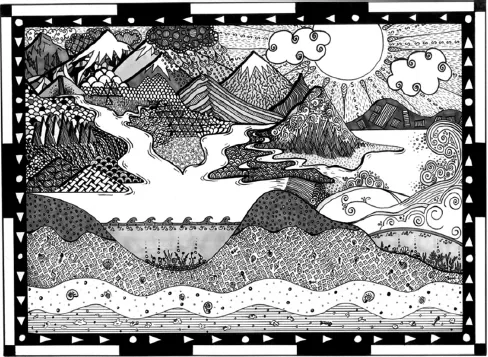
Figure 1.1 is a metaphorical depiction of a modern work environment. When people are asked how this image relates to their organization they engage in divergent conversations about what it represents, some positive, some negative, all insightful reflections.
Competitive advantage does not automatically flow from simply knowing more than others; it requires application of that knowledge faster and more efficiently and effectively than anyone else in your industry or others. Everyone knows what it takes to live a healthier lifestyle—eat less and exercise more! That we KNOW this that counts less than whether we can act on it effectively. Whether you are a commercial enterprise, in government, or a not-for-profit, being the best and doing the right things at the right times requires constant reflection and a forward-focused strategic plan.
Figure 1.1 Knowledge flows recycle and adapt through the environment
What Is KNOWledge SUCCESSion?
The way we interact with each other significantly impacts our success. To KNOW SUCCESS in a sustainable manner, individuals, teams, and organizations need to actively manage their KNOWledge SUCCESSion. We must understand what we need to know, how we come to know it, when we need it, and what we need to unlearn or adapt for future application.
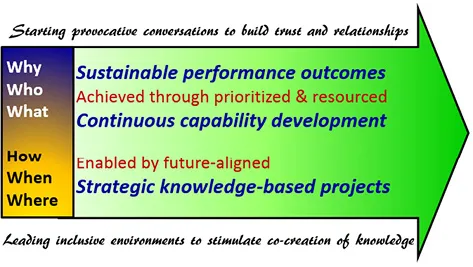
KNOWledgeSUCCESSion (KS) is a new strategy for achieving optimal performance in a world of emergent complexity. More than just capture or transfer of knowledge, KS combines many interdependent aspects of knowledge to create synergies and align actions with overall organizational strategy. KS is depicted in Figure 1.2 as social interactions based on conversations, stories, and shared insights that lead to inclusive interactions. These are connected through constant attention by questioning why actions are being taken and what value they create (both tangible and intangible), that is, directly aligned with the goals of the person, team, or organization. This approach leads to reflective constructive challenges that start with why and end with a carefully considered portfolio of projects that deliver immediate project outputs and create the foundations for future success. Thus, KS becomes the driver of innovation and capability development and, ultimately, sustainable performance.
KS refers to the co-creation, transfer, and application of knowledge in short-term cycles to stimulate value creation and experiential learning. In doing so, it builds foundations, insights, and capabilities for the next stages of organization evolution. KS requires both leadership and management. Leadership must engage others around a common future path and show followers why the priorities chosen represent this optimal path. Management must set the priorities and jettison less important initiatives that may distract effort and drain resources. Successful people and organizations have moved away from a traditional world of “this OR that” to our current contexts of “this AND that.” Often seemingly contradictory actions may run in parallel, exploring multiple options to find the best path. These simultaneous actions generate new insights so that we learn rapidly and develop the next cycle of parallel initiatives. Prioritizing the initiatives that generate the most value is critical because spreading valued knowledge resources across too many activities will also result in failure.2
Figure 1.2 The social and logical aspects of knowledge flows that lead to KNOWledge SUCCESSion
How Does It work?
In short, KNOWledge SUCCESSion provides a means to know and experience success in iterative experiential fragments rather than rigidly plan for long periods. The short cycles remain aligned with the longer vision, but both short- and long-term goals are more flexible than in traditional structures. For example, when hiring new talent, the standard process was to have a very clear description of the qualifications and role. However, now we are more likely to seek someone capable of learning quickly and being highly adaptable, because medium- and long-term roles will likely change. KS philosophy is a more agile and iterative approach than traditional ways of working. It takes an ongoing capability development view of all actions, rather than just the immediate delivery objectives. It thus reverses the traditional approach of every detail in advance and allows emergence to include new knowledge as the process proceeds. It maintains a focus on delivering agreed tangible outputs while enabling the process to adjust during the project. This is not completely new, as some organizations have a history of this approach. For example, NASA did not know if or how “landing a man on the moon and returning him safely to the earth” was possible when challenged to do so by President John F. Kennedy in 1961. NASA experts had to rapidly develop their capabilities to deliver this stated objective, despite a lack of knowledge on how. At least they had a clearly stated vision! It would have been much easier to land on the moon and not worry about safe return. However, in the absence of KNOWledge SUCCESSion, NASA has since “forgotten” how to accomplish this remarkable feat.3
In many ways, our entire world is like this challenge to NASA, except we are now expected to do such tasks on shorter timeframes and with fewer resources. Very few organizations have the longer-term vision of how they will look in a decade, or even if they will still exist. Despite this, very long-term projects still get done. The military still develops and builds new equipment, such as fleets of diversified ships, which take decades to complete. Rarely is anyone present from the beginning of such projects to completion. So every position and role within the lifetime of that project has been handed over to a new person, or even several people.
This highlights why KNOWledge SUCCESSion is so important. The ability to pass on lessons learned as the project proceeds is fundamental to success. Continuous co-creation and exchange of knowledge and insights fuels innovation and builds relationships. This in turn drives engagement and motivation leading to success. Hagel and Brown4 described continuous innovation through the development of specialized capabilities as the ultimate way to drive competitive advantage. The way we interact and how long we maintain our connections determine whether this is likely to occur in our environment. Trusted relationships are the foundation of what gets shared and what does not, and the behavioral environment is set by what we do, not what we say. Leaders are (should be) positive role models and people can choose whether to follow based on how leaders and their actions are perceived. A leader whose behavior contradicts what they ask their followers to do is like a parent who smokes cigarettes or drinks alcohol telling their child not to. Such leaders sacrifice credibility and will be judged as hypocrites. Genuine leaders have willing, intelligent followers: Willing because the followers buy into their leader’s vision, and intelligent because followers have actively considered their leader’s ideas, actions, and credibility and committed to the leader’s vision. That is, they follow because they consciously and ethically choose to, not because they are forced down a path through control and command compliance.5
What Are the Benefits of KS?
KNOWledge SUCCESSion recognizes that we willingly share our knowledge and insights with those we trust and respect. It is a process of interactive exchange that stimulates new ideas and becomes a self-perpetuating cycle in which people feel valued. They are engaged and secure and unafraid to “bounce” something untried. Ideas and concepts are nurtured to a point where they are robust enough to justify themselves, but not so much that the strategically weaker ones survive. The Darwinian evolution concept of “adapt or die” ensures that the most robust innovations arise in the shortest possible time. Evolving WITH the environment as it changes makes KS a powerful concept. It facilitates an emergent pathway that allows people to learn rapidly from their own mistakes, and the mistakes of others, thus providing a greater resilience to external forces.
Leading an environment that facilitates KS is largely about the behavior of leaders and the behaviors that leaders inspire and encourage within their teams. Supporting fast, cheap failure to learn quickly is a feature of the “safe-fail” environment.6 Encouraging appropriate risk taking to drive innovation and rewarding learning guarantees that shared ideas accelerate the transfer and reapplication of knowledge. Knowledge recycling fuels creativity, invention, and innovation just as cash flow fuels the economy. If all knowledge is frozen in the minds of a few, this impedes the flow of knowledge and the potential value it creates. Capture of knowledge is not the key to success—releasing it is! Knowledge must be released internally so it can be amplified, reapplied, reworked, and adapted for new contexts. Sometimes, it needs renovation or decommissioning because newer and better knowledge has been created and can be more productively leveraged across people during role transitions. Those who believe that “knowledge is power” have never experienced the exhilaration of seeing that “knowledge is powerful when shared, socialized, adapted and reapplied.” We greatly amplify our impact and the value we create when we trust others7 with our knowledge and invest time exploring how we collectively leverage it. We keep knowledge flowing though value-generating cycles by nurturing an open and collaborative environment.
What Are the Challenges?
Ironically, open sharing of knowledge is something that we are taught to avoid throughout our lives. In fact, throughout most Western education systems we are punished for sharing or being creative about how we use or adapt knowledge.8 You can’t copy or benefit from what your fellow student does. You can’t tell them what your ideas are as that is considered to be cheating. You must write the number in the box, color between the lines, or paint according to the coded numbers to generate a standardized result. It should be no surprise that “educated people” emerging from this system are not very good at sharing when they arrive in the workplace! The system has removed interactivity and creativity and generated homo-geneous graduates who can recite facts, without a deep understanding of what facts mean, why they are important, or how to act on them.
Some learning facilitators are taking a different approach, more aligned with KS. In postgraduate knowledge courses I have designed and facilitated, everything is different. Students are rewarded for helping other students, because that is what we want in the workplace. Assignments are completed in open wiki environments, so students learn for each other and collectively generate a database that is both robust and relevant to work contexts and capabilities. In this way, the overall standard is raised for everyone. Students are exposed to wider and richer knowledge-sharing experience, and this collaborative experiential learning builds student’s capabilities well beyond what each learns individually. These courses are popular and highly rated by participants, not because they are easy, but because they challenge students and provide freedom to explore what is valuable for their future. Although guided by past knowledge, they come to understand how to generate insights about unknown future scenarios. They enjoy the exhilaration of co-creation, discovery, and reflecting on how what they are learning can be applied to THEIR real world. Inspiring others to share and transfer knowledge can be influenced more by what you reject, than by what you attempt to control. Learning is about opening minds, not filling them.
This approach to co-creative and active learning applies equally well in organizations as in optimal formal learning. Organizational leaders can demonstrate their commitment to the KS approach by doing it themselves. They can:
ask, instead of tell;
acknowledge the benefits of learning when errors are made;
constructively critique successes to see if they could have been better; and
admit and reflect upon their own errors.
Such leaders are more likely to be admired and respected by behaving this way, than by pretending to be something they are not. Building a culture like this does not happen overnight. Humans, being both social and competitive by nature, can be complex to deal with and quite unpredictable. Behavioral and cultural changes require patience, persistence, and commitment to overcome the impacts of those who want to “play the game.” People focused on their own short-term benefits rather than mutual value exchange will fight to maintain the status quo, because they are afraid constructive changes toward a KS culture reduces their self-benefits. This does not have to be true. The KS approach will benefit everyone more, though these benefits will be more evenly shared.
One example of a KS-aligned co-creation approach to simplify behavioral interactions is to use a metaphor like The Organizational Zoo.9 Rather than tell people what their stereotypical culture is, the approach allows workshop participants co-create their own assessment through conversation and card games that make it easier to visualize behaviors and their impacts on interactions. This unique and creative approach engages people to represent each behavior as an animal character and to explore the impacts each has on the other animals (behaviors) in the zoo. Most people do not have advanced skills in psychology and do not understand the details of many psychometric profilers. People often feel “categorized” by such tools, which can limit what they think their options are. The Organizational Zoo concept differs because it focuses on which “animals” are most appropriate for the given context, highlighting that people choose behavior proactively instead of being forced to react in defined ways.10 Once participants understand that they can create the behavioral environment that is most likely to generate their desired outcomes, their own behavior and actions change through heightened awareness and self-reflection.
Outcomes?
Constructive conversations help us realize that behavior is not just about individuals, it is about how people work together in each particular context. Metaphor helps us to understand complex situations and to engage with each other on how we can approach uncertainty.11 When we discuss a range of options offered by people with different perspectives, we come to understand that our own view is just one possibility among many. While we may not agree with all offered perspectives, at least we become aware of them. We can make a more informed choice about how we behave to achieve the optimal outcomes, providing us with a greater chance of success. When we don’t engage in conversations about the impacts of behavior and what is best for each situation, failure is more likely. We can decide to be inspirational, creative, and collaborative when brainstorming. Then we can deliberately adjust our behavior to be controlling, critical, and task focused when we prio...