Malcolm Lillie presents a major new holistic appraisal of the evidence for the Mesolithic occupation of Wales. The story begins with a discourse on the Palaeolithic background. In order to set the entire Mesolithic period into its context, subsequent chapters follow a sequence from the palaeoenvironmental background, through a consideration of the use of stone tools, settlement patterning and evidence for subsistence strategies and the range of available resources. Less obvious aspects of hunter-forager and subsequent hunter-fisher-forager groups include the arenas of symbolism, ritual and spirituality that would have been embedded in everyday life. The author here endeavours to integrate an evaluation of these aspects of Mesolithic society in developing a social narrative of Mesolithic lifeways throughout the text in an effort to bring the past to life in a meaningful and considered way.
The term‘hunter-fisher-foragers’ implies a particular combination of subsistence activities, but whilst some groups may well have integrated this range of economic activities into their subsistence strategies, others may not have. The situation in coastal areas of Wales, in relation to subsistence, settlement and even spiritual matters would not necessarily be the same as in upland areas, even when the same groups moved between these zones in the landscape.
The volume concludes with a discussion of the theoretical basis for the shift away from the exploitation of wild resources towards the integration of domesticates into subsistence strategies, i.e. the shift from food procurement to food production, and assesses the context of the changes that occurred as human groups re-orientated their socio-economic, political and ritual beliefs in light of newly available resources, influences from the continent, and ultimately their social condition at the time of‘transition’.
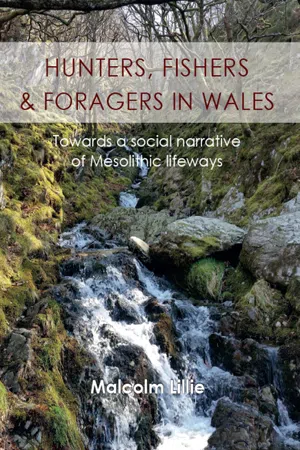
eBook - ePub
Hunters, Fishers and Foragers in Wales
Towards a Social Narrative of Mesolithic Lifeways
- 256 pages
- English
- ePUB (mobile friendly)
- Available on iOS & Android
eBook - ePub
Hunters, Fishers and Foragers in Wales
Towards a Social Narrative of Mesolithic Lifeways
About this book
Information
Subtopic
ArchaeologyIndex
Social Sciences1
SETTING THE SCENE: THE PALAEOLITHIC AND THE LATE-GLACIAL OF BRITAIN, ADAPTATION AND SUBSISTENCE IN A CHANGING ENVIRONMENT
Cultural Man has been on earth for some 2,000,000 years; for over 99 percent of this period he has lived as a hunter-gatherer…of the estimated 150 billion people who have ever lived on earth, over 60 percent have lived as hunters and gatherers; about 35 percent have lived by agriculture, and the remaining few percent have lived in industrial societies … (Lee and Devore 2009a: 3)
Introduction
In geological terms the Quaternary period covers the last 2.4 million years up to the present, with the geological epochs comprising the Pleistocene (ca. 2.4 mya through to ca. 11,700 years ago) being sub-divided into the Lower Pleistocene (2.4 mya to ca. 780,000 years ago), and the Middle and Upper Pleistocene (ca. 780,000 to 126,000 and 126,000 to 11,700 years ago respectively), followed by the current interglacial period, the Holocene (ca. 11,700 years ago up to the present). However, as noted by Lowe and Walker (1997: 1) the past 11,700 years or so simply represent another warm period within the sequence of glacial/interglacial cycles of the Pleistocene, and as such should really simply be considered to be the most recent part of the Pleistocene. As indicated, during the Pleistocene numerous cold periods (glacials), were interspersed by warmer periods (interglacials), and shorter, often more unstable stadial and interstadial periods. In archaeological terms this period is termed the Palaeolithic (Old Stone Age), and from ca. 1.9–1.6 mya hominins of the Homo erectus group were producing flaked stone tools. By the end of the Early Pleistocene, there were tool-using hominins around the North Sea Basin (Parfitt et al. 2010) and tools, most frequently recognised in the handaxes, indicate their intermittent presence through much of the Middle and Late Pleistocene. From the Middle Palaeolithic (ca. 200,000–40,000 years ago) Homo sapiens, our ancestors, evolved in Africa and migrated outwards, being evidenced in Britain towards the end of this period.
The Middle Palaeolithic in Britain has been sub-divided by White and Jacobi (2002) into two stages, an Early British Middle Palaeolithic (equivalent to Marine Isotope Stages1 [MIS] 8–7, starting at ca. 300,000 years ago; discussed below), when a new flintworking technology, the Prepared Core or Levallois technique was introduced (Stringer 2006), and a Late British Middle Palaeolithic (beginning in terminal MIS 4/early MIS 3). Recently, White and Pettitt (2011) have suggested that the Early Middle Palaeolithic should be equated to MIS 9–7 (ca. 330,000–180,000 BP), and the Late Middle Palaeolithic correlated to MIS 3 (ca. 60–35,000 BP).
These stages are separated by a period of human absence between the penultimate glaciation and the Middle Devensian (MIS 6–3) lasting some 120,000 years (White and Jacobi 2002: 111, White and Pettitt 2011: 26). Recolonisation by Neanderthals occurred during the late Middle Palaeolithic (MIS 3) at around 60,000 years ago, Bout coupé handaxes appear in the artefact record in significant numbers, and Levallois technology is rare at this time (White and Jacobi 2002: 123–8, White et al. 2006: 526). By ca. 40,000 years ago anatomically modern humans (Homo sapiens sapiens) were in Europe and probably Britain (Stringer 2006). It is likely that the anatomically modern humans that occur in Europe after ca. 40,000 years ago, during the Aurignacian period, encountered and interacted with the Neanderthals (White and Pettitt 2011), but the precise reasons for the demise of the latter lineage is still open to debate, with climate change and competition with modern humans being considered as possible factors in their extinction (Mellars 2004; Stewart 2007; Banks et al. 2008). However, a reconsideration of the evidence for Britain by White and Pettitt (2011: 59) has led to the suggestion, or as they state “the falsifiable hypothesis”, that Homo sapiens (Aurignacian culture) arrived only after a considerable occupation gap following regional Neanderthal extinction.
Neanderthal morphological characteristics appear to have entered the Homo lineage at some point around 250,000 years ago, with the fully developed Homo neanderthalensis entering the record at around 125,000 years ago (during the Ipswichian interglacial; although there is no evidence for a human presence in Britain during this Marine Isotope Stage [5e]). The use of oxygen isotope records from microfossils contained in marine cores, and their designation as Marine Isotope Stages, works because the marine oxygen isotope balance is controlled by fluctuations in land ice volume; as such the variations in evidence in the oxygen isotope record reflect glacial/interglacial fluctuations during the Pleistocene (Lowe and Walker 1997: 9; for an overview of the various dating techniques used to produce an absolute chronology for the Pleistocene epoch see Walker 2005).
All of our distant relatives subsisted as hunters and gatherers (occasionally probably scavengers as well, especially in the Lower Palaeolithic), and hunting and gathering continued to be the main subsistence strategy for human groups into the Holocene period (at ca. 10,200 years ago). Whilst the main evidence for the exploitation of marine resources occurs in the last ca. 50,000 years or so (Gaudzinski-Windheuser and Niven 2009: 101), there are sites that date back to 115–60,000 years ago e.g. at Moscerini cave in Italy (i.e. Middle Palaeolithic age), and at Grotte Vaufrey in France at least six different fish species were probably exploited. An even earlier date exists for marine resource exploitation at 160,000 years ago, at Pinnacle Point in South Africa (although in this example the evidence consists of just 79 shells) (Bailey and Flemming 2008). For freshwater resource exploitation the evidence is primarily confined to the last 20,000 years or so (Richards et al. 2001), and by the late Middle Palaeolithic period hominin exploitation of small game, birds and fish becomes more visible in the archaeological record (Gaudzinski-Windheuser and Niven 2009: 101). Despite these observations, it is only at (or just prior to), the start of the Holocene period that the nature of subsistence strategies orientated more visibly towards a strategic combination of hunter-fisher-forager lifeways, with these gradually shifting to the domesticating of wild grasses and animals in certain locations around the globe. Ultimately agriculture is adopted, the timing of which again differs depending on a myriad of influencing factors globally.
In trying to disentangle the nature and impact of the various glacial/interglacial cycles during the Pleistocene, it is worth noting that, when writing in 2004, Clarke et al. reported that there were some 2,000 academic papers written in the past 150 years that considered the nature of (solely) the last glacial period (the Devensian; after ca. 75–70,000 years ago, although progressive cooling had been occurring across marine oxygen isotope stages 5d–a, i.e. from around 110,000 years ago) in Britain, and many more papers have been written on this subject since this date. Even with a GIS (Geographical Information System) database that included some 20,000 features, when attempting to produce a glacial map of the Devensian ice sheet, Clarke et al. (2004) note that the database was still not fully comprehensive (see also Lowe and Walker 1997: fig. 2.12). Given this observation, and the complex nature of glacial/interglacial cycles up to the last glacial period, it is perhaps unsurprising that the ca. 18 or 19 glacial/interglacial (stadial/interstadial) cycles that are known to have characterised the Pleistocene period have had a huge and complicating impact on the archaeological and environmental evidence for the past, such that we have only a limited, fragmentary record prior to the Last Glacial Maximum in Britain (and even this latter period remains partial in certain respects) (e.g. Clark et al. 2004; Murton et al. 2009). However, before we consider the Late-glacial period in detail (i.e. the period between ca. 14,000–10,200 BP) it is worth remembering that during the Palaeolithic period in Wales and England the available evidence appears to indicate intermittent hominin activity in the landscape from at least ca. 0.66 mya (or ca. 660,000 years ago) until 11,700 years ago, during both the colder and warmer phases of global climate change. Although Stringer (2006) notes that between ca. 200,000 and 60,000 years ago, Britain was abandoned.
In Britain as a whole, we now have evidence that appears to suggest that some of our pre-human ancestors visited this northwestern part of the European landmass, possibly from as early as ca. >9–800,000 years ago (Parfitt et al. 2010), and very probably pre-ca. 700,000 years ago (Stringer 2006). Two key English sites, Pakefield in Suffolk (at ca. >700,000 years ago) and Happisburgh in Norfolk (pronounced Haysborough – Stringer 2006) (ca. 970–814,000 years ago, or younger – see below) apparently demonstrate the ability of early hominins to exploit the differing environments at the southern edge of the Boreal zone at a very early date (Parfitt et al. 2010; Coope 2006). The material at Happisburgh comprises 78 flint artefacts used as tools by these early hominins (which included hard-hammer flakes, notches, retouched flakes and cores), and which on the basis of the geological evidence, were deposited at an activity site located in the upper estuarine zone of the Thames river during an interglacial stage in the earlier Pleistocene period (>0.78 Myr). However, Westaway (2011: 384) has inserted a note of caution in relation to the dating of a number of earlier sites, such as Pakefield and West Runton, arguing that “sites with distinct biostratigraphy do not necessarily represent different MIS (Marine Isotope Stage) sub-stages or even different MIS stages”. Indeed, Westaway has argued that Happisburgh 3 and West Runton (Norfolk) and Pakefield (Suffolk), eastern England, all appear to fit in MIS 15 (ca. 600–550,000 years ago), and that the earlier dating of Happisburgh to MIS 25 or 21 should be treated with some caution on the basis of a re-assessment of the stratigraphy, pollen, faunal and geomagnetic evidence from this location (2011: 394). Despite questions relating to the dating of this site, which is clearly pre-Anglian glaciation, Marine Isotope Stage 12, in age (pre ca. 450,000 years ago), the finds of sturgeon, pike and carp bones from Happisburgh might provide a very early indication for the opportunistic exploitation of these species in the Palaeolithic period. More detail on the evidence from the earlier activity sites from Britain can be found in Stringer (2006) and White et al. (2006).
In general, interglacial deposits correlated to MIS 9 (Purfleet on Thames – ca. 340–300,000 years ago), MIS 11 (ca. 400,000 years ago – Hoxnian interglacial/Swanscombe skull [Stringer 2006]), and MIS 13 (ca. 500,000 years ago – Boxgrove and Westbury [ibid.]), and more recent MIS 7 (ca. 200,000 years ago) and MIS 5 (ca. 125–70,000 years ago), are in evidence in Britain, but, as might be anticipated, the further back in time we go, the less precision we have in the dating of the chronological boundaries. This situation is not simply due to problems of dating, but also due to limitations in the evidence, and occasionally, debate about what characterises the shift from glacial to interglacial conditions, and back again. Despite these limitations, the evidence from ocean cores has indicated that the cold-warm alternations extend back beyond the Middle Pleistocene, although the terrestrial evidence for earlier glaciations is poor (e.g. Lee et al. 2004). In addition, pre-human and human groups in the Palaeolithic were considerably fewer in number than those that characterise the early Holocene period (Smith 1992a; 1992b), thus making the recovery of direct evidence for human-landscape interactions a more fortuitous and often tenuous endeavour, as the above discussion indicates.
An additional complication lies in the fact that, in general, the material that has survived down the millennia is often derived from its original depositional context, sometimes being re-worked over significant distances, and through reworking, the associations between artefacts, human and faunal remains and depositional sequences are often difficult to determine with any degree of certainty, and as a consequence, are often poorly dated. There are exceptions to this general rule, as the sites at Hoxne in Suffolk, Swanscombe in the Thames Valley and Boxgrove, on the south coast of England attest (e.g. Roberts et al. 1994; Stringer et al. 1998; Stringer 2006). At these locations, and others, it is frequently the lack of any clear spatial patterning to the activity areas that confuses the evidence, for as Gamble (2001: 26) notes, despite their antiquity “these are some of the best preserved sites in the whole of European prehistory”. The exceptional preservation at these locations is attested by the presence of the footprints of extinct deer in the soft silts that contain the stone tools at Swanscombe (ibid.); at Boxgrove over 300 handaxes have been excavated, locations where people (Homo heidelbergensis) crouched down to produce their stone tools, and butchery marks on the bones of giant deer, red deer, bison, horse and rhinoceros indicate that these people had primary access to large game animals during the Middle Pleistocene (Stringer 2006).
The environmental evidence
We are fortunate enough to have the evidence from deep-ocean sediment records and ice cores from the Greenland and Antarctic ice sheets (with their record of changing oxygen isotope and other signals) to provide a relatively detailed picture of the various warm and cold stages during the Mid-Later Palaeolithic periods (e.g. Green and Walker 1991; Lowe and Walker 1997; Alley 2000a; Mayewski and White 2002), and for more recent periods there are detailed palaeoenvironmental records that provide a much greater resolution for use in interpreting environmental change. The evidence that we have for reconstructing the past includes macroscopic evidence (>1mm in size which can be seen with the naked eye), e.g. bones (human and animal), plant material, seeds, fruits and leaves, wood and charcoal, and insect remains etc.; and microfossil evidence such as pollen, diatoms, fungal spores etc. which require analysis under the microscope (as the name might imply) (for an overview of environmental techniques see Berglund 1986; Lowe and Walker 1997: 162–236; Mackay et al. 2003).
As the ice sheets spread across the landscape, scouring out and mixing up the evidence from earlier periods, away from the ice sheets reworking of archaeo-environmental material occurred through additional factors such as the action of frost, rivers flowing across the landscape, and wind etc., all of which erode, mix and damage the archaeological record. However, despite the taphonomic mixing that occurred during the Pleistocene, there are tantalising glimpses into the past. These “glimpses” are provided by the exceptional sites such as Happisburgh in Norfolk, where the plant taxa recorded by Parfitt et al. (2010: 466) included hemlock and hop-hornbeam type (which were thought to only occur in the Early Pleistocene between 2.52 and 0.78 Myr), along with a fauna which included southern mammoth, extinct equid (horse), extinct elk, red deer, and at least two species of extinct vole, and also “advanced” forms of voles. Taken together the dating, plant and animal evidence are thought to bracket occupation at this site sometime between 0.99 and 0.78 Myr ago (i.e. 990–700,000 years ago), although see discussion above, and Westaway (2011).
Other environmental evidence at Happisburgh includes pollen, seeds, pine cones and wood alongside foraminifera, marine molluscs, barnacles, beetles and vertebrates (a very rare suite of environmental evidence for this early period). The environment immediately preceding the deposition of the flint artefacts (stone tools) at Happisburgh (i.e. immediately preceding hominin activity at this site) was characterised by deciduous oak woodland with hop-hornbeam, elm and alder in evidence; the earliest stage of artefact deposition occurred in a heathland dominated environment (Ericaceae-type), with pine and spruce in evidence (Parfitt et al. 2010: 231). These two tree species dominated the environment during the main phase of hominin activity at Happisburgh, although the conifer forest did have a minor deciduous component and grassland habitats were clearly present in the vicinity. This exceptional range of environmental evidence indicates that the river at this location was large and slow-flowing, with adjacent reed-swamp, alder carr, marshy areas and pools, and sturgeon swimming in the river; average summer temperatures (as indicated by the beetle evidence) were 16–18°C, not too dissimilar to southern Britain in the present; whilst winter temperatures were slightly lower than experienced in the present at 0 to –3°C (ibid.: 232).
The evidence from Happisburgh provides us with an exceptionally vivid insight into the sort of environments that our distant ancestors exploited, whilst highlighting the fact that, in reality, we would easily recognise these landscapes, and also those that existed to the south of 45°N where steppe, tropical f...
Table of contents
- Cover
- Dedication
- Title Page
- Copyright
- Contents
- List of figures and tables
- Acknowledgements
- Prologue
- Introduction
- Chapter 1: Setting the scene: the Palaeolithic and the Late-glacial of Britain, adaptation and subsistence in a changing environment
- Chapter 2: The view from the hills: sea level rise, post-glacial climate change, landscape change and changing environments
- Chapter 3: Tools of the trade: post-glacial tool-kits, their use and their significance
- Chapter 4: Coming home to a real fire: landscape utilisation and settlement patterning
- Chapter 5: Food for thought: subsistence strategies and economic activity
- Chapter 6: The living and the dead: ritual aspects of Mesolithic life
- Chapter 7: The end is in sight: the adoption of new resources and the shift from hunting and gathering towards the integration and exploitation of domesticated animals and plants in subsistence strategies
- Epilogue
- References
- Appendix
Trusted by 375,005 students
Access to over 1.5 million titles for a fair monthly price.
Study more efficiently using our study tools.
Frequently asked questions
Yes, you can cancel anytime from the Subscription tab in your account settings on the Perlego website. Your subscription will stay active until the end of your current billing period. Learn how to cancel your subscription
No, books cannot be downloaded as external files, such as PDFs, for use outside of Perlego. However, you can download books within the Perlego app for offline reading on mobile or tablet. Learn how to download books offline
Perlego offers two plans: Essential and Complete
- Essential is ideal for learners and professionals who enjoy exploring a wide range of subjects. Access the Essential Library with 800,000+ trusted titles and best-sellers across business, personal growth, and the humanities. Includes unlimited reading time and Standard Read Aloud voice.
- Complete: Perfect for advanced learners and researchers needing full, unrestricted access. Unlock 1.5M+ books across hundreds of subjects, including academic and specialized titles. The Complete Plan also includes advanced features like Premium Read Aloud and Research Assistant.
We are an online textbook subscription service, where you can get access to an entire online library for less than the price of a single book per month. With over 1.5 million books across 990+ topics, we’ve got you covered! Learn about our mission
Look out for the read-aloud symbol on your next book to see if you can listen to it. The read-aloud tool reads text aloud for you, highlighting the text as it is being read. You can pause it, speed it up and slow it down. Learn more about Read Aloud
Yes! You can use the Perlego app on both iOS and Android devices to read anytime, anywhere — even offline. Perfect for commutes or when you’re on the go.
Please note we cannot support devices running on iOS 13 and Android 7 or earlier. Learn more about using the app
Please note we cannot support devices running on iOS 13 and Android 7 or earlier. Learn more about using the app
Yes, you can access Hunters, Fishers and Foragers in Wales by Malcolm Lillie in PDF and/or ePUB format, as well as other popular books in Social Sciences & Archaeology. We have over 1.5 million books available in our catalogue for you to explore.