This innovative book blends constitutional theory with real-life political practice to explore the impact of codifying constitutional amendments on the operation of the constitution in relation to democracy, the rule of law, and the separation of powers.
It draws from comparative, historical, political and theoretical perspectives to answer questions all constitutional designers should ask themselves:
- Should the constitution append amendments sequentially to the end of the text?
- Should it embed amendments directly into the existing text, with notations about what has been modified and how?
- Should it instead insert amendments into the text without indicating at all that any alteration has occurred?
The book examines the 3 major models of amendment codification – the appendative, the integrative, and the invisible models – and also shows how some jurisdictions have innovated alternative forms of amendment codification that combine elements of more than 1 model in a unique hybridisation driven by history, law, and politics.
Constitutional designers rarely consider where in the constitution to codify amendments once they are ratified. Yet this choice is pivotal to the operation of any constitution. This groundbreaking book shows why the placement of constitutional amendments goes well beyond mere aesthetics. It influences how and whether a people remembers its past, how the constitutional text will be interpreted and by whom, and whether the constitution will be easily accessible to the governed.
A global tour of the high stakes of constitution-making, this book features 18 diverse and outstanding scholars from around the world – across Africa, America, Asia and Oceania, and Europe – raising new questions, opening our eyes to new streams of research, and uncovering new possibilities for constitutional design.
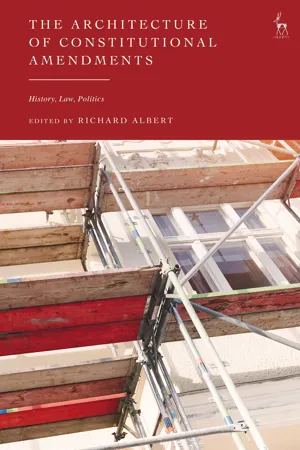
- 336 pages
- English
- ePUB (mobile friendly)
- Available on iOS & Android
eBook - ePub
About this book
Information
Table of contents
- Cover
- Title Page
- Acknowledgements
- Contents
- Contributors
- Introduction: How Should Constitutions Codify Amendments?
- 1. The Traces of Formalism: The Invisible Spanish Model of Constitutional Codification
- 2. The Presentist Portuguese Constitution
- 3. Caught Between: On the Distinctive Character of Mexico’s Model of Amendment Codification
- 4. The Incorporation of Amendments in Paraguayan Constitutionalism
- 5. The Codification of Constitutional Amendments in Brazil: Beyond the Appendative and Integrative Models
- 6. The Form of Constitutional Amendments in Japan
- 7. When the Temporary Becomes Indefinite: Legitimacy, Path Dependency and Taiwan’s Hybrid Approach to Constitutional Amendment Codification
- 8. Amendment Politics in South Korea: Invisible Constitutional Replacements in 1960 and 1962
- 9. Crafting Amendments during Political Upheaval: Amendment Models and Constitutional Stability in Afghanistan
- 10. Codifying Secularism in the Bangladesh Constitution
- 11. The Integrative Model of Constitutional Amendments in Indonesia as Constitutional Communication
- 12. The Amalgamation of Amendment Codification Models in Ethiopia: A Move Towards an Unwritten Constitution
- 13. Amendment Codification in Switzerland: Codifying an Evolving Culture of Constitutional Pragmatism
- 14. Between Accessibility and Oblivion: Strengths and Weaknesses of the ‘Invisible’ Dutch Constitutional Amendment Model
- 15. Codification of Constitutional Amendments as a Symbol for Transitions: A Case Study from Hungary
- 16. One Constitution, Two Models of Codification: Between Trust and Distrust Towards Constitutional Interpretations in Albania
- 17. Georgia’s Model of Constitutional Amendment Codification
- Index
- Copyright Page
Trusted by 375,005 students
Access to over 1.5 million titles for a fair monthly price.
Study more efficiently using our study tools.
Frequently asked questions
Yes, you can cancel anytime from the Subscription tab in your account settings on the Perlego website. Your subscription will stay active until the end of your current billing period. Learn how to cancel your subscription
No, books cannot be downloaded as external files, such as PDFs, for use outside of Perlego. However, you can download books within the Perlego app for offline reading on mobile or tablet. Learn how to download books offline
Perlego offers two plans: Essential and Complete
- Essential is ideal for learners and professionals who enjoy exploring a wide range of subjects. Access the Essential Library with 800,000+ trusted titles and best-sellers across business, personal growth, and the humanities. Includes unlimited reading time and Standard Read Aloud voice.
- Complete: Perfect for advanced learners and researchers needing full, unrestricted access. Unlock 1.5M+ books across hundreds of subjects, including academic and specialized titles. The Complete Plan also includes advanced features like Premium Read Aloud and Research Assistant.
We are an online textbook subscription service, where you can get access to an entire online library for less than the price of a single book per month. With over 1.5 million books across 990+ topics, we’ve got you covered! Learn about our mission
Look out for the read-aloud symbol on your next book to see if you can listen to it. The read-aloud tool reads text aloud for you, highlighting the text as it is being read. You can pause it, speed it up and slow it down. Learn more about Read Aloud
Yes! You can use the Perlego app on both iOS and Android devices to read anytime, anywhere — even offline. Perfect for commutes or when you’re on the go.
Please note we cannot support devices running on iOS 13 and Android 7 or earlier. Learn more about using the app
Please note we cannot support devices running on iOS 13 and Android 7 or earlier. Learn more about using the app
Yes, you can access The Architecture of Constitutional Amendments by Richard Albert in PDF and/or ePUB format, as well as other popular books in Law & Comparative Law. We have over 1.5 million books available in our catalogue for you to explore.