eBook - ePub
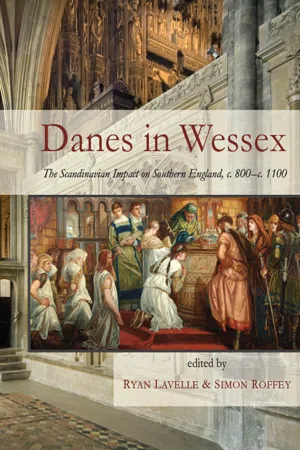
Danes in Wessex
The Scandinavian Impact on Southern England, c. 800–c. 1100
- 288 pages
- English
- ePUB (mobile friendly)
- Available on iOS & Android
eBook - ePub
Danes in Wessex
The Scandinavian Impact on Southern England, c. 800–c. 1100
About this book
There have been many studies of the Scandinavians in Britain, but this is the first collection of essays to be devoted solely to their engagement with Wessex. New work on the early Middle Ages, not least the excavations of mass graves associated with the Viking Age in Dorset and Oxford, drew attention to the gaps in our understanding of the wider impact of Scandinavians in areas of Britain not traditionally associated with them. Here, a multi-disciplinary and inter-disciplinary approach to the problems of their study is presented. While there may not have been the same degree of impact, discernable particularly in place-names and archaeology, as in those areas of Britain which had substantial influxes of Scandinavian settlers, Wessex was a major theatre of the Viking wars in the reigns of Alfred and Æthelred Unræd. Two major topics, the Viking wars and the Danish landowning elite, figure strongly in this collection but are shown not to be the sole reasons for the presence of Danes, or items associated with them, in Wessex. Multi-disciplinary approaches evoke Vikings and Danes not just through the written record, but through their impact on real and imaginary landscapes and via the objects they owned or produced. The papers raise wider questions too, such as when did aggressive Vikings morph into more acceptable Danes, and what issues of identity were there for natives and incomers in a province whose founders were believed to have also come from North Sea areas, if not from parts of Denmark itself? Readers can continue for themselves aspects of these broader debates that will be stimulated by this fascinating and significant series of studies by both established scholars and new researchers.
Information
Subtopic
British HistoryIndex
Social SciencesCHAPTER ONE
Introduction: Danes in Wessex
In many ways the title of this volume draws attention to the problems associated with the perception of the Viking Age in the south of England. While scholars commonly deal with the vocabulary of ‘the Danelaw’ and ‘Anglo-Scandinavian England’ when discussing the east Midlands and northern England, Wessex, for understandable reasons, is an area which is often treated as remaining ‘Anglo-Saxon’ throughout the later Anglo-Saxon period. This is hardly surprising. The narrative of the ninth and tenth centuries is one of the resistance of the rulers of Wessex against Viking invaders and the eventual imposition of a notion of an ‘English’ identity, that of the Angelcynn, over parts of the rest of England.1
The survival of the West Saxon dynasty is one of the ‘great’ themes of early medieval English history and it would be perverse if the title of this book were to have been something like Anglo-Scandinavian Wessex or even Viking Wessex (to our publisher’s credit, this title was never suggested to us). The notion of ‘Danes in Wessex’, which was the title of the conference from which many of the papers in this volume are drawn, is deliberately unspecific, reflecting the range of ways in which the papers in this volume have interpreted its theme. The lack of a definite article in the title is intentional: we cannot speak of the Danes in Wessex because the notion of ‘Danes’, as discussed in our other joint contribution to this volume (Chapter 2), often seems to have been semantically fluid, encompassing members of ‘Viking’ warbands and settlers who may not just have come from Scandinavia, let alone Denmark; such groups of ‘Danes’ are likely to have included other Scandinavians (especially Norwegians, as noted in Lavelle’s own contribution (Chapter 8), but also those from north of the Arctic Circle), those from the ‘Danelaw’ regions of Britain and other areas associated with the Viking diaspora such as the Baltic states and Belarus, as well as those who actually came from the provinces of the Danish polities (notwithstanding that these were somewhat different from the twenty-first-century Kongeriget Danmark).2 Again, this is probably understandable, as the volume covers three centuries of early medieval history, during which one could hardly expect notions of identity to remain static. (We might note too that notions of ‘Wessex’ could vary; this is an issue which is touched on in our own contribution to this volume but we have not proscribed our contributors’ definitions of the region/s, as its geographical variations over three centuries are not insignificant.)
‘Danes’ were in Wessex, then, and while there was no ‘Danish’ Wessex, there were close links between West Saxons and Danes in the early middle ages. These links were not necessarily hostile. The earliest known reference to Denmark, as Denamearc, is, famously, in a vernacular West Saxon version of the work of the late Roman historian Paulus Orosius, The Seven Books of Histories against the Pagans, amongst added details of northern voyages, recounted at the West Saxon court by a Norwegian chieftain, Ohthere (ON Óttarr).3 Before the Viking Age, as Barbara Yorke noted, the presence at Hamwic (Anglo-Saxon Southampton) of eighth-century ‘Wodan/monster’ sceattas – coins which ‘may’ have been minted in Ribe, Denmark – ‘imply that the Norwegian marauders [of c.789] may not have been the first Scandinavian ships to land in Wessex’.4 Still, it is the influences of the ‘Viking Age’ in Wessex which ensure that the topic of this book is a valid one, determined by two ‘Viking Ages’ in the region:5 the ‘First Viking Age’ in the second half of the ninth century, traditionally seen to have tailed off in southern England in the early tenth century as the successor of King Alfred, Edward the Elder, took the initiative – perhaps through the support of his sister, Æthelflæd, ‘Lady of the Mercians’ – by seizing control of areas of the former Danelaw. (Inside the frontiers of Wessex itself the first Viking Age might be said to have ended with the whimper of the night flight of the renegade member of the West Saxon dynasty, dubbed the ‘king of the pagans’ (rex paganorum) because of his alliances with Danes, Æthelwold, from Wimborne, Dorset, in 899 or 900, though Wessex was hardly unaffected in the aftermath.6) The activities of the ‘Second Viking Age’ in the later tenth century, which had a direct impact on Wessex, led to the establishment of a Danish dynasty in England, centred on Winchester, as a consequence of the conquest of Cnut ‘the Great’, son of the Danish ruler Swein Forkbeard, in 1016, with the further influence of Danes in Wessex for at least the next thirty years, arguably the next fifty.
Those two Viking Ages have tended to shape our perceptions of Danish influence in Wessex, and they have often been treated separately, or with the sense that the resistance successfully put up by Alfred the Great as a consequence of campaigns across Hampshire, Dorset, Somerset and Wiltshire during the 870s and other campaigns on the outer parts of what might be termed ‘Greater Wessex’ in Kent in the 890s can be contrasted with the less successful resistance of the English during the reign of Æthelred II (‘the Unready’), during which a series of brief ‘hit and run’ raids rapidly gave way to a series of longer campaigns, with tragic consequences for the king and his kingdom. Depending on their relative temperaments, modern commentators have been more or less vituperative in their criticism for Æthelred and high-flown in their praise for Alfred, but it should be noted that there is continuity to the Viking Age in Wessex that we should acknowledge. Alfred may have been successful in the campaigns of the late ninth century but the Viking impact was not without significance. There were a small number of ‘Danes’ who lived peacefully in Wessex as a consequence of the actions of the ninth century, whose presence should not be forgotten,7 but lest this consideration be seen as a radical attempt to unpick a neatly sewn West Saxon history, it is perhaps better to consider the impact itself, for which the broader themes of the two Viking Ages emerge. The Old Minster in Winchester’s lease of some of its land and stock to the king, at what appears to have been unfavourable terms,8 provides a parallel with the actions of ecclesiastical landholders in the reign of Æthelred II, during which land was, somewhat more infamously, sold by the likes of Christ Church Canterbury in order to raise money to pay geld.9 Although the parallel is not a new one, it is worth bearing in mind the larger number of surviving charters from the late tenth and early eleventh centuries in comparison to those of the late ninth and early tenth, so those earlier examples from Winchester may represent a much wider phenomenon.
Another theme is of course that of Alfred and his sons’ emergence as a powerful dynasty. While comparisons with Æthelred here are – as has been noted – the stock-in-trade of the late Anglo-Saxonist, parallels with the dynasty of Cnut are less common in terms of consideration of Wessex. With a sense of the primacy of Winchester within Wessex, as we shall see in the following chapter, Cnut may have underwritten the history of the English dynasty in the early eleventh century, at a time when, under Æthelred, London had become more important.10 Although we should probably exercise some caution in reading Alfred’s direct role in the importance of Winchester, there may be something of a parallel in the manner in which the ninth-century decline of Hamwic, perhaps under the pressure of its vulnerability to Viking raids, allowed its smaller neighbour to emerge as an administrative and cultural centre during the course of the ninth century.11
Indeed, it may be noted that while we may still not talk in terms of an Anglo-Scandinavian society in Wessex prior to 1016 (although, as Jane Kershaw shows in chapter 5, Scandinavian material influences were greater than was once thought), the very fact that Alfred and his successors’ hands were strengthened makes late Anglo-Saxon Wessex itself a direct product of the Viking Age. There is a certain dichotomy between the written sources, which portray Alfred as a pious Christian and Cnut as a Viking warrior, a dichotomy which should be borne in mind when considering their respective impacts upon Wessex and England. Arguably these figures had much more in common than is often acknowledged. Where West Saxon elites had asserted themselves over Britons in the earlier ninth century and Alfred the warrior king had made far more use and reference to the Anglo-Scandinavian roots of his dynasty than the image makers who shaped our picture of the ‘Alfredian court’ would have him doing,12 Cnut and some Danish elites whose positions stemmed from his rule asserted themselves as lords over English men and women, while emphasising their Christian culture. In the employment of a Danish elite culture in the eleventh century, the language of assertion had changed but the political and social frameworks in which it was employed remained, in some ways, very much the same as they had been during the ninth century. Thus, a parallel may be made between West Saxon control in the South-West in the ninth century, recently imposed and at times tenuous, and the attention given to the region by Cnut in the early years of his reign, as he strove to ensure loyalty there in the wake of revolt.13
Such assertions of control within West Saxon political frameworks and the demonstration of control in a range of ways by ruling elites, are at the heart of this volume. Though there is, understandably, no consensus of opinion amongst the contributors as to the most significant of the assertions of control in the Viking Age (or the two ‘Viking Ages’) there is a degree of unity of purpose in the contributions. These encompass the political and social manifestations of ‘Danishness’ in Wessex, as well as Anglo-Saxon responses to it. Studies of the Viking Age are often nuanced, focusing on the cultural, social and economic effects of the Viking impact in a manner that requires necessary oversight (or at least pausing) of the view of excesses of violence,14 but an understanding of the violence that underlies that Viking impact remains crucial. While this volume does not hold up an unreconstructed ‘back to basics’ reading of the relentless violence of hairy barbarians, the place of Viking Age violence and, of course, violence perpetrated by Vikings should not be underestimated. Two of the contributions to this volume, by Thomas Williams (Chapter 3), and by John Baker and Stuart Brookes (Chapter 5), specifically address the military dimensions of responses to the Viking threat, using the region of Wessex as the focus for the study of wider-ranging phenomena, and fulfil something of the expectation of what might be seen in a volume titled Danes in Wessex. If any doubt remained as to the violence of the age, Angela Boyle’s report on Vikings as victims of violence (Chapter 7) is invaluable.15 Derek Gore’s consideration of the South-West in the ninth and early tenth centuries (Chapter 4), Ryan Lavelle’s discussion of West Saxon ealdormen in the late tenth century (Chapter 8), the first of Ann Williams’s papers, on the career of a ‘Viking’ in the early eleventh century (Chapter 9), and indeed some of what follows in our own discussion of manifestations of ethnic identity in Chapter 2 are discussions conceived around the violence of Scandinavian actions, though the violence – whether real or threatened – of incursions, and the violence of responses underlies each of the papers in this volume. Readers of military history, of a narrative of ‘The Viking Threat’, should not be too disappointed, then, though if they expect that narrative to fulfil familiar motifs of threat, response, defeat, resistance, salvation, and struggle, they may be. Where the military history is most useful, it is often in terms of consideration within a wider socio-political context. Thomas Williams’s contribution considers the experience of the early medieval battlefield and the degree to which shifting cultural expectations in the face of Viking warfare changed the perceptions of the battlefield – and ultimately perceptions of the West Saxon kingdom.16 His chapter, as with other contributions to this volume, shows the value of multi-disciplinary and interdisciplinary approaches in terms of the ways in which archaeological readings of the battlefield go beyond the physical stratigraphic remains, many of which, as Williams notes, do not lend themselves to conventional battlefield archaeology.17 Baker and Brookes bring to light their experience in running a cutting-edge project on the development of defensive systems in the Anglo-Saxon kingdom, using place-name, historical and archaeological evidence.18 Their contribution to this volume showcases the value of their work in the Wes...
Table of contents
- Cover
- Title Page
- Copyright
- Contents
- Editorial Preface
- Foreword
- List of Contributors
- List of Abbreviations
- List of Illustrations
- Chapter 1: Introduction: Danes in Wessex
- Chapter 2: West Saxons and Danes: Negotiating Early Medieval Identities
- Chapter 3: The Place of Slaughter: Exploring the West Saxon Battlescape
- Chapter 4: A Review of Viking Attacks in Western England to the Early Tenth Century: Their Motives and Responses
- Chapter 5: Landscapes of Violence in Early Medieval Wessex: Towards a Reassessment of Anglo-Saxon Strategic Landscapes
- Chapter 6: Scandinavian-style Metalwork from Southern England: New Light on the ‘First Viking Age’ in Wessex
- Chapter 7: Death on the Dorset Ridgeway: The Discovery and Excavation of an Early Medieval Mass Burial
- Chapter 8: Law, Death and Peacemaking in the ‘Second Viking Age’: An Ealdorman, his King, and some ‘Danes’ in Wessex
- Chapter 9: Thorkell the Tall and the Bubble Reputation: The Vicissitudes of Fame
- Chapter 10: A Place in the Country: Orc of Abbotsbury and Tole of Tolpuddle, Dorset
- Chapter 11: Danish Landowners in Wessex in 1066
- Chapter 12: Danish Royal Burials in Winchester: Cnut and his Family
- Chapter 13: Some Reflections on Danes in Wessex Today
- Select Bibliography
Trusted by 375,005 students
Access to over 1.5 million titles for a fair monthly price.
Study more efficiently using our study tools.
Frequently asked questions
Yes, you can cancel anytime from the Subscription tab in your account settings on the Perlego website. Your subscription will stay active until the end of your current billing period. Learn how to cancel your subscription
No, books cannot be downloaded as external files, such as PDFs, for use outside of Perlego. However, you can download books within the Perlego app for offline reading on mobile or tablet. Learn how to download books offline
Perlego offers two plans: Essential and Complete
- Essential is ideal for learners and professionals who enjoy exploring a wide range of subjects. Access the Essential Library with 800,000+ trusted titles and best-sellers across business, personal growth, and the humanities. Includes unlimited reading time and Standard Read Aloud voice.
- Complete: Perfect for advanced learners and researchers needing full, unrestricted access. Unlock 1.5M+ books across hundreds of subjects, including academic and specialized titles. The Complete Plan also includes advanced features like Premium Read Aloud and Research Assistant.
We are an online textbook subscription service, where you can get access to an entire online library for less than the price of a single book per month. With over 1.5 million books across 990+ topics, we’ve got you covered! Learn about our mission
Look out for the read-aloud symbol on your next book to see if you can listen to it. The read-aloud tool reads text aloud for you, highlighting the text as it is being read. You can pause it, speed it up and slow it down. Learn more about Read Aloud
Yes! You can use the Perlego app on both iOS and Android devices to read anytime, anywhere — even offline. Perfect for commutes or when you’re on the go.
Please note we cannot support devices running on iOS 13 and Android 7 or earlier. Learn more about using the app
Please note we cannot support devices running on iOS 13 and Android 7 or earlier. Learn more about using the app
Yes, you can access Danes in Wessex by Ryan Lavelle, Simon Roffey, Ryan Lavelle,Simon Roffey in PDF and/or ePUB format, as well as other popular books in Social Sciences & British History. We have over 1.5 million books available in our catalogue for you to explore.