At a time when Art Nouveau was all the rage, Fuller burst upon the scene as its living embodiment. A new kind of dancer whose simple movements were highly expressive, she created a fantasy world of dazzling shapes and light play. Every mixed-media artist today owes a debt to her pioneering use of electrical lighting and her synthesis of music, color, light and fabric.—Anna Kisselgoff. The New York Times
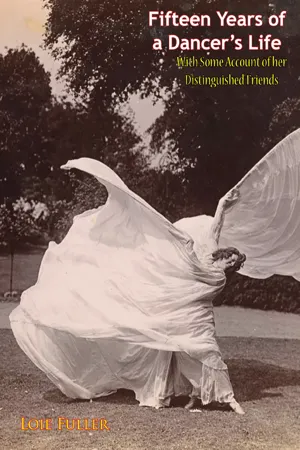
Loïe Fuller began her theatrical career as a professional child actress and later choreographing and performing dances in burlesque, vaudeville, and circus shows. Although Fuller became famous in America, she felt that she was not taken seriously by the public. After a warm reception in Paris during a tour, Fuller remained in France and became a regular performer at the Folies Bergère with works such as Fire Dance; she became the embodiment of the Art Nouveau movement. Fuller's pioneering work attracted the attention, respect, and friendship of many French artists and scientists, including Jules Chéret, Henri de Toulouse-Lautrec, François-Raoul Larche, Henri-Pierre Roché, Auguste Rodin, Stéphane Mallarmé, and Marie Curie. More a theatrician than a dancer, Fuller invented many effects we still use today: the stage surrounded in black curtains to focus attention on the performer; the color-wheel; scenic projection; and, "specials" that are individual lights used to emphasize an effect. She took pieces out of the stage floor, replacing them with glass panels and upwardly directed lights. Fuller held many patents related to stage lighting including chemical compounds for creating color gel and the use of chemical salts for luminescent lighting and garments. She was also a member of the French Astronomical Society. Fuller is responsible for the European tours of the early modern dancers, introducing Isadora Duncan to Parisian audiences and developing the acceptance of modern dance as a serious art form.-Uni of Washington.
eBook - ePub
Fifteen Years of a Dancer's Life
With Some Account of her Distinguished Friends
- 163 pages
- English
- ePUB (mobile friendly)
- Available on iOS & Android
eBook - ePub
About this book
Information
Subtopic
Film & VideoTable of contents
- Title page
- TABLE OF CONTENTS
- INTRODUCTION
- ILLUSTRATIONS
- I - MY STAGE ENTRANCE
- II - MY APPEARANCE ON A REAL STAGE AT TWO YEARS AND A HALF
- III - HOW I CREATED THE SERPENTINE DANCE
- IV - HOW I CAME TO PARIS
- V - MY APPEARANCE AT THE FOLIES-BERGÈRE
- VI - LIGHT AND THE DANCE
- VII - A JOURNEY TO RUSSIA-A BROKEN CONTRACT
- VIII - SARAH BERNHARDT-THE DREAM AND THE REALITY
- IX - ALEXANDRE DUMAS
- X - M. AND MME. CAMILLE FLAMMARION
- XI - A VISIT AT RODIN’S
- XII - M. GROULT’S COLLECTION
- XIII - MY DANCES AND THE CHILDREN
- XIV - PRINCESS MARIE
- XV - SEVERAL SOVEREIGNS
- XVI - OTHER MONARCHS
- XVII - SOME PHILOSOPHERS
- XVIII - HOW I DISCOVERED HANAKO
- XIX - SARDOU AND KAWAKAMI
- XX - AN EXPERIENCE
- XXI - AMERICAN AFFAIRS
- XXII - GAB
- XXIII - THE VALUE OF A NAME
- XXIV - HOW M. CLARETIE INDUCED ME TO WRITE THIS BOOK
Trusted by 375,005 students
Access to over 1.5 million titles for a fair monthly price.
Study more efficiently using our study tools.
Frequently asked questions
Yes, you can cancel anytime from the Subscription tab in your account settings on the Perlego website. Your subscription will stay active until the end of your current billing period. Learn how to cancel your subscription
No, books cannot be downloaded as external files, such as PDFs, for use outside of Perlego. However, you can download books within the Perlego app for offline reading on mobile or tablet. Learn how to download books offline
Perlego offers two plans: Essential and Complete
- Essential is ideal for learners and professionals who enjoy exploring a wide range of subjects. Access the Essential Library with 800,000+ trusted titles and best-sellers across business, personal growth, and the humanities. Includes unlimited reading time and Standard Read Aloud voice.
- Complete: Perfect for advanced learners and researchers needing full, unrestricted access. Unlock 1.5M+ books across hundreds of subjects, including academic and specialized titles. The Complete Plan also includes advanced features like Premium Read Aloud and Research Assistant.
We are an online textbook subscription service, where you can get access to an entire online library for less than the price of a single book per month. With over 1.5 million books across 990+ topics, we’ve got you covered! Learn about our mission
Look out for the read-aloud symbol on your next book to see if you can listen to it. The read-aloud tool reads text aloud for you, highlighting the text as it is being read. You can pause it, speed it up and slow it down. Learn more about Read Aloud
Yes! You can use the Perlego app on both iOS and Android devices to read anytime, anywhere — even offline. Perfect for commutes or when you’re on the go.
Please note we cannot support devices running on iOS 13 and Android 7 or earlier. Learn more about using the app
Please note we cannot support devices running on iOS 13 and Android 7 or earlier. Learn more about using the app
Yes, you can access Fifteen Years of a Dancer's Life by Loie Fuller in PDF and/or ePUB format, as well as other popular books in Media & Performing Arts & Film & Video. We have over 1.5 million books available in our catalogue for you to explore.