Both modern Ukrainian nationhood and the historical preconditions of the country’s contemporary conflict with Russia are rooted in a complex period of development in Cossack Ukraine. The Making of Cossack Ukraine traces the evolution of early modern Ukrainian political thought and culture from their sixteenth-century origins to 1714.
Early modern Ukraine was home to a multitude of interrelated political cultures, including those of the Ruthenian nobility, the Kyivan clergy, and the Cossacks. Zenon Kohut shows how constant interplay between these cultures contributed to the development of political, territorial, religious, ethnic, and national collective visions that reflected early modern concepts of nation, state, and identity. Two persistent narratives – the idea of Ukrainian autonomy and perpetual rights, and the idea of a continuous “Russian” tsardom stemming from medieval times – formed the foundation for not only Ukrainian state- and nation-building but also Russia’s modern identity and sense of nationhood, creating the ideological underpinning for Russian imperialism.
Based in a classical analysis of ethnic, religious, and political ideas developed by early modern Ukrainian intellectuals, The Making of Cossack Ukraine brings to light the origins of present-day Ukrainian political thought.
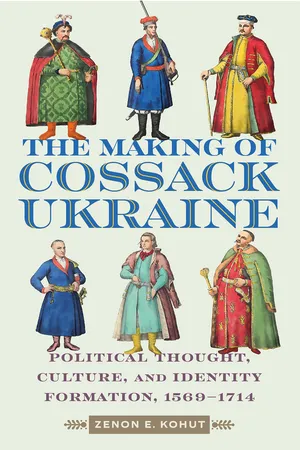
eBook - ePub
The Making of Cossack Ukraine
Political Thought, Culture, and Identity Formation, 1569-1714
- English
- ePUB (mobile friendly)
- Available on iOS & Android
eBook - ePub
The Making of Cossack Ukraine
Political Thought, Culture, and Identity Formation, 1569-1714
About this book
Information
Print ISBN
9780228019015
Table of contents
- Cover Page
- Half-Title Page
- Title Page
- Copyright Page
- Contents
- Note on Transliteration, Translations, Dates, and Terminology
- Acknowledgments
- Abbreviations
- Maps
- Introduction
- 1 Ruthenian-Ukrainian Political Culture in the Polish-Lithuanian Commonwealth (1569–1640s)
- 2 Establishing Goals, Political Concepts, and Values: The Khmel'nyts'kyi Uprising and the Hetmanate (1648–68)
- 3 Uniting the Fatherland: Hetman Petro Doroshenko (1665–75)
- 4 The Left-Bank Hetmanate: Hetman Ivan Samoilovych (1672–87)
- 5 The Construction of Historical-Political Narratives (1660–80s)
- 6 In Service to Tsar and Ukraine: Hetman Ivan Mazepa
- 7 Mazepa: Modernizer and Enlightened Ruler (1687–1708)
- 8 Mazepa: Hetman of a Sacred Rutheno-Rossian Realm
- 9 From Tsarist Service to Swedish Protection (1705–09)
- 10 From Reprisals to Ideological Combat: Peter vs Mazepa
- 11 Liberating Ukraine: Hetman Pylyp Orlyk (1709–14)
- 12 Rethinking Ukraine: Envisioning a Free Cossack Commonwealth
- Conclusions
- Epilogue
- Notes
- Bibliography
- Index
Trusted by 375,005 students
Access to over 1.5 million titles for a fair monthly price.
Study more efficiently using our study tools.